


Why Custom Planner Quotes Vary: Paper, Printing, Binding, Packaging, and Freight Cost Drivers Explained
- Leo Xia

- Jul 20
- 4 min read
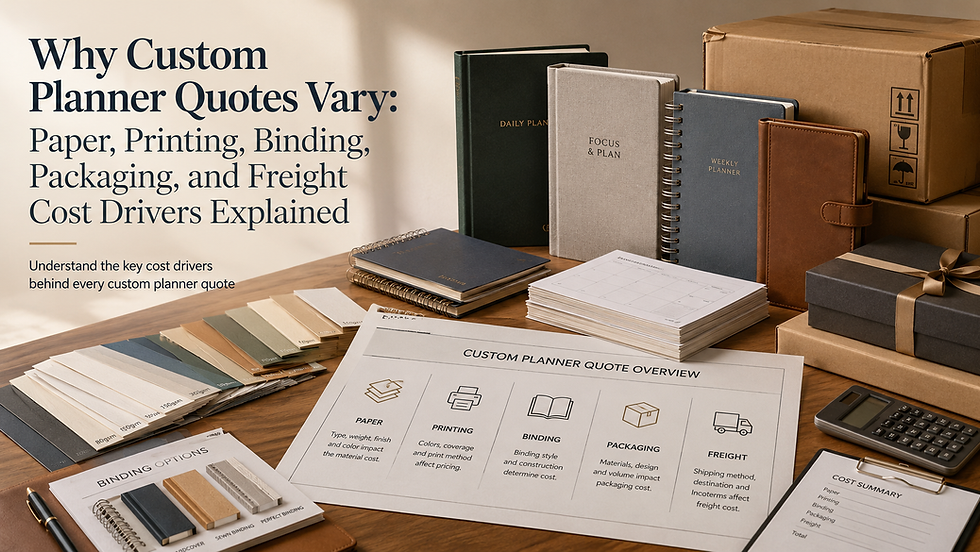
Quick Answer: Custom planner quotes vary significantly because unit costs are driven by a combination of material choices (such as paper weight and FSC certification), printing and finishing techniques, binding complexity, custom packaging specifications, and shipping/freight logistics. To optimize your budget, it is essential to understand how these custom planner printing cost drivers interact across the entire supply chain.
Quick Content Reach:
What are the primary paper specifications that influence a planner bulk printing quote?
Paper is the most substantial physical component of any planner, making up a major portion of the raw material cost. When requesting a planner bulk printing quote, small adjustments in paper specifications can drastically alter the final pricing.
Paper Weight (GSM): Planners typically use paper ranging from 80 GSM to 120 GSM. Heavier paper prevents ink bleeding and ghosting, which is vital for high-quality planners, but it increases the overall paper weight and cost.
Paper Type and Texture: Uncoated wood-free paper is preferred for writing, while coated art paper is used for vibrant divider pages. Premium textured or colored papers command a price premium.
Sustainability Credentials: Sourcing FSC-certified paper or recycled paper lines aligns with eco-friendly branding but carries a slight cost premium of 3% to 5% over non-certified stock.
Paper Weight and Cost Comparison Table
Paper Weight (GSM) | Recommended Use Case | Bleed Resistance | Relative Cost Factor |
|---|---|---|---|
:--- | :--- | :--- | :--- |
80 GSM | Standard pocket planners / pocket notebooks | Low (pencil or ballpoint pen) | Baseline (1.0) |
100 GSM | Everyday journals, student planners | Medium (gel pens, light highlighters) | 1.15x - 1.20x |
120 GSM | High-end artistic planners, bullet journals | High (fountain pens, markers) | 1.35x - 1.45x |

How do printing methods and cover embellishments affect custom planner manufacturing cost?
The printing technology and cover design choices directly determine the complexity of the custom planner manufacturing cost. Customizing the exterior of the planner requires balancing aesthetic impact with setup costs.
Offset Printing vs. Digital Printing: Offset printing is highly cost-effective for large volumes because the high initial plate setup cost is diluted across thousands of units. Digital printing is cheaper for short-run prototyping but expensive for mass orders.
Ink and Color Schemes: Standard black-and-white inner pages are the most economical. Full-color (CMYK) interiors require high registration precision, raising printing and inspection costs.
Cover Materials and Embellishments: Upgrading from standard paperboard covers to premium materials like PU leather, linen fabric, or hardboard with customized cloth increases costs. Adding decorative finishes—such as foil stamping, debossing, spot UV, or gilded edges—adds multiple manual and machine steps during production.
Which binding styles are the most cost-effective for custom notebook planner wholesale orders?
Binding determines how a planner opens, lays flat, and withstands daily use. Selecting the right binding is a critical decision for custom notebook planner wholesale buyers who want to balance cost and user experience.
Wire-O and Spiral Binding: Highly popular for planners because they allow the book to lay completely flat and fold 360 degrees. Metal Wire-O is durable and easy to assemble on automated lines, making it highly cost-efficient.
Case Bound (Hardcover Perfect Bound): This premium method involves sewing page signatures together and wrapping them in a rigid cover. While highly durable and professional, it requires significant manual labor and specialized casing-in machines, increasing production time and cost.
Softcover Perfect Bound: The most economical binding method for high-volume catalogs and notebooks, though it doesn't allow the planner to lay perfectly flat without spine cracking.

How do packaging and freight choices impact the overall commercial planner production pricing?
When calculating the total landed cost of a planner, packaging and freight are often overlooked but can account for 15% to 30% of the overall budget. These factors heavily influence commercial planner production pricing.
Custom Packaging: Individually shrink-wrapped planners protect the product from moisture but add minor labor costs. Upgrading to custom rigid gift boxes, belly bands, or individual mailer boxes adds material cost and increases the outer dimensions of the shipping cartons.
Volumetric Weight and Carton Optimization: Heavy, thick paper and rigid hardcovers increase shipping weight. Inefficiently sized packaging creates empty space inside shipping cartons, leading to higher volumetric shipping fees.
Manufacturing Origin and Logistics: Utilizing a dual-location supply chain can yield immense freight and tariff savings. For example, exporting mass production orders from a Cambodian facility can bypass high import tariffs to North America, while using a Jiaxing hub for development and express sampling ensures fast product turnaround.

How can buyers horizontally compare custom planner quotes to avoid quality risks?
To ensure you are getting an accurate, apples-to-apples comparison between different manufacturers, look beyond the bottom-line unit price. Ensure that each quotation specifies the exact paper GSM, brand of binding wire, thickness of greyboard, and carton drop-test standards.
Working with a supply chain partner that utilizes clear, standardized SOPs, AQL sampling, and automated production machinery reduces the risk of unexpected defects.
Understanding these major cost variables allows brands to selectively invest in high-impact features—like premium cover embellishments—while saving money on inner page weights or shipping optimization.
Ready to manufacture your next custom planner collection?
Let our experts guide you through material selection and design optimization to maximize your budget.
FAQ
What is the typical minimum order quantity (MOQ) for a custom planner bulk printing quote?
Standard MOQs generally range from 1,000 to 3,000 units depending on the complexity of the materials, binding styles, and customized features requested. Higher volumes significantly reduce the unit manufacturing cost.
How much does FSC-certified paper increase the cost of a planner order?
Sourcing FSC-certified or recycled paper usually carries a minor premium of 3% to 5% over standard wood-free paper. However, it ensures a highly sustainable supply chain that benefits brand social responsibility.
How does shipping origin (China vs. Cambodia) affect custom planner pricing?
Manufacturing in Cambodia offers significant tariff and duty advantages for shipments to the United States and Europe. Meanwhile, leveraging a Jiaxing, China facility allows for rapid development, precise sampling, and faster local sourcing of specialty materials.


Comments