


Comprehensive Guide to Wooden Notebook Edge Finishing: Techniques, Profiles, and Quality Standards

Wooden notebook edge finishing involves precision sanding, beveling, and sealant coating applied to laser-cut or CNC-milled cover perimeters to eliminate carbon soot, prevent edge splintering, and block moisture ingress for long-term structural stability. High-grade perimeter treatments transform raw timber, multi-ply sheets, or engineered veneers into smooth, tactile, and moisture-resistant stationery covers suitable for international retail shelves.
What Are the Key Edge Finishing Techniques for Wooden Notebook Covers?
Industrial wooden notebook production relies on specific processing methods depending on the initial cutting method, cover thickness, and desired edge aesthetics. The primary techniques address raw perimeter roughness, carbonization, and material exposure.
Rotary Drum and Oscillating Edge Sanding: Mechanical abrasives smooth raw wood fibers immediately after rough cutting. Multi-stage grit progression (typically transitioning from 120-grit to 320-grit) removes micro-burrs and levels perimeter irregularities without rounding off intended crisp structural lines.
Laser Cut Edge Post-Processing: Laser cutting introduces high thermal energy, resulting in dark carbonized borders and volatile organic residues. Industrial post-processing utilizes localized deburring, soft-grit orbital buffing, or controlled chemical wiping to stabilize the dark tone or remove carbon soot entirely, preventing edge crocking and smudge transfer to the inner paper text block.
Precision CNC Profile Routing: Computerized router tooling shapes the outer perimeter with sub-millimeter consistency. CNC routing enables decorative or functional profiles directly along the raw edge, creating uniform bevels, stepped grooves, or perimeter relief channels before chemical sealing.
Edge Sealing and Polyurethane Dipping: Specialized edge coatings seal exposed end-grain pores against atmospheric humidity. Low-VOC acrylic emulsions, nitrocellulose lacquers, and polyurethane topcoats penetrate the cellular structure of the timber, arresting grain lifting and structural warping.

Precision chamfering creates a distinct angled facet that deflects impact and enhances edge durability.
Finishing Technique | Primary Tooling | Aesthetic Result | Key Processing Benefit |
|---|---|---|---|
:--- | :--- | :--- | :--- |
Laser Edge Finishing | CO2 laser + orbital dry buffer | Crisp, dark carbonized edge | Clean cutline with stabilized carbon transfer |
CNC Edge Routing | Diamond/Carbide router bits | Uniform profile geometry | High dimensional accuracy without charring |
Rotary Abrasive Sanding | Oscillating sanding belt (180–320 grit) | Natural, tactile wood texture | Completely eliminates fiber tear-out and burrs |
Spray/Dip Sealing | Automated HVLP or roller applicators | Matte, satin, or gloss sealed barrier | Moisture-proof perimeter, prevents ply separation |
How Do Material Selections Affect Wood Cover Edge Treatment?
Substrate composition fundamentally dictates how the notebook perimeter behaves during cutting, shaping, and finishing. Solid hardwoods, multi-ply birch plywood, and paper-backed engineered veneers require distinct production considerations.
Solid Hardwood Edge Treatment
Solid hardwoods such as American walnut, white oak, maple, and beech feature continuous open or closed vascular structures. Open-grain species (such as oak) require higher-viscosity edge fillers or sanding sealers to prevent liquid finish from sinking irregularly into the end-grain. Solid wood perimeters are susceptible to moisture absorption across the transverse cross-section; failing to apply a balanced perimeter seal can lead to cupping or transverse bowing across the journal front.
Multi-Ply Plywood and Engineered Core Edges
Plywood covers—most commonly cross-laminated Baltic birch in 2.0 mm to 3.5 mm thicknesses—expose alternating horizontal grain layers along the outer edge. While structurally stable against warping, exposed veneer ply lines require smooth sanding to avoid voids or fiber splintering at layer interfaces. Industrial processors often apply dark pigmented stains, deep carbonizing laser passes, or colored wax sealants to transform exposed plies into an intentional, uniform design feature.
Wood Veneer Laminated to High-Density Fiberboard (HDF) or Greyboard
When thin decorative real-wood veneers (0.3 mm to 0.6 mm) are laminated over rigid core boards, edge finishing must conceal or protect the multi-material interface. Edge treatment options include precision micro-chamfering to soften the sharp laminated boundary, edge staining to match the surface veneer species, or wrapping paper/textile binding elements along the spine edge to reinforce structural integrity.
What Structural Edge Profiles Can Be Engineered onto a Wood Notebook Cover?
Edge profiling enhances hand-feel and protects notebook perimeters against impact damage during daily transport. Tooling profiles convert sharp 90-degree outer boundaries into refined structural geometries.
Square Edge with Eased Arris (0.5 mm Break): Retains a modern, minimalist silhouette while dulling sharp microscopic splinters along the perimeter corner. A standard abrasive pass breaks the razor edge without noticeably altering the rectangular profile.
Beveled Wood Notebook Cover (Chamfered Edge): A continuous 30-degree or 45-degree angled cut applied along the perimeter. Beveling reduces edge mass, creates distinctive shadow lines, and deflects impact energy, minimizing the likelihood of perimeter denting when carried in bags.
Bullnose and Radius Rounded Edge: A fully rounded half-circle or continuous 1.5 mm to 2.5 mm corner radius. This profile yields the smoothest hand-feel, eliminating all sharp points and enhancing ergonomics when opening and closing hardcover spiral or case-bound wood journals.
Recessed Step and Decorative Shadow Line: A CNC-milled stepped groove cut into the perimeter margin. This treatment is often utilized to integrate elastic closure bands, metal corner protectors, or layered contrasting spine materials.

Post-processing laser-cut edges stabilizes carbon residues and seals plywood end-grain against moisture.
How Is Wooden Journal Edge Sealing Conducted for Environmental Resistance?
Raw wood edges absorb and release atmospheric moisture significantly faster through transverse cut fibers than through longitudinal surfaces. Unprotected edges exposed to humidity fluctuations can cause asymmetrical swelling, warping, and mold vulnerability.
Mechanical Grain Preparation: Cover blanks are sanded up to 240-grit to create an even surface baseline, clearing loose fiber dust via ionized air knives.
Sanding Sealer Application: A thin, high-solids sanding sealer is applied via automated spray or edge-roller stations. The sealer penetrates 0.1 mm to 0.3 mm into open end-grain pores, binding cell walls.
Intermediate De-Nibbing: Once cured, the edge undergoes light mechanical sanding (320-grit to 400-grit) to shear off "raised grain" fibers caused by moisture in water-borne basecoats.
Topcoat Application (Matte/Satin/Gloss): Polyurethane, acrylic, or natural wax-oil blends are applied to establish an impervious barrier against ambient humidity, hand sweat, and surface abrasion.
UV or Infrared Curing: Coated covers move through controlled UV or IR drying tunnels, achieving full cross-linking and surface hardness without distorting the underlying paper text block during subsequent binding.
What Quality Defects Must Be Inspected During Edge Finishing Production?
Production teams must enforce stringent quality control criteria across batch manufacturing runs. SOPs and AQL inspection protocols identify defects prior to binding and final packaging.
Fiber Fraying and Splintering: Tear-out caused by dull CNC router tooling or incorrect feed rates. Inspected via tactile wipe tests to ensure no loose splinters snag on fabric or fingers.
Laser Char Transfer and Soot Smudging: Residual unbonded carbon along laser-cut margins transferring onto hands, covers, or cream interior pages. Inspected using dry white wipe tests under standard QC lighting.
Layer Delamination on Plywood Edges: Micro-separation between internal veneer plies due to excessive cutting friction or insufficient adhesive bonding. Inspected by edge flexure sampling.
Uneven Sealant Pooling or "Orange Peel": Excess liquid topcoat accumulating at corner radiuses or leaving textured surface ripples. Inspected via specular light reflection.
Dimensional Variation: Inconsistent edge thickness or profile asymmetry affecting the alignment between front and back covers. Verified using digital calipers across multiple inspection points.
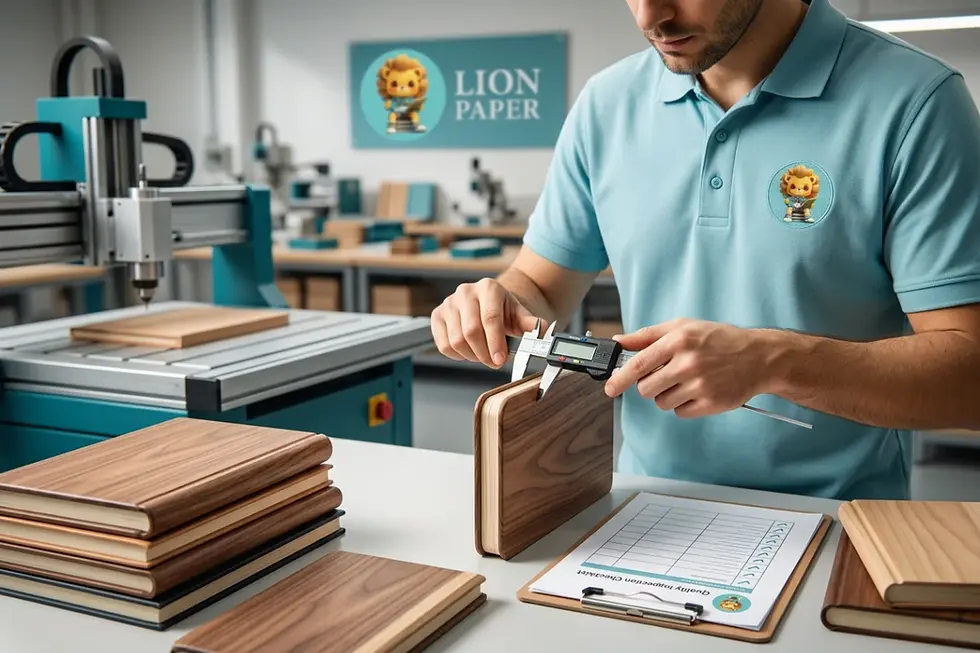
Consistent edge profile geometry and dimensional tolerances are verified via standardized AQL inspection checkpoints.
How Should Product Developers Specify Edge Finishing in an RFQ?
Clear technical specifications within your Request for Quotation (RFQ) prevent production delays, eliminate sampling misunderstandings, and optimize landed costs.
Specify Precise Geometry: Define perimeter profile terms explicitly (e.g., "1.0 mm 45-degree chamfer on outer perimeter, 0.5 mm eased arris on inner perimeter") rather than generic "smooth edges."
Define Edge Color and Finish: Clarify whether edges should retain natural exposed grain, match surface wood stain, feature stabilized dark laser carbonization, or carry an opaque solid tone.
Indicate Environmental and Compliance Requirements: State required standards such as FSC traceability, low-VOC or water-based chemical finishes, and compliance with REACH or CPSIA limits for consumer products.
Outline Packaging and Protection: Specify individual shrink-wrapping, corner guards, or protective interleaving sheets to prevent edge friction abrasion during multi-modal ocean or air freight.
Lion Paper Products (Jiaxing) Co., Ltd., founded in 2015, operates an integrated supply-chain model featuring dual-site synergy between a 3,000 m² design and rapid-prototyping facility in Jiaxing, China, and a 10,000 m² mass-manufacturing hub in Cambodia. Producing over 5 million notebooks annually, Lion Paper combines CNC edge routing, precision laser cutting, and standardized finishing SOPs with FSC-traceable materials and ISO 9001 quality controls. Discuss your custom wood notebook specifications with our engineering team to review material selection, structural edge profiles, and landed cost optimization.
FAQ
Will laser cut wood notebook edges leave black soot on users' hands?
Unprocessed laser-cut wood covers will leave residual carbon soot. However, professional manufacturing includes secondary post-processing—such as abrasive buffing, chemical wiping, or protective clear sealing—to lock or remove free carbon particles, ensuring clean, non-transferring edges.
What is the difference between a chamfered edge and a rounded edge on a wooden journal?
A chamfered (beveled) edge features a flat, angled facet (typically 30 or 45 degrees) that creates a crisp, modern aesthetic and deflects impacts. A rounded (radius/bullnose) edge creates a smooth, continuous convex curve that delivers a softer, traditional hand-feel.
How does edge sealing prevent wooden notebook covers from warping?
Wood naturally absorbs and releases moisture through its exposed end-grain pores. Industrial edge sealing applies penetrating sealers and protective topcoats directly to cut borders, blocking atmospheric humidity fluctuations that cause asymmetrical swelling, cupping, and warping.


Comments