


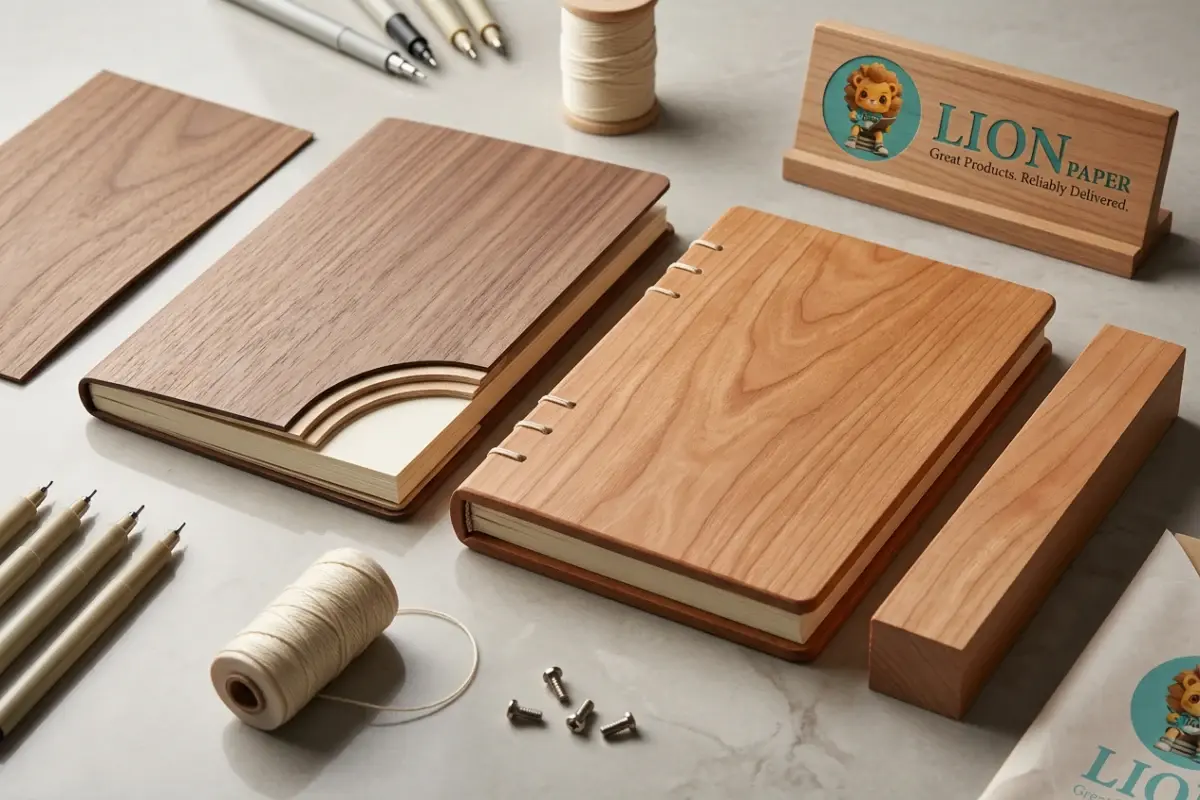
Wood Veneer vs Solid Wood Notebook Cover: Manufacturing, Cost, and Durability Guide

Wood veneer notebook covers offer superior dimensional stability, lighter weight, and lower warpage risk by laminating thin natural wood sheets onto rigid greyboard or Kraft cores, whereas solid wood covers deliver premium weight and rich grain depth but carry higher material costs and greater vulnerability to humidity-induced cracking and warping. For commercial stationery programs, wood veneer delivers reliable scalability across diverse binding formats, while solid wood serves luxury, limited-run gift markets requiring rigid plank aesthetics.
What Are the Core Differences Between Wood Veneer and Solid Wood Notebook Covers?
Choosing between natural wood veneer and solid lumber dictates the mechanical performance, aesthetic weight, and structural reliability of a custom notebook. While both surfaces showcase genuine timber grains, their internal cross-sections and production behaviors differ fundamentally.
Wood veneer journal covers consist of a micro-thin layer of real wood—typically between 0.2 mm and 0.6 mm thick—spliced and bonded under heat and pressure to a dense composite substrate, such as high-density greyboard, MDF, or multi-ply Kraft paper. In contrast, solid wood covers are milled directly from natural hardwood or softwood planks, sliced down to a standard thickness of 2.5 mm to 5.0 mm without synthetic internal stabilization.
Evaluation Metric | Wood Veneer Notebook Cover | Solid Wood Notebook Cover | |||||||||||||||
|---|---|---|---|---|---|---|---|---|---|---|---|---|---|---|---|---|---|
:--- | :--- | :--- | :--- | :--- | :--- | :--- | :--- | :--- | :--- | :--- | :--- | :--- | :--- | :--- | :--- | :--- | :--- |
Core Structure | Thin natural wood laminated over greyboard/MDF | 100% Solid timber milled from lumber planks | |||||||||||||||
Standard Cover Thickness | 1.5 mm – 2.8 mm total assembly | 2.5 mm – 5.0 mm solid profile | |||||||||||||||
Unit Weight | 180 g – 260 g (Lightweight, efficient freight) | 320 g – 520 g (Heavy, tactile mass) | |||||||||||||||
Warpage Resistance | High (Cross-grain multi-layer balancing) | Moderate to Low (Sensitive to relative humidity) | |||||||||||||||
Binding Compatibility | Wire-O, Spiral, Casebound, Flexible Living Hinge | Twin-Wire, Spiral, Open spine stitch, External Rivets | |||||||||||||||
Laser Engraving Depth | 0.1 mm – 0.3 mm (Controlled surface contrast) | 0.5 mm – 1.5 mm (Deep relief carving achievable) | |||||||||||||||
Edge Treatment | Edge-banded, turned edge, or painted flush cut | Beveled, routed, sanded, and clear-sealed perimeter | |||||||||||||||
Scalability & Cost | Highly scalable, optimized material yield, lower landed cost | Niche scalability, higher scrap rate, higher shipping expense |

Engineered wood veneer covers utilize multi-layer balancing over rigid greyboard to prevent warping caused by humidity changes.
How Does Material Engineering Prevent Warping and Cracking in Wooden Covers?
Wood is an anisotropic, hygroscopic material that naturally expands and contracts across its grain as surrounding relative humidity shifts. Solid wood lumber absorbs environmental moisture into its cellular cavities, causing lateral swelling across tangential grain lines. When a solid wood notebook travels between humid shipping containers and dry retail environments, unbalanced expansion leads to cup warping, edge curl, or catastrophic hairline splitting along grain seams.
In wooden notebook cover manufacturing, engineered wood veneer overcomes moisture-driven deformation through substrate balancing and multi-layer tension control:
Symmetrical Balancing Backers: Applying an identical veneer sheet or balancing paper to the reverse side of the board neutralizes surface tension when humidity fluctuates.
Cross-Laminated Core Integrity: Rigid greyboard cores absorb internal stress equally in all directions, preventing the one-directional expansion inherent to organic timber.
Moisture Equilibrium Conditioning: Raw veneer sheets and composite boards are conditioned inside climate-controlled chambers to maintain moisture content between 8% and 12% prior to gluing.
Flexible Fleece Backing: Micro-thin veneers reinforced with non-woven cellulose backing allow the wood to flex without cracking around living hinges or rounded book spine joints.
Solid wood covers mitigate warping by selecting quartersawn lumber rather than plainsawn boards, as vertical annual rings expand more uniformly. However, solid lumber still requires protective polyurethane, conversion varnish, or natural wax sealants to restrict rapid moisture exchange through exposed end grains.
Which Binding Methods Work Best for Wood Veneer vs. Solid Wood Notebooks?
Binding selection determines how the cover opens, flexes, and interfaces with the internal paper text block. Solid wood notebook binding requires rigid-to-rigid mechanical fasteners, whereas wood veneer covers integrate into both flexible and rigid binding configurations.
Binding Format Compatibility
Wood Veneer Covers:
Casebound Hardcover (Turned-edge spine with flexible paper hinge)
Flexible Living-Hinge (Laser micro-kerf cut spine structure)
Twin-Wire & Spiral Binding (Standard punched perimeter holes)
Perfect Bound Softcover (Flexible fleece-backed veneer wrap)
Solid Wood Covers:
Twin-Wire & Double Spiral Binding (CNC pre-drilled edge holes)
Exposed Coptic & French Stitch Binding (Drilled face holes)
Metal Ring & Post Screw Systems (Removable refilling mechanism)
Segmented Wooden Spine Hinge (Piano hinge with metal pin joints)
Living Hinge and Casebound Integration for Veneer
Because wood veneer can be precision-machined with micro-kerf laser cuts, a single veneer board can wrap seamlessly from front cover to back cover across the spine. The laser removes precise channels of wood, allowing the rigid material to bend fluidly like leather. Additionally, standard bookbinding equipment can wrap turned-edge veneer sheets over greyboard, producing classic lay-flat casebound notebooks that cannot be achieved with solid timber.
Mechanical and Drilled Hole Binding for Solid Wood
Solid wood planks cannot bend without breaking unless segmented into individual slats linked by canvas or metal pins. Consequently, solid wood notebooks rely primarily on twin-wire punching or CNC-drilled perimeter perforations. Manufacturers must maintain a minimum distance of 5.0 mm to 8.0 mm from the hole edge to the cover border to prevent stress fractures when wire rings turn under daily use.

Veneer covers allow flexible laser-cut living hinges and turned-edge binding, while solid wood covers utilize mechanical wire bindings.
What Surface Finishing, Foil Stamping, and Laser Engraving Techniques Are Compatible?
Branding and visual detailing on wooden notebook covers depend on how heat, pressure, and lasers interact with the surface layer thickness.
Laser Engraving: Solid wood allows deep, dimensional relief engraving (0.5 mm to 1.5 mm deep) with rich charring effects. Wood veneer requires lower wattage and higher focal speed (0.1 mm to 0.3 mm deep) to avoid burning through the thin timber surface into the underlying greyboard core.
Foil Stamping and Hot Debossing: Veneer covers over dense greyboard support crisp hot foil stamping and debossed logo impressions using standard heated brass dies. Solid wood covers resist uniform debossing unless applied with high hydraulic tonnage, which risks cracking uneven grain densities.
Screen and UV Digital Printing: Both substrates accept high-adhesion UV curable inks and multi-color screen printing. However, veneer provides a smoother, flatter substrate profile, leading to sharper line definition and lower ink bleed across porous fibers.
Clear Protective Topcoats: Matte, satin, and low-VOC waterborne polyurethane coats shield both materials from finger oil, cosmetic stains, and atmospheric moisture without masking the organic tactile feel of timber.
How Do Unit Economics, Minimum Order Quantities, and Freight Costs Compare?
Evaluating custom wooden stationery sourcing requires assessing raw material utilization, production labor, packaging cube, and total landed logistics costs.
Raw Material Yield and Scrap Ratios
Wood veneer slicing yields up to 800% more usable surface area per harvested log compared to solid lumber milling. Milled solid wood suffers high scrap rates due to knots, natural bark inclusions, checking, and dimensional irregularities that must be discarded. Veneer sorting standardizes grain patterns, minimizing raw component wastage during high-speed assembly.
Production Efficiency and MOQ Profiles
Automated case-making and laminating machines process veneer covers at speeds exceeding 1,200 to 2,000 units per hour. Solid wood fabrication requires multi-step CNC cutting, hole drilling, manual orbital sanding, stain spraying, and extended drying rack intervals. Consequently, solid wood orders generally carry higher labor cost structures and higher minimum production setup times.
Cost & Logistics Breakdown Summary (A5 Notebook Program Baseline)
Wood Veneer Cover Program:
Material Cost: Moderate (Standardized composite efficiency)
Fabrication Labor: Low to Moderate (Automated lamination & die-cutting)
Production Speed: High (Scalable for volume retail replenishment)
Landed Freight: Compact and lightweight (~220 g unit weight)
Best Suited For: Mass retail, corporate gift lines, seasonal DTC brands
Solid Wood Cover Program:
Material Cost: High (Premium lumber grading & high discard rate)
Fabrication Labor: High (Manual sanding, CNC routing, bespoke finishing)
Production Speed: Moderate (Batch-oriented processing)
Landed Freight: Elevated shipping cost (~420 g unit weight + rigid protective carton)
Best Suited For: Premium limited editions, commemorative collections, boutique luxury

In-line quality control tracks moisture equilibrium between 8% and 12% to ensure dimensional stability and prevent cover curling.
What Sourcing and Quality Assurance Criteria Ensure Compliant Wooden Covers?
Brands sourcing wooden notebook programs must implement rigorous quality inspection protocols from initial substrate receipt to final packaging verification. Partnering with an integrated supply-chain specialist that bridges rapid engineering with scaled production ensures balanced moisture, clean grain aesthetics, and retail-ready compliance.
Quality Assurance Checklist for Factory Audits and In-Line Inspection
Moisture Content (MC) Verification: Measure all cover components with a pinless moisture meter prior to lamination and binding (Target: 8%–12% MC).
Tension and Warpage Tolerances: Place finished covers flat on an inspection marble slab. Maximum allowable corner lift should not exceed 1.5 mm under standard AQL 2.5 testing parameters.
Lamination Adhesion and Delamination Resistance: Perform cross-hatch tape adhesion tests on laminated veneer sheets to guarantee uniform glue bond without bubbling or edge peeling.
Laser Cut Cleanliness: Inspect micro-hinges and engraved surfaces for excessive burn residue, heat haloing, or loose fiber fraying.
Sanding Uniformity and Corner Radius: Verify that all outer edges and laser-cut corners are chamfered and sanded smooth to prevent splinter hazards.
Environmental and Social Certifications: Confirm FSC-certified chain of custody for timber tracing, alongside ISO 9001 quality systems and SMETA/WCA social compliance across production sites.
By leveraging dual-site manufacturing networks that unite design prototyping with cost-effective regional production, brands can develop durable wooden cover notebooks tailored to precise retail price points.
To explore custom wood species, laser-cut living hinges, and volume production configurations, request a personalized wooden cover feasibility review with Lion Paper's engineering team.
FAQ
Can wood veneer notebook covers peel or chip over time?
When manufactured with industrial hot-press PUR or PVA adhesives over high-density greyboard, wood veneer does not peel under normal handling. Micro-fleece cellulose backings further reinforce natural timber fibers to prevent chipping along edges and flex zones.
Which wood species are most commonly used for wooden journal covers?
The most common species for both veneer and solid wood covers are American Walnut, Birch, Bamboo, Cherry, Maple, and Oak. Walnut and Bamboo provide high dimensional stability and distinct laser contrast, making them ideal for custom branding.
How does shipping weight differ between wood veneer and solid wood notebooks?
An A5 wood veneer notebook typically weighs between 180 g and 260 g, comparable to a standard hardcover journal. A solid wood A5 notebook weighs between 320 g and 520 g, which increases international ocean and air freight landed costs by 40% to 60% per unit.
Is FSC certification available for both wood veneer and solid wood stationery?
Yes. Certified paper and wooden stationery manufacturers can provide 100% FSC-certified timber veneers, solid lumber planks, and internal recycled text paper blocks to ensure full chain-of-custody traceability and ESG compliance.


Comments