


Complete Guide to Window Sticker Print Orientation, Layering, and Sourcing

Window sticker print orientation defines whether adhesive and ink layers are configured for inside-glass viewing outward (face adhesive or reverse print) or outside-surface mounting (back adhesive or standard print). This technical orientation dictates substrate selection, whether clear vinyl or PET is required, the order of CMYK and white flood ink passes, and whether a light-blocking barrier layer is needed to ensure readability and UV durability.
What Is Window Sticker Print Orientation and Why Does Viewing Direction Matter?
Window sticker print orientation refers to the specific spatial order in which graphic ink passes, opaque backing layers, substrate carriers, and adhesive films are assembled relative to the mounting surface and the intended viewer. Getting the orientation right during pre-press engineering determines whether a graphic appears sharp, legible, and protected behind glass or exposed directly to outdoor environmental wear.
Selecting the correct orientation requires answering two foundational questions: Where will the sticker be physically installed (inside the glass or outside the glass), and from which direction will the target audience view the design (looking from the outside in, inside out, or both directions simultaneously)?
When decals are applied to architectural storefronts, vehicle windows, institutional entrances, or retail display cases, inside-glass installation is often preferred. This approach shields the graphic against vandalism, physical abrasion, chemical window cleaners, wiper blade friction, and severe weather. However, applying a decal to the interior side of a pane so that passersby on the exterior can read it requires specialized inside glass window sticker printing. Without reverse image printing and face-applied adhesive, an inside-mounted graphic would either appear backwards to outdoor pedestrians or be completely hidden behind an opaque backing liner.
Conversely, exterior-mounted graphics use standard first-surface printing where adhesive is placed on the backside of an opaque or clear film. While easier to manufacture, exterior graphics require robust UV-cured inks and scratch-resistant laminates to withstand moisture, thermal cycling, and continuous sunlight exposure. Defining viewing direction and substrate layering before plate-making or digital production prevents costly field failures, unreadable text, and rejected production runs.

Reverse print window sticker construction requires mirrored CMYK passes backed by opaque white flood ink.
How Do Face Adhesive, Back Adhesive, and Static Cling Options Compare?
Choosing the optimal adhesive construction depends on glass cleanliness, expected installation lifespan, ease of removal, and substrate clarity. Commercial window stickers generally fall into three structural adhesive categories: front adhesive window decals, standard back-adhesive stickers, and adhesive-free static clings.
Feature / Metric | Front Adhesive Decals (Inside Mount) | Back Adhesive Decals (Outside Mount) | Static Cling (Inside / Outside) |
|---|---|---|---|
:--- | :--- | :--- | :--- |
Adhesive Placement | On the printed graphic face | On the backing substrate | No adhesive (cohesive static vinyl) |
Primary Substrate | Optically clear PET or Cast Vinyl | White or clear PVC, Vinyl, Polypropylene | Highly plasticized PVC film (clear/white) |
Environmental Protection | Maximum (protected inside glass) | Moderate to Low (exposed to elements) | High indoors; Low outdoor resistance |
Application Longevity | Long-term (1 to 5+ years) | Short to Medium (6 months to 3 years) | Short-term / Seasonal (1 to 6 months) |
Installation Difficulty | Moderate (requires wet or dry squeegee) | Easy to Moderate | Extremely easy (bubble-free repositioning) |
Removability | Removable / Low-tack acrylic | Permanent or Removable solvent adhesive | 100% residue-free reusable removal |
Typical Use Cases | Retail point-of-sale, auto permits, memberships | Exterior fleet branding, outdoor signs | Holiday retail promos, temporary sales |
Front adhesive window decals utilize an optically clear, pressure-sensitive acrylic adhesive spread directly across the front face of the printed artwork. This setup allows the sticker to mount firmly against the interior glass pane while presenting vivid graphics outward without air gaps or visual haze. Standard back-adhesive products adhere from the rear and are ideal for solid wall applications, one-way vision perforated window films, or quick outdoor signage where internal window access is unavailable.
Static cling materials eliminate chemical adhesives entirely, relying on microscopic surface cohesion between smooth, non-porous glass and highly plasticized polyvinyl chloride. While static clings offer effortless installation and residue-free removal, they lack the tensile peel strength and thermal resistance of acrylic adhesive decals, making them best suited for short-term indoor promotional campaigns.
What Layering and Reverse Printing Techniques Are Required for Inside Glass Application?
Manufacturing reverse print window stickers for inside-glass viewing requires a fundamentally inverted production sequence compared to conventional label printing. On an optically transparent film—such as treated clear polyester (PET) or transparent vinyl—the artwork must be mirrored horizontally during digital pre-press prep.
The mechanical printing stack follows a rigorous multi-pass layering process:
First-Down Clear Base & Mirrored CMYK: The transparent substrate receives the four-color graphic artwork printed in reverse (mirror-image orientation). This layer faces the glass directly and delivers the visible primary image to outdoor observers.
White Ink Flood / Masking Layer: Because standard digital and offset CMYK process inks are translucent, printing directly on clear film produces washed-out colors when illuminated by outdoor daylight. A dense, high-opacity white ink layer (often applied via double-pass UV screen or heavy digital white ink heads) is laid down directly behind the mirrored CMYK image. This white flood provides an optical reflection barrier, restoring contrast, color saturation, and graphic opacity.
Protective Topcoat or Face Adhesive Application: Depending on whether the transparent film itself serves as the front carrier or the back carrier, an optically clear, non-yellowing adhesive layer is laminated across the graphic surface, backed with a siliconized release liner.
Selecting high-grade optical-clarity PET over standard monomeric PVC prevents visual distortion or orange-peel texture when viewed through architectural window glass. Proper tension control during inline reverse printing ensures that the mirrored graphic and the subsequent white backup layer maintain micron-level registration, preventing unsightly white halos around the edges of fine typography and intricate vector line art.
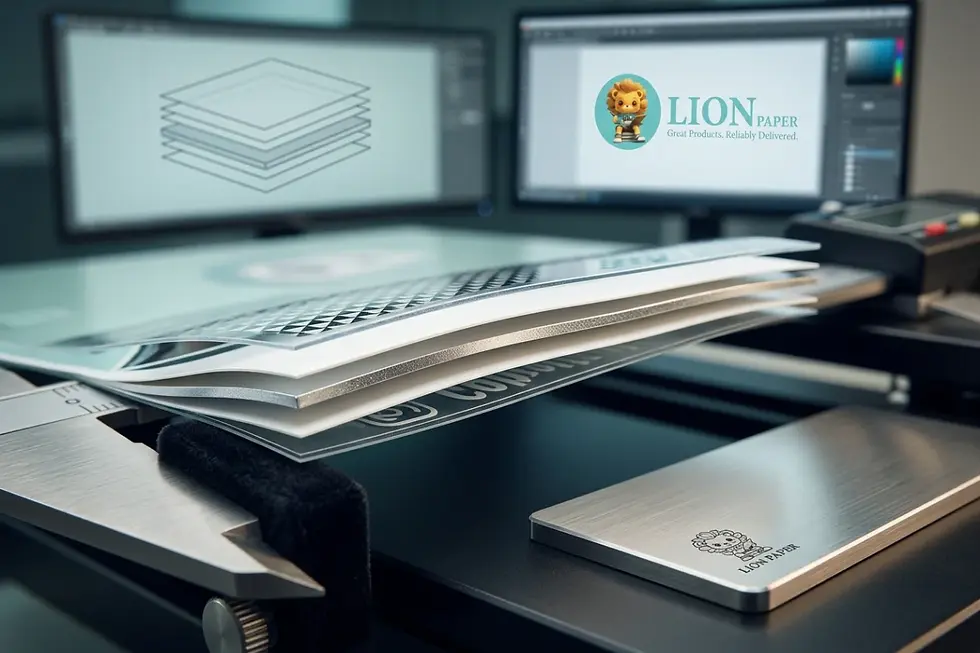
Double-sided window decals utilize a central blockout barrier layer to prevent sunlight bleed-through.
How Does Double-Sided Window Decal Printing Differ from Single-Sided Construction?
When a window graphic must display separate or identical marketing messages to both exterior pedestrians and interior retail shoppers, single-layer printing is insufficient. Double sided window decal sourcing requires specialized light-blocking engineering to eliminate graphic bleed-through and optical ghosting under harsh ambient lighting.
True two-way reading decals are manufactured using a specialized five-layer or sandwich-lamination architecture:
Layer 1 (Side A Graphic): Mirrored CMYK process ink printed onto optically clear film for exterior glass viewing.
Layer 2 (Side A White Backup): High-opacity white ink layer establishing base contrast for Side A.
Layer 3 (Center Blockout Core): A metallic silver foil, black carbon barrier film, or dense charcoal barrier ink flood. This core acts as a 100% light-blocking barrier, preventing bright sunlight or interior store lighting from projecting the rear image through the front artwork.
Layer 4 (Side B White Base): An additional white ink flood coating providing a neutral, reflective surface for the interior graphic.
Layer 5 (Side B Graphic): Standard right-reading CMYK print layer visible to customers standing inside the store or facility.
Dual-sided decals can feature identical mirrored branding on both faces (such as store operating hours or brand logos) or completely different dual-message artwork (for example, "Push to Enter" facing outside and "Thank You for Visiting" facing inside). Commercial buyers must clearly specify required opacity thresholds and caliper limits during RFQ development, as insufficient blockout core density remains the primary driver of end-user visibility complaints.
What Manufacturing and Sourcing Strategies Balance Cost, MOQs, and Dual-Site Scale?
Balancing low unit costs, strict dimensional tolerances, and fast production turnarounds requires an integrated sourcing framework that leverages multi-site manufacturing capabilities. Production runs for customized window stickers vary widely from short-run localized retail campaigns (1,000 to 5,000 units) to multi-million-unit mass-market retail and automotive accessory rollouts.
Optimizing total landed cost and operational agility involves structuring production across complementary operational hubs:
Rapid Prototyping & Material Engineering: Utilizing dedicated pre-press, color-matching, and sample prototyping centers in Jiaxing, China, brand teams can validate multi-layer white flood density, adhesive peel values, and kiss-cut registration within short sampling windows. This stage ensures proof-of-concept approval before committing to large-scale tool manufacturing.
High-Volume Mass Manufacturing: Transitioning approved programs to scaled, automated mass-production facilities—such as modern industrial operations in Cambodia—delivers substantial cost efficiencies for large-format sheeted runs, seasonal rollouts, and bulk consumer packaging.
Substrate Consolidation: Aggregating clear release liners, silicone release coatings, and eco-conscious carrier films across notebook, stationery, and packaging production lines drives volume purchasing efficiencies, lowering unit prices across custom sticker accessory programs.
Packaging & Retail Integration: Supplying retail-ready packaging formats—such as custom printed backing cards with hang-holes, barcode labeling, multi-pack clear polybags, and protective slip-sheets—streamlines in-store merchandising and Amazon FBA warehouse handling.
By uniting high-precision prepress development with large-scale converting infrastructure, supply chain managers achieve dependable production throughput, favorable minimum order quantities (MOQs), and resilient delivery schedules that mitigate regional disruption risks.

Standardized optical clarity and adhesion testing guarantee defect-free retail window sticker batches.
What Quality Control Protocols and RFQ Specifications Prevent Adhesion and Clarity Failures?
Preventing field failures in window decal programs requires drafting precise Request for Quotation (RFQ) specifications and enforcing standardized pre-shipment Quality Control (QC) inspection checkpoints. Misunderstandings regarding print orientation, opacity, or liner slitting lead directly to unusable shipments.
When preparing an engineering RFQ for window sticker printing, specify the following technical parameters:
Viewing Dynamic: Define orientation explicitly as "Inside-Mount Reverse Print for Outside Viewing," "Outside-Mount Standard Print," or "Two-Way Double-Sided with Center Blockout Layer."
Face Stock & Liner Specifications: Clarify base film type (e.g., 50-micron clear PET, 80-micron clear Cast Vinyl, 100-micron static cling PVC), surface corona treatment levels, and backing liner construction (e.g., 120gsm double-sided PE-coated glassine or polyester release film).
Adhesive Performance: Designate required tack levels (low-tack removable acrylic, micro-suction silicone, or high-performance permanent pressure-sensitive) along with operating temperature ranges (-20°C to +70°C).
Ink Chemistry & UV Longevity: Require lightfast UV-curable inks with 1-to-3-year outdoor fade resistance ratings, supplemented by anti-scratch gloss or matte spot laminations where applicable.
Liner Slitting & Finishing: Detail whether the final parts require single kiss-cuts on rectangular backing sheets, individual die-cut contour shapes with crack-and-peel backing slits, or multi-decal sticker sheets.
During mass production, quality control teams should follow standardized AQL 2.5/4.0 sampling procedures adhering to ISO 9001, FSC, SMETA, and CPSIA consumer product compliance benchmarks. Critical inspection points include:
Optical Clarity & Haze Testing: Verifying that face adhesives and clear carrier films show zero milkiness, air entrapment, or solvent distortion when mounted to calibrated float glass panels.
Cross-Hatch Ink Adhesion (ASTM D3359): Ensuring heavy multi-pass UV white floods and CMYK ink layers resist delamination under tape pull stress.
Opacity & Light-Transmission Spectrophotometry: Confirming that double-sided blockout layers maintain total opacity without shadow transfer under high-lumen backlight testing.
Peel Adhesion & Residue Verification (FINAT FTM 1/FTM 2): Measuring clean, residue-free removability on tempered glass after 72 hours of accelerated heat and humidity aging.
Standardizing these metrics prevents supply chain delays, eliminates ambiguity between brand buyers and manufacturing engineers, and guarantees consistent visual presentation across all retail installations.
Frequently Asked Questions
What is the primary difference between reverse print and standard print window stickers?
Standard print window stickers are printed on the front side of an opaque or clear material with adhesive applied to the back, designed to be mounted on the exterior side of a glass surface. Reverse print window stickers are printed in mirror image on clear film with a white flood backing and adhesive placed over the artwork face, allowing them to be installed on the interior side of glass while reading correctly from the outside.
Can clear window stickers be printed without a white ink flood layer?
Yes, but colors will appear translucent and stained-glass-like. Without a solid white ink backing layer, ambient daylight and interior background colors will wash out the CMYK pigments, significantly reducing visual contrast, text legibility, and color accuracy when viewed from a distance.
How does static cling differ from front adhesive decals for inside-glass mounting?
Static cling uses cohesive vinyl flexibility to adhere to smooth glass without adhesive chemistry, making it easy to reposition and remove without residue, though it has lower durability in high-humidity or fluctuating temperature environments. Front adhesive decals use a low-tack, optically clear acrylic adhesive that provides stronger, long-term adhesion and higher resistance to edge lifting over time.
What prevents double-sided window stickers from showing ghost images through the glass?
A dedicated center blockout barrier layer—typically composed of opaque metallic silver foil, carbon barrier film, or high-density screen-printed black ink sandwiched between dual white flood passes—blocks 100% of light transmission, completely preventing image bleed-through between the two sides.
Ready to engineer and manufacture flawless window graphics for your upcoming brand or retail rollout? Share sticker application, face stock, adhesive, size, printing/lamination, durability target, quantity and packaging with Lion Paper for a sourcing/QC brief.
FAQ
What is the primary difference between reverse print and standard print window stickers?
Standard print window stickers are printed on the front side of an opaque or clear material with adhesive applied to the back, designed to be mounted on the exterior side of a glass surface. Reverse print window stickers are printed in mirror image on clear film with a white flood backing and adhesive placed over the artwork face, allowing them to be installed on the interior side of glass while reading correctly from the outside.
Can clear window stickers be printed without a white ink flood layer?
Yes, but colors will appear translucent and stained-glass-like. Without a solid white ink backing layer, ambient daylight and interior background colors will wash out the CMYK pigments, significantly reducing visual contrast, text legibility, and color accuracy when viewed from a distance.
How does static cling differ from front adhesive decals for inside-glass mounting?
Static cling uses cohesive vinyl flexibility to adhere to smooth glass without adhesive chemistry, making it easy to reposition and remove without residue, though it has lower durability in high-humidity or fluctuating temperature environments. Front adhesive decals use a low-tack, optically clear acrylic adhesive that provides stronger, long-term adhesion and higher resistance to edge lifting over time.
What prevents double-sided window stickers from showing ghost images through the glass?
A dedicated center blockout barrier layer—typically composed of opaque metallic silver foil, carbon barrier film, or high-density screen-printed black ink sandwiched between dual white flood passes—blocks 100% of light transmission, completely preventing image bleed-through between the two sides.


Comments