


Weekly vs Monthly A3 Desk Pad: Complete Manufacturing and Sourcing Guide

Weekly A3 desk pads typically feature 52 to 60 tear-off sheets engineered for detailed daily task execution and sprint tracking, whereas monthly A3 desk pads contain 12 to 24 sheets designed for high-level timeline overviews, lower unit freight, and accessible retail price points. Deciding between a weekly desk pad vs monthly calendar pad depends on user workflow requirements, catalog positioning, retail packaging thresholds, and total landed logistics cost.
What Are the Core Functional Differences Between Weekly and Monthly A3 Desk Pads?
The primary distinction between a weekly vs monthly A3 desk pad lies in planning granularity and visual layout density. An A3 format measures 297 x 420 mm (11.7 x 16.5 inches), providing an expansive desktop footprint that serves simultaneously as an active workstation planner and a protective desk blotter.
A weekly A3 desk pad emphasizes operational throughput. The layout typically segments the sheet into vertical or horizontal daily columns from Monday through Sunday, augmented with dedicated sections for priority checklists, habit tracking, project milestones, and freeform grid notes. Because a weekly layout covers 52 weeks of the year, users interact with the surface continuously throughout the workday, making rapid notes during calls, tracking hourly deadlines, and reorganizing immediate action items.
In contrast, a monthly A3 calendar pad functions as a macro scheduling tool. The A3 surface is dominated by an expansive 5-week or 6-week grid matrix displaying the entire month at a glance. Individual day blocks are larger in area than typical bookbound planners, providing ample space for project deadlines, marketing launch dates, travel itineraries, and recurring operational milestones. Monthly desk pads are frequently referenced by managers, project leads, academic instructors, and shared cross-functional teams who need ambient visibility over overarching schedules without turning planner pages.

Precision edge gluing and premium FSC paper stock ensure clean sheet detachment without tearing or adhesive residue.
What Technical Specifications, Sheet Counts, and Paper Weights Define Each Format?
Material specifications directly impact the perceived quality, functional durability, and manufacturing feasibility of large-format desktop stationery. In professional A3 desk planner manufacturing, standard technical parameters vary systematically between weekly and monthly variants.
Weekly A3 desk pads require higher sheet counts to provide a full year of utility, typically standardized at 52 sheets, with 54 to 60 sheets used when incorporating introductory overview leaves or quarterly planning buffers. Due to the high page volume, the choice of paper grammage must balance writing opacity against pad thickness. Premium weekly desk blotters usually specify 100 gsm to 120 gsm woodfree uncoated paper. This weight prevents ink bleed-through and ghosting from fountain pens, rollerballs, and highlighters while keeping the total spine profile manageable at 6.0 mm to 7.5 mm.
Monthly A3 desk pads use significantly fewer sheets, commonly configured with 12 tear-off sheets for standard calendar years, 14 sheets for academic formats (July through August of the following year), or 18 to 24 sheets for multi-year planning pads. Because the sheet count is lower, manufacturers often utilize heavier paper stock ranging from 120 gsm to 160 gsm offset or specialty woodfree paper. The increased caliper imparts substantial hand-feel, structural rigidity, and tear resistance to each individual monthly leaf, ensuring the surface remains smooth and flat despite extended desktop exposure over 30 days.
Standard Weekly Sheet Range: 52 to 60 leaves (covers 52 active weeks plus notes/planning leaves).
Standard Monthly Sheet Range: 12, 14, 18, or 24 leaves (calendar-year or academic cycles).
Optimal Weekly Paper Weight: 100 gsm to 120 gsm uncoated woodfree or FSC-certified offset paper.
Optimal Monthly Paper Weight: 120 gsm to 160 gsm premium heavy offset paper.
Backing Board Density: 1.5 mm to 2.5 mm greyboard (900 gsm to 1500 gsm) to prevent perimeter curling.
How Do Binding Mechanics, Edge Gluing, and Backing Boards Impact Pad Durability?
Large-format paper pads present unique engineering considerations due to environmental humidity, wrist friction, and tear-off stresses. When engineering a wholesale paper desk blotter, the binding method determines how cleanly sheets detach and whether the pad maintains structural integrity across months of desktop use.
Top-edge padding utilizing flexible PVA compound or hot-melt adhesive represents the standard binding mechanism for both weekly and monthly formats. In top-glued constructions, sheets are clamped, aligned, and edge-glued along the upper 420 mm edge. To prevent the corners from dog-earing or lifting as the user's wrists move across the pad, manufacturers frequently incorporate clear PVC, PU leatherette, or paper corner protectors at the bottom two corners. Alternatively, a bottom-edge glue strip or perimeter three-side chip-bonding technique can be applied to maintain flat sheet alignment during active writing.
Backing boards serve as the rigid foundation of the pad. An A3 surface requires heavy-duty support to withstand desktop shifting. Standard production employs rigid greyboard ranging from 1200 gsm (approximately 1.8 mm) to 1800 gsm (approximately 2.8 mm). Premium retail programs often wrap the backing board in printed art paper, black kraft liner, or non-slip embossed material to provide enhanced aesthetics and surface friction on polished timber, laminate, or glass desks.
Perforated top bindings with cloth headbands or wire-O twin-loop bindings represent an alternative mechanical style. Perforated pads feature micro-perforations positioned 12 mm below a rigid top header, allowing clean tearing without leaving adhesive residue on the removed sheet. Wire-O bindings on monthly pads allow users to flip pages backward to preserve historical scheduling records rather than tearing and discarding expired months.
Which Format Offers Better Commercial Margins for Retail, E-Commerce, and Corporate Gifting?
Channel strategy, packaging volume, and freight density play a decisive role when selecting between weekly and monthly layouts for private-label collections and brand catalogs.
In retail environments, weekly A3 desk pads command higher retail price points ($18.00 to $32.00 MSRP) due to their substantial 52-sheet volume and perceived year-long utility. The perceived value of a hefty, year-long productivity planner allows stationery brands to maintain healthy gross margins even after accounting for higher paper substrate costs. However, weekly pads exhibit higher unit shipping weights (typically 750 g to 950 g per unit), which increases pallet shipping costs and Amazon FBA fulfillment tier charges.
Monthly A3 desk pads represent an agile, high-margin entry point for e-commerce brands and promotional corporate gift buyers. With only 12 to 24 sheets, a monthly pad weighs between 260 g and 420 g, substantially reducing dimensional air freight and domestic postal delivery expenses. This lighter profile allows e-commerce retailers to hit competitive sub-$20 price points while protecting net operating margins. For corporate gifting, monthly desk pads offer large branding real estate on every sheet and the top header, delivering year-round brand impressions across executive desks at a cost-effective production budget.

Standardized automated converting lines maintain exact sheet alignment and consistent glue adhesion across volume production runs.
Side-by-Side Comparison: Weekly vs Monthly A3 Desk Pads
The following matrix outlines the key structural, manufacturing, and commercial variables for product developers and procurement managers evaluating weekly vs monthly A3 desk pad options:
Specification & Commercial Factor | Weekly A3 Desk Pad | Monthly A3 Desk Pad |
|---|---|---|
:--- | :--- | :--- |
Standard Sheet Count | 52 to 60 sheets | 12 to 24 sheets |
Standard Paper Weight | 100 gsm – 120 gsm Woodfree / Offset | 120 gsm – 160 gsm Heavyweight Offset |
Pad Thickness (Excluding Board) | Approx. 5.5 mm – 7.2 mm | Approx. 1.5 mm – 3.2 mm |
Unit Weight (with 2.0 mm Backing) | Approx. 780 g – 950 g | Approx. 280 g – 420 g |
Primary Planning Scope | Daily task tracking, habit tracking, hourly sprints | Monthly project milestones, editorial calendars, macro dates |
Typical Binding Style | Top-edge glue padding, optional bottom corner pockets | Top-edge glue or micro-perforated top band, Wire-O |
Average Retail Price (MSRP) | $18.00 – $32.00 USD | $12.00 – $22.00 USD |
Packaging Requirements | Shrink-wrap with rigid corner guards or corrugated mailer | Flat shrink-wrap with chipboard insert or poly bag |
Ideal Distribution Channel | Direct-to-Consumer (DTC), boutique stationery, premium retail | Corporate gifting, volume retail, promotional merchandising |
Reorder & Sales Seasonality | Year-round (undated) or Q4 holiday surge (dated) | Q4/Q1 calendar season, back-to-school (academic) |
How Do Sustainable Sourcing and FSC Papers Apply to Large-Format Desk Blotters?
Modern corporate buyers, institutional retailers, and creator brands prioritize eco-friendly paper solutions that comply with international environmental criteria. Because an A3 sheet has more than double the surface area of a standard A4 sheet, the environmental footprint of material selection is amplified across large production runs.
Partnering with an audited custom desk pad supplier ensures that all primary paper substrates originate from responsibly managed forests certified under FSC (Forest Stewardship Council) standards, with full Chain of Custody (CoC) traceability. Recycled post-consumer waste (PCW) papers ranging from 30% to 100% recycled content can be integrated into interior sheets without sacrificing ink holdout or smooth erasability.
Beyond paper selection, sustainable manufacturing processes eliminate non-recyclable plastic components. Traditional PVC corner covers can be replaced with biodegradable Kraft paper corner protectors, reinforced bookbinding cloth, or folded FSC paperboard tabs. Furthermore, printing is executed using low-VOC, soy-based or vegetable-based offset inks, and padding is completed with non-toxic, water-based emulsion adhesives. These sustainable configurations allow brands to market fully recyclable desktop goods that align with corporate ESG mandates and environmental consumer preferences.
How Does Dual-Site Manufacturing Streamline Desk Pad Development and Delivery?
Managing large-format stationery programs requires balancing rapid design iteration against cost-efficient mass production. Utilizing a dual-site manufacturing model bridges the gap between initial concept engineering and reliable global container delivery.
Lion Paper Products operates an integrated supply network combining a 3,000-square-meter innovation and sampling hub in Jiaxing, China, with a 10,000-square-meter mass manufacturing facility in Cambodia. The Jiaxing operation specializes in structural product engineering, rapid digital prototyping, paper selection testing, and color-matched proofing. This infrastructure enables brand teams and purchasing agents to receive physical pre-production samples within days, verifying paper opacity, grid alignment, and tear-off smoothness before committing to volume production.
For volume rollouts, seasonal production shifts to the Cambodia manufacturing facility. Equipped with high-speed automated sheeting, precision offset printing presses, and automated glue-padding assembly lines, the facility delivers consistent quality across runs exceeding hundreds of thousands of units. Dual-site coordination provides B2B buyers with tariff optimization, scalable output capacity exceeding 5 million paper stationery units annually, and strict compliance backed by ISO 9001, FSC, SMETA, WCA, and CPSIA audits.
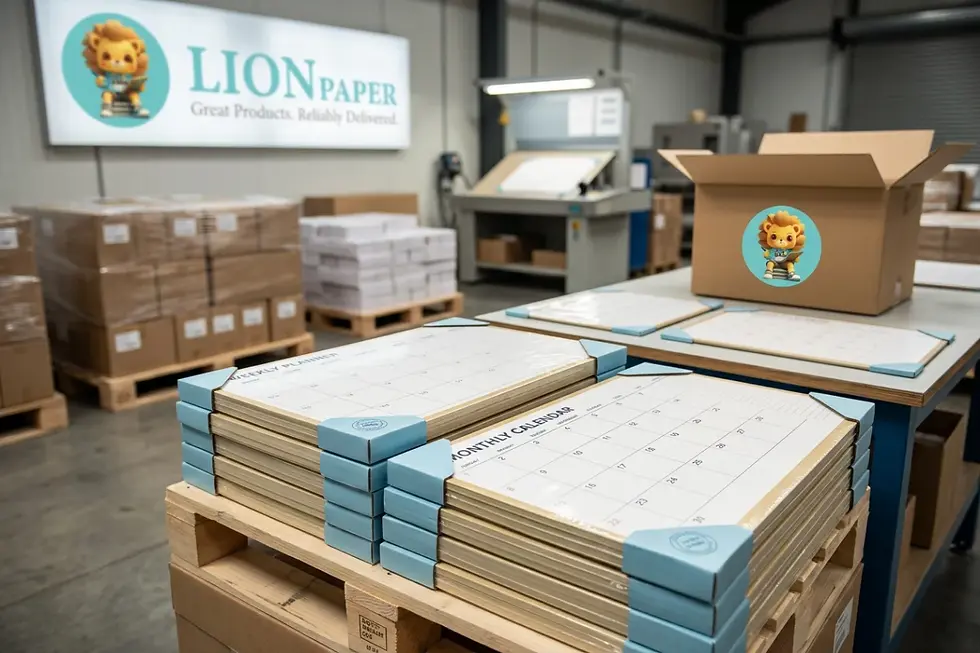
Rigid corner caps and heavy-duty shrink-wrap protect large-format desk blotters against edge bending during international transit.
Strategic Buyer Decision Framework: Choosing the Right Format for Your Catalog
Selecting between a weekly desk pad vs monthly calendar pad requires balancing catalog portfolio gaps, customer demographics, and margin goals. Product planners should evaluate three strategic criteria before issuing manufacturing specifications:
Target Workflow Density: If your core audience consists of software engineers, administrative specialists, busy students, or operational managers managing daily to-do lists, the 52-sheet weekly desk pad provides essential micro-planning capacity. If your customers are executives, marketing strategists, or educators focused on multi-week campaign planning, a 12-to-18-sheet monthly format is the natural choice.
Landed Logistics and Retail Footprint: For DTC and Amazon e-commerce programs where volumetric weight and shipping zones dictate profitability, monthly desk pads offer lower postal tiers and reduced shipping damage risk. For brick-and-mortar retail displays where physical presence and spine thickness justify premium retail pricing, weekly pads deliver higher shelf impact.
Undated vs Dated Inventory Risk: Undated weekly layouts eliminate inventory obsolescence, allowing brands to sell inventory continuously across all twelve months without end-of-year discounting. Dated monthly pads capture peak Q4 holiday and January New Year buying surges but require tight inventory forecasting to prevent post-January clearance losses.
To begin production on your next stationery collection, Share desk-pad size, layout, sheet count, backing, tear-off method and packaging; request an A3 desk-pad specification and sample plan.
FAQ
Can custom A3 desk pads combine weekly and monthly layouts in a single pad?
Yes. Hybrid A3 desk pads can be engineered with custom page sequences, such as 12 monthly overview sheets followed by 52 weekly planning sheets, or repeating monthly-plus-weekly modular sections, provided the backing board and top binding are calibrated for the total sheet thickness.
What is the standard minimum order quantity (MOQ) for custom A3 desk planner manufacturing?
Standard production runs for custom-printed A3 desk pads typically start at 1,000 to 2,500 units per artwork version. Flexible pilot runs for emerging creator brands or SKU testing can be accommodated through our agile China prototyping and sampling facility.
How do you prevent corner curling on large-format A3 paper desk blotters?
Corner curling is mitigated by pairing rigid 1.8 mm to 2.5 mm greyboard backings with high-caliper 100+ gsm internal paper, and adding bottom corner protectors crafted from paperboard, faux leather, or transparent recyclable polymers.
What packaging methods protect large-format A3 pads from shipping damage?
Due to their broad surface area, A3 pads are typically flat-packed with reinforced rigid corner guards, sealed in heavy-gauge shrink-wrap or sealed polybags, and packed into five-ply corrugated master cartons with edge-board reinforcement to prevent transit creasing.


Comments