


Value Retail Pencil Case Manufacturing: Engineering, Compliance, and Sourcing Guide

Developing a value retail pencil case requires balancing durable fabrics, reliable zipper hardware, and optimized construction with disciplined cost engineering and scalable dual-site manufacturing. By aligning precise material specifications, efficient pattern cutting, and international compliance standards, retail stationery brands can achieve competitive shelf pricing while protecting profit margins across high-volume back-to-school and everyday office collections.
What Are the Core Material and Construction Specs for a Value Retail Pencil Case?
Selecting the right balance between raw material cost and perceived retail value is the foundation of competitive pencil case manufacturing. In mass retail environments, consumers evaluate pencil cases based on tactile feel, visual appeal, zipper smoothness, and internal capacity. Retailers, on the other hand, prioritize dimensional stability, stitch durability, washability, and unit landed cost. Achieving these twin goals requires specifying functional, commercially proven textiles that take print or embroidery well without requiring expensive secondary reinforcement steps.
Standard fabrics utilized across cost-effective pencil pouches range from basic 300D to heavy-duty 600D polyester, structured canvas, and water-resistant nylon, as well as clear or tinted TPU/PVC for transparent exam cases. For eco-conscious retail programs, Recycled Polyethylene Terephthalate (rPET) derived from post-consumer plastic bottles provides a strong sustainability narrative with certified Global Recycled Standard (GRS) traceability. When developing retail stationery accessories, sourcing certified recycled textiles allows commercial brands to meet stringent corporate environmental guidelines while retaining identical color brilliance, abrasion ratings, and tensile properties as virgin polymers.
Specification Component | Entry-Level Value Tier | Mid-Tier Retail Standard | Sustainable / Trend Tier |
|---|---|---|---|
:--- | :--- | :--- | :--- |
Primary Outer Material | 300D Polyester with light PU backing | 600D Polyester with PVC/PU coating or 10oz Cotton Canvas | 600D GRS-Certified Recycled PET (rPET) or Washable Kraft Paper |
Inner Lining Material | Unlined (heat-sealed seams) or 190T Polyester | 210D Polyester / TC (Polyester-Cotton) blend | Recycled 210D rPET or unbleached organic cotton |
Zipper Hardware | #3 Nylon coil zipper with standard zinc alloy pull | #5 Nylon coil zipper with molded pull or custom puller | #5 Recycled nylon zipper with matte electroplated alloy pull |
Edge Finishing | Internal overlock stitch or non-woven binding | 210D polyester fabric binding tape with turned edges | Self-fabric piping or bound seams with reinforced bartacks |
Structural Reinforcement | None (soft-shell drape) | 1mm to 2mm EPE foam or EVA foam laminated panel | Recycled felt backing or stiffened cellulose board |
Standard Dimensions | 200 mm x 50 mm x 45 mm (single compartment) | 215 mm x 95 mm x 60 mm (gusseted base / double pocket) | 220 mm x 105 mm x 75 mm (multi-tier organizer) |
Selecting construction methods impacts both labor time and material yield. Single-compartment pouch styles with a flat bottom or minimal gusset offer the most efficient fabric utilization, minimizing scrap during automated die-cutting. Adding internal organizers, such as elastic pen loops, mesh divider pockets, or exterior slash compartments, enhances perceived functionality for students and professionals while adding modest labor overhead that can be offset through high-volume assembly lines. In value retail manufacturing, balancing internal compartment complexity against sewing cycle seconds per unit remains the single most impactful lever for preserving vendor pricing structures and channel margins.

Carefully specified seams, fabric backings, and durable nylon zippers optimize production costs and product longevity.
How Does Cost Engineering Protect Margins in Pencil Case Manufacturing?
Cost engineering in pencil pouch production involves analyzing every component of the Bill of Materials (BOM) and every second of assembly line labor to remove unnecessary expense while protecting consumer-facing quality. In the competitive landscape of retail stationery accessories, margin erosion often stems from unoptimized pattern nesting, over-specified internal reinforcements, or inefficient zipper installation techniques. To safeguard wholesale and retail margins, factories must combine precise industrial pattern engineering with continuous workflow improvements across cutting, binding, stitching, and finishing work cells.
To maximize margin performance for high-volume retail distributions, manufacturing partners apply several structural and operational optimizations:
Pattern Optimization and Nesting Yield: Computer-aided design (CAD) nesting software lays out pattern pieces across standard fabric roll widths (typically 58 inches / 147 cm) to achieve material utilization rates exceeding 92%, substantially reducing scrap waste during automated clicker-die or laser cutting operations.
Zipper Integration and Pull Customization: Using continuous nylon coil chain cut to custom length on automated insertion machinery lowers hardware costs compared to pre-cut zipper assemblies. Custom branding is most cost-effectively achieved by debossing a zinc alloy puller or adding a printed woven zipper pull tab rather than molding proprietary metal sliders from scratch.
Assembly Sequence Engineering: Designing pouches with straight-line stitching paths allows high-speed flatbed sewing machines to operate at peak output. Utilizing self-binding folds or automated edge-binding attachments reduces manual fabric handling by sewing operators, cutting assembly labor time by up to 18% per finished unit.
Labeling and Branding Techniques: Screen printing, heat transfer, and woven damask labels offer the most economical branding methods for high-run retail programs. High-frequency debossed PU patches provide a premium leatherette appearance at a fraction of genuine leather applique costs, adding perceived value without compounding sewing labor.
Packaging and Carton Density: Packaging pencil cases flat or nested inside retail-ready counter display units (CDUs) reduces volumetric freight charges. Shipping items in flat polybags or minimal FSC-certified paper wrap bands ensures maximum container stuffing density, reducing per-unit ocean freight expenses across high-cube sea containers.
Applying these principles systematically allows brands to meet critical retail price points (such as $1.99, $3.99, or $4.99 price bands) while ensuring gross margins remain robust across diverse retail channels, including mass supermarkets, university bookstores, and global discount chains. Sourcing teams that conduct systematic line-item cost teardowns during the prototyping phase routinely uncover between 8% and 15% in direct cost savings without sacrificing visual impact or physical performance.
What Is the Standard Workflow for Custom Stationery Pouch Development and Prototyping?
Bringing a new stationery organizer from concept to retail shelves requires a disciplined, multi-stage product development methodology. Custom stationery pouch development bridges creative industrial design and high-volume mass production, ensuring that aesthetic concepts retain structural integrity when transferred to automated assembly lines. Without rigorous prototyping checkpoints, commercial stationery programs risk production delays, material mismatched tolerances, and unpredictable quality drift during peak seasonal production runs.
The development journey follows a clear six-stage sequence:
Stage 1: Concept & Briefing: Aligning customer aesthetic vision, target retail price, and functional parameters.
Stage 2: Pattern Engineering: Translating two-dimensional sketches into exact CAD cutting dies and seam allowances.
Stage 3: Material Sourcing: Procuring baseline textiles, specialized zipper chains, and custom pulls.
Stage 4: Rapid Prototyping: Generating physical structural mockups for dimensional and functional testing.
Stage 5: Pre-Production Review: Evaluating Golden Samples under lab and retail planogram conditions.
Stage 6: Mass Tooling: Fabricating high-output clicker dies, sewing jigs, and standardized assembly line SOPs.
The development execution unfolds across four practical operational phases:
Design Brief and Tech Pack Creation: The brand provides initial sketches, dimension targets, pantone references, and target retail pricing. The development engineering team translates these inputs into a technical pack outlining seam allowances, stitch density (stitches per inch), thread type (such as bonded nylon or core-spun polyester), and structural reinforcement layers.
Pattern Drafting and Rapid Prototyping: In a dedicated prototyping facility—such as the 3,000-square-meter development and sampling center operated by Lion Paper in Jiaxing, China—pattern makers create physical master paper patterns. First-round structural mockups are constructed within 3 to 5 business days using available stock materials to verify spatial volume, zipper action, and seam stability.
Sales Sample Creation and Colorway Matching: Once structural approval is secured, counter-samples are produced using custom-dyed or rotary-printed fabrics matching exact Pantone Matching System (PMS) standards. These samples feature complete retail trims, woven branding labels, barcode swing tags, and inner wash care tags for buyer presentations and seasonal planogram reviews.
Pre-Production Tooling and Golden Sample Sign-Off: Prior to full mass manufacturing, steel cutting dies (clicker dies) are fabricated for fabric cutting. A final "Golden Sample" is generated directly from the mass-production line tooling, serving as the immutable quality benchmark for mass inspection and quality sign-off.

Rapid sampling and precision pattern drafting bridge creative design concepts with scalable factory production.
Which Quality Assurance and Compliance Standards Apply to Retail Stationery Accessories?
Retail stationery accessories targeted at school, home, and office markets are subject to stringent physical, chemical, and ethical compliance standards, particularly when products are intended for or accessible to children. Retail buyers and global brand owners must ensure that every production batch complies with destination-market legislation to prevent costly recalls, customs holds, or brand damage. Establishing end-to-end quality control and supply-chain traceability guarantees that mass-market products meet consumer safety regulations across international retail territories.
Key compliance and quality control frameworks include:
Chemical and Toxicological Safety: In North America, products must comply with the Consumer Product Safety Improvement Act (CPSIA) and California Proposition 65, mandating strict lead thresholds (under 90 ppm for surface coatings and under 100 ppm for substrates) and limits on restricted phthalates (such as DEHP, DBP, BBP, DINP). In Europe, materials must adhere to REACH regulations (Regulation (EC) No 1907/2006) for restricted substances, azo dyes, and heavy metal extraction.
Mechanical and Physical Durability Testing: Testing protocols assess zipper cycle durability (minimum 1,000 to 3,000 smooth open-close cycles without tooth separation), seam pull strength (resisting minimum 80 N to 120 N tension), zipper puller detachment force (resisting over 50 N to 70 N to prevent choking hazards under 16 CFR 1501), and colorfastness to light, rubbing, and water exposure.
Ethical Manufacturing Audits: Mainstream retail distributors require manufacturing facilities to hold verified social compliance certifications, including SMETA (Sedex Members Ethical Trade Audit), WCA (Workplace Conditions Assessment), and Disney FAMA (Facility and Merchandise Authorization) compliance.
Standardized Quality Control Protocols: Quality verification follows ANSI/ASQ Z1.4 (ISO 2859-1) Acceptable Quality Limit (AQL) sampling standards, typically using AQL 1.5 for critical functional defects (such as broken zipper sliders or open seam ruptures) and AQL 2.5 or 4.0 for minor cosmetic imperfections (such as untrimmed thread ends or minor fabric weave irregularities).
Integrating standard operating procedures (SOPs), in-line sewing inspections, needle detection protocols, and automated carton drop testing guarantees batch consistency across large production runs, shielding retail partners from quality claims and maintaining uniform shelf presentation across thousands of retail store doors.
How Can Brands Integrate Cost-Effective Pencil Pouches into Broader Stationery Assortments?
Stationery pencil cases rarely exist in isolation on the retail shelf. Instead, they function as high-performing accessories within coordinated lifestyle, back-to-school, and executive office collections. Creating cohesive stationery suites increases average basket sizes and strengthens retail brand presence. When accessories and paper goods share common design languages, materials, and finishings, consumers perceive a complete lifestyle solution rather than a standalone commodity item.
To build effective cross-category synergy, product development teams align pencil case aesthetics with surrounding stationery categories:
Surface Pattern and Palette Alignment: Coordinated color palettes, floral prints, geometric motifs, or licensed character artwork are aligned across wire-bound notebooks, daily planners, hardbound journals, desktop organizers, and pencil cases. Rotary or digital fabric printing allows exact color matching to offset-printed paper covers.
Material Harmony: Pairing tactile textiles—such as textured bookcloth, linen, or kraft paper finishes—creates a multi-sensory connection across planners, file folders, and matching accessories.
Assortment Bundling and Kit Packaging: Packaging pencil pouches together with coordinating gel pens, highlighters, sticky note flags, and elastic-bound notebooks into pre-packed stationery kits or holiday gift sets delivers exceptional perceived value for gift buyers and seasonal promotional events.
Scenario-Specific Architecture: Differentiating designs according to clear usage scenarios ensures broad market coverage:
Student Back-to-School: High-capacity multi-compartment polyester cases with durable #5 zippers and internal mesh pockets for calculators and drafting tools.
Professional Office / Minimalist: Slimline faux-leather or textured canvas pouches designed to slip neatly into laptop sleeves and briefcases.
Creative & Journaling Enthusiasts: Expanding standing pencil pouches (telescopic pop-up cases) that convert from a portable pouch into a desktop pen cup.
By unifying accessory design with paper goods manufacturing, brands simplify vendor management, reduce development overhead, and provide retailers with a turnkey, visually unified merchandising display that commands prime eye-level planogram placement.
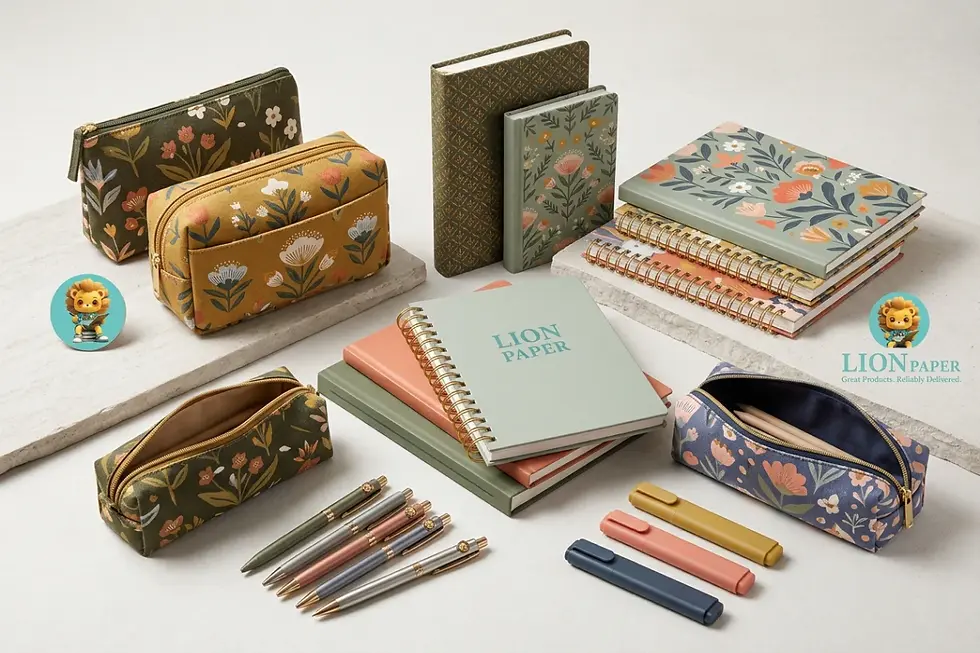
Integrating pencil cases into broader coordinated stationery assortments increases retail shelf appeal and average basket size.
How Does China–Cambodia Dual-Site Synergy Deliver Scalable Value in Mass Retail Production?
Managing global retail supply chains requires mitigating geopolitical risks, balancing direct labor costs, and maintaining fast development agility. Lion Paper Products operates a flexible dual-site supply chain model that bridges rapid development capabilities in Jiaxing, China, with high-volume, cost-optimized manufacturing in Cambodia. This bi-nodal infrastructure allows retail buyers to avoid the traditional trade-off between creative speed and bulk production cost efficiency.
This integrated dual-site infrastructure provides specific commercial and operational advantages for mass retail programs:
Design and Rapid Prototyping in Jiaxing: The 3,000-square-meter Jiaxing headquarters serves as the strategic hub for creative conceptualization, CAD structural engineering, raw material sourcing, and rapid sample turnaround. Proximity to East China’s specialized textile, zipper, and packaging markets allows immediate access to the latest fabric developments and trim innovations.
Large-Scale Production in Cambodia: The 10,000-square-meter manufacturing facility in Cambodia is engineered for high-volume, cost-efficient mass production. Equipped with standardized production lines, advanced automated cutting systems, and trained assembly teams, this facility delivers substantial labor cost efficiencies and favorable tariff positions for shipments heading to North American and European retail destinations.
Unified Quality and SOP Control: Both manufacturing sites operate under identical ISO 9001-aligned quality management systems, standardized assembly SOPs, and rigorous AQL defect standards. This ensures that pre-production samples developed in Jiaxing translate into identical mass-manufactured goods in Cambodia.
Scalable Volume and Supply Stability: With annual notebook capacity exceeding 5 million units alongside dedicated accessory sewing cells, this dual-site framework provides retail partners with scalable fulfillment options for multi-container seasonal replenishment, national back-to-school rollouts, and multi-SKU private label collections.
Through agile coordination between design hubs and regional manufacturing facilities, brand buyers secure the optimal balance of speed to market, strict compliance governance, and highly competitive landed pricing.
To begin custom development for your upcoming retail collection, Share target retail price, material, hardware finish, branding and assortment concept; request a pencil-case costed design proposal.
Frequently Asked Questions
What is the typical Minimum Order Quantity (MOQ) for custom pencil case manufacturing?
Custom pencil pouch MOQs generally range from 1,000 to 3,000 pieces per colorway when utilizing standard catalog fabrics (such as standard 600D polyester or canvas). For custom pantone-dyed fabrics, unique rotary patterns, or custom-molded zipper hardware, MOQs typically start at 3,000 to 5,000 pieces per style to satisfy textile mill dye-vat and printing minimums.
Can pencil cases be manufactured using certified recycled or eco-friendly materials?
Yes. Retail pencil pouches can be manufactured using certified post-consumer recycled fabrics, such as 100% GRS-certified rPET, organic cotton canvas, washable kraft paper, or FSC-certified paper composites. Recycled fabrics can be paired with recycled zipper tapes, electroplated low-lead zinc pullers, and recyclable paper wrap-band packaging to achieve fully circular product credentials.
What are the standard lead times for prototyping and mass manufacturing?
Physical structural prototyping generally requires 3 to 5 business days using standard in-house materials. Full sales samples featuring custom-printed fabrics and custom trims require 10 to 14 days. Mass production lead times typically range from 35 to 50 days following Golden Sample approval and receipt of deposit, depending on order volume and packaging complexity.
FAQ
What is the typical Minimum Order Quantity (MOQ) for custom pencil case manufacturing?
Custom pencil pouch MOQs generally range from 1,000 to 3,000 pieces per colorway when utilizing standard catalog fabrics (such as standard 600D polyester or canvas). For custom pantone-dyed fabrics, unique rotary patterns, or custom-molded zipper hardware, MOQs typically start at 3,000 to 5,000 pieces per style to satisfy textile mill dye-vat and printing minimums.
Can pencil cases be manufactured using certified recycled or eco-friendly materials?
Yes. Retail pencil pouches can be manufactured using certified post-consumer recycled fabrics, such as 100% GRS-certified rPET, organic cotton canvas, washable kraft paper, or FSC-certified paper composites. Recycled fabrics can be paired with recycled zipper tapes, electroplated low-lead zinc pullers, and recyclable paper wrap-band packaging to achieve fully circular product credentials.
What are the standard lead times for prototyping and mass manufacturing?
Physical structural prototyping generally requires 3 to 5 business days using standard in-house materials. Full sales samples featuring custom-printed fabrics and custom trims require 10 to 14 days. Mass production lead times typically range from 35 to 50 days following Golden Sample approval and receipt of deposit, depending on order volume and packaging complexity.


Comments