


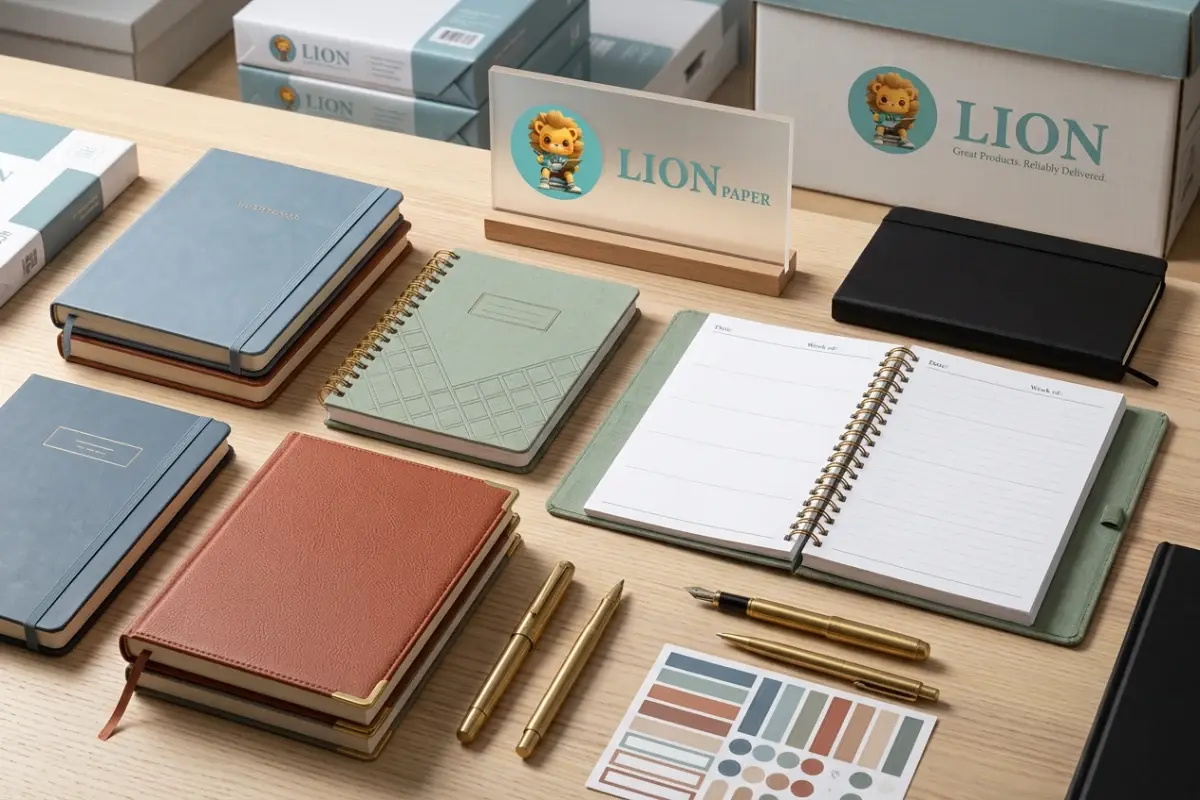
Undated Academic Planners Wholesale: B2B Sourcing and Manufacturing Guide

Undated academic planners provide campus bookstores, educational publishers, and lifestyle stationery brands with year-round retail flexibility by eliminating fixed calendar obsolescence, minimizing unsold inventory write-offs, and supporting versatile semester-based organization. Sourcing undated planners in wholesale volume allows retailers and institutional buyers to maintain steady gross margins regardless of rolling admissions, non-standard collegiate terms, or shifting back-to-school purchasing cycles.
Why Choose Undated vs. Dated Academic Planners for Wholesale Inventory Management?
Procurement managers and stationery brand directors frequently encounter margin compression when managing dated academic inventory. Dated planners carry an abrupt depreciation curve; once the September back-to-school rush or January mid-year intake concludes, dated inventory often requires markdowns between 40% and 70% to clear shelf space.
In contrast, bulk undated academic agendas eliminate date-based depreciation. An undated layout features open header fields for months and days, allowing students to activate their planner at any point during fall, spring, or summer terms without wasting pre-printed dated leaves.
Feature Matrix | Dated Academic Planners | Bulk Undated Academic Agendas |
|---|---|---|
:--- | :--- | :--- |
Inventory Shelf Life | Limited to 3–6 months per academic cycle | Perpetual (multi-season carryover without discounting) |
Stockout Replenishment Risk | High risk of overstocking during late reorders | Zero obsolescence risk on safety stock |
Academic Term Fit | Standard fall-to-spring calendar only | Trimester, quarter, semester, or summer sessions |
Buyer Margin Protection | Subject to aggressive post-season markdowns | Stable full-margin retail pricing year-round |
Fill-Rate Utilization | Fixed page allocation per week/month | 100% active use; zero skipped vacation weeks |
By transitioning a core percentage of catalog SKUs to wholesale flexible academic organizers, campus retailers and private-label stationery brands insulate their operations from erratic seasonal demand swings. Surpluses from autumn terms seamlessly roll into spring orientation sales, eliminating liquidation waste and stabilizing working capital.

Modular undated page layouts allow students to structure schedules across traditional or non-standard collegiate terms.
How Do Custom Undated Student Planners Serve Campus Bookstores and Education Brands?
Custom undated student planners serve diverse educational and commercial distribution channels. Because modern post-secondary learning encompasses traditional undergraduate degrees, rolling master's programs, accelerated nursing or vocational cohorts, and international study exchanges, planning tools must adapt to non-linear schedules.
Campus Bookstores and Auxiliary Services: Institutional bookstores require branded merchandise that appeals to incoming freshmen, graduate researchers, and faculty alike. Custom cover debossing with university crests, collegiate color palettes, and undated modular layouts allow auxiliary retail buyers to order larger production runs without fear of end-of-year write-downs.
Private Label and Direct-to-Consumer (DTC) Stationery Brands: Creator-led stationery lines and boutique productivity brands rely on custom undated student planners to serve aesthetic, goal-oriented audiences. These buyers prioritize premium tactile finishes, customized habit trackers, project roadmaps, and modular time-blocking sections.
University Admissions and Orientation Welcome Kits: Higher education marketing teams utilize branded undated organizers as high-perceived-value orientation gifts. Because recruitment events happen throughout the calendar year, undated internal pages ensure that materials delivered during spring preview days remain fully functional when classes commence.
Academic Coaching and Test Preparation Centers: Specialized tutoring institutions require structured project management tools for multi-month exam preparations, such as MCAT, LSAT, or CPA tracks. Custom undated spreads permit coaches to structure 12-week or 16-week intensive study milestones without relying on standard calendar months.
Which Paper Weights, Cover Materials, and Bindings Best Support Heavy Academic Wear?
Student planners undergo rigorous daily use across lecture halls, library desks, and transit backpacks. Specifying the correct combination of paper opacity, surface sizing, board caliper, and spine reinforcement ensures the finished product withstands continuous handling across multiple terms.
Component | Recommended Specification | Functional Performance Benefit |
|---|---|---|
:--- | :--- | :--- |
Interior Paper Stock | 100–120 gsm Woodfree / FSC-Certified Uncoated | Resists ghosting and ink bleed from gel pens, highlighters, and fountain inks |
Hardcover Binding | 1.8mm–2.5mm Rigid Greyboard with C1S Art Paper or Bookcloth | Provides a rigid writing surface on student laps and protects interior signatures |
Softcover Binding | 300–400 gsm Art Card or Thermo-PU with Flexible Core | Lightweight for commuter bags; bends without creasing spine corners |
Twin-Ring Wire-O | 1.2mm–1.5mm Gauge Double-Loop Steel Wire (Gold, Black, Rose Gold) | Enables true 360-degree flat lay for compact desktop work in tight lecture seats |
Smyth-Sewn Casebound | Section-Sewn Signatures with Reinforced Gauze Backing | High-end aesthetic with lay-flat functionality; zero risk of loose page drop-outs |
For premium retail brands, paper texture and ink holdout are paramount. An uncoated 100 to 120 gsm woodfree sheet provides smooth tactile feedback for rapid note-taking while preventing the show-through common in standard 70 gsm commodity notebooks. When engineering campus bookstore planner manufacturing projects, balancing weight and bulk is essential to keep the finished book portable while maintaining heavy-duty archival integrity.

Selecting 100–120 gsm FSC-certified paper and reinforced binding structures ensures longevity under daily academic use.
What Decision Framework Should Buyers Use for Formats, Sizing, and Accessories?
Developing a balanced academic planner catalog requires matching format structures with target user habits. Procurement teams must balance page count, overall dimensions, functional layouts, and value-added accessories.
Sizing Selection:
A5 (5.8 x 8.3 in / 148 x 210 mm): The industry standard for personal carry. Ideal for daily task tracking and weekly scheduling.
B5 (7.0 x 9.8 in / 176 x 250 mm): The preferred balance between desk workspace and backpack portability, widely favored by collegiate and graduate students managing complex timetables.
A4 / Letter (8.5 x 11.0 in / 216 x 279 mm): Designed for comprehensive project mapping, group study coordination, and faculty curriculum management.
Interior Layout Architecture:
Horizontal Weekly Undated: Traditional open horizontal rows allowing equal balance between daily homework reminders and personal tasks.
Vertical Weekly Hourly Undated: Columnar layouts running from 06:00 to 22:00, suited for university students balancing lecture blocks, lab rotations, athletic practices, and part-time jobs.
Modular Semester Hubs: Dedicated sections combining course syllabi trackers, grade calculators, exam countdown matrices, dot-grid project zones, and undated monthly spreads.
Value-Added Functional Accessories:
Elastic Closure Straps: 7mm to 10mm woven elastic bands matching or contrasting cover pantones to keep loose handouts secure.
Gusseted Back Pockets: 250 gsm reinforced card stock accordion pockets glued to the inside back cover for holding syllabi, receipts, and flashcards.
Dual Grosgrain Ribbon Markers: 5mm to 7mm woven ribbons enabling instant navigation between weekly active pages and monthly overview spreads.
Mylar-Coated Index Tabs: Tear-resistant tabbed dividers separating weekly logs, project matrices, and blank note sections.
Customized Sticker Sheets: Integrated sheets featuring exam flags, deadline indicators, grade icons, and wellness reminders tipped into the back binding.
How Does China–Cambodia Dual-Site Manufacturing Optimize Landed Costs and Compliance?
Managing global procurement for undated academic planners wholesale requires balancing responsive design development with scalable, cost-efficient mass production. Lion Paper Products (Jiaxing) Co., Ltd. resolves this supply chain challenge through an integrated China-Cambodia dual-site production model.
Jiaxing Facility (China): Spanning 3,000 square meters, the Jiaxing operational hub serves as the center for product planning, structural engineering, rapid prototype sampling, specialty material sourcing, and initial pilot runs. Design teams collaborate directly with clients to refine foil stamping dies, custom endpaper prints, and ergonomic page grids.
Cambodia Production Base: Covering 10,000 square meters, the Cambodia manufacturing facility is optimized for scalable mass manufacturing, automated casing-in, large-volume wire binding, and high-efficiency export assembly. With an aggregate annual capacity exceeding 5 million notebook and planner units, this dual-site infrastructure gives global buyers flexible tariff mitigation pathways, favorable trade lanes, and competitive total landed costs.
Standardized Quality and Compliance: Both operating facilities follow uniform Standard Operating Procedures (SOPs), stringent Acceptable Quality Limit (AQL) inspection tables, and standardized defect catalogs. Supply chain compliance is anchored by certifications and rigorous audit alignments, including ISO 9001, FSC chain-of-custody paper traceability, SMETA, WCA, GSV, FAMA, and CPSIA safety testing protocols.
Category Ecosystem Synergy: In addition to planners, Lion Paper integrates capabilities across eight key product categories, including Eco Paper Products, Notebooks & Journals, Stationery & Office supplies, Accessories (pens, clips, bookmarks), Bags & Organizers, and Retail Gift Packaging. This enables procurement teams to manufacture coordinated back-to-school stationery bundles, boxed gift sets, and retail-ready merchandise collections under a unified manufacturing umbrella.

Lion Paper's China-Cambodia dual-site facilities deliver scalable production capacity exceeding 5 million units annually.
What Specifications Belong in an RFQ for Campus Bookstore Planner Manufacturing?
To ensure rapid quote turnaround and precise cost engineering, buyers compiling a Request for Quotation (RFQ) for custom undated student planners should outline clear structural and material parameters. A complete procurement brief eliminates ambiguity and streamlines sampling lead times.
Target Volume & Batch Splits: Total production units per SKU, including test-batch volumes versus scheduled annual releases.
Finished Dimensions: Trim size width by height in millimeters or inches.
Page Count & Pagination: Total interior pages (e.g., 192 pages / 96 leaves) plus front/back matter and endpapers.
Core Paper Weight & Shade: Paper basis weight (e.g., 100 gsm or 120 gsm), shade (natural cream vs. high-brightness white), and certification (FSC-certified 100%, Mix, or Recycled).
Interior Printing Specs: Color configuration (e.g., 1C/1C subtle grey line grid or 2C/2C customized pantone palette).
Binding Construction: Spine style (Twin-ring Wire-O concealed, Smyth-sewn round back casebound, or flexible thermal PU flexi-cover).
Cover Board & Outer Material: Board caliper (e.g., 2.0mm greyboard) wrapped in 157 gsm art paper, linen bookcloth, or soft-touch vegan PU leather.
Embellishments & Finishing: Hot foil stamping (matte gold, silver, holographic), debossing/embossing depth, spot UV varnish, or anti-scratch matte lamination.
Functional Accessories: Elastic band dimensions, number of ribbon markers, gusseted back pockets, tipped-in sticker sheets, or metal corner protectors.
Packaging & Retail Requirements: Individual biodegradable polybags, retail belly bands with scannable UPC barcodes, PDQ counter displays, or custom rigid presentation gift boxes.
Ready to engineer your next stationery collection? Send your format, date range, quantities, and customization specifications to our team to receive a detailed production quotation, physical material swatches, and structural prototyping support.
FAQ
What is the typical minimum order quantity (MOQ) for custom undated academic planners?
Typical MOQs for fully customized undated student planners start at 1,000 to 3,000 units per design, depending on the complexity of cover materials, custom tooling dies, and accessory integration. Flexible pilot-run programs may be accommodated through our Jiaxing rapid development site.
Can undated academic planners be customized with specific school or university logos?
Yes. We offer comprehensive OEM/ODM customization including precision blind debossing, foil stamping, custom printed endsheets, branded belly bands, institutional color matching, and bespoke tipped-in pages featuring campus maps or academic honor codes.
How does undated planner inventory help reduce supply chain risks for campus retailers?
Because undated planners contain no pre-printed calendar years or fixed day dates, unsold stock remains 100% viable across subsequent academic terms. This eliminates seasonal clearance discounts and protects institutional profit margins against unexpected enrollment fluctuations.
What quality assurance and social compliance standards are followed during production?
Manufacturing adheres to ISO 9001 quality management systems, FSC chain-of-custody certifications for responsible paper sourcing, and international ethical labor standards audited under SMETA, WCA, GSV, FAMA, and CPSIA frameworks.


Comments