


Trade Show Notebooks with QR Codes: Engineering Print Precision, Lead Capture, and Production Quality

Integrating dynamic QR codes into trade show notebooks bridges physical corporate gifting with real-time digital lead generation through high-contrast print placement, durable substrate selection, and trackable destination architecture. By engineering scan-optimized layouts across cover interiors, belly bands, or flyleaves, brands transform static merchandise into measurable, interactive marketing assets that deliver verifiable post-event attribution, higher audience engagement, and extended product utility.
Why Should Brands Integrate Dynamic QR Codes into Trade Show Notebooks?
Trade exhibitions and industry conferences represent substantial commercial investments where capturing qualified attendee attention is critical. Traditional exhibition handouts—such as single-sheet flyers, brochures, and low-utility promotional items—are frequently discarded within hours of receipt. Conversely, high-quality journals and custom corporate stationery achieve retention rates spanning months, remaining directly on decision-makers' desks. Incorporating scannable digital markers elevates these items into trackable branded notebooks that unite physical utility with real-time analytics.
Physical Distribution (Booth Handout) ↓ Immediate Engagement (Agenda / Demo Booking / Asset Download) ↓ Long-Term Desk Utility (Multi-Month Exposure) ↓ Post-Show Nurturing (Dynamic Content Routing / Re-Targeting)
When event marketers configure event merchandise QR code printing, they establish a direct bridge between tactile interactions and digital marketing pipelines. This data integration delivers quantifiable advantages across multiple operational and promotional dimensions:
Precise Attribution Tracking: Marketing operations teams can deploy unique UTM parameters to evaluate scan volume, geolocations, peak scan hours, and conversion ratios specific to distinct booths, regional conferences, or individual field representatives.
Agile Content Adaptability: Unlike printed web addresses that become permanent once cured on paper, dynamic code architectures allow teams to modify destination URLs mid-event—transitioning from live booth schedules and prize draws during the show to on-demand technical webinars and whitepapers post-event.
Frictionless Contact Acquisition: Attendees avoid typing complex corporate URLs or searching through dense site menus on mobile devices; a single camera scan immediately serves customized mobile landing pages, calendar scheduling widgets, or digital business cards (vCards).
Reduced Print Waste: Essential supplementary documentation, technical datasheets, full product catalogs, and sustainability disclosures can reside digitally behind the code, reducing the physical page count of the printed collateral and supporting carbon-lite event initiatives.
What Is the Optimal Promotional Notebook QR Code Placement Across Different Book Formats?
Determining the most effective promotional notebook QR code placement requires balancing aesthetic brand integrity with user scanning convenience. If a code is positioned too conspicuously on an exterior cover, it may diminish the notebook's perceived retail-quality elegance, discouraging recipients from using it in executive meetings. Conversely, concealing the code deep within interior grid pages reduces scan initiation rates.

Placing QR codes on the inside flyleaf protects the matrix from abrasion while keeping the exterior cover refined and executive-ready.
Professional corporate stationery manufacturers evaluate five primary placement zones, each suited to specific campaign objectives and book structures:
Inside Front Cover or Front Flyleaf (Endpaper): Positioning the code on the inside front endpaper provides immediate visibility the moment an attendee opens the journal. This placement protects the code from exterior surface abrasion while maintaining an uncluttered, high-end outer cover aesthetic.
Removable Belly Band (Paper Wrap): A full-color printed belly band (sleeve) offers high visual real estate for promotional calls-to-action, sponsor branding, and large-format QR codes. Attendees interact with the code during the initial unboxing at the booth, after which the band can be removed for clean daily use.
Lower Quadrant of the Back Exterior Cover: For organizations wanting permanent digital accessibility without disrupting front-cover debossing or foil logos, a compact, clean code screen-printed or stamped on the bottom back cover delivers lasting visibility.
Custom Insert Cards and Bookmark Ribbons: Inserting a heavy cardstock quick-start guide or printing a micro-code tag on an attached woven ribbon bookmark provides a tactile call-to-action that users encounter repeatedly while turning pages.
Running Footer Across Interior Pages: In training workbooks or custom-printed conference agendas, embedding a subtle, standardized code in the outer bottom margin of specific sectional pages directs readers to session slides or companion digital downloads.
What Substrate, Contrast, and Resolution Standards Ensure Reliable Event Merchandise QR Code Printing?
Camera optical sensors rely on distinct luminance boundaries to isolate and interpret the two-dimensional matrix modules. Printing defects, ink bleeding, low optical contrast, or substrate distortion can render custom promotional notebooks with QR code completely unscannable under uneven exhibition hall lighting.
Technical Parameter | Specification Standard | Production Impact & Failure Risk |
|---|---|---|
:--- | :--- | :--- |
Minimum Print Dimensions | 20 mm × 20 mm (0.8 in × 0.8 in) | Codes below this threshold struggle to resolve on standard smartphone cameras without macro focusing capabilities. |
Optical Contrast Ratio | Minimum 70:1 (Dark ink on light base) | Inverted codes (light code on dark cover) fail optical parity checks on legacy camera apps; high reflectance contrast is essential. |
Artwork Resolution | Native Vector (EPS / AI / PDF) or ≥600 DPI | Bitmaps scaled from low-resolution web previews produce jagged module edges, preventing edge detection during decoding. |
Quiet Zone Margin | Minimum 4× the width of one module | Artwork, text, or edge stitching placed within the quiet zone disrupts the finder pattern recognition framing. |
Ink Dot Gain & Bleed | Compensated curve for uncoated paper | Uncoated woodfree paper absorbs ink, causing dot gain that merges individual modules if not calibrated in prepress. |
Selecting the right paper substrate is equally critical for interior codes. FSC-certified uncoated woodfree paper ranging from 80 gsm to 120 gsm delivers uniform ink absorption, preventing scan-degrading ink halos. When applying codes to textured paperboard, buckram cloth, or synthetic covers, prepress engineers must calibrate plate exposures to compensate for surface depth irregularities.
How Should Dynamic QR Code Architecture and Error Correction Be Structured for Corporate Events?
Behind every successful print deployment is a robust data infrastructure. Trade show notebooks QR codes must balance URL payload length with code density. Long URLs packed with multiple uncompressed tracking tags generate dense matrix grids composed of hundreds of minuscule modules. These high-density grids demand exceptionally high print precision and become vulnerable to minor physical scratches or smudges.
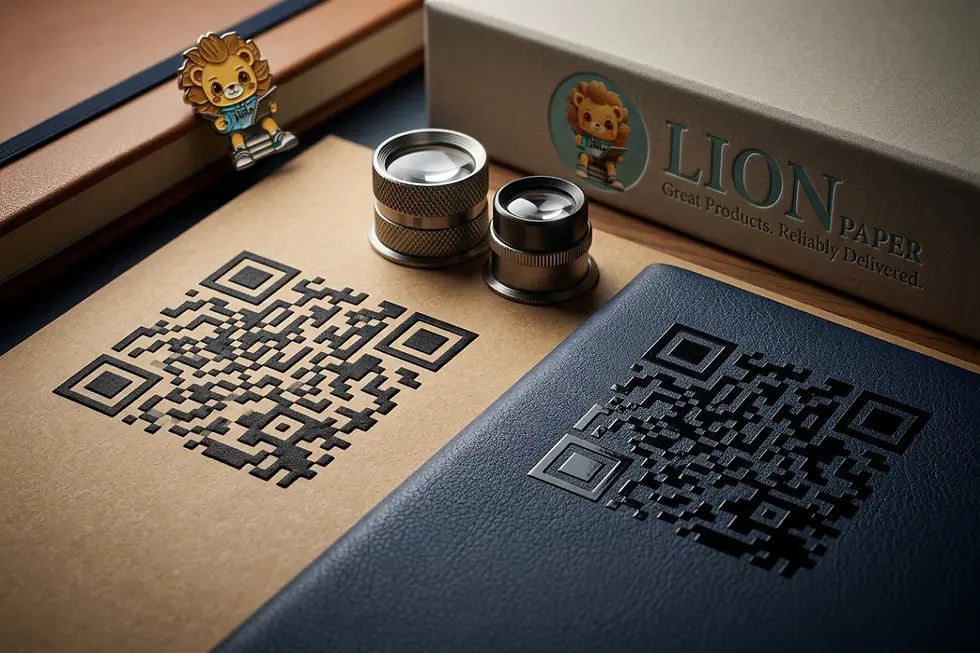
Matte-cured inks and calibrated quiet zones prevent light glare and ink bleed, ensuring instant camera recognition under bright exhibition lighting.
To ensure rapid scanning from varying distances and angles, procurement teams and designers must adhere to core data architecture standards:
Shortened Dynamic Routing URLs: Deploy short routing domains (e.g., brand.link/event24) instead of direct 150-character landing page URLs. A shorter character string produces a low-density, open-matrix QR code with larger individual modules that scan reliably even in low ambient light.
Strategic Error Correction Level (ECC): QR code specifications incorporate Reed-Solomon error correction algorithms across four standard levels:
Level L (Low - 7% recovery): Best for ultra-clean, dense data without graphics; rarely recommended for physical merchandise.
Level M (Medium - 15% recovery): Standard industrial setting; provides an optimal balance between module size and physical damage tolerance for interior paper printing.
Level Q (Quartile - 25% recovery): Recommended when placing brand logotypes in the center of the code or when printing on exterior surfaces subject to pocket friction.
Level H (High - 30% recovery): Maximum redundancy; allows heavy central icon customization but generates high module density that requires larger physical print dimensions.
Server-Side Mobile Optimization: Ensure the destination server features responsive page-speed caching, SSL security certification, and automated device detection to serve lightweight mobile experiences instantly over congested convention Wi-Fi networks.
Which Printing and Finishing Methods Work Best on Custom Promotional Notebooks with QR Code?
Applying a functional 2D code onto premium journal covers requires careful alignment between finishing chemistry, substrate texture, and optical reflectivity. Different decorative techniques yield distinct visual and functional results across various cover materials:
Precision Screen Printing
Screen printing with high-opacity, matte-cure inks is the standard for flat hardcovers, paperboard, and smooth polyurethane (PU) leather. Matte inks eliminate harsh surface glare from overhead trade show spotlights that otherwise blind camera sensors. When printing on dark book covers, an under-base pass of opaque white ink followed by dark matrix modules ensures optimal contrast.
Digital UV Flatbed Printing
For complex campaigns requiring serialized, unique QR codes per individual book (e.g., VIP personalized invitations or attendee-specific credentials), digital UV flatbed printing provides variable data capabilities without physical plate costs. The cured UV ink provides high scuff resistance and crisp line definition.
Hot Foil Stamping Considerations
While metallic gold, silver, or holographic foil stamping elevates luxury presentation, high-reflectance foils scatter directional light, which can degrade scanner readability. If foil stamping is specified for branding, the code should be executed using matte pigmented foils (such as matte black, dark navy, or flat white) rather than mirror-finish metallic foils.
Blind Debossing and Embossing Limitations
Blind debossing relies on depth shadows and tactile indentation rather than color pigmentation. Because camera sensors measure chromatic and luminance contrast rather than tactile depth, pure blind debossed QR codes have an extremely high scanning failure rate. If debossing is desired, it must be paired with high-contrast color foil infill or precise pad printing inside the debossed cavity.
How Do Procurement Teams Select QR Code Specifications by Event Scenario and Format?
Choosing the correct combination of book construction, printing methodology, and digital destination depends directly on the event archetype, audience profile, and distribution volume. A high-volume trade convention requires cost-effective scalability, whereas an executive roundtable demands subtle, luxury integration.

Rigorous in-line optical scanning and AQL batch sampling ensure every trade show notebook achieves immediate digital readability across varied lighting conditions.
The decision framework below matches corporate event formats with appropriate technical notebook specifications and digital tracking architectures:
Event Scenario | Recommended Notebook Construction | Ideal QR Placement & Method | Error Correction & Tracking Setup |
|---|---|---|---|
:--- | :--- | :--- | :--- |
Large-Scale Tech Trade Expos | Softcover Kraft Paperboard (100% Recyclable, Wire-Bound or Singer Stitched) | Removable 4-Color Process Belly Band + Front Inside Cover Screen Print | Level M; UTM link routing to booth-exclusive software trial or interactive map. |
Executive Leadership Summits | Hardcover Casebound, Premium FSC Paper with Soft-Touch Matte Lamination | Blind Debossed Logo with QR Printed on 160 gsm Custom Insert Card / Flyleaf | Level Q (with embedded logo); Direct route to private VIP session recordings and whitepapers. |
Annual Medical / Healthcare Symposia | Flexible Thermal PU Cover, Ribbon Marker, Elastic Band Closure, Back Pocket | Silk-Screened on Interior Expandable Accordion Pocket Bottom Flap | Level M; Dynamic routing to accredited clinical trial data, CME credits, and digital monographs. |
Internal Enterprise Training Workshops | Hardcover Wire-O Binding with Custom Index Dividers and Pen Loop | Printed on Tabbed Dividers and Running Page Footers via Offset Litho | Level L or M; Link architecture mapped to internal learning management modules and survey feedback. |
Dealer Conferences & Franchise Expos | Co-Branded Stationery Gift Set with Hardcover Journal and Metal Pen | Foil Stamped Gift Box Interior Lid + Flyleaf Litho Print | Level Q; Dynamic portal connecting partners to wholesale ordering sheets and supply-chain specs. |
How Does Dual-Site Manufacturing Ensure Quality Assurance and Readability for Event Merchandise QR Code Printing?
Achieving consistent scan precision across hundreds of thousands of production units requires rigorous process controls and specialized manufacturing infrastructure. Operating as an integrated supply-chain partner rather than a transactional broker, Lion Paper Products (Jiaxing) Co., Ltd. coordinates design engineering and mass manufacturing across dual production hubs.
Established in 2015, Lion Paper combines a 3,000-square-meter design, prototyping, and technical development center in Jiaxing, China, with a large-scale 10,000-square-meter production facility in Cambodia. This dual-site synergy allows enterprise clients to complete rapid physical prepress sampling, functional scan testing, and structural engineering in China before initiating cost-effective, high-capacity manufacturing runs in Cambodia, where annual notebook output exceeds 5 million units.
Concept & Prepress Verification (Jiaxing R&D Center) ↓ Physical Pilot Proofing & Optical Scanning Validation ↓ Automated Mass Production (Cambodia Manufacturing Base) ↓ In-Line SOP & AQL Statistical Verification (ISO 9001 Standards) ↓ Direct Global Logistics (Containerized On-Time Delivery)
To safeguard brand reputations at critical industry events, manufacturing workflows follow disciplined quality assurance protocols across eight primary product categories—including eco-friendly paper stationery, custom journals, planners, organizer bags, and retail-ready gift sets:
Prepress Optical Simulation: Before physical plates are output, technical artwork files undergo automated RIP (Raster Image Processor) software checks to verify quiet zone tolerances, module resolution, and optical contrast curves.
Physical Drawdown and Pilot Scanning: Prototype notebooks are produced using target production paper and cover stocks. Technicians verify scan responsiveness across iOS and Android hardware under simulated 300-lux fluorescent, 100-lux ambient, and bright directional trade show lighting.
In-Line SOP Verification: Mass production lines deploy standardized operating sheets and ISO 9001-aligned process controls. Automated vision inspection cameras flag micro-smudges, misregistration, or matrix skewing in real time.
AQL Final Lot Inspection: Before packaging, finished notebooks undergo Acceptable Quality Limit (AQL) random sampling. Defect inspection protocols check exterior covers, binding squareness, foil integrity, and QR readability across production batches.
Global Compliance Framework: Materials and processes comply with international audit frameworks, supported by FSC chain-of-custody certification for sustainable paper sourcing, SMETA, WCA, GSV, FAMA, and CPSIA compliance for consumer safety.
Planning a successful conference, product launch, or corporate gifting initiative requires balancing tactile design, structural durability, digital tracking, and landed-cost efficiency. Contact our team today with your event timeline, artwork files, volume requirements, and packaging specifications to receive a comprehensive technical review and quotation for your custom branded stationery program.
FAQ
Can we update the destination link after the trade show notebooks are printed and distributed?
Yes, provided the artwork was configured using a dynamic QR code structure rather than a static URL. Dynamic QR codes route through an intermediary redirect URL, allowing your marketing operations team to update the target landing page, edit UTM campaign parameters, or change digital assets in real time without altering the physical printed code on the notebooks.
What is the absolute minimum recommended size for a QR code printed on custom notebooks?
The industry standard minimum physical size is 20 mm × 20 mm (0.8 inches × 0.8 inches) for standard mobile camera scanning from a distance of 15 to 25 cm. If the code contains a high character count (dense matrix) or incorporates a central company logo (Error Correction Level Q or H), increase the physical footprint to at least 25 mm × 25 mm (1.0 inch × 1.0 inch) to ensure fast optical recognition.
How does ambient booth lighting affect QR code scanning on glossy notebook finishes?
High-gloss laminations, reflective foil stamping, and spot UV varnishes produce direct specular reflections under overhead convention spotlights, obscuring individual matrix modules from smartphone optical sensors. To ensure reliable readability, apply codes onto matte-laminated surfaces, uncoated paper stocks, or use non-reflective matte inks.
Can a company logo be embedded in the center of the QR code without breaking scan reliability?
Yes, embedding a central corporate mark is fully achievable by generating the code with Error Correction Level Q (25% data recovery) or Level H (30% data recovery). This mathematical redundancy allows smartphone cameras to reconstruct any visual data obscured by the central graphic. Maintain a strict quiet zone boundary between the logo edge and surrounding matrix elements.


Comments