


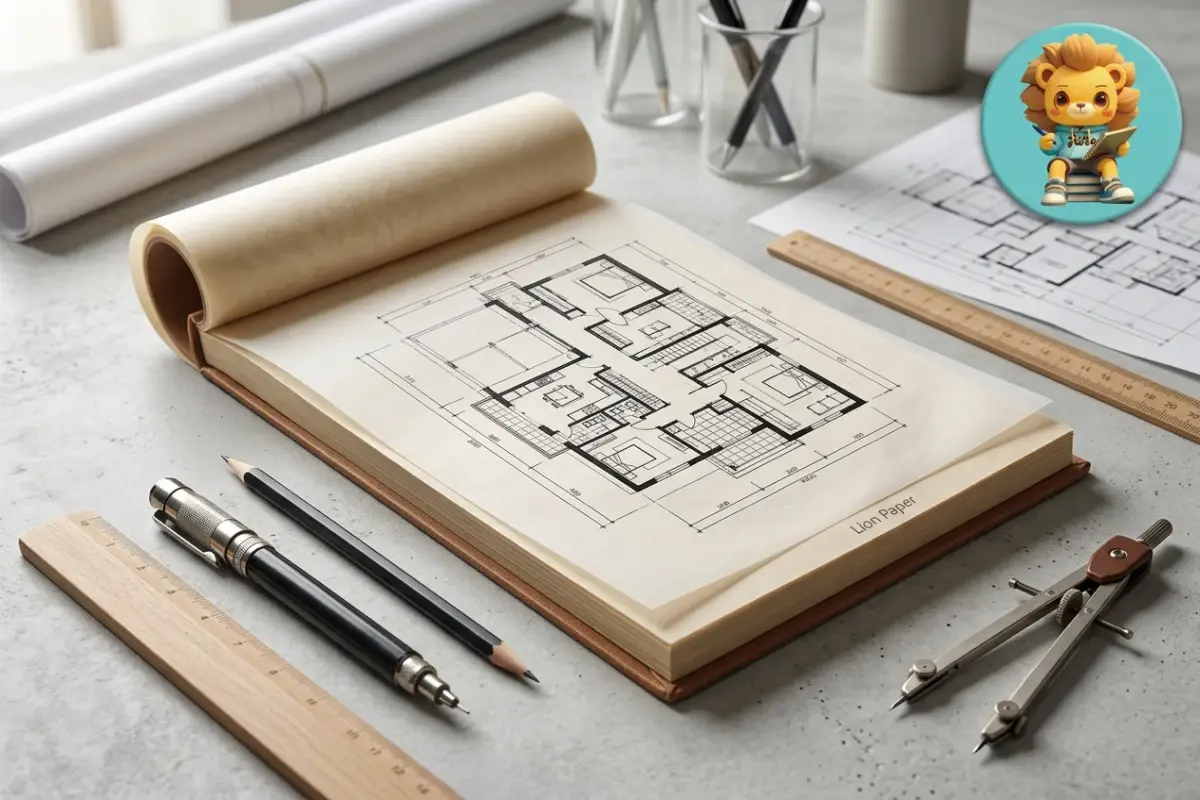
Tracing Paper Pad Manufacturing: Technical Standards, Paper Substrates, and Production Solutions

Tracing paper pad manufacturing requires precise engineering of sheet transparency, dimensional stability, tear resistance, and binding structure to support multi-medium drafting and art applications. As an integrated supply-chain partner with dual-facility capabilities in Jiaxing, China, and Cambodia, Lion Paper Products combines design-to-manufacturing integration with strict AQL inspection standards, delivering high-performance customized paper pads for creative brands, architectural suppliers, and major stationery retailers worldwide.
What Are the Core Technical Parameters in Tracing Paper Pad Manufacturing?
Manufacturing professional-grade custom tracing paper pads demands a fine balance between optical properties, tensile durability, and mechanical integrity. Unlike standard offset stationery, translucent art paper pads must support graphite, technical drafting inks, markers, and light media washes without warping, bleeding, or losing clarity.
The foundational technical specifications evaluated during OEM drafting paper manufacturer development include:
Grammage (GSM Range): Standard weights span from 40 gsm for lightweight sketch layouts to 63 gsm, 73 gsm, 90 gsm, and 112 gsm for architectural drafting and engineering masters.
Optical Translucency: Achieved through high-density mechanical refining (hydration) of wood pulp fibers to achieve transparency ratings between 70% and 85% without chemical clouding.
Tensile Strength and Tear Resistance: High internal fiber bonding ensures that repeated erasing or mechanical pen pressure does not tear or puncture the sheet.
Surface Roughness (Sheffield/Bendtsen): Controlled micro-texture balancing low friction for fluid ink glide with micro-tooth for graphite and colored pencil adhesion.
Dimensional Stability: Resistance to ambient humidity changes to prevent dimensional expansion, paper curl, or cockling across varying retail and studio environments.
Technical Parameter | Standard Art & Sketch Range | Professional Drafting & Engineering Range | Testing / Measurement Metric |
|---|---|---|---|
:--- | :--- | :--- | :--- |
Grammage | 40 gsm – 63 gsm | 73 gsm – 112 gsm | ISO 536 (g/m²) |
Transparency | 75% – 85% | 70% – 80% | ISO 2469 Optical Opacity (%) |
Tensile Index (MD/CD) | ≥ 45 / 25 N·m/g | ≥ 60 / 35 N·m/g | ISO 1924-2 |
Surface Smoothness | 150 – 250 ml/min | 80 – 160 ml/min | Bendtsen Roughness |
pH Value | Acid-free (6.8 – 7.5) | Acid-free archival (7.0 – 8.0) | Cold extraction pH |
Erasability | Standard graphite release | High-abrasion film resist | ISO 15184 pencil hardness |

Testing optical translucency and fiber formation across diverse paper weights.
How Do Manufacturers Optimize Transparency, Grammage, and Fiber Uniformity?
Translucent art paper is manufactured using highly refined, acid-free virgin wood fibers. Producing pure translucency requires extensive mechanical beating in the paper mill, which flattens fibers and eliminates light-scattering air voids between micro-fibrils.
Key processing criteria managed by a professional translucent art paper pad supplier include:
Fiber Selection: Utilizing pure cellulose long-fiber kraft pulp certified under sustainable forest standards (such as FSC-traceable pulp) ensures clear formation and minimal optical inclusions.
Calendering Consistency: Heavy supercalendering under heated steel rolls compresses the web, giving the sheet a uniform caliper and ultra-smooth surface profile.
Formation Uniformity: Eliminating cloudiness, micro-pinholes, or streaking across the sheet ensures that light passes through evenly, allowing precise line overlay and light-table scanning.
pH Neutrality: Archival, acid-free formulations prevent yellowing, embrittlement, and optical degradation over long storage cycles.
How to Prevent Paper Curl and Enhance Ink and Graphite Performance?
One of the main challenges in tracing paper pad manufacturing is paper curl caused by moisture absorption. Because translucent cellulose fibers are densely beaten, they absorb and release ambient moisture faster than opaque papers, causing differential expansion along machine direction (MD) and cross direction (CD).
To counter paper deformation and maintain media compatibility, manufacturers implement three specific controls:
Controlled In-Process Moisture Equilibrium: Paper stock is acclimated and slit in temperature- and humidity-controlled clean environments, keeping factory moisture content strictly between 4.5% and 6.0%.
Surface Sizing Formulations: Applying micro-thin surface sizing prevents deep solvent penetration from alcohol-based markers and technical drawing inks, stopping line feathering and strike-through while retaining pencil bite.
Fiber Grain Alignment: In pad conversion, sheet grain must always run parallel to the binding edge. This prevents cross-sheet wave formation and curling when individual sheets are separated or exposed to atmospheric humidity shifts.

Precision spine binding ensures clean, residue-free tear-off performance.
What Are the Standard Tracing Paper Pad Binding Specifications?
The structural format of a tracing pad directly impacts its usability, durability, and retail shelf appeal. When determining tracing paper pad binding specifications, OEM buyers must match the binding construction to the intended application, whether quick loose-leaf sheet removal or lay-flat portfolio review.
Padded Glue-Top (Tear-Off / Strip Binding):
Structure: Sheets bound at the top head with flexible, high-tensile hot-melt or cold PVA emulsion glue, reinforced with heavy cloth binding tape or a fold-over scored paper card cover.
Application: Quick-tear, clean extraction of single drafting sheets without fiber residue along the glue line.
Tape-Bound / Fold-Over Pad Construction:
Structure: The top cover wraps around the head of the pad and is glued or wire-stitched to the rigid backing before being wrapped with protective linen tape.
Application: Studio work where the cover flips neatly behind the pad without tearing off prematurely.
Double Wire-O / Spiral Binding:
Structure: Twin-loop metal wire-o binding with micro-perforated inner sheets for flat 360-degree rotation and clean sheet detaching.
Application: Mobile sketching, instructional tracing books, and creative workbooks.
Glued Dual-Side / Four-Side Blocks:
Structure: Block-glued along two or four edges to keep individual sheets under tension while working with wet ink or marker overlays, peeling off cleanly upon completion.
Binding Format | Primary Mechanism | Tear-Off Cleanliness | Lay-Flat Capability | Best Use Scenario |
|---|---|---|---|---|
:--- | :--- | :--- | :--- | :--- |
Glue-Top Tear-Off | Flexible synthetic hot-melt adhesive | High (zero fiber tear) | 180° Open | Studio tracing, quick drafting, student work |
Tape-Bound Wrap | Stitched/Glued with buckram tape | High | 180° Fold-Back | Professional studio drafting, architecture |
Twin-Loop Wire-O | Perforated sheet punch + wire spine | Clean micro-perf tear | 360° Rotation | Field sketch, technical design, art classes |
Four-Edge Glued Block | Perimeter peelable gumming | Perimeter blade lift | Flat taut surface | Multi-layer marker rendering, wet ink design |
What Rigid Backing, Cover Options, and Retail Packaging Are Recommended?
Because tracing paper has a flexible, low-stiffness profile compared to heavier mixed-media stock, the backboard and protective covers provide the primary rigidity during transit, retail merchandising, and desktop drafting.
Heavyweight Rigid Backing Boards: Using 1.5 mm to 2.5 mm grayboard, chipboard, or duplex white-lined backing boards (up to 1200–1800 gsm) ensures firm drawing support without needing a tabletop drawing board.
Protective Cover Materials: Front covers typically feature 250–350 gsm C1S art cardstock, kraft board, or durable translucent frosted polypropylene (PP) sheets with scratch-resistant matte UV lamination, metallic foil stamping, or soft-touch coating.
Retail and E-Commerce Packaging: Single-pad shrink wrapping with moisture-barrier film, retail barcoding, hanging headers, and corrugated inner cartons with corner corner-drop protectors safeguard against edge dings and humidity during sea freight.

Rigid backboards and protective shrink packaging preserve dimensional stability during global shipping.
Why Partner with Lion Paper for Custom Tracing Paper Pad Manufacturing?
Lion Paper Products (Jiaxing) Co., Ltd., founded in 2015, operates as an integrated supply-chain partner for customized paper goods and creative products, offering complete design-to-manufacturing integration.
Our manufacturing network combines an agile 3,000 m² product engineering, fast-prototyping, and customer support center in Jiaxing, China, with a large-scale 10,000 m² production facility in Cambodia. With an annual capacity surpassing 5 million notebooks and bound paper products, our multi-site footprint delivers distinct benefits:
Scenario-Based Product Engineering: We tailor paper weight, transparency, binding flexibility, and packaging specifically for private labels, arts-and-crafts brands, architectural supply chains, and online retail channels.
Strict Quality Control Protocols: Every production batch follows standardized SOPs, defect catalog mapping, and AQL 1.5/4.0 sampling standards for sheet transparency, trim tolerances, spine glue flexibility, and transit durability.
Global Compliance & ESG Alignment: We maintain operational audits and certifications across ISO 9001, FSC, SMETA, WCA, GSV, FAMA, and CPSIA requirements, supporting recyclable packaging, traceable virgin fibers, and low-impact printing.
Total-Cost Efficiency: By balancing China-based rapid prototyping and material sourcing with Cambodia-based duty-optimized volume manufacturing, we optimize landed costs and delivery timelines for North American, European, Middle Eastern, and Southeast Asian markets.
If you are planning a new product line or looking to optimize an existing product, contact our engineering team to share your target medium, paper size, GSM, surface finish, sheet count, and binding specifications, and request customized paper swatches and fully converted pad samples today.
FAQ
What is the typical minimum order quantity (MOQ) for custom tracing paper pads?
Our standard minimum order quantity generally starts from 1,000 to 3,000 units per specification depending on custom size, specific paper grammage (such as 63 gsm, 73 gsm, or 90 gsm), and specialized cover printing requirements. Flexible pilot batch volumes can also be evaluated during initial product launch prototyping.
How does Lion Paper prevent tracing paper sheets from wrinkling or curling during transit?
We control workshop moisture balance strictly between 4.5% and 6.0%, align the paper grain parallel to the pad spine, and pack finished pads in heavy-duty moisture-barrier shrink wrap with desiccant protection and rigid master export cartons to prevent ambient humidity penetration.
Can you produce FSC-certified custom tracing paper pads?
Yes. Lion Paper supports FSC-traceable wood pulp substrates across translucent art papers, backing chipboards, and front card covers, ensuring complete supply-chain chain-of-custody compliance for eco-conscious retail brands.
What cover finishing options are available for OEM drafting paper pads?
We provide a wide range of cover embellishments including soft-touch lamination, matte or gloss UV varnish, hot foil stamping, debossing, fold-over flaps, and clear or frosted polypropylene (PP) protective overlays.


Comments