


Tourist Attraction Private Label Notebooks: Strategic Sourcing and Merchandising Guide

For tourist attraction retail programs, the most cost-effective and agile strategy is standardizing an evergreen notebook base structure while rotating cover artwork for seasonal exhibitions and landmark features. By pairing standardized inner text blocks, binding formats, and trim sizes with localized cover finishing, cultural venues achieve high gross margins, reduce inventory risk, and maintain premium presentation across all retail ready souvenir stationery collections.
Why is balancing evergreen core lines with rotating exhibition editions the foundational strategy for tourist attraction private label notebooks?
Souvenir retail programs operate under distinct seasonal traffic peaks, fluctuating visitor demographics, and rapid shifts in featured exhibits. Developing unique structural formats for every new landmark theme or temporary art exhibition introduces substantial tooling costs, high minimum order quantities (MOQs), and unpredictable inventory overhang. Standardizing an evergreen physical platform solves this operational bottleneck.
Under an evergreen-and-rotation sourcing architecture, the structural foundation of the notebook remains identical across all SKUs within a tier:
Standardized Inner Text Block: Standardizing on 160 or 192 pages of 80–100 gsm FSC-certified cream wood-free paper, configured with an understated 5mm light-grey dot grid or narrow rule, allows procurement teams to pool paper volume and negotiate aggressive bulk raw material rates.
Universal Hardware and Trims: Consistent components—such as dyed-to-match 7mm grosgrain ribbon page markers, durable elastic closure bands, and expandable inner back pockets—are ordered in aggregate volumes, reducing per-unit hardware costs.
Identical Dimensions and Spine Widths: Standardizing trim dimensions (such as standard A5 at 148 x 210 mm, medium B6 at 125 x 176 mm, or compact pocket format at 90 x 140 mm) ensures that secondary packaging, shipping master cartons, and retail display fixtures remain fixed year-round.
With the base specification frozen, visual differentiation is achieved entirely through custom surface treatments. Museum exhibition private label notebooks utilize four-color offset printing, soft-touch matte lamination, metallic hot-stamping, precision blind debossing, and spot UV accents on covers to mirror featured masterworks. For temporary exhibitions lasting three to six months, gift shops can commission shorter, highly targeted print runs of covers that wrap around mass-produced, standardized book blocks. This approach slashes product development lead times from months to weeks, eliminates leftover non-sellable stock, and preserves standard retail gross margins of 65% to 75%.
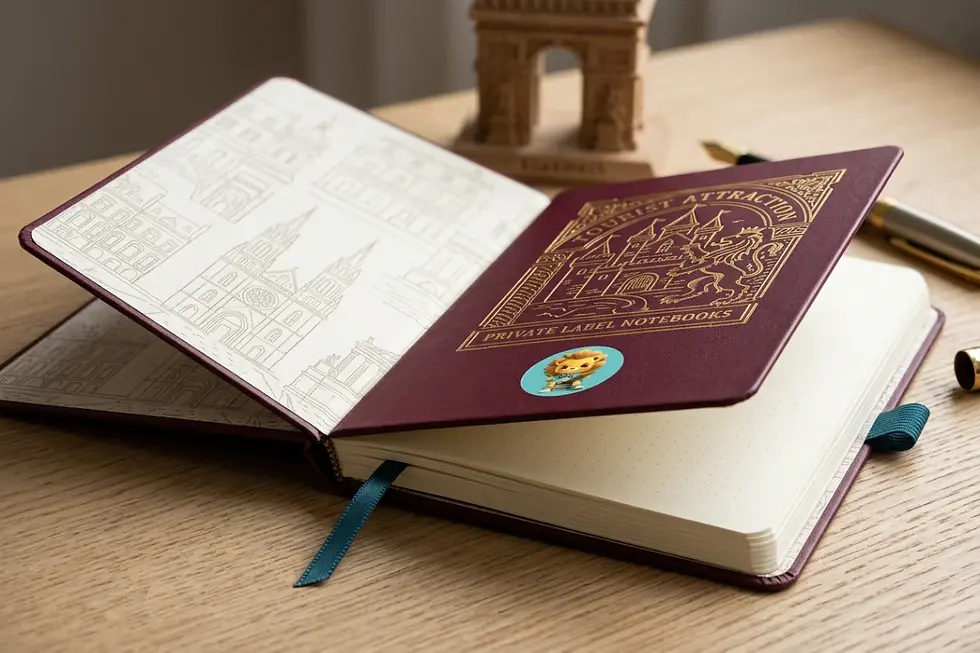
Standardized book block structures allow premium cover finishes like foil stamping and blind debossing.
How do gift shops, cultural venues, and theme parks utilize custom paper goods manufacturing across different buyer scenarios?
Different visitor destinations cater to diverse retail motivations, ranging from impulse children's purchases to high-end architectural collectors. Tailoring product specifications to specific visitor profiles maximizes sales velocity and basket size:
1. Art Museums and Cultural Heritage Institutions
Museum gift shop custom journals serve as tangible intellectual souvenirs. Buyers in this segment demand authentic color reproduction, archival-grade binding, and tactile elegance. These institutions typically order case-bound hardcovers wrapped in textured art paper, cloth spine quarter-bindings, or debossed faux-leather covers that replicate architectural elements or historic manuscripts. Notebooks often include customized information front sheets containing brief curatorial notes, exhibition provenance, or archival photography, turning the journal into a collectible keepsake.
2. National Parks, Botanical Gardens, and Nature Reserves
Outdoor and conservation-led destinations prioritize tactile sustainability and durability. Product lines focus on flexi-bound softcovers, exposed thread sewn spines, and covers crafted from post-consumer recycled kraft or textured seed paper. Inner layouts frequently incorporate field-journal templates, outdoor log prompts, birdwatching checklists, and regional topography maps. Sourcing requires end-to-end FSC-certified chain-of-custody paper, soy-based inks, and zero-plastic packaging to align with conservation brand mandates.
3. Historic Landmarks, Castles, and Memorials
Heritage venues target both international tourists and domestic educational tours. The product assortment typically includes medium-format hardcovers featuring vintage map engravings, gold foil architectural linework, and gilded paper edges. Buyers frequently package these journals alongside matching bookmark ribbons, metal alloy charm pendants, or custom-molded metallic badge clips to create retail-ready gift sets with higher perceived gift-giving value.
4. Theme Parks, Commercial Attractions, and Family Destinations
High-volume family venues focus on vibrant, interactive souvenir stationery. Assortments lean heavily toward wire-bound sketchbooks, spiral notebook formats, holographic foil finishes, and PVC-free glitter covers. Notebooks for this audience often integrate dual-purpose fun features, such as die-cut character index tabs, integrated activity and coloring pages, and sheets of collectible vinyl stickers tipped into the back pocket.
How should attraction retail buyers optimize assortment architecture and display footprints for gift shop custom journals?
Retail square footage in tourist destination shops is exceptionally constrained, demanding high revenue density per square meter. A disciplined assortment architecture balances entry-level impulse items with mid-tier staples and collector-grade gift merchandise.
Merchandising Tier | Target Product Format | Target Retail Price Point | Primary Consumer Intent | Display Placement Strategy |
|---|---|---|---|---|
:--- | :--- | :--- | :--- | :--- |
Entry / Impulse | Slim stitched softcover notebook (32–48 pages), pocket size (A6/B7), sold individually or in 3-packs | $4.95 – $9.95 | Impulse purchase, pocket money, quick multi-destination souvenir | Point-of-sale (POS) counter spinner racks, cash wrap impulse bowls |
Core / Mid-Tier | Flexible or case-bound A5 journal (160 pages), dot grid/lined, ribbon marker, elastic closure | $14.95 – $22.95 | Personal journaling, self-gifting, everyday work and travel recording | Main stationery fixture bay, eye-level shelf display grouped by landmark theme |
Premium / Gift Set | Deluxe boxed journal with metal pen, gilded edges, debossed cloth/hardcover, informational inserts | $28.00 – $45.00 | Formal gifting, VIP visitors, high-ticket commemorative keepsakes | Front-of-store feature tables, illuminated glass vitrines, curated gift endcaps |
To optimize physical footprint and retail operations:
Maintain Unified Spine Thickness: Specifying uniform page counts across all core A5 journals ensures that books sit flush on shelf ledges, preventing messy retail displays and maximizing shelf space.
Employ Retail-Ready Counter Display Units (CDUs): Sourcing lightweight, custom-printed corrugated cardboard display trays pre-loaded with mixed SKU assortments reduces shop floor restocking time and provides turnkey visual merchandising for smaller satellite kiosk locations.
Standardize Barcode and Hang-Tag Formats: Every unit must arrive pre-labeled with standardized GS1-compliant EAN/UPC barcodes, price callouts, and product description belly bands to eliminate manual ticketing by gift shop staff.

Optimized assortment architecture balances entry-level impulse pocket notebooks with mid-tier core journals.
What are the unit economics, margin structures, and packaging specifications for retail ready souvenir stationery?
Maintaining retail profitability in cultural and attraction retail requires balancing manufacturing cost, international shipping, landed import tariffs, and retail price elasticity. Tourist gift shops typically operate on a minimum keystone markup (50% gross margin) and frequently target 65% to 75% gross margins on proprietary souvenir collections to offset significant physical venue overhead and licensing royalty fees.
Target Retail Price (A5 Core Hardcover Journal): $18.00 Target Wholesale / Landed Cost (25% - 30% of MSRP): $4.50 - $5.40 Target Factory FOB Manufacturing Cost (China / Cambodia): $1.80 - $2.60 Freight, Duties, Port Handling, and Domestic Warehousing: $0.80 - $1.30 Final Retailer Gross Margin Contribution: $12.60 - $13.50 (70% - 75%)
Optimizing unit economics requires integrated supply-chain management. Sourcing through manufacturers that maintain dual-site operations—leveraging specialized prototyping and pre-press prep in China alongside scaled, duty-advantaged mass production in facilities such as Cambodia—enables buyers to keep factory FOB costs within target brackets even when specifying premium materials.
Retail-ready packaging must balance aesthetic protection with sustainable disposal mandates:
Eco-Friendly Paper Belly Bands: A 150–200 gsm FSC art paper belly band (sleeve) wrapped around the notebook displays the collection name, historical background, barcode, and price point without obscuring the cover art. Belly bands eliminate the need for plastic wrap while keeping the book securely closed on the shelf.
Scratch-Resistant Matte Lamination: Souvenir notebooks are handled repeatedly by hundreds of visitors. Applying an anti-scratch thermal matte BOPP film over printed paper covers prevents scuffing, fingerprinting, and edge-fraying during customer handling.
Biodegradable or Zero-Plastic Wrapping: For high-humidity locations or premium gift sets requiring dust protection, replace conventional polybags with certified home-compostable PLA wrapping or recyclable glassine paper sleeves sealed with paper adhesive wafer tabs.
How can heritage venues manage museum exhibition private label notebooks with low-risk seasonal artwork rotation?
Temporary exhibitions, seasonal celebrations, and landmark centenaries present substantial revenue opportunities, but also carry high financial risk if unsold inventory cannot be liquidated after the event closes. Successful institutions mitigate this risk using agile, low-risk custom paper goods manufacturing workflows.
Phase 1 (Months 1-2): Master Asset & Core Block Agreement
Finalize universal internal book block (trim size, page count, grid, paper grade).
Secure institutional licensing, curatorial text, and high-resolution artwork.
Phase 2 (Month 3): Rapid Prototyping & Sampling
Produce physical pre-production samples of printed covers, deboss dies, and belly bands.
Complete multi-party color-matching against original museum artifacts using digital proofs.
Phase 3 (Months 4-5): Scaled Core Production & Agile Cover Wrap
Mass-produce standard book blocks in volume to maximize scale economies.
Run precise, segmented batches of specialized cover artwork matched to exhibition projections.
Phase 4 (Exhibition Launch & Replenishment):
Ship initial 60% of forecast volume for exhibition opening.
Maintain pre-cleared cover stock at factory facility for rapid 3-week replenishment if sell-through surges.
By decoupling inner page manufacturing from final cover binding and decoration, cultural retailers avoid committing their entire budget upfront to untested art concepts. If an exhibition becomes an unexpected blockbuster, replenishment covers are printed and cased onto ready reserve book blocks within short turnaround windows.
What technical specifications and material standards are recommended for tourist attraction notebook lines?
Specifying durable, archival-quality, and sustainably compliant components ensures customer satisfaction, reduces store returns, and protects institutional brand prestige.
Technical Component | Recommended Specification | Target Benefit for Attraction Gift Shops | |
|---|---|---|---|
:--- | :--- | :--- | :--- |
Text Paper Weight & Type | 100 gsm FSC-certified ivory/cream wood-free paper | Resists fountain pen and gel pen ink bleed-through; warm tone enhances readability and premium feel | |
Binding Style | Case-bound thread-sewn (Smyth sewn) with square spine | Lies completely flat (180°) when opened on a desk, providing effortless writing comfort across full spreads | |
Cover Substrate | 1200–1500 gsm rigid recycled greyboard wrapped with 128 gsm art paper or coated buckram cloth | Prevents cover corner warping in high-humidity climate zones and withstands rough transit in tourist daypacks | |
Endpapers | 140–160 gsm wood-free paper, custom-printed with venue maps, floorplans, or historical sketches | Maximizes visual immersion immediately upon opening; adds collectible storytelling value | |
Closure & Hardware | 7mm woven flat polyester/cotton elastic band and matching dyed grosgrain ribbon marker | Keeps notebook contents compact during travel; color-matched to dominant palette of cover artwork | |
Back Storage Pocket | Expandable gusseted pocket crafted from 250 gsm reinforced card stock and fabric cloth cloth sides | Provides functional tourist storage for exhibition ticket stubs, admission wristbands, travel receipts, and postcards | |
Compliance & Audits | FSC-STD-40-004 chain-of-custody, CPSIA (lead/phthalates), ISO 9001, SMETA/WCA ethical standards | Ensures full regulatory compliance across North American and European retail import channels |

Agile manufacturing and standardized quality control ensure consistent production across high-volume souvenir lines.
What procurement checklist should buyers follow when launching custom paper goods for retail gift shops?
Before submitting a Request for Quotation (RFQ) to a stationery manufacturing partner, procurement managers should assemble a concise project brief covering technical, merchandising, and logistical parameters:
Project Scope and Program Type: Clarify whether the project is an evergreen venue core staple, a seasonal collection, or a time-sensitive temporary exhibition line.
Trim Size and Page Architecture: Define exact dimensions (e.g., A5, B6, pocket), page count (e.g., 160 pages), inner layout (lined, dot grid, blank, custom prompt), and paper weight (80–120 gsm).
Cover Finishing Specifications: List all desired cover treatments, including 4C offset printing, specific Pantone matches, blind deboss dimensions, foil stamping color codes, and lamination preferences.
Quantity and SKU Assortment: Define the overall volume and individual SKU splits across cover art variations to establish accurate pricing tiers and optimal production routing.
Packaging and Retail Readiness: Specify belly band dimensions, barcode labeling placement, shrink-wrap requirements, and master carton drop-test standards.
Timeline and Compliance: Confirm the exhibition opening date, target delivery port (FOB or DDP terms), and required factory audit accreditations (e.g., FSC, SMETA, ISO 9001, FAMA).
If you are planning an upcoming souvenir line or exhibition stationery range, contact our custom stationery team with your retail channels, intended product formats, packaging requirements, expected volume tiers, and target launch dates to develop an optimized private label notebook program.
FAQ
What is the typical production lead time for tourist attraction private label notebooks?
Prototyping and pre-production sampling generally require 5 to 7 business days following artwork approval. Mass manufacturing typically takes 25 to 35 days, with international ocean transit adding approximately 20 to 35 days depending on the final destination port and chosen shipping terms.
What are the minimum order quantities (MOQs) for custom museum and attraction notebooks?
Standard private label programs with full cover customization typically start at 1,000 to 3,000 units per production run. Utilizing standardized inner text blocks allows buyers to divide the total volume across multiple cover art designs (e.g., 500 units per cover variant across four designs).
How do you ensure paper sustainability and institutional ethical compliance?
Production adheres to FSC chain-of-custody standards, utilizing responsibly sourced virgin pulp or post-consumer recycled paper paired with low-VOC soy inks. Manufacturing facilities maintain compliance with international social and quality benchmarks, including ISO 9001, SMETA, WCA, and CPSIA testing standards.
Can custom notebooks incorporate licensed artwork and archival collection content?
Yes. Custom paper goods manufacturing easily integrates high-resolution licensed artwork, proprietary institutional typography, curatorial essays on front flyleaves, historical collection maps on endpapers, and branded packaging elements.


Comments