


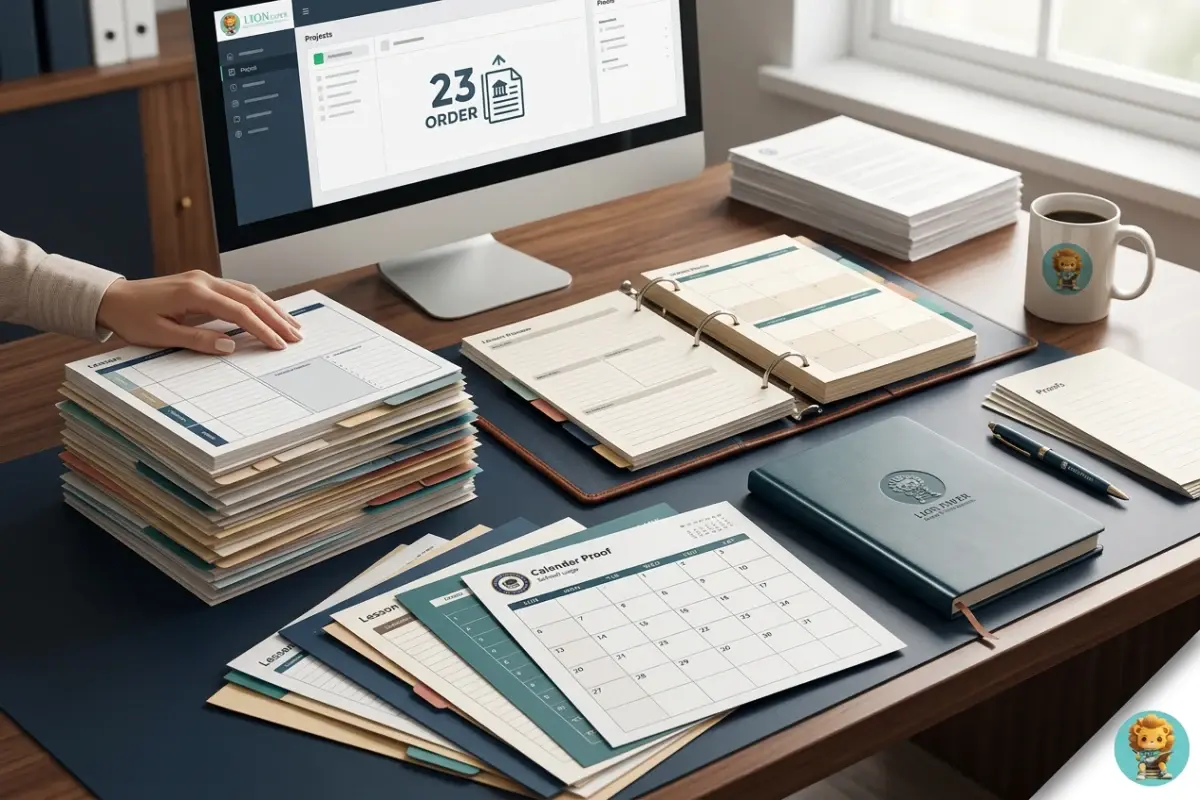
Teacher Planner Inserts for Districts: Sourcing, Customization, and Manufacturing Guide

When procuring teacher planner inserts for school districts, deciding between localized layouts with custom district calendar blocks and standardized modular inserts depends on annual reusability, print volume, and lead times, with hybrid modular systems offering the best balance of institutional compliance and cost efficiency. District-wide standardized cores paired with targeted custom inserts minimize annual plate charges while ensuring full alignment with local grading periods, professional development schedules, and regional educational standards.
How Do Localized District Calendars Compare to Standardized Teacher Planner Inserts?
School district procurement teams face a fundamental architectural choice when sourcing planning tools: fully localized single-run planners or standardized modular teacher lesson planner inserts. Localized planners integrate municipal holidays, district testing windows, block schedules, and school board reporting milestones directly into every printed weekly and monthly spread. In contrast, standardized systems utilize universal calendar grids supplemented by localized add-in modules.
While localized printing guarantees that every educator has district-mandated dates pre-printed, it introduces recurring annual prepress costs. Every change in a district board meeting or state testing date requires layout modifications, new plate setups, and tight delivery windows between school calendar approval and back-to-school delivery. Standardized modular inserts resolve this bottleneck by decoupling timeless lesson-planning templates (such as weekly 7-period grids, student performance trackers, and seating charts) from time-sensitive academic calendars.
Fully Localized Layouts: Best suited for static curricula and established academic calendars with high district-wide adoption, though they incur annual setup and revision lead times.
Universal Core Inserts: Focus on pedagogy, weekly lesson matrices, and daily attendance logs that remain unchanged across academic years, lowering baseline manufacturing costs.
Hybrid Sectional Inserts: Combine high-volume universal planning pages with a dedicated 8- to 16-page custom localized section bound or inserted at the front of each unit.
For most educational systems, bulk custom teacher planners produced with a hybrid insert architecture reduce production lead times by up to 30% while retaining critical district-specific compliance data.
What Are the Layout Trade-offs Between Custom Schedule Blocks, Holiday Calendars, and Unit Economics?
Configuring custom layouts for district-wide deployment requires balancing instructional specificity with production unit economics. Adding complex multi-color coding, custom period divisions, and pre-printed professional learning community (PLC) agendas increases page counts and print setup complexity.
The primary driver of per-unit cost in academic calendar planner manufacturing is signature pagination. Commercial offset presses print sheet signatures in multiples of 8, 16, or 32 pages. Designing a planner layout that finishes at an odd page count (for example, 134 pages) forces the press to run partial signatures, creating paper waste and increasing manual bindery collation expenses. Procurement specifications should align all custom layout sections with standard 16-page press signatures.
Specification Factor | Fully Customized District Layout | Modular Standard Core + Custom Inserts | Off-the-Shelf Standard Planner |
|---|---|---|---|
:--- | :--- | :--- | :--- |
Prepress & Tooling Cost | High (Annual plate creation for full book block) | Low to Medium (Plates required only for custom section) | Zero setup charges |
Minimum Order Quantity (MOQ) | Typically 1,000+ units per specific interior layout | 500–1,000 units for custom insert integration | Low (available from distributor stock) |
Lead Time (Design to Delivery) | 10–14 weeks | 6–8 weeks | 2–3 weeks |
Curriculum Alignment | 100% aligned with district pacing guides | 90–95% aligned via specialized front/back inserts | Generic instructional layout |
Year-over-Year Cost Stability | Variable (subject to full re-typesetting) | Highly stable (bulk runs on core interior) | Fixed catalog pricing |
When calculating unit economics, purchasing departments must evaluate not just the initial purchase order price, but also the lifecycle flexibility. If a district alters its grading period schedule mid-year, a fully bound custom planner becomes obsolete, whereas modular teacher lesson planner inserts permit targeted replacement of the calendar section without discarding the underlying lesson frameworks.

Optimized weekly lesson grid layouts designed on bleed-resistant 100 gsm uncoated woodfree paper.
Why Should Districts Choose Modular Loose-Leaf Systems Over Permanently Bound Planners?
Transitioning from traditional casebound or plastic-spiral books to modular teacher planner inserts for districts delivers measurable administrative and financial advantages. Modular systems utilize multi-hole punched loose-leaf formats (such as standard 3-ring, 7-ring, or discbound configurations) housed within durable, reusable binder covers.
The administrative efficiency of loose-leaf procurement rests on three operational benefits:
Year-Over-Year Cover Reusability: Rather than paying for virgin paperboard, premium book cloth, or synthetic leather covers every August, districts invest once in heavy-duty vinyl, polypropylene, or stitched covers. In subsequent years, the procurement requirement drops strictly to refill text blocks, yielding paper and packaging cost reductions of 25% to 40%.
Role-Specific Customization: A single unified district procurement order can satisfy multiple grade bands. Elementary teachers can receive daily 6-subject horizontal block inserts, middle school educators can receive 7-period vertical grids, and special education teachers can incorporate specialized individualized education program (IEP) tracking inserts—all utilizing the same outer housing.
Mid-Year Template Updates: If state education authorities introduce revised lesson pacing guidelines or standardized assessment metrics mid-year, supplementary packet inserts can be distributed to faculty for immediate insertion into their existing binders without disrupting active planning materials.
Furthermore, modular refill systems support district sustainability goals by reducing total raw material waste and lowering freight weights during annual distribution cycles.
What Material and Structural Specifications Ensure Planner Durability and Bleed Resistance?
Educators utilize a wide array of writing instruments, from standard ballpoint pens and gel inks to wet fountain pens, permanent markers, and high-pigment highlighters. Specifying substandard paper stock leads to ink strike-through, feathering, and ghosting, rendering two-sided weekly planner sheets unusable. High-volume school district custom planner procurement must enforce rigid physical paper metrics.
Paper Basis Weight: Specify 100 gsm to 120 gsm uncoated woodfree paper (equivalent to 28 lb to 32 lb bond). Standard 70 gsm or 80 gsm copy paper is inadequate for two-sided planner production where highlighters and wet ink are used simultaneously.
Opacity and Brightness: Target an opacity rating of at least 92% to prevent shadow ghosting between the recto and verso sides of the page. An ISO brightness rating between 90% and 95% balances contrast without causing visual fatigue during long grading sessions.
Fiber Sizing and Surface Smoothness: High internal and surface sizing controls ink absorption rates, preventing feathering. Calendered paper surfaces offer smooth pen glide while retaining enough tooth for pencil annotations.
Punch Reinforcement and Tear Strength: For loose-leaf modular teacher lesson planner inserts, the spine margin requires a reinforced mylar strip or enhanced internal tear-resistance specifications (minimum Elmendorf tear strength of 500 mN) to withstand frequent page turning within ring binders.
Tab Divider Engineering: Section dividers separating monthly calendars from weekly lesson plans must use heavy index cardstock (minimum 200 gsm to 250 gsm) protected by laminated mylar tab extensions to prevent bending, fraying, and soil accumulation.
Target Material Specifications Matrix:
Sheet Basis Weight: 100-120 gsm Uncoated Woodfree (FSC-Certified)
Opacity: >= 92%
Ink Compatibility: Gel, Rollerball, High-Lighter, Dye-based Inks
Ring Reinforcement: Synthetic Mylar reinforcement strip along spine edge
Tab Dividers: 210 gsm C1S Board with 30-micron PET film lamination
Adhering to these structural parameters ensures that inserts maintain structural integrity across a rigorous 180-day instructional year.

Rigorous paper basis weight and bleed-resistance testing ensure planner durability across the school year.
How Does Academic Calendar Planner Manufacturing Scale for High-Volume District Procurement?
Scaling custom planner production across dozens of schools and thousands of educators requires an industrial supply chain capable of agile pre-production prototyping and high-throughput volume conversion. Lion Paper Products addresses this operational challenge through a strategic China–Cambodia dual-site synergy.
Pre-press proofing, structural engineering, digital template validation, and fast-turnaround sampling originate from Lion Paper's 3,000-square-meter design and prototyping facility in Jiaxing, China. Here, district graphic assets, localized pacing guides, and custom layouts are verified for press readiness. Once digital proofs and physical master samples receive district sign-off, bulk production transitions to the 10,000-square-meter facility in Cambodia.
This manufacturing architecture provides significant advantages for municipal school boards and institutional buyers:
Production Volume Capacity: With an annual notebook and planner capacity exceeding 5 million units, automated high-speed web and sheet-fed offset presses effortlessly handle large-scale district runs exceeding 50,000 units.
Total-Cost Efficiency: Combining large-scale raw material sourcing, automated gathering, folding, and drilling lines, and optimized labor economics delivers low landed costs without compromising build quality.
Institutional Compliance and Auditing: Manufacturing operations align with international quality and social compliance standards, supported by ISO 9001, FSC traceability for responsible forestry, SMETA, WCA, GSV, and CPSIA product safety protocols.
Quality Consistency: Standardized operating procedures (SOPs), in-line optical inspection, and rigorous AQL (Acceptable Quality Limit) sampling ensure that every box of teacher planner inserts matches the approved prototype in color fidelity, registration, and hole-punch tolerances.
By linking responsive pre-production design directly to tariff-advantaged, large-scale mass manufacturing, districts achieve dependable delivery schedules well in advance of annual fall faculty orientations.
What Is the Essential School District Custom Planner Procurement Checklist?
Procurement officers and curriculum supervisors should follow a structured evaluation pathway when issuing RFPs or reviewing manufacturing bids for bulk custom teacher planners. Utilizing a systematic checklist ensures technical feasibility, prevents costly change orders, and guarantees on-time delivery.
Define Instructional Scope & Core Layouts
Determine whether standard 5-day, 6-period, or 7-period vertical/horizontal grids are required.
Identify necessary supplemental sections: student rosters, substitute teacher instructions, parent communication logs, professional development notes, and grade trackers.
Establish Customization Boundaries
Isolate district-specific content (school calendar, staff directory, testing dates) into dedicated signature inserts to control pagination costs.
Select color palette options: 1-color (black or grayscale) for standard interior planning pages; 2-color or 4-color process (CMYK) for localized promotional and informational pages.
Specify Physical & Environmental Standards
Mandate FSC-certified woodfree paper (minimum 100 gsm) to meet district sustainability and bleed-resistance requirements.
Select binder drilling formats: standard 3-hole punch (5/16" diameter, 4-1/4" centers) or specialized comb/disc perforations.
Define packaging requirements: shrink-wrapping individual sets in moisture-barrier film, labeled by school site and department.
Confirm Compliance and Factory Audit Verifications
Require documented proof of ISO 9001 quality management.
Verify social compliance and security audits (SMETA, WCA, GSV).
Ensure non-toxic ink and substrate compliance under CPSIA standards for school environments.
Lock Manufacturing and Delivery Timelines
Prototype approval milestone: April / May.
Mass manufacturing run: June.
Port-to-door ocean freight and regional consolidation: July.
School warehouse receiving: Late July / Early August.

Standardized moisture-barrier packaging ensures safe freight transit and streamlined school-level distribution.
How Can Procurement Teams Balance Cost Efficiency and Customization in Bulk Orders?
District purchasing managers do not need to choose between rigid, uninspiring stock books and cost-prohibitive custom printing. Balancing customized school identity with fiscal responsibility requires leveraging manufacturing economies of scale. Consolidating planning layouts across elementary, middle, and high school divisions into a shared core block reduces print run segmentation, driving down the unit cost.
When ordering bulk custom teacher planners, structuring contracts to allow raw paper volume aggregation while varying only the specialized insert leaves delivers maximum savings. Lion Paper Products serves as an integrated supply-chain partner, assisting curriculum teams in selecting the optimal paper weights, binding formats, and packaging setups to eliminate unnecessary waste and lower shipping volume.
To begin tailoring an optimized planning solution for your schools, request a manufacturing feasibility review by sharing your intended user workflow, planner or logbook layout, projected volume, and required delivery schedule with our technical development team.
FAQ
What is the recommended paper weight for custom teacher planner inserts?
A minimum of 100 gsm to 120 gsm uncoated woodfree paper is strongly recommended. This weight prevents ink bleed-through, feathering, and ghosting from highlighters, rollerball pens, and gel pens commonly used by educators.
How can a school district reduce the cost of custom teacher planners year-over-year?
Districts can switch to modular loose-leaf insert systems. By purchasing durable ring binders once and procuring only annual refill inserts in subsequent years, districts save 25% to 40% on materials and reduce freight weight.
What is the typical production lead time for bulk district planner manufacturing?
Custom mass production typically requires 6 to 10 weeks following final pre-press proof approval, plus ocean freight transit. Procurement teams should initiate sampling and design lock-in between March and May for on-time July/August delivery.
Can different school levels in the same district share a single bulk order?
Yes. Districts can aggregate total paper volume by utilizing a shared core format or housing, while customizing internal weekly signatures (e.g., block schedules for elementary vs. period grids for secondary schools) to achieve bulk price tiers.


Comments