


Student Revision Pads Wholesale Guide: Exam Trackers & Daily Study Checklists for Retailers

For bookstore education assortments, exam tracking notepads provide structured milestone and subject-weight monitoring for high-stakes testing seasons, whereas daily study checklist pads drive consistent, year-round replenishment through agile, tear-off task management. Sourcing high-performing revision stationery requires balancing bleed-resistant paper weights (100 to 120 gsm), rigid backing boards (1000 to 1500 gsm), and retail-ready point-of-sale packaging tailored for university, secondary school, and commercial academic retailers.
How Do Exam Trackers Differ From Daily Revision Checklists in Bookstore Assortments?
Academic stationery buyers must segment student revision pads by specific cognitive functions and study cadences to optimize shelf turnover and inventory return. Exam tracking notepads and daily study checklist pads address distinct stages of student preparation, requiring different layout densities, sheet counts, and merchandising placements.
Exam trackers are macro-level planning tools designed for intermediate-to-long-term test preparation across multiple academic subjects. These pads typically feature structured tables for syllabi breakdowns, priority weightings, target grades, past-paper score logs, and spaced repetition schedules. Because a single exam planning cycle spans several weeks or months, students consume fewer sheets per term, making 30 to 50 sheets per pad an optimal retail configuration. In retail merchandising, exam tracking pads achieve peak sales velocity during Back-to-School (BTS) campaigns, mid-term testing windows, and end-of-year examination cycles.
In contrast, daily study checklist pads are micro-level execution tools. They focus on daily time-blocking, granular task prioritization, pomodoro revision intervals, and daily habit tracking. Because students use one sheet per study day, daily checklist pads require higher sheet counts—typically 50 to 100 tear-off sheets—to provide adequate utility across a standard academic semester. Daily checklist pads represent high-frequency replenishment stationery, maintaining stable baseline sales throughout the entire academic year rather than fluctuating strictly around major exam dates.
Functional Parameter | Custom Exam Tracking Notepads | Daily Study Checklist Pads Wholesale |
|---|---|---|
:--- | :--- | :--- |
Primary Objective | Long-term syllabus mapping & score tracking | Daily revision schedule & task execution |
Optimal Sheet Count | 30 to 50 tear-off sheets | 50 to 100 tear-off sheets |
Common Pad Formats | A4 (210 x 297 mm) or US Letter (8.5 x 11 in) | A5 (148 x 210 mm), Slim Desk (100 x 210 mm) |
Standard Paper Weight | 100 to 120 gsm smooth woodfree paper | 80 to 100 gsm uncoated offset paper |
Recommended Backing | 1200 to 1500 gsm rigid greyboard | 1000 to 1200 gsm sturdy chipboard |
Turnover Velocity | Seasonal surges (BTS, Midterms, Finals) | Consistent, year-round replenishment |
Key Target User | High school, collegiate, & test-prep students | Multi-level students, self-learners, educators |
Balancing both formats within an academic retail stationery collection allows campus bookstores and commercial stationers to capture both impulse planning purchases and continuous replenishment sales across the school year.
What Grid Formats and Functional Layouts Best Support Academic Study Workflows?
Effective functional design directly dictates the retail sell-through of academic stationery. Generic lined or blank pads fail to meet the organizational demands of modern learners. Professional academic retail stationery pads incorporate evidence-based learning methodologies into their printed inner layouts.
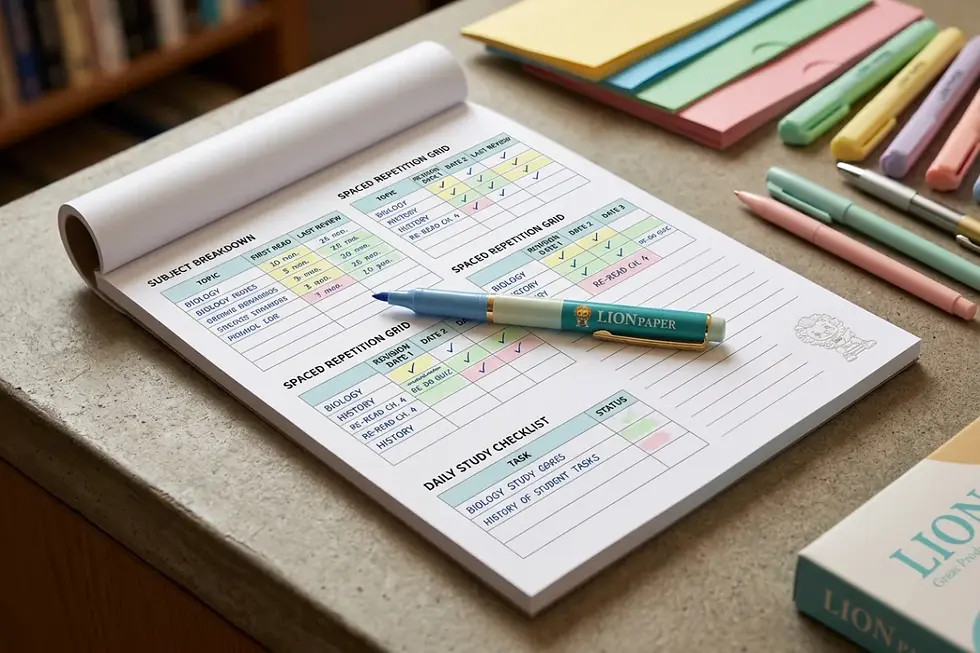
Functional grid layouts incorporating spaced repetition tables and revision trackers improve student learning efficiency.
1. Spaced Repetition and Active Recall Tracking Tables
For custom exam tracking notepads, structured tables with predefined retention review intervals (e.g., 1-day, 3-day, 7-day, 14-day, and 30-day review check-boxes) enable students to implement spaced repetition scientifically. Incorporating columns for Subject Module, Topic Difficulty (1–5 scale), Confidence Level, and Practice Test Scores allows learners to pinpoint knowledge gaps rapidly.
2. Cornell Notes Layout Variations with Action Grids
Revision pads adapting the Cornell note-taking format integrate a 2.5-inch cue column on the left for key terminology and active recall prompts, an expansive 6-inch note area with subtle 5mm dot grid or 7mm ruling, and a designated 2-inch summary footer at the base. This layout encourages systematic self-quizzing directly on tear-off sheets that students can easily file into binders or pin to bulletin boards.
3. Time-Blocked Revision Intervals and Task Prioritization
Daily study checklist pads wholesale layouts benefit from visual hierarchy segmentation. The layout structure should divide the page into distinct functional quadrants:
High-Priority Focus (Top 3 Must-Complete Topics): Highlighted with bold entry borders to enforce academic focus.
Hourly Time Blocks (06:00 to 22:00): Divided into 30-minute increments for scheduled study sessions, mock exam blocks, and rest intervals.
Revision Session Metric Counters: Small bubble trackers for tracking completed 25-minute study intervals, hydration, and mental energy levels.
Notes and Formula Sandbox: Unruled or light-grey 5mm grid sections at the bottom for quick arithmetic, chemical equations, or vocabulary retention.
4. Subject Color-Coded Header Zones
Including dedicated header zones with fields for "Course / Subject," "Exam Date," "Study Target / Goal," and "Week Number" helps students categorize loose tear-off sheets across multiple academic disciplines without visual clutter.
Which Paper Weights, Backboard Rigidity, and Binding Types Ensure Durability?
Material specifications determine how well revision pads withstand intense daily student use, heavy highlighter saturation, and frequent desk-to-backpack handling. When specifying tear off revision pads manufacturing, campus bookstore buyers and stationery brands should adhere to rigorous material benchmarks.
Interior Paper Stock and Bleed Resistance
Students rely heavily on dual-tip highlighters, rollerball pens, gel ink pens, and fineliners during revision sessions. Standard 70 gsm commercial paper suffers from significant ink feathering and show-through (bleed-through), rendering the reverse side or underlying sheets unusable.
100 gsm to 120 gsm Woodfree Offset Paper: The industry standard for premium revision pads. It provides smooth surface sizing, high opacity (minimum 94%), neutral white color tone to reduce eye strain, and complete resistance to standard gel and water-based highlighter bleed.
FSC-Certified and Recycled Substrates: Sourcing FSC Mix or 100% post-consumer recycled (PCR) paper meets the sustainability mandates of modern institutional and campus retail environments without sacrificing ink compatibility.
Backboard Density and Rigidity Standards
Unlike standard desk notepads, student revision pads are frequently used without a desk surface—on lecture hall lap trays, library armchairs, or public transport. Sturdy backing is vital:
1000 to 1200 gsm Laminated Chipboard: Appropriate for smaller A5 daily checklist pads where moderate rigidity is required.
1200 to 1500 gsm Heavyweight Greyboard: Recommended for A4 and US Letter exam tracking pads. A 1.8mm to 2.2mm thickness prevents pad bending, protects sheet edges from curling during transit, and provides a rigid writing surface.

Precision tear-off adhesive binding and rigid 1200+ gsm greyboard provide durable writing support across study environments.
Binding Mechanisms and Clean Sheet Removal
The method of sheet binding directly influences usability and the visual longevity of the notepad throughout the semester:
Padded Top Glue Binding (Tear-Off Gumming): A flexible synthetic latex or EVA adhesive applied along the top edge secures sheets firmly during use while enabling clean, residue-free tear-off without sheet perforation tearing or paper fraying.
Micro-Perforated Wire-O Binding: For revision systems where students prefer retaining sheets together until the final exam, twin-loop wire-o binding paired with micro-perforations gives users the choice between structured flipping and smooth sheet detachment.
Top Protective Header Tape / Cloth Binding: Adding a reinforced printed paper strip or linen tape over the top glued edge shields the adhesive spine from cracking when packed tightly into university bookbags.
When Should Campus Bookstores Schedule Procurement for Peak Exam Windows?
Procurement timing for educational retail follows rigid academic calendars. Missing key intake dates leads to lost seasonal revenue that cannot be recovered until the next academic cycle. Planning student revision pads bookstore wholesale manufacturing requires accounting for product development, mass production, quality control, ocean freight, and store distribution lead times.

Retail-ready packaging including heat-shrink film and scannable belly bands optimizes bookstore merchandising efficiency.
The Academic Retail Merchandising Calendar
Back-to-School (BTS) Autumn Window (August–October Intake): The largest retail sales window of the year. Bulk shipments must land at regional distribution centers or campus bookstore backrooms by late July to early August.
Mid-Year / Spring Semester Window (January–February Intake): Focuses on spring semester replenishment and winter exam preparation. Products should arrive at retail locations by late December to early January.
Spring Testing & Final Exams Window (April–June Intake): Focused heavily on intensive custom exam tracking notepads and revision sprint planners for national standardized tests, GCSE/A-Levels, AP exams, and university finals. Stock intake is required by mid-March.
Lead Time Breakdown for Custom Production
Working with an agile dual-base manufacturing partner allows retailers to compress procurement cycles while controlling landed costs:
Layout Prototyping & Sampling (China Facility): 7 to 10 days for structural prototyping, grid artwork proofing, paper compatibility testing, and packaging mockups.
Mass Production Run (Cambodia / China Operations): 25 to 35 days for high-volume automated sheet printing, precision edge-trimming, backing board lamination, and automated padding.
Transit & Logistics (FOB / DDP Delivery): 15 to 35 days depending on the final destination (e.g., North America West/East Coast, European distribution hubs, or Australian retail centers).
Retail buyers should initiate design and SKU rationalization 4 to 5 months ahead of the target on-shelf merchandising date to guarantee inventory availability and secure favorable ocean freight schedules.
What Quality Control and Packaging Specifications Are Critical for Retail Display?
In academic retail and high-traffic bookstore environments, product packaging must protect the notepad edges against handling damage, facilitate rapid barcode scanning, and support attractive shelf presentation.
Standard Quality Control Metrics for Revision Pads
To eliminate batch variations and manufacturing defects, production runs must adhere to ISO 9001 and AQL (Acceptable Quality Limit) 2.5/4.0 inspection standards:
Sheet Count Integrity: Automated optical or weight-verified batch counters to ensure every pad contains the exact contracted sheet count without shortfall.
Glue Tensile Strength: Testing the top gummed binding to ensure individual sheets detach cleanly without adhesive residue on the writing area, while ensuring the entire block remains intact during 180-degree flat opening.
Grid Alignment & Print Contrast: Precision registration of lines and dot grids within +/- 0.5 mm tolerances, using low-opacity grey ink (typically 15% to 25% black) to keep layout lines legible without overpowering student handwriting.
Edge Flatness & Corner Squareness: Clean guillotining with zero edge burring or corner creasing, protecting aesthetic appeal on open bookstore display tables.
Retail-Ready Packaging Options
Individual POF Heat-Shrink Wrapping: Protects uncoated cover sheets from dust, moisture, and frequent customer handling in retail aisles. Preserves pad corners in pristine condition until retail purchase.
Scannable Retail Belly Bands / Header Cards: Custom-printed 250 gsm paper bands wrapped around each pad provide clear branding, educational usage diagrams, features, and pre-printed EAN/UPC barcodes for instant POS checkout scanning.
Integrated Euro-Slot Hang Tabs: For vertical pegboard and end-cap retail displays, heavy-duty clear plastic or reinforced paper hang tabs adhered to the backboard maximize merchandising flexibility on limited bookstore floor footprints.
Custom Retail Counter Display Units (CDU): Sturdy corrugated cardboard counter display boxes designed to hold 12 to 24 units upright, ideal for placement next to cash registers and high-traffic study book aisles.
How Can Private Label Retailers Partner with Lion Paper for Custom Study Pad Manufacturing?
Lion Paper Products (Jiaxing) Co., Ltd. operates as a specialized supply-chain solution provider for customized paper goods and educational stationery. Founded in 2015, Lion Paper operates an integrated dual-base manufacturing infrastructure designed to bridge creative concept design with cost-effective, high-volume production.
Dual-Site Synergy: Our 3,000-square-meter facility in Jiaxing, China, is dedicated to rapid concept design, structural engineering, artwork sampling, and client support. Our 10,000-square-meter facility in Cambodia delivers large-scale automated manufacturing, annual capacity exceeding 5 million units, and competitive tariff advantages for international retail programs.
End-to-End OEM/ODM Services: Lion Paper provides end-to-end supply chain execution—from initial grid layout development and specialized paper sourcing (including FSC-certified and recycled stocks) to automated binding, custom retail packaging, and global logistics.
Rigorous Compliance Framework: Our operations meet stringent international retail and social accountability standards, supported by ISO 9001, FSC, SMETA, WCA, GSV, FAMA, and CPSIA audit readiness.
Whether developing a custom exam tracking notepad collection for university bookstores or launching daily study checklist pads wholesale for lifestyle retail chains, Lion Paper delivers stable, compliant, and cost-efficient stationery solutions.
To begin developing your custom study pad collection, please submit your detailed product specifications—including preferred trim sizes, sheet counts, inner grid layouts, paper GSM, estimated order quantities, and packaging requirements—to connect with our engineering team.
FAQ
What is the standard Minimum Order Quantity (MOQ) for custom student revision pads?
Standard production MOQs for custom-printed student revision pads typically start at 1,000 to 3,000 units per design layout. For multi-SKU retail collections (e.g., combining daily checklists, exam trackers, and weekly revision planners under a unified brand), flexible batch splitting across identical pad dimensions and paper weights is available.
Can interior pages be customized with proprietary university or school branding?
Yes. OEM/ODM production supports 100% custom interior grid printing, including institution logos, proprietary study formulas, custom line ruling, pantone-matched brand colors, and specialized header fields tailored to specific campus curricula or exam board requirements.
How does Lion Paper ensure paper stock prevents fountain pen and highlighter bleed?
We source premium 100 to 120 gsm woodfree offset paper with high surface sizing density and internal opacity exceeding 94%. Each paper batch undergoes strict absorbency and ink-penetration testing with standard pigment highlighters, rollerballs, and gel ink pens before printing to guarantee zero bleed-through.
What sustainability certifications are available for wholesale bookstore stationery?
Lion Paper supports full chain-of-custody FSC certification (FSC-C108146-aligned), 100% post-consumer waste (PCW) recycled paper stocks, soy-based or vegetable-based inks, and plastic-free paper packaging alternatives to fulfill corporate ESG standards and university sustainability mandates.


Comments