


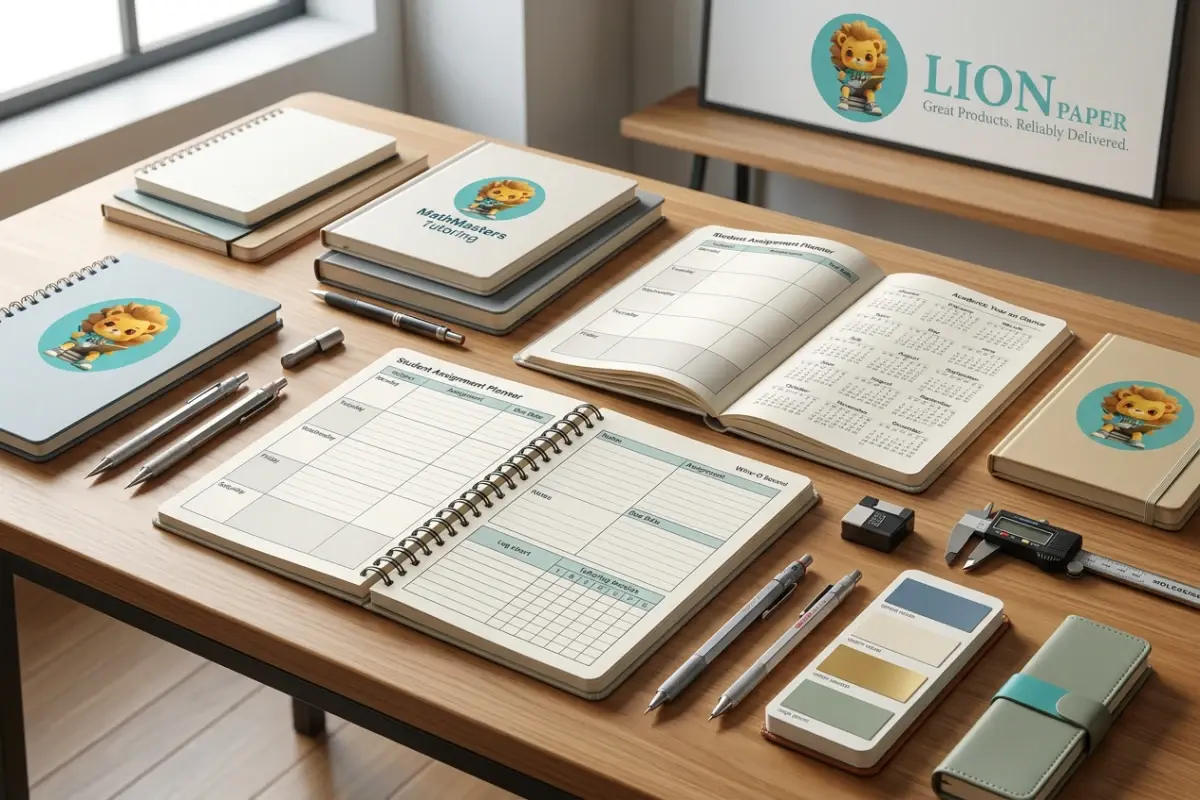
Student Assignment Planners for Tutoring Brands: Custom Academic Manufacturing Guide
Custom student assignment planners for tutoring brands require term-synchronized page counts, bleed-resistant 100 to 120 gsm paper, targeted progress-tracking layouts, and balanced print runs aligned with quarterly enrollment cycles. Integrating session logs, objective milestones, and parent-tutor feedback fields turns standard stationery into a branded pedagogical tool that boosts student retention and institutional consistency.
How Should Tutoring Brands Synchronize Student Assignment Planners with Academic Terms?
Tutoring centers, test-preparation academies, and supplemental learning brands operate on strict educational cycles. Unlike general retail planners that follow a rigid 12-month calendar year, custom academic planners for tutoring centers must reflect modular terms—such as 8-week test prep bootcamps, 10-week quarters, 12-week trimesters, or 16-week semesters.
Aligning your planner's pagination with your term structure prevents unused pages, cuts paper costs, and keeps book spine thickness manageable for young students. When engineering term-based student planner manufacturing, brands should build their page counts using 16-page or 32-page printing signatures to optimize press efficiency.
Term Structure | Typical Duration | Recommended Weekly Spreads | Target Page Count (Signatures) | Common Educational Use Case |
|---|---|---|---|---|
:--- | :--- | :--- | :--- | :--- |
Short Intensive | 6 to 8 Weeks | 8 Weekly Tracking Spreads | 48 to 64 Pages (3–4 Signatures) | SAT/ACT Prep, Summer Camps, Exam Sprints |
Standard Quarter | 10 to 12 Weeks | 12 Weekly Tracking Spreads | 80 to 96 Pages (5–6 Signatures) | STEM Clinics, Remedial Reading Terms |
Semester Model | 16 to 18 Weeks | 18 Weekly Tracking Spreads | 128 to 144 Pages (8–9 Signatures) | Year-Round Academic Tutoring, Language Centers |
Full Academic Year | 40 to 52 Weeks | 40–52 Weekly Tracking Spreads | 192 to 224 Pages (12–14 Signatures) | Comprehensive K-12 After-School Franchises |
To maximize brand utility, consider standardizing on an undated weekly format with designated fill-in blocks for term week numbering. This prevents obsolete inventory if student cohorts start off-cycle, while maintaining a consistent structure across every tutoring branch.

Structured interior spreads help tutoring students organize assignments by subject while tracking daily completion.
What Interior Layouts Maximize Student Accountability and Parent-Tutor Communication?
An effective educational planner is both a student schedule manager and an operational communication bridge between tutors, learners, and parents. Generic lined or grid pages fail to capture tutoring-specific workflows. When developing bulk assignment tracker notebooks, brands should organize their interior layouts into three functional zones:
Goal Setting and Baseline Metrics: Front-matter spreads dedicated to diagnostic test scores, target grade bands, subject-specific focus areas, and skill mastery roadmaps.
Weekly Subject-by-Subject Assignment Grids: Two-page horizontal or vertical weekly spreads divided by subject (e.g., Mathematics, Science, Language Arts, Test Strategy). Each row includes target completion dates, estimated study minutes, actual completion checkmarks, and assignment submission flags.
Parent-Tutor Verification Blocks: Dedicated sign-off sections at the foot of every weekly spread. These contain structured check-boxes for homework completion, qualitative tutor feedback notes, focus ratings (e.g., 1 to 5 stars), and parent signature lines.
In multi-branch tutoring franchises, standardized interior layouts enforce consistent instructional reporting. A uniform logbook ensures that substitute instructors, head tutors, and academic directors can audit any student's notebook in seconds to assess homework completion rates and curriculum pacing.
Which Material Specifications Prevent Ink Bleed and Ensure Durability in Educational Logbooks?
Students subject their planners to heavy friction, backpack pressure, and diverse writing instruments including gel pens, highlighters, rollerballs, and correction fluid. Selecting the right educational logbook printing specifications directly influences whether the book survives an entire academic year.
Paper weight and surface sizing are critical. Standard 70 or 80 gsm offset paper frequently allows heavy highlighter ink to bleed through to the reverse side, rendering double-sided tracking charts illegible. Educational planners require high-opacity uncoated woodfree paper or FSC-certified offset paper ranging from 100 to 120 gsm.
Specification Component | Recommended Baseline | Premium / Heavy-Duty Option | Manufacturing Rationale |
|---|---|---|---|
:--- | :--- | :--- | :--- |
Interior Text Paper | 100 gsm FSC Uncoated Woodfree | 120 gsm Smooth Writing Offset | Eliminates show-through from highlighters, rollerball pens, and heavy pencil pressure. |
Interior Ink & Print | 1C/1C (Charcoal/Neutral Grey) | 2C/2C or 4C/4C Offset Printing | Soft grey grids reduce eye strain; colored subject coding aids visual navigation. |
Cover Stock (Softcover) | 300–350 gsm C1S Artboard | 400 gsm White Kraft or Polypropylene | High tear resistance; withstands frequent bending without cracking at score lines. |
Cover Finish | Matte or Gloss OPP Lamination | Anti-Scratch Soft-Touch + Spot UV | Prevents surface scuffing, water droplet damage, and edge delamination in backpacks. |
Hardcover Core Board | 1.8 mm Greyboard | 2.5 mm High-Density Kappa Board | Rigid desk support for writing without a flat table; protects interior corners. |
For programs serving younger students (Ages 6–11), specifying rounded corners with a 6 mm or 8 mm die-cut radius prevents dog-eared edges and reduces paper cuts. Anti-scratch thermal lamination protects dark-colored background prints from visible transit rub marks.

Specifying 100 to 120 gsm bleed-resistant paper prevents highlighter and gel pen show-through during daily study.
Which Binding Methods Work Best for Intensive Daily Use: Wire-O, Flexi-Cover, or Casebound?
Choosing the correct binding format requires balancing desk utility, production cost, spine durability, and student age ergonomics. An assignment planner must lay completely flat on a desk alongside textbooks and laptop keyboards.
Wire-O Twin-Loop Binding: The gold standard for daily task tracking. Wire-O allows the notebook to fold back 360 degrees, consuming minimal desk space during tutoring sessions. Using 1.2 mm to 1.5 mm electro-galvanized steel double loops prevents wire crushing. For young students, semi-concealed Wire-O covers encase the metal spiral inside a hard paper spine, combining 360-degree flat writing with a clean, printable shelf spine.
Flexible Softcover (Section-Sewn Flexi-Binding): A lightweight, cost-effective alternative for quarterly logbooks. Section sewing (Smyth sewing) combined with a flexible drawn-on softcover allows the book to lay flat when pressed open without individual pages detaching from the spine under stress.
Casebound Hardcover: Ideal for year-long premium private tutoring and college prep academies. Hardcovers provide structural rigidity for students writing on their laps or during commutes. Adding elastic closure bands, dual satin ribbon bookmarks, and an expandable back-cover gusseted pocket for loose worksheets creates an all-in-one academic portfolio.
Tutoring brands should avoid standard adhesive perfect binding without sewing. Pure glue binding restricts lay-flat performance and risks page detachment after repeated daily flexing across a multi-month academic term.
How Can Tutoring Centers Optimize Production Batches, MOQs, and Staggered Delivery Schedules?
Educational franchises often face fluctuating student enrollment figures across seasonal intakes in Autumn, Winter, and Spring. Committing to a single massive print run can lock up working capital, while running multiple micro-runs drives up unit costs.
Partnering with an integrated supply-chain manufacturer like Lion Paper Products allows tutoring networks to leverage flexible dual-site capabilities. Prototyping, custom layout proofing, and initial pilot batches are executed through the 3,000-square-meter Jiaxing facility, while high-volume mass production runs exceeding tens of thousands of units are fulfilled efficiently through the 10,000-square-meter Cambodia facility.
Standardized Shell Printing with Split Intake Finishing: Print standardized interior tracking pages in large, cost-effective offset press runs (e.g., 20,000 sets). Store flat folded signatures and bind smaller batches with term-specific customized covers ahead of quarterly intake dates.
Multi-Campus Distribution Kitting: Consolidate central manufacturing orders, split packing by campus location, and barcode cartons by grade level or term track for direct-to-branch logistics.
Annual Volume Aggregation: Contract your full annual supply under a blanket purchase agreement to lock in paper raw material pricing while scheduling tiered deliveries across Fall and Spring peak periods.
This supply chain model delivers total-cost efficiency, minimizes domestic warehousing overhead, and ensures compliance with international quality standards such as ISO 9001 and FSC material traceability.

Selecting durable binding formats ensures custom academic planners lay completely flat and survive intensive classroom use.
What Is the Step-by-Step OEM/ODM Manufacturing Checklist for Custom Academic Planners?
To ensure rapid sampling and eliminate press-run errors, educational procurement managers should establish clear manufacturing parameters before initiating production. Follow this structured development sequence:
Workflow & Layout Mapping: Define term duration, weekly spread structure, subject categories, and verification sections in 1:1 scale digital vector files.
Structural Prototype Evaluation: Request an unprinted paper dummy (white sample) matching exact target paper weights, cover board densities, and binding mechanics to test physical lay-flat performance and weight.
Writing & Erasability Testing: Verify that sample paper stocks resist bleed-through, feathering, and ghosting across all targeted student pen types, including pencil erasures.
Color Proofing & Branding Sign-Off: Review digitally calibrated press proofs (GMG proofs) or wet press proofs to verify institutional brand colors (Pantone matching) and legibility of subtle interior grid lines.
Accessory & Packaging Configuration: Finalize functional accessories, such as color-coded monthly tab dividers, sticker sheets for milestone tracking, elastic pen loops, and retail-ready shrink-wrapping with campus inventory labels.
Mass Production & Quality Assurance: Execute mass production governed by standardized SOPs and AQL sampling inspections, ensuring strict dimensional tolerance, spine alignment, and carton palletization integrity.
Send your intended user workflow, planner or logbook layout, volume and delivery schedule to our engineering team for a comprehensive manufacturing feasibility review.
FAQ
What is the typical minimum order quantity (MOQ) for custom tutoring assignment planners?
Custom academic planner MOQs generally start at 1,000 units for fully customized softcover and Wire-O formats, and 2,000 to 3,000 units for custom-tooled hardcovers and specialized finishes. Smaller pilot runs can be evaluated during initial product development.
Can custom assignment trackers include undated weekly layouts for flexible student enrollment?
Yes. Undated layouts with blank week-number headings and fill-in calendar headers are highly recommended for tutoring centers. This allows students who enroll mid-term to start immediately without wasting printed calendar pages.
What paper weight is recommended to prevent highlighter and marker bleed-through?
We recommend 100 gsm to 120 gsm FSC-certified uncoated woodfree paper. This density provides superior opacity, rapid ink absorption, and robust resistance against bleed-through from highlighters, gel pens, and heavy pencil pressure.
How do China and Cambodia manufacturing facilities coordinate for global tutoring brands?
Product development, structural design, rapid prototyping, and sampling are handled by the Jiaxing facility in China, while cost-efficient large-scale mass manufacturing and global sea-freight logistics are managed through the Cambodia production base.