


Stationery Return Rate Economics: Cost of Quality, AQL Standards, and Margin Protection

Stationery return rate economics is governed by the Cost of Quality (CoQ) framework, where proactive spending on precise defect classification, in-process quality control, and transit-ready packaging is substantially lower than downstream retail penalties. While consumer returns and chargebacks can erode 15% to 30% of gross margin, upstream prevention and appraisal typically cost between 1.5% and 3.5% of total procurement value, yielding immediate return on investment.
What Is Stationery Return Rate Economics and the Cost of Quality Framework?
Stationery return rate economics measures the net financial impact of defective, damaged, or non-compliant paper products as they move through the supply chain to end consumers. In the paper goods sector—covering notebooks, journals, planners, office filing, and boxed gift sets—evaluating returns requires looking beyond the raw factory unit cost. Instead, brand owners and procurement directors must evaluate the Total Cost of Ownership (TCO) through the classic Cost of Quality (CoQ) model.
The Cost of Quality framework divides quality-related expenditures into four distinct categories:
Prevention Costs: Proactive investments made before and during initial manufacturing to prevent defects. This includes supplier engineering audits, paper grain orientation testing, binding adhesive stress testing, structural packaging prototyping, and pre-production color drawdowns.
Appraisal Costs: Expenses incurred to measure, evaluate, and audit products against defined standards. This includes raw material inspection (GSM verification, paper moisture content, ink rub tests), in-line process checks, and finished-goods notebook defect classification AQL inspections.
Internal Failure Costs: Costs resulting from defects identified before products ship from the factory. Examples include scrapped printed sheets, binding line re-runs, manual debossing re-alignment, and sorting labor.
External Failure Costs: The most expensive quadrant, encompassing costs incurred after the goods leave the factory gate. This includes ocean container carton collapse, distribution center (DC) inbound rejections, retailer non-compliance penalties, reverse logistics freight, customer service overhead, consumer refunds, and brand equity erosion.
Quality Cost Category | Primary Operational Elements | Typical % of Product Value | Financial Impact Level |
|---|---|---|---|
:--- | :--- | :--- | :--- |
Prevention | Tooling design, packaging drop testing, SOP development | 1.0% – 2.0% | High ROI / Low Cost |
Appraisal | Paper product quality inspection cost, AQL sampling, lab tests | 0.8% – 1.5% | Moderate Cost / High Risk Mitigation |
Internal Failure | Factory scrap, sheet recycling, line downtime rework | 2.0% – 5.0% | Contained Factory Expense |
External Failure | Returns, retail chargebacks, reverse freight, stock disposal | 12.0% – 25.0%+ | Catastrophic Margin Erosion |
In high-volume paper stationery manufacturing, an uninspected flaw that costs pennies to correct on the press sheet translates into multiple times the unit value once it reaches a big-box retailer or e-commerce fulfillment center.
How Do Downstream Retail Chargebacks and Reverse Logistics Impact Margins?
When a consumer or wholesale retailer rejects a batch of custom notebooks or planners, the financial loss extends far beyond the production cost of the physical item. In modern omni-channel and retail environments, downstream failures trigger compounding layers of operational penalties.
Retail stationery chargebacks reduction has become a primary operational focus for retail suppliers working with major North American and European retailers. Retail compliance programs impose strict fines for supply chain non-conformities, such as:
EDI and Barcode Failures: Illegible GS1 barcodes, misplaced price stickers, or mismatched SKU labels trigger scanning error chargebacks ranging from $5.00 to $50.00 per carton, plus labor fees for manual relabeling.
Pallet and Carton Integrity Non-Compliance: Crushed master cartons resulting from inadequate board burst strength (e.g., using single-wall 32 ECT instead of double-wall 44 ECT or 200# test corrugated) lead to DC floor rejections, sorting fees, and administrative penalties.
Aesthetic and Functional Shelf Defects: Warped covers, skewed spine stamping, or broken wire-o loops discovered during retail receiving lead to Return to Vendor (RTV) freight charges, restocking markdowns, or total merchandise disposal debits.

Verifying master carton integrity and barcode scannability prevents costly retail distribution chargebacks.
In direct-to-consumer (DTC) and e-commerce channels, the economics of a single return are equally punishing. For a premium journal retailing at $24.00 with a landed production cost of $4.50, a customer return due to ink bleed-through or cracked spine binding consumes substantial capital:
Initial Outbound Pick, Pack, and Shipping: $5.50
Customer Return Reverse Freight: $6.20
Return Processing and Grading Labor: $2.50
Unsellable Inventory Liquidation / Disposal Loss: $4.50
Payment Gateway Non-Refundable Processing Fees: $0.80
The total direct loss from one returned $24.00 journal often exceeds $19.50, completely erasing the profit from four successfully sold units. Controlling defect rates at the manufacturing stage through rigorous quality assurance is therefore the single most effective way to protect net operating margins.
What Are the Notebook Defect Classification and AQL Sampling Standards?
To manage stationery cost of quality objectively, global brands and manufacturers utilize the ISO 2859-1 (ANSI/ASQ Z1.4) Acceptance Quality Limit (AQL) sampling system. Establishing standardized defect classifications removes subjective opinions between procurement teams and manufacturing facilities.
Inspections typically use Normal General Inspection Level II, which dictates the sample size based on overall batch volume. Defects are categorized into three standard tiers: Critical, Major, and Minor.
Defect Classification | Industry AQL Limit | Definition | Stationery Industry Examples |
|---|---|---|---|
:--- | :--- | :--- | :--- |
Critical | 0.0 (Zero Tolerance) | Poses safety hazards, violates legal/regulatory standards, or makes the product completely unusable. | Sharp exposed wire-o ends; mold/mildew presence; phthalates or lead exceeding CPSIA limits; missing required legal or recycling markings. |
Major | 1.5% to 2.5% | Seriously impairs functional utility, structural integrity, or physical salability. | Broken or split perfect binding spine; incorrect page count or missing signature; significant ink smearing/offsetting; crooked cover foil debossing (>1.5 mm); barcode unreadable by scanner. |
Minor | 4.0% | Slight cosmetic deviation that does not affect functional performance or overall marketability. | Ribbon bookmark edge fraying (<2 mm); minor glue residue on inner endpaper (<1 mm); slight corner scuffing on slipcase; minute color density variation within Delta E < 2.0. |
For an order of 20,000 hardcover notebooks inspected under Level II Normal Sampling, the inspection lot size requires 315 randomly sampled books across all master cartons. Under an AQL standard of 0 / 1.5 / 4.0:
The entire 20,000-unit lot is accepted if there are 0 Critical defects, 10 or fewer Major defects, and 21 or fewer Minor defects.
The entire lot is rejected and placed on factory hold if there is 1 Critical defect, 11 or more Major defects, or 22 or more Minor defects.
Instituting clear notebook defect classification AQL guidelines within production contracts prevents sub-standard batches from boarding ocean freight vessels, containing quality expenditures within the lower-cost factory environment.
What Are the Manufacturing and Packaging Root Causes of Stationery Returns?
Understanding the physical and chemical root causes behind paper product defects enables procurement engineers to specify preventative safeguards during product development.
1. Paper and Printing Substrate Failures
Paper is a living, hygroscopic material that continuously exchanges moisture with its surrounding atmosphere. When inner pages and cover boards are cut without considering paper grain orientation (machine direction), the book will curl, warp, or pucker when exposed to atmospheric humidity shifts.
Ink Bleed and Feathering: Low-grade uncoated woodfree paper with inconsistent sizing allows liquid fountain pen inks or heavy gel pens to feather across surface fibers and bleed to the reverse page, prompting heavy consumer returns.
Ghosting and Show-Through: Selecting paper with inadequate opacity (<88% opacity on 70–80 GSM papers) creates double-sided visibility issues, degrading user satisfaction.
2. Binding and Structural Failures
Binding failures represent the highest percentage of functional Major defects in notebooks and journals:
Adhesive Degradation: Using standard EVA hot-melt glue instead of Polyurethane Reactive (PUR) glue on heavy coated papers or high-page-count notebooks results in spine cracking and loose leaf detachment when opened flat.
Thread Sewing Tension: In smyth-sewn or case-bound journals, improper tension calibration leads to loose signatures or needle hole tearing along inner gutters.
Wire-O and Spiral Binding Pitch Irregularities: Wire loops that are unevenly crimped cause page catch, snagging, or outer cover detachment during shelf handling.

Precision spine binding and paper grain alignment eliminate page fallout and cover warping.
3. Packaging and Transit Failures
Even a well-manufactured notebook can become unsellable due to packaging deficiencies during long-haul intermodal transit:
Corner Crushing: Notebooks packed edge-to-edge inside corrugated cartons without interior perimeter corner protectors or sufficient carton headspace suffer corner dinging during drop impacts.
Moisture and Mold Accumulation: Ocean freight traversing tropical routes experiences container rain (condensation cycles). Inadequate master carton poly-bag lining or missing micro-pak/silica desiccants leads to mold growth and musty odor absorption.
How Do You Balance Unit Cost, Production Throughput, and Inspection Cost?
Procurement managers frequently face pressure to lower factory unit prices by shaving production steps or eliminating third-party inspection budgets. However, paper product quality inspection cost represents an indispensable risk mitigation strategy rather than an administrative overhead.
A typical pre-shipment inspection (PSI) conducted by a qualified quality engineer costs between $250 and $600 per man-day. For a $50,000 order comprising 20,000 planners, a comprehensive 2-man-day inspection costs roughly $600 to $1,000—representing just 1.2% to 2.0% of order value.
Procurement Strategy | Inspection & Prevention Budget | Internal Defect Catch Rate | Average Post-Delivery Return Rate | Total Landed Cost of Quality Risk |
|---|---|---|---|---|
:--- | :--- | :--- | :--- | :--- |
Lowest-Bidder (No QC Oversight) | 0% of PO Value | <40% (Factory Self-Check Only) | 4.5% – 8.0% | High: Severe risk of retail chargebacks, inventory write-offs, and margin erosion. |
Standard Third-Party PSI Only | 1.0% – 1.8% of PO Value | 80% – 88% (Catches Final Flaws) | 1.5% – 2.5% | Moderate: Catches bulk defects, but rework at final stage causes shipping delays. |
Integrated Dual-Site QA Model | 2.0% – 3.2% of PO Value | >98% (In-Line, Materials, Pre-Ship) | <0.5% | Optimized: Predictable landed costs, zero chargebacks, protected retail partner trust. |
Integrated supply chain systems achieve cost efficiency not by cutting quality inspections, but by optimizing manufacturing layout and balancing dual-site operations.
By leveraging China-based facilities for rapid structural prototyping, precise material sourcing, and specialized prepress engineering alongside automated, high-volume mass production lines in cost-advantaged regions like Cambodia, brands secure low manufacturing unit costs while maintaining strict, automated standard operating procedures (SOPs) that keep defect rates well below commercial thresholds.
What Root-Cause Corrective Actions and Retained Sample Audits Prevent Repeat Failures?
When quality deviations are identified during production or through post-delivery retail feedback, suppliers must execute a structured Corrective and Preventive Action (CAPA) protocol rather than merely replacing damaged stock.
An effective CAPA framework consists of five core operational stages:
Containment: Quarantining the affected batch immediately at the manufacturing cell, warehouse, or transit hub to prevent mixed-lot distribution.
Root-Cause Investigation (5 Whys / Ishikawa Fishbone): Tracing the failure beyond operator error to the systemic source—such as raw material paper grain orientation, glue curing temperature curves, or packaging compression ratings.
Corrective Action Implementation: Modifying tool parameters, adjusting adhesive formulations (e.g., transitioning from standard hot-melt to flexible PUR), or upgrading carton burst strengths.
Verification and Stress Testing: Running sample pilot batches through accelerated aging, high-low temperature exposure cycles (-10°C to +50°C), paper folding endurance tests, and ISTA-1A drop tests.
Standard Operating Procedure (SOP) Standardization: Updating visual defect boards, machine operator setup cards, and inline inspection checklists across all production lines to prevent recurrence.
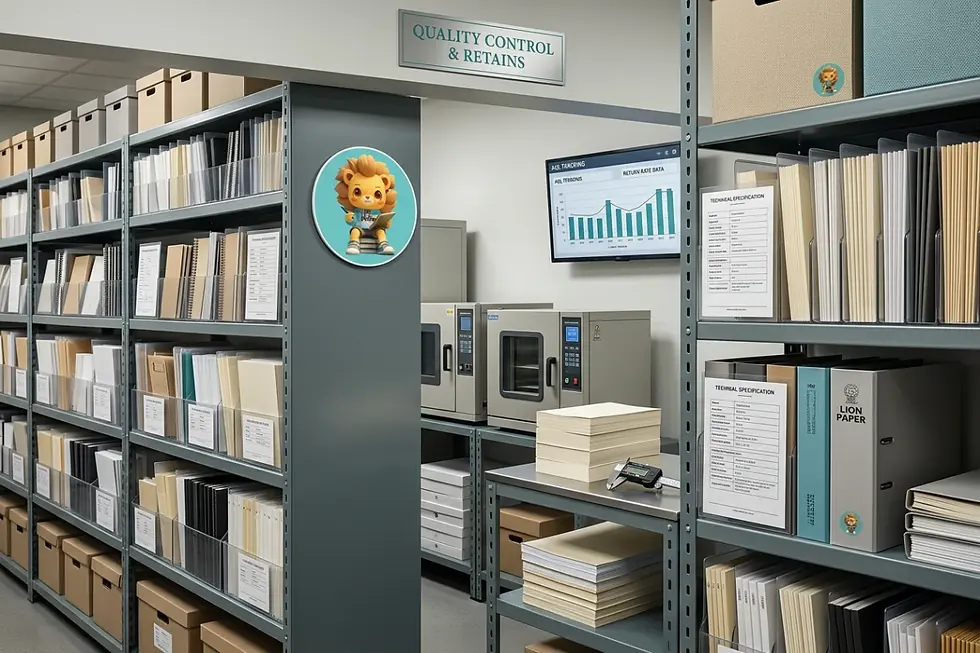
Systematic retained sample libraries ensure batch-to-batch consistency and rapid root-cause corrective action.
Maintaining a formal Retained Sample Library is equally vital. For every production run, production teams should archive randomly selected "golden samples" representing the approved standard, along with retained production specimens from the beginning, middle, and end of the run. These samples serve as baseline benchmarks for batch-to-batch color delta evaluations, binding strength verification, and rapid resolution of retail customer disputes.
What Action Plan Should Stationery Buyers Implement for RFQs and Spec Sheets?
To lock in quality standards and minimize return rates from day one, procurement teams must construct precise, unambiguous Request for Quotation (RFQ) packages and technical specification sheets.
Incorporate the following mandatory specifications into all stationery manufacturing agreements:
Substrate & Environmental Specs: Exact paper GSM weight, caliper thickness, opacity percentage, brightness rating, moisture content (target 4.5%–6.5%), and required certifications (e.g., FSC-certified traceable stock).
Binding Engineering Parameters: Binding type (wire-o loop diameter and gauge, case-bound smyth sewn with signature count, or square-back PUR binding), thread material, ribbon marker heat-sealed cut angles, and endpaper GSM.
Finishing Tolerances: Maximum allowable registration variance for hot foil stamping, embossing/debossing depth (±0.2 mm), and die-cut positioning tolerances (±0.5 mm).
Packaging and Carton Requirements: Double-wall corrugated export master cartons with defined Edge Crush Test (ECT) or Mullen Burst ratings; sealed moisture-barrier polybags inside master cartons; corner guard protectors; pallet stacking limits; and exact GS1-128 barcode placement specs.
Inspection and Acceptance Protocols: Explicit contractual agreement on ANSI/ASQ Z1.4 / ISO 2859-1 Level II sampling, detailing Critical (0), Major (1.5–2.5), and Minor (4.0) thresholds, alongside defined chargeback liability clauses for defect-related RTV shipments.
By codifying clear defect standards, structuring preventive inspection gates, and choosing experienced manufacturing partners with robust quality management systems, stationery brands can systematically eliminate downstream return costs and secure long-term profitability.
To audit your supply chain and protect product margins, Share defect photos/data, return reasons, chargeback criteria, inspection rules and volumes with Lion Paper for a corrective-action and QC review.
Frequently Asked Questions
What is the acceptable return rate benchmark for retail paper stationery?
In mainstream retail and e-commerce stationery categories, a total return rate between 1.0% and 1.5% is generally considered normal. High-performance brands targeting tier-one retail channels strive for defect-related return rates below 0.5%. Return rates exceeding 3.0% indicate fundamental flaws in paper selection, binding adhesives, structural carton packaging, or transit humidity protection that require immediate corrective action.
How does paper grain direction affect notebook cover warping and returns?
Paper fibers align parallel to the moving screen of the paper manufacturing machine during production, creating a distinct grain direction. If the grain of the cover board, printed outer wrap, and interior text pages are not aligned in the parallel spine direction, changes in ambient moisture cause the materials to expand at different rates. This differential expansion leads to severe cover warping, puckering, and page waviness, which are frequent drivers of retail rejection.
Why is PUR binding preferred over EVA hot melt for high-page-count journals?
Polyurethane Reactive (PUR) adhesive undergoes a chemical moisture-curing process that forms an exceptionally strong, flexible bond resistant to extreme temperature fluctuations (-40°C to 90°C). Unlike standard ethylene-vinyl acetate (EVA) hot melt, which can become brittle in cold temperatures and crack along the spine, PUR allows journals to open flat repeatedly without loose-leaf page shedding, significantly lowering structural return rates for heavy-use notebooks.
What constitutes a Critical versus Major defect in retail stationery inspections?
A Critical defect involves safety hazards or legal violations (e.g., sharp exposed wire ends, excessive chemical content violating CPSIA regulations, or missing required legal country-of-origin markings) and carries a zero-tolerance (0.0 AQL) threshold. A Major defect impairs the physical usability or commercial salability of the product (e.g., missing planner pages, cracked spines, upside-down text blocks, or unscannable barcodes) and is typically governed by an AQL threshold of 1.5% to 2.5%.
FAQ
What is the acceptable return rate benchmark for retail paper stationery?
In mainstream retail and e-commerce stationery categories, a total return rate between 1.0% and 1.5% is generally considered normal. High-performance brands targeting tier-one retail channels strive for defect-related return rates below 0.5%. Return rates exceeding 3.0% indicate fundamental flaws in paper selection, binding adhesives, structural carton packaging, or transit humidity protection that require immediate corrective action.
How does paper grain direction affect notebook cover warping and returns?
Paper fibers align parallel to the moving screen of the paper manufacturing machine during production, creating a distinct grain direction. If the grain of the cover board, printed outer wrap, and interior text pages are not aligned in the parallel spine direction, changes in ambient moisture cause the materials to expand at different rates. This differential expansion leads to severe cover warping, puckering, and page waviness, which are frequent drivers of retail rejection.
Why is PUR binding preferred over EVA hot melt for high-page-count journals?
Polyurethane Reactive (PUR) adhesive undergoes a chemical moisture-curing process that forms an exceptionally strong, flexible bond resistant to extreme temperature fluctuations (-40°C to 90°C). Unlike standard ethylene-vinyl acetate (EVA) hot melt, which can become brittle in cold temperatures and crack along the spine, PUR allows journals to open flat repeatedly without loose-leaf page shedding, significantly lowering structural return rates for heavy-use notebooks.
What constitutes a Critical versus Major defect in retail stationery inspections?
A Critical defect involves safety hazards or legal violations (e.g., sharp exposed wire ends, excessive chemical content violating CPSIA regulations, or missing required legal country-of-origin markings) and carries a zero-tolerance (0.0 AQL) threshold. A Major defect impairs the physical usability or commercial salability of the product (e.g., missing planner pages, cracked spines, upside-down text blocks, or unscannable barcodes) and is typically governed by an AQL threshold of 1.5% to 2.5%.


Comments