


Standard vs Jumbo Pencil Sharpener: Complete B2B Sourcing and Manufacturing Guide

The primary difference between a standard vs jumbo pencil sharpener lies in aperture diameter and blade cutting geometry: standard sharpeners accommodate 7 to 8 mm barrels for everyday writing, while jumbo sharpeners support 9 to 12 mm oversized, primary, or triangular barrels. Jumbo models demand adjusted blade bevel angles, larger waste canisters, and tailored safety compliance for school, art, and retail stationery sets.
What are the key dimensional and mechanical differences between standard and jumbo sharpeners?
Pencil sharpeners are precision cutting tools calibrated to specific barrel diameters, core hardness levels, and cutting bevel angles. Selecting between a standard aperture and a jumbo format impacts everything from housing design to blade tension and shaving containment.
Standard Aperture Specifications: Standard pencil sharpeners feature an entry hole diameter between 7.8 mm and 8.2 mm. They are engineered to sharpen conventional graphite pencils (such as HB/#2), slim colored pencils, and fine drawing media with a 7 to 8 mm hexagonal, round, or triangular cross-section. The internal cone angle typically ranges from 18 to 22 degrees, yielding an elongated, acute tip optimized for fine-line writing.
Jumbo Aperture Specifications: Jumbo pencil sharpeners feature entry diameters from 10.0 mm to 12.5 mm. These are designed for early-learner primary pencils, thick art colored pencils, cosmetic pencils, and chunky ergonomic writing tools. The internal sharpening taper uses a broader cone angle—generally 23 to 30 degrees—to provide mechanical support to thick, fragile wax- or oil-based cores, preventing lead breakage during rotation.
Dual-Hole Multi-Diameter Configurations: To solve the compatibility dilemma, dual-hole pencil sharpeners combine both an 8 mm standard hole and an 11–12 mm jumbo hole in a single molded chassis. This hybrid format represents one of the most commercially versatile stationery accessories for back-to-school kits and retail stationery sets.
Mechanical Parameter | Standard Sharpener Format | Jumbo Sharpener Format | Dual-Hole Combined Sharpener |
|---|---|---|---|
:--- | :--- | :--- | :--- |
Aperture Diameter | 7.8 mm – 8.2 mm | 10.0 mm – 12.5 mm | Dual: 8.0 mm & 11.5 mm |
Pencil Compatibility | Conventional 7–8 mm (#2, HB, slim colored) | 9–12 mm (Primary, chunky, triangular) | Universal standard and oversized barrels |
Standard Cone Taper Angle | 18° – 22° (Slim, acute point) | 23° – 30° (Sturdy, blunt point) | 20° (Standard) / 26° (Jumbo) |
Waste Volume Requirement | Compact (10–25 cm³ reservoir) | High-capacity (30–60 cm³ reservoir) | High-capacity (35–70 cm³ reservoir) |
Primary Market Focus | General office, middle/high school, drafting | Early childhood, special education, fine arts | B2B retail sets, back-to-school kits, gift bundles |

Precision aperture dimensions: standard 8mm vs jumbo 12mm cone structures for different barrel types.
How do standard vs jumbo sharpeners compare in performance, tooling costs, and manufacturability?
When evaluating product development and procurement for stationery product lines, commercial buyers must weigh production complexity, material consumption, and unit tooling investments.
Standard single-hole sharpeners represent high-volume, low-tooling-cost production runs. Because standard sharpeners use standardized, high-cavity injection molds (often 16 to 32 cavities per mold base), unit costs are exceptionally low. The plastic chassis requires minimal raw material, and standard blades can be sourced off-the-shelf from certified blade stamping facilities.
In contrast, custom pencil sharpener manufacturing for jumbo or oversized formats requires distinct mold design considerations:
Injection Mold Tooling Investment: Jumbo housings require larger mold cavities with extended cooling cycles to prevent sink marks on thick plastic walls. A bespoke jumbo sharpener mold runs 20% to 35% higher in tooling cost than a standard single-hole mold due to increased sliding actions for waste door latches and safety baffles.
Material Consumption & Resin Selection: Jumbo sharpeners, especially enclosed canister styles, require rigid polymers such as GPPS (General Purpose Polystyrene) or AS (Acrylonitrile Styrene) for transparent waste cups, paired with high-impact ABS or PP for the lid and internal sharpener block. This increases unit resin weight by 60% to 120% compared to open metal standard wedges.
Dual Hole Pencil Sharpener Wholesale Viability: Dual-hole models offer the highest perceived retail value. Sourcing dual hole pencil sharpener wholesale units allows private label stationery brands to capture both elementary school requirements and general consumer needs in a single SKU, maximizing shelf-space efficiency and reducing supply chain fragmentation.
What blade metallurgy, safety standards, and quality control requirements apply?
Pencil sharpeners sold into educational and retail consumer markets must satisfy strict mechanical and chemical regulatory frameworks across North America and Europe.
Blade Metallurgy and Hardness: Standard and jumbo sharpeners use high-carbon steel (such as SK5, 65Mn) or anti-rust stainless steel (420J2). High-carbon blades undergo continuous vacuum heat treatment to achieve a Rockwell hardness of HRC 54–60. Jumbo sharpeners exert greater torque during cutting, requiring thicker blade stock (0.6 mm vs 0.4 mm in standard models) to resist blade deflection and core snapping.
Chemical Compliance (CPSIA, EN 71, REACH): Plastic bodies, coatings, and metal parts must comply with CPSIA (lead content under 100 ppm, phthalates under 1,000 ppm), ASTM F963, and European EN 71-3 (migration of heavy elements) and REACH annex XVII regulations. In addition, certifications such as ISO 9001 and audit standards like SMETA, WCA, and GSV ensure factory-level compliance.
Mechanical and Child Safety Features: Jumbo sharpeners intended for young learners (pre-K through 2nd grade) require internal safety barriers or recessed blade positioning to prevent small fingers from contacting the cutting edge. Furthermore, screw torque testing must verify that the blade retaining screw resists a minimum pull-off torque (typically >0.4 N·m) to prevent accidental detachment and ingestion hazards.
Quality Control & AQL Standards: Quality inspections should follow standardized SOPs and AQL 1.5/4.0 sampling plans. Inspection checks include smooth core sharpening without wood split-out, concentric taper alignment, hinge durability on shavings receptacles (minimum 500 open/close cycles), and drop tests from 1 meter to ensure zero cracking.
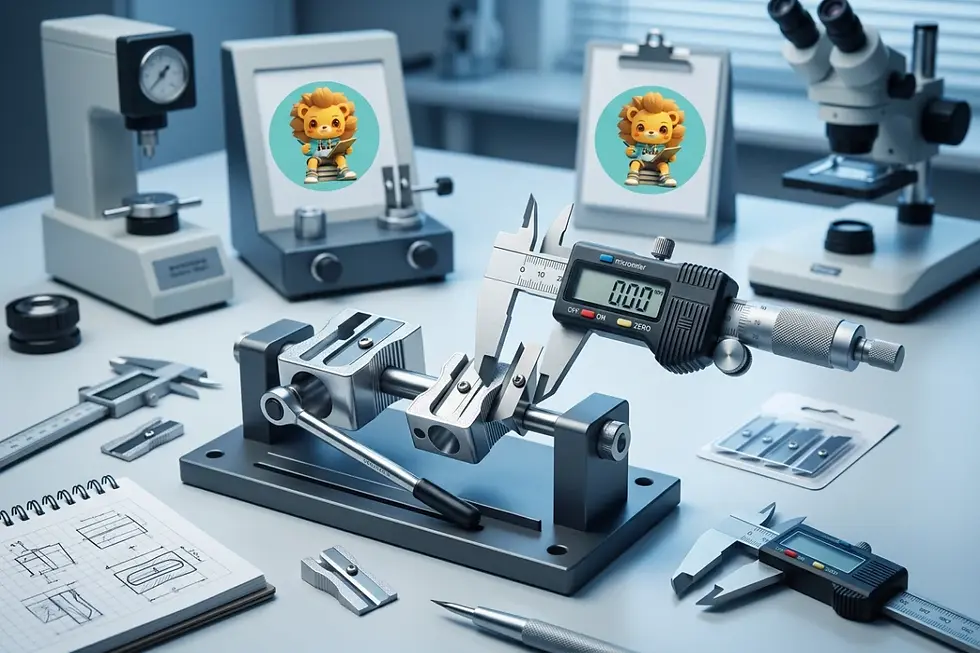
Strict quality control ensures blade hardness (HRC 54-60), safety screw retention, and smooth sharpening performance.
What are the most effective packaging strategies for retail, educational, and stationery bundles?
Packaging for sharpeners must balance visual product presentation, anti-theft security, e-commerce drop-test durability, and sustainability.
Blister Cards and Hanging Clamshells: Transparent thermoformed PET blisters sealed to FSC-certified backing cards remain the industry standard for supermarket and mass-retail pegs. This format displays color variations and aperture configurations clearly while providing barcode and compliance warning space.
Retail-Ready Display Boxes (PDQ): High-density counter display units (CDUs) housing 24 to 48 pieces (loose or individually barcoded) provide immediate retail shelf presence for back-to-school impulse purchases. Dual-hole and jumbo models with colorful shavings collectors perform well in open PDQ bins.
Stationery Accessory Bundles & Private Label School Supplies: For private label school supplies, sharpeners are integrated into coordinated sets featuring notebooks, colored pencils, erasers, and pencil pouches. Bundling standard or dual-hole sharpeners into curated student kits increases average order value and optimizes shipping cube volume.
Sustainable Packaging Alternatives: Brands targeting ESG benchmarks can transition from PVC blisters to 100% plastic-free packaging, such as folded kraft window boxes made from FSC-traceable paperboard and printed with low-impact soy inks.
Packaging Format | Target Channel | Key Structural Features | Sustainability & Cost Index |
|---|---|---|---|
:--- | :--- | :--- | :--- |
Hanging Blister Card | Supermarkets, mass retail, stationery chains | Heat-sealed rPET bubble on FSC paperboard card | Moderate unit cost; high visual impact; recyclable card |
Countertop PDQ Display | Bookstores, impulse checkout, gift boutiques | Corrugated CDU holding 24–48 loose units | Low packaging cost per unit; retail-ready shelf drop |
Polybag with Header Card | Discount channels, back-to-school bulk distribution | Sealed OPP/PE bag with punched euro-hole card | Lowest packaging cost; compact freight volume |
Integrated Kit Insert | Private label gift sets, notebook & planner bundles | Custom thermoformed or paper pulp tray inside gift box | High perceived value; premium unboxing experience |
How should B2B buyers select the optimal sharpener configuration?
Choosing the right sharpener configuration requires evaluating channel demographics, pencil assortments, and target cost structures.
Analyze the Lead and Barrel Assortment: If the product assortment is exclusively standard #2 graphite or slim colored pencils, a compact standard sharpener minimizes raw material footprint and logistics freight. If the assortment includes early-childhood jumbo pencils, triangular grip tools, or soft-core art crayons, jumbo or dual-hole sharpeners are mandatory.
Determine Waste Canister Needs: Handheld sharpeners without waste canisters are suited for art studios or pencil box inserts where space is minimal. Canister sharpeners with integrated shaving reservoirs are preferred in classroom and corporate office settings to keep desks clean.
Balance Single-Hole vs Dual-Hole Value Proposition: While single-hole jumbo sharpeners serve niche early-education niches, dual-hole sharpeners deliver broader universal compatibility. For private label retail programs, dual-hole models reduce stock-keeping unit (SKU) proliferation and reduce consumer return rates caused by sizing mismatches.
Confirm Regional Regulatory and ESG Mandates: Align sharpener housing resins (virgin vs recycled post-consumer plastics) and blade testing documentation with target market requirements (CPSIA/CA Prop 65 in the USA, REACH/CE/UKCA in Europe).

Retail-ready packaging solutions from blister cards to co-packed stationery gift sets.
How does Lion Paper deliver integrated sourcing, manufacturing, and co-packing solutions?
Founded in 2015 with headquarters in Jiaxing, Zhejiang, China, Lion Paper Products (Jiaxing) Co., Ltd. is an integrated supply-chain partner for customized paper goods and creative stationery products. Lion Paper operates an agile dual-site manufacturing network: a 3,000-square-meter facility in Jiaxing dedicated to product planning, design engineering, fast sampling, and prototyping, complemented by a 10,000-square-meter mass production facility in Cambodia designed for scale manufacturing, total-cost efficiency, and global delivery.
Lion Paper provides end-to-end support across eight core categories: Eco Paper Products, Notebooks & Journals, Planners & Calendars, Stationery & Office, Bags & Organizers, Accessories, Gift & Packaging, and Home & Living. With annual notebook capacity exceeding 5 million units, Lion Paper serves brands, volume retailers, Amazon and DTC sellers, and educational distributors across North America, Europe, Australia, the Middle East, and Southeast Asia.
Through its Design-to-Manufacturing Integration model, Lion Paper bridges stationery accessory sourcing with custom paper production. Rather than purchasing sharpeners, rulers, erasers, and pencil pouches from fragmented third-party vendors, clients can streamline their supply chain under one roof:
Scenario-Based Development: Customizing pencil sharpener formats, colors, pantone-matched finishes, and branding (pad printing, screen printing, or laser engraving) to align with notebook collections and corporate gift lines.
Quality Consistency and Compliance: Production protocols adhere to ISO 9001, FSC, SMETA, WCA, GSV, FAMA, and CPSIA frameworks. Incoming blade hardness tests, assembly pull tests, and unified defect catalogs ensure consistent quality across every production batch.
Co-Packing and Kitting Efficiency: Lion Paper automates the kitting of sharpeners into custom pencil cases, blister packs, stationery gift boxes, or e-commerce ready sets, optimizing carton packout dimensions to reduce ocean and parcel freight costs.
China–Cambodia Dual-Site Synergy: Clients benefit from rapid prototype turnarounds in Jiaxing followed by cost-optimized, tariff-resilient mass assembly and shipping from Cambodia.
To build a cohesive private label stationery program, Share pencil diameters, target channel, sharpener format and pack concept; request a sharpener compatibility and sampling plan.
FAQ
Can a standard pencil sharpener sharpen jumbo colored pencils or makeup pencils?
No. A standard sharpener has a fixed aperture of 7.8 to 8.2 mm, which physically blocks oversized 9 to 12 mm jumbo pencils. Forcing a thick pencil into a standard entry will damage both the pencil barrel and the blade casing. Jumbo or dual-hole sharpeners are required for oversized barrels.
What is the primary advantage of choosing a dual-hole pencil sharpener for private label collections?
A dual-hole pencil sharpener incorporates both an 8 mm standard hole and an 11–12 mm jumbo hole in a single body. This eliminates the need for consumers to buy separate sharpeners, accommodates diverse pencil sets (such as standard graphite plus jumbo crayons), and simplifies SKU management for retailers.
What certifications are required when importing pencil sharpeners into the US and European markets?
In the United States, sharpeners must comply with CPSIA standards for total lead and phthalate limits, alongside ASTM F963 for mechanical sharp edges and small parts. In the European Union, sharpeners must meet EN 71-1/2/3 and REACH regulations. Facilities should maintain ISO 9001 and social compliance audits such as SMETA or WCA.
How does blade material affect sharpening performance and lifespan?
High-carbon steel (SK5 or 65Mn) heat-treated to HRC 54–60 provides the sharpest edge retention, suitable for high-volume writing and hard graphite cores. Stainless steel (such as 420J2) offers superior rust resistance, making it ideal for high-humidity climates or cosmetic pencil applications where wax residues are present.


Comments