


Single Sided vs Double Sided Coloring Book: Paper Specs, Layout, and Manufacturing Guide

Single-sided coloring books print line art on the front face of each leaf with a blank or patterned reverse, preventing coloring book paper bleed through when using wet mediums like alcohol markers, gel pens, and watercolor washes. Double-sided coloring books print artwork on both faces of every leaf, cutting paper consumption by half to maximize page count economics and lower unit costs for mass-market children's activity books using wax crayons or dry colored pencils.
What Are the Structural Differences Between Single-Sided and Double-Sided Layouts?
Choosing between a single-sided and double-sided coloring book page layout alters how a physical book is engineered, imposed, and bound. While both formats utilize standard sheet-fed or web offset presses, their internal imposition rules and plate counts diverge substantially.
In a single-sided coloring book page layout, artwork appears exclusively on the recto (right-hand) page when the book is opened flat, while the verso (left-hand) page remains unprinted, carries a faint watermark, or features a solid black/dark grey carbon-style flood coat. The black flood coat serves a functional purpose: it visually masks minor ink bleed or strike-through from heavy ink saturation, protecting the aesthetic integrity of the subsequent leaf. Mechanically, a 64-page single-sided book contains 32 sheets of paper (leaves) with 32 printable illustrations. It requires half the plate changes for the interior line art, though total leaf thickness matches that of a 64-page double-sided book using identical basis weight stock.
In contrast, a double-sided layout utilizes both the recto and verso of every leaf for active illustrations. A 64-page double-sided book features 64 distinct illustrations spread across 32 physical sheets of paper. This format demands strict design alignment: margins, gutter margins, and line art weights must mirror perfectly across the spread to maintain optical balance. Double-sided construction also imposes stringent paper opacity thresholds because any visual ghosting degrades the illustration on the reverse side before the user applies ink or pigment.
Structural Metric | Single-Sided Coloring Book | Double-Sided Coloring Book |
|---|---|---|
:--- | :--- | :--- |
Printable Art Pages per Sheet | 1 artwork per leaf (recto only) | 2 artworks per leaf (recto and verso) |
Verso Treatment | Blank white, light pattern, or black flood coat | Active line art illustration |
Visual Strike-Through Impact | Zero impact on neighboring designs | High risk; bleed damages reverse illustration |
Sheet Count for 40 Artworks | 40 physical paper leaves | 20 physical paper leaves |
Imposition Plate Count | Typically single-side black plate runs | Full two-sided imposition runs |
Best Target Medium | Alcohol markers, gouache, water-based pens | Wax crayons, hard colored pencils, dry pastel |
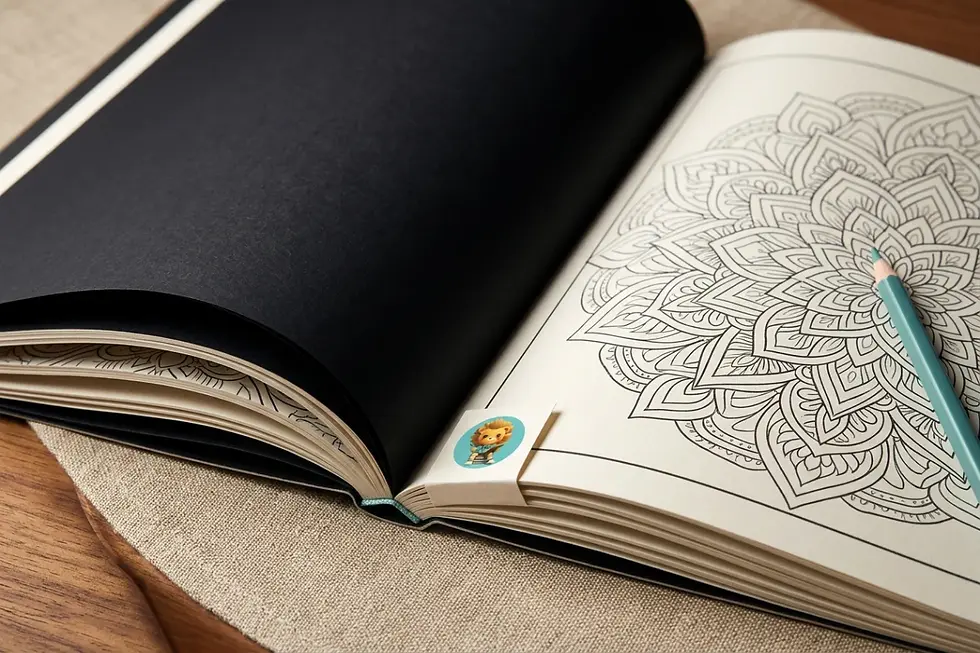
Black flood coat backing on single-sided pages absorbs strike-through and preserves aesthetic finish.
How Do Coloring Mediums and Target Users Determine Page Format Selection?
Coloring medium viscosity, solvent composition, and user demographic drive the technical specification process in custom coloring book manufacturing. Selecting the wrong format leads to consumer dissatisfaction, high return rates, and negative retail reviews caused by ink penetration.
Adult coloring enthusiasts, craft hobbyists, and institutional art therapy users favor single-sided coloring books. These demographics predominantly color with alcohol-based markers (such as dual-tip sketch markers), fine-liner pigment pens, acrylic paint markers, and heavy wet-in-wet watercolor techniques. Alcohol marker formulations utilize fast-evaporating organic solvents that instantly saturate cellulose paper fibers, creating capillary dispersion that bleeds through standard uncoated paper stocks regardless of GSM. Single-sided designs accommodate this chemical bleed by isolating each design on its own paper leaf. When an end-user places an underlying blotter sheet beneath the active page, the adjacent designs remain protected.
Conversely, children's coloring books, classroom novelty workbooks, and value-tier retail activity sets rely on double-sided formatting. The primary tools used by children under 10 years old are paraffin wax crayons, oil pastels, and wax- or oil-based colored pencils. These dry drawing tools rely on physical friction to deposit pigment binders onto the surface tooth of the paper without chemical fiber penetration. Because wax and dry binders do not liquefy or seep into capillary voids, double-sided printing provides double the coloring content without risking artwork damage, matching the lower price expectations of mass-market retail.
Adult and Premium Segment: Standardizes on single-sided formats to facilitate page removal, framing, multi-layer solvent blending, and zero risk to sequential artwork.
Early Childhood and Activity Segment: Standardizes on double-sided formats to deliver 80 to 128 coloring activities in compact, cost-efficient signatures.
Mixed Media and Educational Workbooks: Frequently utilizes alternating formats, pairing a single-sided detailed coloring page with a double-sided text or tracing prompt.
What Paper GSM and Opacity Standards Prevent Coloring Book Bleed-Through?
Preventing coloring book paper bleed through requires an engineering balance between basis weight (GSM), paper sizing, fiber density, and surface opacity. Paper opacity is measured as a percentage of light prevented from passing through the sheet; values above 94% are necessary for double-sided dry coloring, whereas wet markers bypass opacity entirely through solvent dispersion.
For double-sided coloring books using colored pencils and crayons, standard uncoated woodfree (offset) paper ranging from 100 GSM to 120 GSM provides sufficient bulk and opacity. At 100 GSM, uncoated offset offers approximately 92% to 94% opacity, which keeps pencil outlines from visible "show-through" (ghosting). For higher-tier double-sided books where users may introduce light water-based felt-tip pens, standardizing on 140 GSM to 160 GSM premium woodfree paper is essential. These higher GSM papers feature internal surface sizing—chemical additives like alkyl ketene dimer (AKD) that increase water resistance and retard liquid uptake into the pulp matrix.
For single-sided coloring books, selecting paper is less about preventing solvent strike-through and more about tactile tooth, sheet stiffness, and blotter performance. Single-sided books utilize paper weights from 120 GSM up to 200 GSM uncoated woodfree stock, or 180 GSM to 240 GSM medium-tooth drawing paper. Heavyweight stock gives the physical leaf adequate stiffness when bound into large-format books, preventing paper buckling when exposed to liquid markers or watercolor washes.
Paper Grade Selection Matrix
Double-Sided Economy (Crayons/Pencils): 80 - 100 GSM Uncoated Offset (Opacity: 88-92%)
Double-Sided Standard (Pencils/Light Markers): 120 - 140 GSM Premium Woodfree (Opacity: 94-96%)
Single-Sided Premium (Water-based Gel Pens/Brush Pens): 140 - 160 GSM Art Stock (Opacity: 96-98%)
Single-Sided Mixed Media (Alcohol Markers/Watercolor): 180 - 240 GSM Heavy Drawing Paper (Opacity: 99%+)
Lion Paper Products incorporates FSC-certified virgin pulp and controlled-recycled stocks across its Jiaxing and Cambodia manufacturing centers, verifying caliper consistency and smoothness values (Sheffield 120–160) to ensure zero feathering across diverse ink formulas.

Higher paper GSM and internal sizing prevent liquid markers from feathering and penetrating the sheet.
Which Binding Methods and Perforation Options Work Best for Each Format?
Binding structures directly dictate how flat a coloring book opens and whether pages can be cleanly removed for display. The structural choice depends on page count, target spine bulk, and single versus double-sided orientation.
Wire-O and Spiral Binding
Double-loop wire-o and plastic spiral binding are ideal for single-sided coloring books. These mechanical bindings allow 360-degree rotation, enabling the user to fold the front cover completely behind the book and work on a rigid, perfectly flat surface. Because single-sided books often utilize heavy 160+ GSM stock, wire-o binding eliminates the tension along the spine that usually causes adhesive-bound books to snap shut.
Perfect Binding and Lay-Flat Thread-Sewn Binding
Perfect binding (PUR or EVA adhesive) is standard for high-page-count double-sided and single-sided coloring books sold in trade bookstores. However, standard EVA adhesive restricts page opening near the gutter. In double-sided formats, intricate illustrations running close to the center margin get lost inside the spine pinch. For premium lines, lay-flat thread-sewn (Swiss binding or exposed spine binding) allows double-page spreads to open 180 degrees flat without cracking the spine.
Saddle Stitching
For low-page-count products (16 to 48 pages), wire saddle stitching provides the most cost-efficient binding. Saddle stitching works seamlessly for children's double-sided activity books using 80–100 GSM paper. However, single-sided books bound with saddle stitching feel physically thin, requiring minimum sheet thresholds to achieve commercial retail weight.
Micro-Perforation Technology
Perforations are critical for single-sided coloring books. Placing a high-density micro-perforation line (30 to 50 teeth per inch) approximately 10mm to 15mm from the spine gutter allows users to cleanly tear out their finished artwork without destroying the binding. In double-sided books, perforation is rarely used because removing one sheet tears out two active illustrations, breaking the narrative or structural continuity of the book.
Binding Method | Lay-Flat Capability | Best Suited Format | Perforation Compatibility | Relative Cost Tier | |
|---|---|---|---|---|---|
:--- | :--- | :--- | :--- | :--- | :--- |
Saddle Stitch | High (in low page counts) | Double-Sided (16-48 pp) | Moderate (spine stability risk) | Economy Tier | |
Perfect Bound (PUR) | Moderate | Single & Double (64-160 pp) | High (with 12mm gutter margin) | Standard Commercial | |
Thread-Sewn Lay-Flat | Complete 180° flat | Single & Double Spreads | Low | Premium Mid-Tier | |
Wire-O / Spiral | Complete 360° rotation | Single-Sided Art Books | Not Required / Optional | Premium Craft Tier |
How Do Layout Formats Impact Production Costs, Page Count Economics, and Retail Sets?
From a custom coloring book manufacturing perspective, single-sided vs double-sided coloring book formats yield distinct unit cost structures. The primary cost drivers are paper volume, press signature imposition, plate consumption, and shipping container load efficiency.
A single-sided book containing 50 coloring illustrations requires 50 physical sheets (leaves), translating to 100 book pages in manufacturing nomenclature. A double-sided book containing 50 illustrations requires only 25 physical sheets (50 book pages). Because raw paper stock represents 40% to 60% of total printed product manufacturing costs, a single-sided book incurs roughly double the paper material expenditure for the same number of individual coloring designs.
Comparative Unit Economics: 50 Designs Run at 10,000 Units ┌────────────────────────────────────────────────────────┐ │ Single-Sided: 50 Leaves (100 Page Body) │ │ • Paper Mass: ~380g per unit (140 GSM Stock) │ │ • Press Imposition: 3.125 Signatures (32pp master form)│ │ • Pallet Capacity: ~1,200 units per standard pallet │ │ • Landed Unit Cost Baseline: 1.65x - 1.85x │
┘ ┌────────────────────────────────────────────────────────┐ │ Double-Sided: 25 Leaves (50 Page Body) │ │ • Paper Mass: ~190g per unit (140 GSM Stock) │ │ • Press Imposition: 1.56 Signatures (32pp master form) │ │ • Pallet Capacity: ~2,400 units per standard pallet │ │ • Landed Unit Cost Baseline: 1.0x (Reference Index) │
┘
Beyond raw materials, single-sided formats influence retail packaging sets and freight density. The added thickness of single-sided books increases carton dimensions and reduces pallet density by up to 50%, resulting in higher ocean freight and Amazon FBA fulfillment fees per artwork unit. However, single-sided products command retail prices 40% to 100% higher than double-sided activity books in consumer channels, creating healthy gross margin dollars for stationery brands.
Retailers often pair single-sided coloring books with complementary product extensions, such as bundled fine-liner marker sets, detachable rigid backing boards, or customized gift packaging boxes. Lion Paper Products supports these configurations by integrating paper manufacturing with accessory sourcing, rigid box assembly, and multi-piece retail kitting across its dual-site manufacturing facilities.

Binding options and micro-perforated edges tailored for commercial retail collections.
What Pre-Press Specifications and QC Protocols Are Required for Manufacturing?
Achieving flawless print runs for coloring books requires strict adherence to coloring book printing specifications and quality control procedures before plates are burned and ink hits the press blanket.
Pre-Press File Configuration
Line art files must be supplied as vector PDFs or 1200 DPI bitmap (1-bit) TIFF files. Line art rendered at 300 DPI grayscale often generates visible anti-aliasing (halftone screen dots) on line edges, resulting in fuzzy margins rather than clean, solid black boundaries. Minimum line weight should not fall below 0.5 pt (0.175 mm) to prevent line drop-out during high-speed offset plate exposure.
Bleed and Margin Tolerances
Full-Bleed Designs: Require a minimum 3 mm (0.125 in) bleed extending past the trim line on all exterior edges.
Safe Margins: Keep critical visual elements at least 8 mm inside the trim line for saddle stitch and wire-o, and at least 15 mm away from the gutter for perfect-bound books to prevent art from entering the spine glue zone.
Solid Black Backing Imposition: For single-sided layouts using black verso flood coats, ensure a 5 mm white border buffer is maintained at the gutter edge to prevent solvent-heavy black offset inks from contaminating the binding adhesive seam.
Quality Control and Compliance Protocol
During mass production, Lion Paper enforces ISO 9001 standardized operating procedures and AQL 2.5/4.0 defect inspection protocols across our 3,000 m² Jiaxing prototyping hub and 10,000 m² Cambodia production facility. Internal QC teams inspect paper caliper consistency, ink optical density (D-max minimum 1.80 for rich line contrast), sheet squareness, perforation tear resistance, and binding glue adhesion tensile strength.
All materials comply with CPSIA, ASTM F963, and European EN 71 safety regulations for children's goods, ensuring heavy-metal-free inks and non-toxic adhesives. Facilities maintain active audit compliance with FSC, SMETA, FAMA, GSV, and WCA standards.
To begin your production run, send your trim size, page count, target coloring medium, binding preference, artwork files, and target retail packaging specifications to the engineering team at Lion Paper's project review team for a complete manufacturability and costing review.
FAQ
Can I use alcohol markers on double-sided coloring books?
Alcohol markers are not recommended for double-sided coloring books. Alcohol solvents penetrate through cellulose paper fibers regardless of standard paper GSM, which inevitably bleeds through and ruins the illustration on the reverse side. Alcohol markers require single-sided printing combined with a removable backing sheet.
What is the industry standard paper weight for an adult single-sided coloring book?
The industry standard paper weight for high-quality adult single-sided coloring books ranges between 140 GSM and 180 GSM uncoated woodfree (offset) paper. For professional artist editions supporting wet media or watercolors, paper weight typically increases to 200 GSM to 240 GSM.
Why do some single-sided coloring books have black ink printed on the back of every page?
Black ink printed on the verso (back) of single-sided pages serves as a visual barrier. If wet inks or markers bleed through the paper fibers, the black background masks the bleed spots, preventing unsightly ink stains and maintaining a clean visual appearance across the book.
How does page count differ between single-sided and double-sided catalog specifications?
In commercial printing terminology, a 'page' refers to one side of a sheet, while a 'leaf' or 'sheet' has two pages. A 40-artwork single-sided book contains 40 sheets (80 total catalog pages, with 40 printed and 40 blank/black). A 40-artwork double-sided book requires only 20 sheets (40 total printed catalog pages).


Comments