


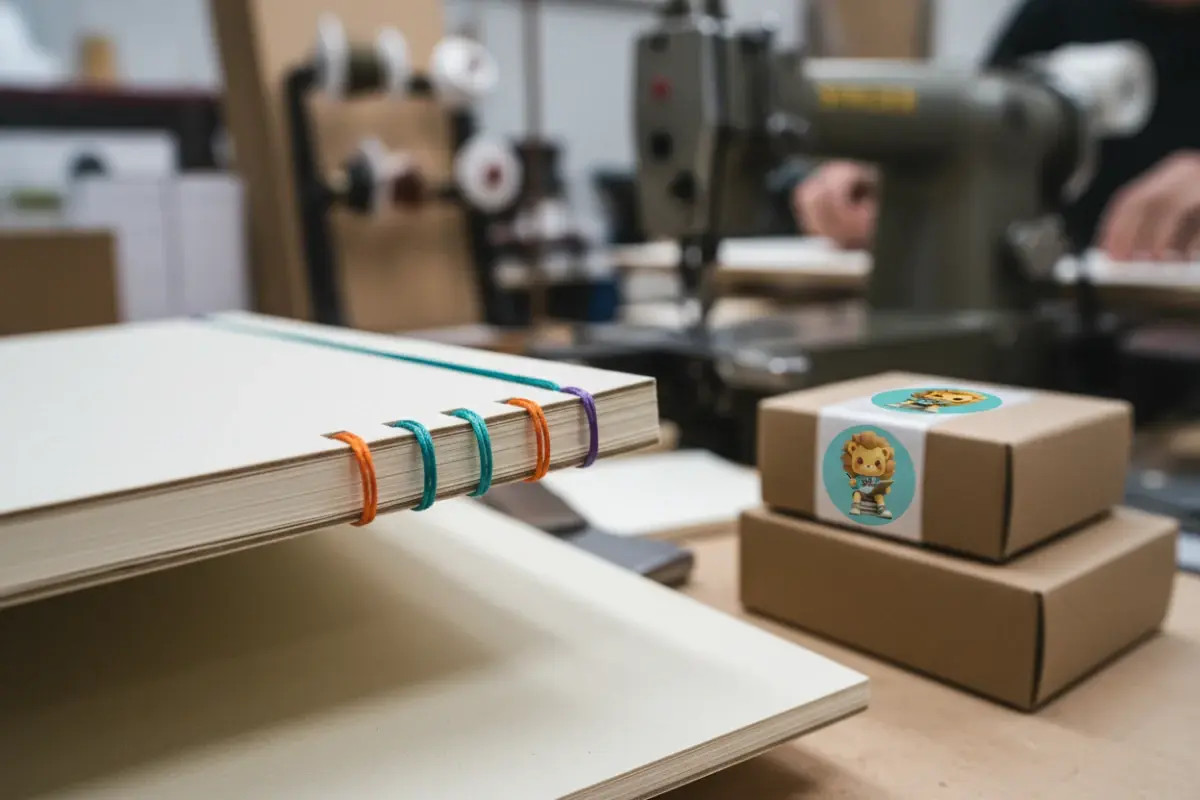
Singer Sewn Stitch Length and Tension: Engineering Specifications and Manufacturing Guide

In Singer sewn notebook manufacturing, stitch length and thread tension directly determine spine strength, page lay-flat performance, and sheet integrity. Calibrating stitch length between 4.0 mm and 6.0 mm (4 to 6 stitches per inch) alongside balanced top and bottom thread tension prevents the "postage stamp effect"—paper perforation tears along the fold—while eliminating loose signatures and spine puckering across various paper weights.
What Are the Ideal Singer Sewn Stitch Length and Tension Settings for Notebooks?
Setting accurate Singer sewn stitch length and tension requires balancing mechanical hold against the structural shear resistance of folded paper stock. In industrial bookbinding, standard mechanical settings depend on page count, text block caliper, and paper grammage (GSM).
When sewing through a spine fold, the needle cuts through cellulose fibers. If the stitch length is too short, the high concentration of needle penetrations compromises the paper spine, leading to seam failure. Conversely, if the stitch length is too long, the mechanical grip loosens, allowing interior leaves to shift or pull out under tensile stress.
Specification Parameter | Light Text Blocks (32–48 Pages / 70–80 GSM) | Medium Text Blocks (48–80 Pages / 80–100 GSM) | Heavy / Mixed Blocks (80–128 Pages / 100–140 GSM) | ||||||||
|---|---|---|---|---|---|---|---|---|---|---|---|
:--- | :--- | :--- | :--- | :--- | :--- | :--- | :--- | :--- | :--- | :--- | :--- |
Stitch Length (mm) | 4.0 mm – 4.5 mm | 4.5 mm – 5.5 mm | 5.0 mm – 6.5 mm | ||||||||
Stitches Per Inch (SPI) | 5.5 – 6.0 SPI | 4.5 – 5.5 SPI | 4.0 – 4.5 SPI | ||||||||
Needle System & Size | 134-35 (R or SES) / NM 90–100 | 134-35 (R or SD1) / NM 100–110 | 134-35 (SD1) / NM 110–130 | ||||||||
Top Thread Tension (cN) | 110 – 130 cN | 130 – 160 cN | 160 – 210 cN | ||||||||
Bobbin Thread Tension (cN) | 90 – 110 cN | 110 – 135 cN | 135 – 175 cN | ||||||||
Thread Type & Ticket Size | Poly-Poly Core 50–60 / Cotton #40 | Poly-Poly Core 36–40 / Cotton #30 | High-Tenacity Poly Core 25–30 / Bonded Nylon 40 |
Achieving optimal Singer sewn notebook binding specifications involves dynamic calibration on the production line. Technicians adjust the feed dog stroke, presser foot pressure, and disc tension units so that the upper and bobbin threads lock precisely in the center plane of the folded signature.
How Does Stitch Length Prevent Paper Perforation and Spine Tearing?
Managing Singer stitch density paper tearing requires understanding how needle penetrations affect paper tensile strength. When an industrial needle pierces paper, it creates micro-fractures in the surrounding cellulose matrix. When multiple needle holes are placed in close proximity along the spine crease, the remaining paper bridges between punctures weaken under mechanical shear.
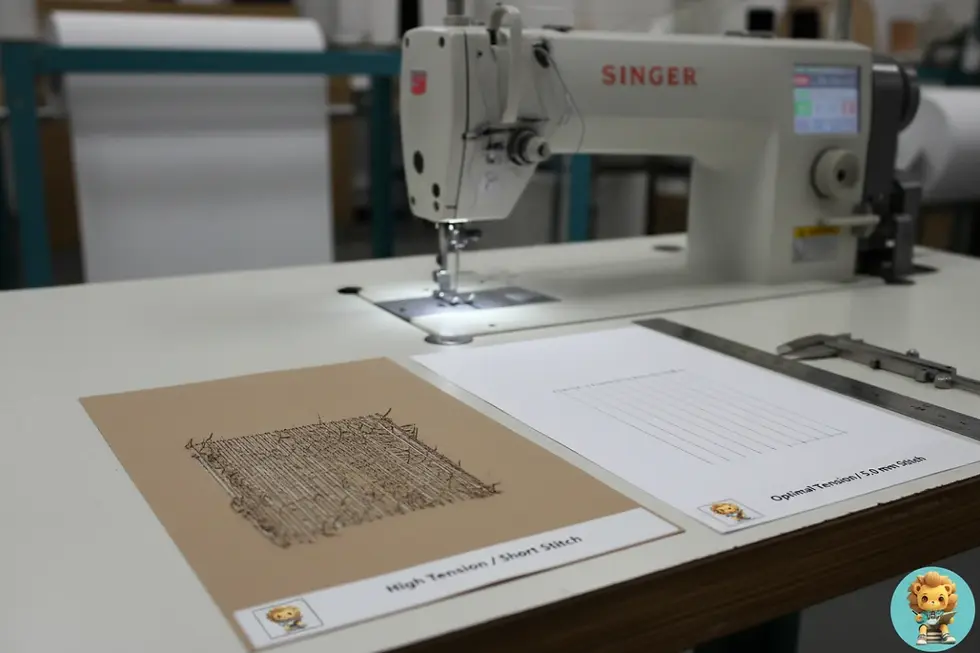
Calibrating stitch length avoids the postage stamp effect and preserves paper fiber strength along the spine fold.
The Mechanics of the Postage Stamp Effect
The "postage stamp effect" occurs when stitch density exceeds the tear threshold of the paper sheet. In high-density stitching (e.g., stitch lengths below 3.5 mm or greater than 7 stitches per inch), the ratio of pierced void space to intact paper fiber along the spine fold line becomes critically unbalanced:
Crease Weakening: Scoring and folding paper stretches outer fibers and compresses inner fibers, pre-stressing the sheet along the spine line.
Fiber Rupture: Needle penetration shears the folded paper fibers. High puncture density leaves insufficient fiber bridge width to support leaf turning.
Dynamic Stress Concentration: When an end-user opens the notebook flat, the lever arm of the leaf directs concentrated peel force directly onto the micro-fractures between needle holes.
To prevent perforation tears, maintain a minimum fiber bridge width of 3.5 mm between successive needle holes on uncoated woodfree paper, and at least 4.5 mm on coated art papers or high-density recycled stocks.
Paper Grain Direction and Stitch Length Selection
Paper grain orientation relative to the spine fold significantly impacts the risk of tearing:
Grain Long (Grain Parallel to Spine): The fold runs parallel to fiber alignment. This makes folding easier and reduces spine bulking, but paper tears more easily along the grain line. Stitch lengths should be lengthened slightly (by +0.5 mm to +1.0 mm) to increase fiber bridge distance.
Grain Short (Grain Perpendicular to Spine): Fibers cross the fold line, resisting spine tear-out. However, folding against the grain introduces cross-fiber stiffness and micro-cracking during scoring. Stitch tension must be lowered to avoid edge buckling.
How Does Thread Tension in Book Sewing Control Lay-Flat Quality and Spine Bowing?
Calibrating thread tension in book sewing requires balancing tension so the lockstitch junction sits within the center leaf of the signature rather than protruding on the outside spine or inside spread.
   CORRECT TENSION BALANCE (Interlock at Spine Midpoint)
   Outside Cover Layer ───[ Top Thread Loop ]───
                                ▲
                        Interlock Point (Center Fold)
                                ▼
   Inside Center Leaf  ───[ Bobbin Thread Loop ]───

   EXCESSIVE TOP TENSION (Pull-Through & Puckering)
   Outside Cover Layer ───[ Tight Top Thread ]─── (Puckered Spine)
                                ▲
   Inside Center Leaf  ───[ Interlock Pulled High ]─── (Visible Knot Inside)
Causes and Remedies of Common Tension Defects
Spine Puckering and Cockling: When upper needle thread tension is excessively high relative to the paper caliper, the thread compresses the signature along the stitch line, creating undulating ripples or bowing along the spine. Solution: Reduce upper disc tension by 15–20% and verify that the presser foot is not dragging during feed cycles.
Spine Bowing (Arching): High bobbin tension combined with tight needle tension creates sustained elastic contraction along the spine, causing the notebook to curve upward when laid on a flat surface. Solution: Balance bobbin case spring resistance to release thread smoothly at standard pull forces (90–135 cN depending on thread gauge).
Loose Signatures and Leaf Dropping: Insufficient tension allows slack loops along the inner fold. When the notebook is opened, inner pages shift laterally, exposing the thread channel and destabilizing binding integrity. Solution: Incrementally increase tension on both channels until the thread seats firmly against the paper without indenting the surface.
Thread Knot Migration: When needle tension and bobbin tension are uneven, the interlocking knot is pulled completely to either the exterior spine or interior gutter. Solution: Use a mechanical tension gauge to balance both thread paths so the lock occurs within the internal signature sheets.

Balanced top and bottom thread tension ensures the lockstitch interlocks within the center of the signature.
Which Needle Sizes and Thread Materials Match Different Paper GSM and Calipers?
In custom sewn notebook manufacturing, needle selection and thread composition directly influence stitch consistency, frictional heat generation, and puncture clean-cut quality.
Needle Point Geometry for Paper Binding
Unlike textile sewing where ballpoint needles push aside fabric yarns, bookbinding operations require specialized needle points that create clean, controlled punctures through compressed paper sheets:
Round Point (R): Standard point profile for general uncoated paper stocks (70–100 GSM). Creates a round hole with minimal fiber shearing.
Small Ball Point (SES): Recommended for lightweight and delicate tissue-like stocks to minimize transverse fiber fracturing.
Cross Cutting / Precision Diamond Point (SD1): Features a polished micro-triangular or lens tip designed for dense coated art papers, synthetic paper stocks, and laminated covers. It reduces piercing force and heat buildup during high-speed multi-sheet penetration.
Thread Types and Performance Attributes
Polyester-Wrapped Polyester Core (Poly-Poly Core): Offers high tensile strength, uniform elongation, and friction resistance. Resists rot and environmental moisture fluctuations, making it suitable for long-lasting journals and corporate stationery.
100% Glace Cotton Thread: Delivers an organic, matte aesthetic suited for eco-friendly notebooks. Cotton embeds into paper fibers with zero static electricity, though it requires slightly higher needle thread clearance to prevent lint accumulation in the tension discs.
Bonded Nylon: Used for heavy-duty notebooks (exceeding 96 pages of high-caliper paper) where extreme tensile strength is needed to resist signature pull-out.
What Are the Key Defect Standards and Quality Control Metrics for Custom Sewn Notebook Manufacturing?
Industrial quality assurance for Singer sewn binding uses ISO 9001-aligned standard operating procedures (SOPs), AQL (Acceptable Quality Limit) sampling, and standardized defect catalogs to ensure reliable performance across mass-production runs.
         PULL-OUT TENSILE STRENGTH TESTING
                 ┌────────────────┐
                 │ Clamping Fixture│ (Top Clamp on Single Leaf)
                 └───────▲────────┘
                         │ Pull Force (F ≥ 25 N)
                   [Paper Sheet]
                         │
                 ════════╪════════  (Spine Fold & Stitch Line)
                 ┌───────▼────────┐
                 │ Spine Base Jig │ (Secured at Gutter)
                 └────────────────┘
Critical Quality Inspection Checkpoints
Tensile Pull-Out Test (Leaf Retention Force): A single center leaf is clamped in a calibrated tensiometer and pulled perpendicularly from the spine at a constant rate (100 mm/min). The target leaf retention force must meet or exceed 20 N for lightweight sheets (70–80 GSM) and 28 N for heavyweight sheets (100–120 GSM) before fiber rupture occurs.
Tear Resistance Along the Crease: Fold endurance and puncture bridge strength are evaluated by cycling leaves 180 degrees back and forth under moderate load. Zero spine perforation tearing should occur across a minimum of 50 manual turns.
Tail Thread Trim & Lock Integrity: Tail threads at the head and foot of the spine must be cut flush or back-tacked depending on product specifications. Thread tails must not unravel under a 5 N pull force, and knot interlocks must remain seated inside the paper fold.
Spine Alignment & Skew: The stitch line must run along the creased apex of the spine fold. Lateral deviation must not exceed ±0.5 mm across the spine length to prevent asymmetrical leaf dimensions.

Custom Singer sewn notebook manufacturing combining lay-flat durability with sustainable paper materials.
How Does Lion Paper Engineer Reliable Singer Sewn Notebook Binding Specifications?
Founded in 2015 in Jiaxing, Zhejiang, Lion Paper Products (Jiaxing) Co., Ltd. provides end-to-end supply-chain solutions for customized paper goods and creative products. We bridge design concepts and mass production, serving brands, retail chains, and e-commerce platforms worldwide.
Design-to-Manufacturing Integration
Our China–Cambodia dual-site model ensures rapid engineering development and dependable production:
Jiaxing R&D Center (3,000 m²): Focuses on concept structural design, paper-to-thread calibration, rapid physical sampling, and custom prototyping. Our engineering team calculates spine clearances, punch diameters, and thread tensile ratios to optimize each notebook before mass production.
Cambodia Mass Production Facility (10,000 m²): Delivers scalable production, total-cost efficiency, and consistent lead times. Equipped with automated precision stitching lines and standardized SOPs, our operations produce over 5 million notebooks annually.
End-to-End Compliance and Quality Assurance
Lion Paper applies ISO-aligned process controls, AQL sampling standards, and defect catalogs to maintain batch-to-batch consistency. Our operations are supported by ISO 9001, FSC, SMETA, WCA, GSV, FAMA, and CPSIA audit capabilities. We offer FSC-certified papers, recycled post-consumer stocks, low-impact inks, and recyclable packaging for brands targeting sustainable sourcing goals.
To optimize your next notebook project, Send page count, paper GSM, cover and binding target; request a sewn-notebook feasibility and sample review.
Frequently Asked Questions
What is the difference between Singer sewn binding and saddle stitch binding?
Singer sewn binding uses a continuous thread lockstitch or chainstitch along the folded spine, creating a durable, decorative, and lay-flat finish with zero metal parts. Saddle stitch binding uses wire staples through the spine. Singer sewing offers higher aesthetic value, avoids rusted metal staples, and is fully recyclable with the paper block.
Can Singer sewn binding support notebooks with more than 96 pages?
Singer sewing works best on single-signature text blocks ranging from 16 to 96 pages (8 to 48 sheets), depending on paper GSM and caliper. Beyond 96–128 pages, spine thickness increases paper bulk at the fold, which can cause needle deflection, thread tension imbalances, and a rounded spine. For thicker books, multi-signature Smyth sewn or section-sewn binding is recommended.
How are loose thread ends secured at the head and foot of the notebook spine?
Thread tails can be handled in three ways: back-tacking (reverse stitching 2–3 stitches over the seam ends to lock the knot), flush mechanical trimming with an adhesive anchor dot, or leaving extended decorative tails (15–30 mm) for an artisanal aesthetic. Back-tacking is the most durable industrial method for retail products.
How does paper grain direction affect Singer sewing quality?
Running the paper grain parallel to the spine fold (grain long) allows the notebook to open smoothly and lie flat. However, because paper tears more easily along the grain, stitch length must be set between 4.5 mm and 6.0 mm to maintain sufficient fiber bridge strength between needle holes. Running paper grain short provides higher tear resistance along the spine, but creates spine bulking and resists laying flat.
FAQ
What is the difference between Singer sewn binding and saddle stitch binding?
Singer sewn binding uses a continuous thread lockstitch or chainstitch along the folded spine, creating a durable, decorative, and lay-flat finish with zero metal parts. Saddle stitch binding uses wire staples through the spine. Singer sewing offers higher aesthetic value, avoids rusted metal staples, and is fully recyclable with the paper block.
Can Singer sewn binding support notebooks with more than 96 pages?
Singer sewing works best on single-signature text blocks ranging from 16 to 96 pages (8 to 48 sheets), depending on paper GSM and caliper. Beyond 96–128 pages, spine thickness increases paper bulk at the fold, which can cause needle deflection, thread tension imbalances, and a rounded spine. For thicker books, multi-signature Smyth sewn or section-sewn binding is recommended.
How are loose thread ends secured at the head and foot of the notebook spine?
Thread tails can be handled in three ways: back-tacking (reverse stitching 2–3 stitches over the seam ends to lock the knot), flush mechanical trimming with an adhesive anchor dot, or leaving extended decorative tails (15–30 mm) for an artisanal aesthetic. Back-tacking is the most durable industrial method for retail products.
How does paper grain direction affect Singer sewing quality?
Running the paper grain parallel to the spine fold (grain long) allows the notebook to open smoothly and lie flat. However, because paper tears more easily along the grain, stitch length must be set between 4.5 mm and 6.0 mm to maintain sufficient fiber bridge strength between needle holes. Running paper grain short provides higher tear resistance along the spine, but creates spine bulking and resists laying flat.


Comments