


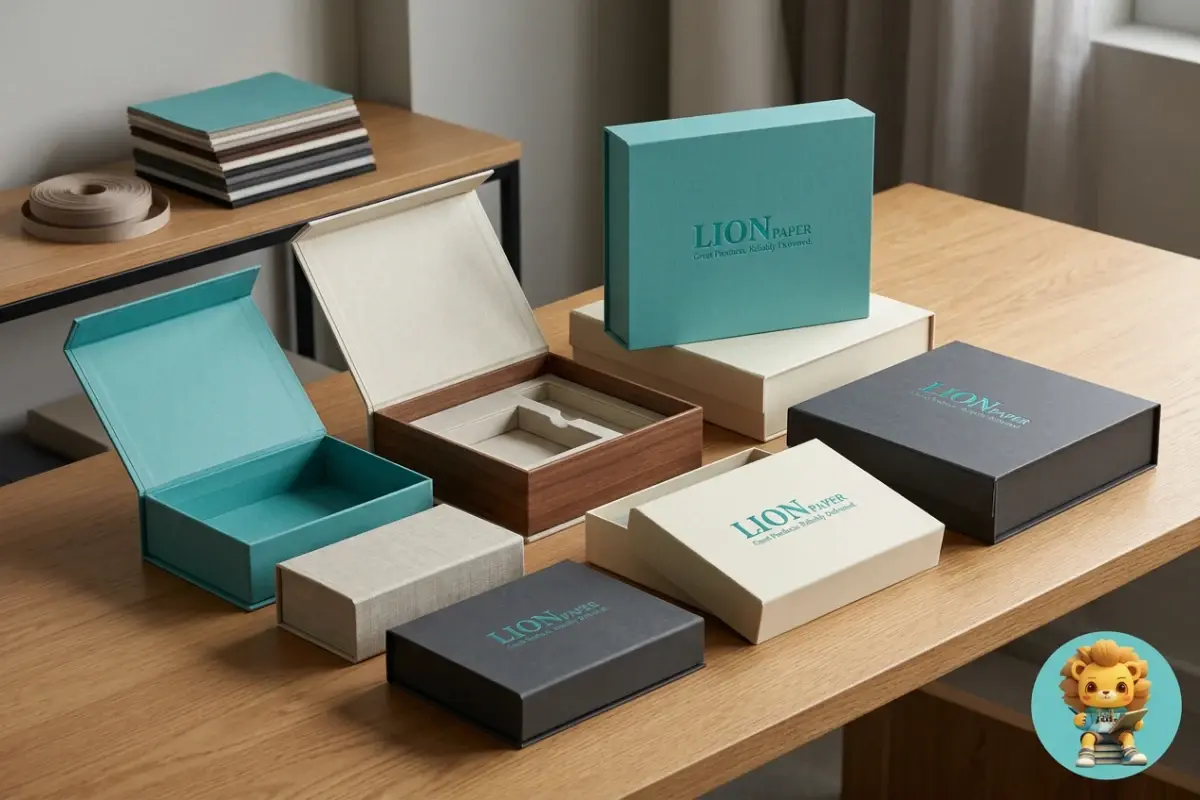
Comprehensive Guide to Rigid Box Packaging: Structures, Materials, and Manufacturing

A rigid box is a high-strength, premium packaging solution constructed from dense paperboard—typically 1.2 mm to 3.0 mm thick greyboard—wrapped in custom-printed or decorative specialty paper. Unlike folding cartons, rigid setup boxes do not collapse flat, delivering superior structural protection, exceptional tactile weight, and an elevated unboxing experience for luxury gift sets, consumer goods, and branded stationery collections.
What Is a Rigid Box and Why Choose It for Premium Gift Packaging?
In retail presentation and consumer goods logistics, packaging serves both a protective and a communicative function. A rigid box—frequently called a rigid setup box—represents the highest tier of paper packaging. It consists of a solid, pre-formed core board wrapped securely with glued outer facing paper. Because these boxes are formed into permanent three-dimensional shapes at the factory, they provide structural rigidity that folding cartons cannot match.
Brands select custom rigid gift boxes when the unboxing experience directly correlates with perceived product value. The substantial hand-feel, sharp clean edges, and precise lid tolerances create a tactile sensory response that signals quality before the end user even touches the product inside.
Packaging Type | Base Material & Caliper | Assembly Method | Crush Resistance | Perceived Value Tier | Typical Application Scenarios |
|---|---|---|---|---|---|
:--- | :--- | :--- | :--- | :--- | :--- |
Rigid Setup Box | 1.2 mm–3.0 mm Solid Greyboard | Pre-assembled, glued wrap | High (Load-bearing) | Luxury / Premium | Executive gift sets, fine stationery, jewelry, electronics |
Folding Carton | 250 gsm–450 gsm SBS / CCNB | Folded flat, glued seams | Low to Moderate | Standard / Retail | Cosmetics, retail stationery singles, food packaging |
Corrugated Mailer | Fluted board (E-flute, B-flute) | Folded on score lines | Moderate to High | Functional / E-commerce | Transit shipping, subscription boxes, bulk outer packaging |
Working with an experienced rigid box packaging manufacturer enables brands to solve three primary product challenges:
Structural Protection: The dense chipboard substrate shields delicate contents—such as hardcover journals, premium pens, accessories, and promotional sets—from compressive impact during retail stacking and customer transit.
Brand Differentiation: The non-collapsible form factor supports complex opening rituals, including smooth friction-fit telescopic lids, magnetic book-style clasps, and sliding drawer systems.
Post-Purchase Reusability: Due to their structural durability, end consumers frequently retain rigid boxes for desk organization, keepsake storage, or home use, extending brand impressions over months or years.

Rigid boxes can be customized into telescopic, magnetic, and drawer formats depending on product dimensions and retail goals.
What Are the Core Structural Styles and Material Specifications for Custom Rigid Boxes?
Choosing the correct box architecture depends on product dimensions, retail display requirements, unboxing sequence, and total cost targets. Custom rigid gift boxes fall into five primary structural classifications:
1. Telescopic Rigid Boxes (Lid and Base)
The two-piece telescopic design is a classic packaging configuration. It consists of an independent lid fitting over a corresponding base tray.
Full-Telescope: The lid depth equals the base depth, covering the entire body for maximum wall reinforcement and clean aesthetics.
Partial-Telescope: The lid covers only part of the base height, reducing material consumption and allowing a contrasting base color to remain visible.
Friction Fit Engineering: Precision air-release gaps are calculated during prototyping to create a controlled, slow-drop opening effect without catching.
2. Magnetic Closure Rigid Boxes (Book-Style and Flip-Top)
Magnetic boxes integrate hidden neodymium disc magnets inside the front flap and base wall. Built like a casebound hardcover book, the outer wrap forms a continuous hinge enclosing an internal three-sided tray. This design combines the convenience of flat-lid opening with an audible magnetic snap, making it a standard choice for luxury gift box development.
3. Drawer and Slide Boxes (Matchbox Style)
Composed of an outer rigid sleeve (shell) and an internal slide-out tray, drawer boxes open horizontally. Designers often add ribbon pulls, PU leather tabs, or die-cut thumb notches on the tray face to make opening intuitive. They are widely used for multi-component stationery kits, desk organizers, and tech accessory bundles.
4. Shoulder and Neck Boxes (Three-Piece Construction)
A shoulder box incorporates an inner collar (neck) glued inside the base that extends upward, providing a ledge upon which the lid rests.
Exposed Neck: The lid and base do not touch when closed, revealing a decorative contrasting collar strip.
Flush Neck: The lid meets the base seamlessly, producing a continuous, level outer profile.
Substrate and Facing Paper Specifications
The core mechanical strength originates from the greyboard, while aesthetic presentation depends on the outer wrapping substrate.
Core Greyboard Density: Ranging from 800 gsm (approx. 1.2 mm) for compact desktop boxes up to 1800–2000 gsm (approx. 2.8–3.0 mm) for oversized presentation hampers. Dense, high-density recycled board prevents warping caused by humidity changes.
Art Paper Wraps (128 gsm–157 gsm): Coated paper optimized for high-resolution CMYK offset printing, pantone matching, and digital embellishments.
Specialty Textured Papers (110 gsm–140 gsm): Uncoated, mass-dyed, linen-embossed, metallic, or tactile virgin pulp sheets that provide distinct sensory qualities.
Eco-Conscious Kraft & Recycled Liners: FSC-certified post-consumer waste (PCW) stocks paired with unbleached kraft papers for clean-label, environmentally conscious retail brands.
How Do Custom Inserts and Surface Finishing Elevate Luxury Gift Box Development?
A complete rigid box system requires precise internal fitment and balanced exterior finishing. Inserts immobilize components during shipment while organizing items for an orderly presentation upon opening.
Insert Material Type | Production Process | Protective Cushioning | Sustainability Profile | Optimal Product Applications |
|---|---|---|---|---|
:--- | :--- | :--- | :--- | :--- |
Molded Paper Pulp | Slurry thermoforming | Medium to High | 100% Biodegradable & Recyclable | Eco-stationery, lifestyle tools, cosmetics, consumer electronics |
Die-Cut Cardstock | Scored paperboard folding | Moderate | Fully Recyclable (Zero plastic) | Notebooks, planners, card decks, lightweight desktop kits |
High-Density EVA Foam | CNC routing / die-stamping | High (Impact absorption) | Non-paper synthetic | Heavy corporate gifts, glassware, pens, delicate instruments |
Flocked Vacuum Trays | Thermoformed PET with velvet | Moderate | Recyclable polymer base | Premium promotional sets, jewelry, luxury writing instruments |

Molded paper pulp inserts and precision hot foil embellishments enhance both interior organization and outer shelf appeal.
Surface Embellishments and Finishing Techniques
Exterior wrapping papers undergo specialized print embellishments to reflect brand identity:
Hot Foil Stamping: Metallic, matte, or holographic foils applied via heated brass dies create sharp, reflective logos and typography.
Spot UV and High-Build Raised Varnish: Gloss polymer layers highlight specific patterns or text against a matte background, adding tactile depth.
Embossing and Debossing: Multi-level CNC-machined dies raise or recess graphic elements into the board, creating tangible dimension.
Soft-Touch and Anti-Scratch Lamination: Polypropylene films applied over printed sheets impart a velvety tactile finish while preventing scuffs during handling and transit.
What Quality Assurance, Compliance, and Transit Protection Standards Apply to Rigid Boxes?
Rigid box manufacturing requires disciplined quality management systems to maintain structural tolerances, surface adhesion, and dimensional stability across production batches. Environmental factors like humidity and shipping stress can cause delamination, warping, or scuffing if not controlled.
Critical Quality Testing Protocols
Board Moisture & Warp Resistance Testing: Greyboard must be conditioned to maintain moisture content between 8% and 12%. Automated gluing lines control water-based adhesive application to prevent board curling and corner splitting.
Glue Bonding & Peeling Shear Tests: Outer wraps and turn-ins undergo peel tests to verify that adhesives create permanent fiber-tear bonds across all surface materials.
Edge Crush & Compressive Stacking Analysis: Finished setup boxes are tested under vertical compression to confirm load capacities for palletization and long-distance shipping.
Drop Testing (ISTA 1A/2A Standards): Packaged prototypes loaded with production-weight components undergo rotational edge and corner drops to ensure structural integrity and insert security.
Standard Production Quality Control Workflow: Incoming Raw Material Inspection (Greyboard GSM, Paper Grain, Moisture) ↓ Precision Board Die-Cutting & Grooving (V-Groove / 90° Corner Cut) ↓ Corner Taping / Base Tray Forming ↓ Automated Wrap Gluing, Mounting & Turning-In ↓ Visual & Dimensional AQL Inspection (AQL 1.5 Major / 4.0 Minor) ↓ Custom Export Cartoning, Edge Protectors & Pallet Wrapping
Compliance, Audits, and Sustainability
International retail supply chains require comprehensive regulatory and ethical compliance. Rigid setup boxes intended for North American, European, and Australian distribution should conform to key framework standards:
FSC Chain of Custody (FSC-C): Guarantees that greyboard, papers, and corrugated liners derive from responsibly managed, traceable forests.
CPSIA & REACH Chemical Compliance: Verifies that heavy metals, phthalates, inks, and surface coatings comply with non-toxic consumer product requirements.
Social & Ethical Factory Audits: Validated compliance under SMETA (Sedex Members Ethical Trade Audit), WCA (Workplace Conditions Assessment), and FAMA frameworks.
Supply Chain Security: Maintenance of GSV (Global Security Verification) controls throughout international shipping channels.
How Can Brands Scale Rigid Box Production with Lion Paper’s Dual-Site Supply Chain?
Scaling custom packaging from initial design concepts to high-volume commercial production requires a balance of rapid prototyping, cost control, and dependable delivery schedules. Lion Paper Products (Jiaxing) Co., Ltd. supports global brands, retail chains, e-commerce sellers, and corporate clients through an integrated Design-to-Manufacturing framework.

Dual-site manufacturing operations combine advanced automation with strict quality controls for consistent global delivery.
China–Cambodia Dual-Site Manufacturing Synergy
Lion Paper operates a dual-facility production model designed to optimize launch speed and landed cost efficiency:
Jiaxing R&D & Prototyping Hub (3,000 sq.m.): Located in Zhejiang, China, this facility focuses on concept development, CAD structural packaging design, rapid 3D physical sampling, specialty material sourcing, and initial pilot runs. In-house designers and packaging engineers refine structural tolerances, insert layouts, and finishing proofs in close coordination with customer teams.
Cambodia Mass Production Base (10,000 sq.m.): Lion Paper’s Cambodia facility manages automated mass production and international container shipping. Automated rigid box forming lines, standardized visual SOPs, and dedicated assembly teams ensure consistent output, tariff advantages, and competitive landed costs for large-scale retail replenishment programs.
End-to-End Capabilities Across Product Categories
With an annual notebook and paper product output exceeding 5 million units, Lion Paper integrates custom rigid boxes with internal product lines across eight distinct categories:
Eco Paper Products & Notebook Collections: Hardcover journals, wire-bound notebooks, and stationery gift sets pre-fitted into custom boxes.
Planners, Calendars & Office Sets: Executive planner sets with matching pens, desk accessories, and complementary organizational tools.
Curated Lifestyle & Gift Packaging: Complete turn-key assembly for corporate gifting, seasonal retail collections, faith-based products, and creator-led merchandise lines.
By uniting design engineering, sustainable materials, and dual-site manufacturing, Lion Paper manages the entire packaging lifecycle from concept to delivery. Contact Lion Paper for custom stationery development and OEM solutions to plan your next packaging collection, review material options, and request customized production samples.
Frequently Asked Questions
What is the minimum order quantity (MOQ) for custom rigid gift boxes?
Custom rigid box production generally starts at an MOQ of 1,000 to 2,000 units per design. This volume accommodates efficient machine setup for board die-cutting, automated gluing, and custom exterior wrap printing. For multi-item collections or multi-SKU retail lines sharing identical structural dimensions, flexible grouping can often be arranged during sampling and pilot runs.
How does greyboard thickness affect box strength and shipping weight?
Greyboard thickness is specified by millimetric caliper or basis weight (gsm). A 1.5 mm board (approx. 1000 gsm) suits lightweight stationery, memo pads, and small accessories. A 2.0 mm board (approx. 1200–1400 gsm) serves as the industry standard for medium-to-large gift sets, providing solid crush resistance. Boards measuring 2.5 mm to 3.0 mm (1600–2000 gsm) are reserved for heavy corporate presentation sets and luxury merchandise. Selecting the appropriate board density balances physical protection with total shipping volume and container freight costs.
Are custom rigid boxes recyclable and eco-friendly?
Yes. When designed using FSC-certified greyboard cores, water-based adhesives, soy-based printing inks, and uncoated or aqueous-varnished paper wraps, rigid setup boxes are fully recyclable in municipal paper recovery streams. To maximize recyclability, brands frequently choose mono-material paper-pulp or die-cut cardstock inserts instead of conventional plastic EVA foam trays.
FAQ
What is the minimum order quantity (MOQ) for custom rigid gift boxes?
Custom rigid box production generally starts at an MOQ of 1,000 to 2,000 units per design. This volume accommodates efficient machine setup for board die-cutting, automated gluing, and custom exterior wrap printing. For multi-item collections or multi-SKU retail lines sharing identical structural dimensions, flexible grouping can often be arranged during sampling and pilot runs.
How does greyboard thickness affect box strength and shipping weight?
Greyboard thickness is specified by millimetric caliper or basis weight (gsm). A 1.5 mm board (approx. 1000 gsm) suits lightweight stationery, memo pads, and small accessories. A 2.0 mm board (approx. 1200–1400 gsm) serves as the industry standard for medium-to-large gift sets, providing solid crush resistance. Boards measuring 2.5 mm to 3.0 mm (1600–2000 gsm) are reserved for heavy corporate presentation sets and luxury merchandise. Selecting the appropriate board density balances physical protection with total shipping volume and container freight costs.
Are custom rigid boxes recyclable and eco-friendly?
Yes. When designed using FSC-certified greyboard cores, water-based adhesives, soy-based printing inks, and uncoated or aqueous-varnished paper wraps, rigid setup boxes are fully recyclable in municipal paper recovery streams. To maximize recyclability, brands frequently choose mono-material paper-pulp or die-cut cardstock inserts instead of conventional plastic EVA foam trays.


Comments