


Replacement Planner Inserts: Engineering, Standardization, and Sourcing Guide

Replacement planner inserts require standardized trim dimensions, tight spine tolerances, and strict paper caliper control to ensure seamless compatibility with reusable covers across multi-season replenishment cycles. Precision die-cutting, consistent hole punching, and high-opacity paper stocks prevent page overhang, mechanical binding jams, and bulk variations. Sourcing through integrated manufacturing partners guarantees that repeat wholesale batches maintain exact dimensional fidelity across successive annual product iterations.
What Defines the System Architecture of Modern Refillable Planner Systems?
Refillable planner systems decouple the durable outer housing from the consumable paper core. This architecture creates an ongoing product lifecycle where consumers retain a premium leather, faux leather, or polymer binder while replacing dated or topical contents each year. For stationery brands and enterprise buyers, this ecosystem shifts the business model from a single seasonal sale to high-margin recurring consumables.
The core system consists of three interacting structural layers:
The Outer Chassis / Cover: The permanent enclosure featuring mechanical ring mechanisms, elastic cord spines, sliding channels, or inner slip pockets designed to hold book blocks.
The Functional Insert Core: The consumable paper refills, encompassing daily, weekly, or monthly calendar grids, project management layouts, dot-grid note pages, and financial ledgers.
Modular Accessories: Polypropylene or cardstock tabbed dividers, snap-in rulers, storage pockets, and bookmark ribbons that integrate directly into the core mechanical binding.
When brands scale refillable planner systems, engineering consistency across production lots is paramount. A cover manufactured in one production cycle must seamlessly accommodate replacement planner inserts produced two or three seasons later. If paper density varies or punch centers drift by even a fraction of a millimeter, the entire physical user experience degrades, leading to increased return rates and customer attrition.
Why Is Planner Refill Standardization Critical for Cover Compatibility?
Planner refill standardization governs whether an insert turns smoothly without catching on mechanical hardware or protruding past the perimeter of the outer cover. In loose-leaf ring systems, discbound formats, and modular slip-in booklets, dimensional variance accumulates quickly across a multi-hundred-page book block.
Standard paper trimming must maintain a tolerance within plus or minus 0.5 mm to prevent uneven page alignment. For hole-punched formats, hole diameter and edge-to-hole margins dictate turning friction. If the punch is positioned too close to the paper edge, page tear-out risks increase; if punched too deep into the margin, the paper binds against the ring spine, preventing the planner from laying flat.
Planner Format / Size | Standard Insert Trim Dimensions (mm) | Binding Standard | Mechanical Punch Pitch / Margin |
|---|---|---|---|
:--- | :--- | :--- | :--- |
A5 Ring-Bound | 148 x 210 mm | 6-Ring Mechanism | 19-19-70-19-19 mm spacing, 5.5 mm hole diameter |
Personal / Medium Ring | 95 x 171 mm | 6-Ring Mechanism | 19-19-51-19-19 mm spacing, 5.0 mm hole diameter |
Pocket / Compact Ring | 81 x 120 mm | 6-Ring Mechanism | 19-19-19-19-19 mm spacing, 4.5 mm hole diameter |
Executive Discbound | 178 x 235 mm | 8-to-11 Disc System | 25 mm center pitch, mushroom-style punch profile |
Standard Traveler Booklet | 110 x 210 mm | Saddle-Stitch / Elastic Band | Flush-cut trim, square spine under 4.0 mm thickness |
B6 Slim Insert | 108 x 178 mm | Sewn Lay-Flat Softcover | 2.0 mm spine lip tolerance for inner slip pockets |
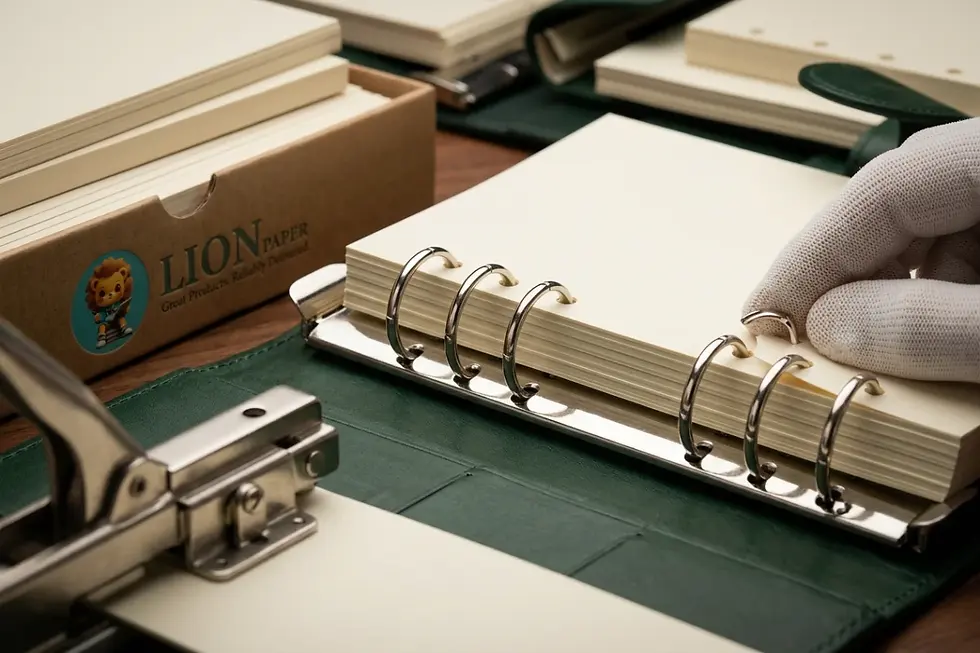
Consistent hole margin spacing ensures replacement inserts turn smoothly without catching on binder rings.
Standardizing these technical baselines allows private label brands to achieve broad compatibility with industry-standard hardware while maintaining custom layout branding. When organizing custom paper inserts wholesale, manufacturing facilities must lock down die-line blueprints and rigid calibration routines across punch tooling to prevent mechanical drift between replenishment runs.
Which Binding Formats Best Support Replacement Planner Inserts?
Choosing the correct binding structure dictates both consumer usability and assembly complexity during planner insert manufacturing. Each structural format addresses specific operational use cases, production economics, and retail price points.
1. Six-Ring Loose-Leaf Mechanisms
Six-ring mechanisms represent the traditional benchmark for executive and lifestyle planners. Precision hole-punch alignment is vital. Inserts are typically grouped in shrink-wrapped bundles, banded, or packaged in rigid slipcases. Tooling must deliver clean, burr-free punch cuts through heavy text paper stocks to prevent interlocking page edges.
2. Discbound Interlocking Systems
Discbound systems use proprietary mushroom-profile punches that snap over individual plastic or aluminum discs. The structural challenge in manufacturing discbound replacement planner inserts lies in paper tear resistance. The paper pulp formulation must feature long wood fibers to ensure the narrow punch stems withstand repeated insertion and removal without delaminating.
3. Slip-In Booklets (Saddle-Stitched or Thread-Sewn)
Booklet-style refills avoid mechanical metal rings entirely, sliding into cover sleeves or under internal elastic cord spines. These refills require tight spine folding and flat-press processing:
Saddle-Stitched Booklets: Cost-effective for lightweight monthly or project-based inserts (typically 32 to 64 pages). Wire staples must be placed accurately along the score line to avoid paper tearing.
Thread-Sewn Lay-Flat Booklets: Preferred for comprehensive annual notebooks (160 to 240 pages). Section sewing with exposed or taped spines guarantees true 180-degree lay-flat opening, enabling unobstructed edge-to-edge writing.
4. Wire-O and Spiral Modules with Sleeve Backers
Some refillable ecosystems utilize twin-loop wire-bound books with extended backboard tabs that slide into vertical pockets inside a premium portfolio cover. This hybrid format combines the 360-degree fold-back flexibility of spiral binding with the visual presentation of a permanent case-bound organizer.
How Do Paper Stock Selection and Caliper Stability Prevent Fit Issues?
Paper caliper—the precise thickness of an individual sheet measured in microns or points—directly dictates the final spine bulk of the entire refill block. In closed refillable systems, binder ring diameters and cover gussets impose absolute physical volume limits. If a paper mill delivers stock that is slightly over-caliper, a 200-page insert may exceed the ring capacity, causing the cover to bow, the closure strap to pull taut, or the ring mechanisms to gap.

Strict paper caliper and opacity control prevents planner spine bulging and ink bleed-through across seasonal batches.
Quality engineering for replacement planner inserts focuses on optimizing three interconnected paper parameters:
Basis Weight (GSM) vs. Bulk Volume: Typical high-performance planner refills utilize wood-free uncoated text paper ranging from 80 gsm to 120 gsm. An 80 gsm high-density paper can achieve the same opacity and fountain-pen friendliness as a loose-fiber 100 gsm paper, while significantly reducing overall spine thickness.
Sizing and Ink Absorption Control: Fountain pens, rollerball pens, and gel markers demand surface sizing formulations that prevent ink feathering and strike-through. Internal and surface sizing agents regulate ink absorption rates, ensuring dark lines remain crisp without ghosting through to the reverse side.
FSC Traceability and Moisture Equilibrium: Sustainable sourcing through FSC-certified forestry channels guarantees predictable fiber sourcing. Furthermore, maintaining strict relative humidity (between 45% and 55%) in production facilities stabilizes moisture content within the paper sheets, preventing post-trim expansion, page cockling, or edge curling.
Controlling these material standards ensures that every pack of custom paper inserts wholesale matches the physical weight and thickness tolerances defined during original cover engineering.
What Engineering Considerations Drive Custom Paper Inserts Wholesale Production?
Transitioning from small prototype runs to scalable mass manufacturing requires specialized automated equipment and rigid quality control protocols. High-speed production lines must balance rapid sheet feeding with micron-level cutting precision.
High-volume planner insert manufacturing relies on several synchronized production stages:
High-Speed Offset and Digital Printing: Consistent line registration is critical. Dual-side offset presses with automated density controls ensure that subtle grid lines, calendar numbering, and dot patterns align perfectly from the front of the sheet to the back, eliminating visible shadows through semi-translucent stocks.
Precision Rotary and Guillotine Cutting: Programmed cutting sequences cut large press sheets down to final trim sizes. Knife blades are continuously monitored; dull blades cause pinched edges, rough bevels, and micro-welded sheets that frustrate end consumers.
Automated Multi-Head Punching and Perforating: Dedicated mechanical punching units handle standardized 6-hole, 7-hole, or disc profiles in uniform sheet stacks. Punch pins are chilled and lubricated to eliminate friction scorching and maintain clean aperture perimeters.
Index Tab Cutting and Mylar Reinforcement: For system inserts featuring monthly dividers, tab extensions undergo automated thermal film lamination (Mylar application) before die-cutting. This lamination reinforces the tab edges against bending and oil absorption from repeated finger contact.
AQL Inspection and Batch Testing: Quality assurance protocols enforce strict AQL (Acceptable Quality Limit) sampling. Inspectors check dimensional trim accuracy, hole center pitch, printing alignment, ink density, and mechanical turning resistance against golden sample masters.

Automated punch tooling and inline inspection guarantee dimensional repeatability across high-volume wholesale production runs.
Executing these steps under standardized SOPs prevents batch drift and guarantees that high-volume wholesale runs match the technical benchmarks demanded by international retail brands.
How Should Brands Structure Reorder SKU Logic and Retail-Ready Packaging?
Managing inventory for refillable planner systems requires clear SKU architecture to handle dated, undated, and functional lifestyle variations. Unlike standard single-use journals, refills are continuously restocked throughout the calendar year, with dramatic demand spikes during fourth-quarter holiday sales and back-to-school seasons.
Successful brands segment their refill inventory across three functional pillars:
Dated Annual Cores: Specific yearly calendars, weekly planners, and quarterly goal-tracking inserts with strict retail launch timelines. These require rapid seasonal production and distribution turnarounds.
Evergreen Undated Modules: Undated daily layouts, meeting notes, meal planners, habit trackers, and blank or dot-grid packs that sell consistently across all four quarters with minimal obsolescence risk.
Accessory Refill Packs: Polypropylene storage envelopes, task card inserts, sticky note pads, and seasonal sticker sheets that elevate average order value (AOV) and customer lifetime value (LTV).
Packaging for replacement planner inserts must protect paper corners from impact during long-haul shipping and direct-to-consumer parcel transit. Standard retail-ready packaging formats include:
Recyclable Belly Bands with Shrink Wrapping: Polyolefin shrink film provides airtight moisture barriers and prevents edge fraying during warehouse handling while allowing consumers to inspect cover designs.
Windowed Paperboard Sleeve Boxes: Premium structural kraft or white SBS paperboard boxes featuring transparent PLA windows, offering shelf-ready display appeal with protective corner bracing.
Pre-Punched Hanging Backer Cards: Designed for pegboard supermarket and stationery retail displays, integrating euro-hole slots with secure tamper-evident seals.
Fulfillment-Ready Barcode Integration: Clear UPC/EAN barcodes, format labeling (e.g., "Fits Standard A5 6-Ring Systems"), and batch lot codes directly printed on outer packaging simplify pick-and-pack operations for omnichannel retail.
How Does Dual-Site Manufacturing Ensure Repeat Consistency and Cost Efficiency?
Balancing agile product development with low landed costs is the primary challenge for growing lifestyle brands. An integrated dual-site manufacturing model addresses this by utilizing different regional strengths across the product lifecycle.
Lion Paper Products operates an established dual-site supply-chain network combining specialized facilities in Jiaxing, China, and Cambodia. This multi-node infrastructure aligns agile engineering with scalable volume output:
Jiaxing R&D and Rapid Prototyping Center: A 3,000-square-meter facility dedicated to front-end product planning, industrial structure design, material sourcing, prototype sampling, and customer technical support. Here, brand concepts and precise cover-insert tolerances are engineered, tested, and validated within days.
Cambodia Large-Scale Manufacturing Base: A 10,000-square-meter production hub equipped with automated printing, binding, cutting, and packaging lines. This facility drives high-volume mass production, optimizing labor efficiency, tariff strategies, and landed import costs for North American, European, and Australian markets.
Integrated SOPs and Quality Systems: Both facilities operate under unified quality control procedures, utilizing shared defect catalogs, ISO 9001 standards, and strict AQL inspection benchmarks. Total annual production capacity exceeds 5 million notebook and planner units.
Full Compliance Framework: Production lines maintain rigorous international compliance validations, including FSC chain-of-custody, SMETA, WCA, GSV, FAMA, and CPSIA testing protocols.
This cross-border collaboration eliminates the typical friction between initial prototype design and large-scale manufacturing. Brands can rapidly engineer sophisticated refill mechanisms, sample new paper stocks, and transition straight into cost-efficient container-load production with absolute consistency across multi-year reorder cycles.
To begin developing your brand's next modular stationery collection, Share planner size, insert thickness, closure, pocket and refill concept; request a refillable-planner cover engineering and sampling plan.
FAQ
What is the standard tolerance for replacement planner insert trim dimensions?
Commercial manufacturing standards require paper trim dimensions to remain within +/- 0.5 mm of specified blueprint sizing. For hole punch pitch and edge margin spacing, tolerances are tightly controlled within +/- 0.25 mm to prevent mechanical binding friction during page turns.
How do you prevent ink bleed-through on lightweight planner insert paper?
Ink holdout is achieved by selecting high-density, wood-free paper stocks with specialized internal and surface sizing additives. Papers between 80 gsm and 100 gsm with high fiber density resist fountain pen and rollerball strike-through while keeping spine thickness compact.
Can custom replacement planner inserts be produced with FSC certification?
Yes. FSC-certified virgin and recycled paper stocks can be integrated across all custom paper inserts wholesale. Chain-of-custody documentation ensures environmental compliance and traceability from sustainably managed forests to the packaged finished product.
What packaging format best protects loose planner inserts during transit?
Heavy-gauge polyolefin shrink wrapping with corrugated corner protectors or rigid paperboard tuck-top boxes provides the best defense against moisture ingress and corner damage during retail distribution and e-commerce transit.


Comments