


How to Structure and Manufacture Regional Retail Private Label Notebook SKUs for High Margin and Fast Replenishment

To maximize profitability across regional retail private label notebook SKUs, buyers should standardize underlying structural specifications—such as page count, paper weight, and binding—while applying store-specific cover artwork, regional barcodes, and retail-ready packaging. Sourcing through an integrated supply chain partner like Lion Paper Products enables category teams to consolidate raw material purchasing while executing localized stationery private label SKUs across diverse geographical storefronts.
How Should Retailers Build a Retail Notebook Assortment Architecture Across Diverse Regions?
Managing regional retail private label notebook SKUs requires balancing localized consumer preferences with production efficiency. When expanding across multi-state, national, or cross-border retail footprints, consumer tastes for ruling styles, cover textures, and visual aesthetics shift significantly. However, generating entirely separate manufacturing runs for every localized variant fragments production volumes, drives up plate-making charges, and erodes retail gross margins.
A disciplined retail notebook assortment architecture establishes a modular framework where 80% of the bill of materials (BOM) remains identical across the entire SKU portfolio, leaving the remaining 20% for decorative, linguistic, and packaging localization.
Core Standardized Base (80%)
Inner Page Block: Unified 80–100 gsm FSC paper
Standardized Ruling: Consistent line spacing / grid pitch
Universal Trim Dimensions: A5 / Medium (148 x 210 mm) or B5 (176 x 250 mm)
Structural Binding: Uniform wire-o, spiral, or section-sewn hardcover
Localized Facet Layer (20%)
Cover Finishing: Regional foil stamping, spot UV, or tactile embossing
Visual Artwork: Demographically targeted palettes or city-specific motifs
Language & Compliance: Localized copyright, legal text, and bilingual copy
Point-of-Sale Assets: Store-specific UPC barcodes, price stickers, and belly bands
By segregating the structural core from surface-level decoration, retail merchants can place bulk orders for base raw materials—such as mill-run FSC-certified text paper and greyboard—while running multiple localized cover designs in gang-run print configurations.
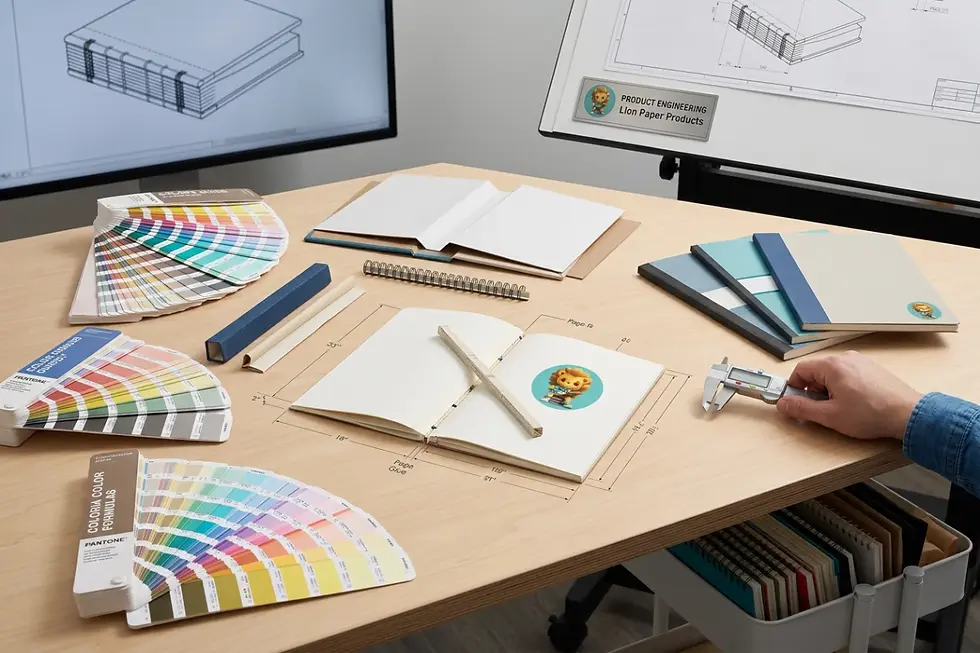
Modular component engineering allows retailers to achieve bulk paper purchasing efficiencies across regional SKUs.
What Are the Standardized Production Specifications for Multi-SKU Notebook Assortments?
For custom retail journal OEM programs, standardizing technical specifications is the primary lever for controlling landed unit costs and maintaining consistent on-shelf quality across stores. When engineering a private label notebook manufacturing program, product developers should specify tight material tolerances to prevent supply chain drift across seasonal cycles.
Specification Parameter | Entry-Tier Mass Retail | Mid-Tier Core Stationery | Premium Lifestyle Journal |
|---|---|---|---|
:--- | :--- | :--- | :--- |
Trim Size | A5 (148 x 210 mm) or US Letter | A5 (148 x 210 mm) / B5 | Custom 135 x 210 mm / B5 |
Binding Style | Double-loop wire-o / Perfect bound | Flexible softcover / Section sewn | Casebound hardcover / Lay-flat sewn |
Text Paper Stock | 70–80 gsm Woodfree Offset | 80–100 gsm FSC Certified Offset | 100–120 gsm Acid-free FSC Cream |
Page Count | 80–120 Pages (40–60 Leaves) | 160–192 Pages (80–96 Leaves) | 192–240 Pages (96–120 Leaves) |
Cover Material | 250–350 gsm C1S Art Card | 300 gsm Kraft / Soft-touch PU | 1.8–2.5 mm Greyboard + Bookcloth/PU |
Cover Embellishment | Matte Lamination + Spot UV | Foil Stamping + Embossing | Debossing + Gilded/Painted Edges |
Functional Add-ons | Basic Belly Band | Ribbon Marker + Elastic Band | Back Pocket + Dual Ribbons + Pen Loop |
Standardizing these technical parameters allows retail purchasing teams to switch cover artwork files between regional distribution centers without altering the inner signature setup. This structural consistency preserves shelf planogram alignment across regional store layouts, simplifying shelf stocking and retail visual merchandising.
How Do Unit Economics and Packaging Configurations Impact Regional Store Footprints?
Packaging configurations directly govern freight density, distribution center handling costs, and planogram velocity for regional retail private label notebook SKUs. Retailers operating localized retail networks often face distinct display constraints, ranging from high-density corrugated floor displays (PDQ/dump bins) in suburban superstores to premium endcap presentations in urban boutiques.
To preserve margin across localized stationery private label SKUs, category managers must optimize secondary and tertiary packaging:
Master Carton Optimization: Standardize outer shipper dimensions to maximize pallet cube utilization across standard 40x48-inch (GMA) and 1200x800-mm (EUR) pallet standards, minimizing air shipment waste.
Retail-Ready Packaging (RRP): Ship notebooks pre-packed in shelf-ready display trays (6 to 12 units per inner caddy) featuring localized outer shelf tray graphics and scannable master barcodes.
Automated Unit Labeling: Apply machine-applied shrink wrap or polybags equipped with regional price-point stickers, regional anti-theft source tags (EAS/RFID), and compliant warning labels in regional languages.
Fulfillment Consolidation: Consolidate multiple regional cover SKUs within balanced master cartons (e.g., 24 units per box containing 4 regional cover designs at 6 units each) to allow smaller-footprint stores to stock diverse regional assortments without taking excess inventory.

Shelf-ready packaging and standardized pallet configurations minimize distribution center handling costs.
How Does China–Cambodia Dual-Site Manufacturing Streamline Production and Regional Replenishment?
Executing high-volume, multi-SKU private label journal lines requires an agile manufacturing model that balances fast sampling with cost-efficient volume production. Sourcing organizations rely on integrated manufacturing networks that coordinate early-stage product engineering with scalable offshore mass production.
Lion Paper Products operates an integrated supply network combining a 3,000-square-meter innovation and development facility in Jiaxing, China, with a 10,000-square-meter mass manufacturing campus in Cambodia. This dual-site synergy delivers specific strategic advantages for private label notebook retail programs:
Rapid Prototyping and Pre-Production Engineering (Jiaxing Facility): Specialized industrial design, structural packaging development, and rapid sampling teams create physical dummies, proof localized cover plates, and perform drop-testing within short development windows.
Scalable Volume Output and Tariff Optimization (Cambodia Facility): Automated high-speed binding lines, large-scale casing-in equipment, and strict standard operating procedures support an annual capacity exceeding 5 million notebook units, providing favorable duty structures for North American and European retail buyers.
Standardized Quality Assurance: Both manufacturing sites adhere to unified ISO 9001 operating controls, AQL inspection standards, and defect mapping systems, ensuring identical binding durability, paper opacity, and foil adhesion across production batches.
Ethical and Environmental Compliance: Production lines are verified under international audit frameworks—including FSC chain-of-custody, SMETA, WCA, GSV, FAMA, and CPSIA compliance—meeting the strict vendor codes of conduct mandated by global supermarket chains and department stores.

Dual-site manufacturing infrastructure supports rapid pre-production prototyping and scalable, compliant mass production.
How Can Retail Category Managers Manage Sourcing Risks for Multi-Region Notebook Programs?
Managing a multi-SKU regional rollout involves supply chain complexities, including fluctuating pulp pricing, ocean freight congestion, and print color variance across decentralized runs. To protect margins and avoid out-of-stock events during critical peak periods (such as Back-to-School or Q4 Holiday Gifting), procurement managers should implement four operational safeguards:
Lock Base Raw Materials Early: Contract text block paper stock and raw greyboard 90 to 120 days ahead of peak assembly, insulating the retail program from spot-market commodity price spikes.
Utilize Digital Color Targets: Establish spectrophotometer-based digital color profiles (Lab* tolerances within Delta E < 2.0) for localized artwork covers to guarantee exact hue matching across multiple print batches.
Maintain Rolling Core Inventory: Keep pre-collated, un-bound inner page blocks at the manufacturing site, allowing quick-turn binding and localized cover stamping to respond rapidly to mid-season store sell-through spikes.
Audit Structural Integrity: Enforce rigorous QA testing, including 180-degree lay-flat spine fatigue tests, page pull-out tension tests (exceeding 4.5 kgf), and glue aging stability tests in temperature-controlled chambers.
If you are planning an upcoming retail program, contact our development team to share your retail channel requirements, intended notebook formats, packaging specifications, projected volumes, and target launch timing to establish a tailored private label manufacturing program.
FAQ
What is the typical minimum order quantity (MOQ) for regional retail private label notebook SKUs?
When leveraging standardized inner page blocks across an assortment, minimum order quantities generally start at 1,000 to 3,000 units per cover design, provided the overall production run for the shared core format meets a combined volume threshold of 5,000 to 10,000 units.
How can retailers ensure FSC traceability across multiple localized notebook variants?
Retailers must partner with an FSC-certified manufacturer capable of maintaining full Chain of Custody (CoC) documentation. Every localized SKU must feature the correct regional FSC on-product label license code corresponding to the certified mill pulp used in the inner text pages and cover boards.
What lead times are required for multi-SKU private label journal programs?
A standard development and production cycle requires 10 to 14 days for structural prototyping and digital color proofing, followed by 35 to 45 days for mass manufacturing and retail-ready packaging assembly, plus maritime freight transit to the destination market.


Comments