


Reference Image to Notebook Manufacturing RFQ: Technical Specification Guide

To convert a reference image or design mockup into an actionable notebook manufacturing RFQ, buyers must translate visual appearance into precise, measurable technical specifications. A production-ready request for quotation deconstructs aesthetic concepts into exact cover board thickness, exterior wrap materials, binding style, interior paper basis weight and sheet count, decorative surface treatments, accessory dimensions, and compliance standards to enable accurate factory cost engineering.
Why is a visual reference image alone insufficient for an accurate OEM notebook manufacturing quote?
A standalone photograph or digital mockup conveys stylistic intent but lacks the foundational engineering data required for manufacturing calculations. When a factory receives only a reference image to notebook manufacturing RFQ inquiries, production engineers are forced to make unverified assumptions regarding material grades, internal structures, yield efficiencies, and mechanical tolerances. These assumptions inevitably produce wide pricing discrepancies, delayed quoting cycles, or unexpected material substitutions during mass production.
Visual renderings frequently obscure the structural distinctions between similar-looking components. For instance, an image showing a debossed textured hardcover cannot communicate whether the substrate is a 120 gsm thermal polyurethane (PU) laminated over 2.0 mm greyboard, a bookcloth fabric backed with paper, or an embossed coated art paper. Each of these options represents drastically different raw material costs, tooling requirements, machine speeds, and gluing chemistries.
Furthermore, images cannot specify internal mechanical functions such as true lay-flat capability, page tensile strength, ink opacity against bleed-through, or regulatory compliance requirements like FSC certification, CPSIA safety thresholds, or REACH chemical restrictions. Converting your visual concept into explicit OEM notebook manufacturing quote requirements eliminates quotation ambiguity, protects product margins, and establishes an objective standard for pre-production quality control.
How do you deconstruct a notebook reference image into core technical parameters?
Translating design mockups to production specs requires a systematic deconstruction methodology that isolates each physical layer of the notebook assembly. Rather than viewing the product as a single decorative item, procurement managers and product designers must analyze it through five distinct engineering layers: outer cover construction, interior text block, binding and spine assembly, functional accessories, and retail packaging.
Technical Layer | Visual Reference Feature | Production Parameter Required for RFQ |
|---|---|---|
:--- | :--- | :--- |
Cover Architecture | Hardcover vs. Softcover look | Base board caliper (e.g., 1.5mm to 3.0mm greyboard), outer wrap substrate, inner endpaper stock |
Book Spine & Binding | Book opening angle, visible threads, or rings | Binding format (Smyth sewn, casebound, double-loop wire-o, spiral, PUR perfect bound) |
Interior Leaf Block | Ruling lines, paper opacity, total thickness | Exact paper grade (woodfree offset, bamboo, recycled), basis weight (gsm), leaf/page count, trim size |
Embellishments | Metallic accents, 3D textures, indented logos | Tooling method (foil stamping, blind deboss, spot UV, edge gilding/spraying) with exact surface area |
Functional Trims | Closures, place markers, document storage | Elastic band width/tension, ribbon width/material, gusseted back pocket paper weight and geometry |
Final Packaging | Boxed, banded, or shrink-wrapped retail state | Belly band paper weight, individual shrink wrap/polybag specs, master carton crush test ratings |
By categorizing your reference photo into these discrete components, you transform an abstract visual into quantifiable line items that estimators in an agile manufacturing facility can accurately source, cost, and schedule.

Deconstructing cover substrates and core board calipers for accurate factory cost engineering.
What cover materials, board weights, and structural constructions should be specified?
The notebook cover establishes the physical durability, perceived value, and tactile identity of the product. When building custom notebook RFQ specifications from a reference image, you must specify the structural core, the exterior covering material, and the assembly construction method.
1. Structural Core Substrates
Greyboard (Chipboard): Used for rigid hardcovers. Specify by caliper thickness (e.g., 1.5 mm, 1.8 mm, 2.0 mm, 2.5 mm, or 3.0 mm) or mass basis (e.g., 1000 gsm to 1800 gsm). Premium retail journals standardly utilize 2.0 mm to 2.5 mm high-density greyboard to prevent warping across variable humidity levels.
Paperboard / Art Card: Utilized for flexible softcover journals. Standard specs range from 250 gsm to 400 gsm C1S (coated one side) or C2S art card, virgin kraft cardstock, or textured specialty paperboards.
Foam Cushioning Layer: If the reference image exhibits a plush, padded tactile feel, specify a 1.0 mm to 3.0 mm high-density sponge layer laminated between the exterior wrap and the rigid greyboard core.
2. Exterior Wrap Materials
Coated Art Paper Wrap: 128 gsm or 157 gsm coated art paper printed via offset lithography and finished with matte, gloss, or soft-touch anti-scratch lamination.
Polyurethane (PU) and Leatherette: Synthetic leather available in thermo-reactive PU (changes tone when debossed with heat), textured cross-grain, or smooth calf-skin touch, laminated over a non-woven or fabric backing.
Bookcloth and Woven Textiles: Natural linen, fine-weave cotton, or recycled polyester bookcloth laminated to paper backing to prevent glue strike-through during casing-in.
Specialty Kraft and Uncoated Papers: Through-dyed specialty papers (e.g., 120 gsm to 140 gsm) providing tactile organic grain and sustainable branding appeal.
3. Corner and Edge Geometries
Indicate whether the cover structure requires sharp square corners or rounded corners. If corners are rounded, specify the radius (typically 6 mm, 8 mm, or 10 mm). For hardcovers, state whether the outer covering should be turned over the greyboard edges (standard casebound wrap) or feature flush-cut edges with painted edge sealant.
Which binding method best aligns with your notebook format and functionality?
The binding method dictates how the notebook opens, how securely pages are retained, and how efficiently the unit can be assembled on automated production lines. A clear reference image may show a spine silhouette, but the RFQ must specify the internal mechanical execution.
Casebound Smyth-Sewn Binding (Hardcover Thread-Sewn): Interior pages are collated into 16-page or 32-page folded signatures, machine-sewn with polyester thread, reinforced with gauze (mull) and back-lining paper, and cased into a rigid cover. This is the global benchmark for archival journals, offering maximum durability and true 180-degree lay-flat functionality.
Section-Sewn Softcover Binding (Flexi-Bound): Similar to casebound thread-sewing, but cased into a flexible cardstock or laminated PU cover without heavy greyboard cores, combining lay-flat usability with lightweight portability.
PUR Perfect Binding: Signatures are trimmed into single leaves and bound using Polyurethane Reactive (PUR) adhesive. PUR offers superior page-pull strength and temperature resistance compared to conventional EVA hot melt, making it ideal for thick, economical softcover workbooks.
Double-Loop Wire-O and Spiral Binding: Twin-wire metal loops (available in standard diameters from 1/4 inch to 1-1/2 inch) punched through squared or round holes. Specify whether the wire binding is exposed, semi-concealed inside a hard spine, or fully enclosed within a three-panel fold-over case.
Saddle Stitching: Folded sheets fastened through the spine centerline with 2 to 3 wire staples. Optimal for slim notebooks, field journals, and exercise booklets under 64 to 80 pages.
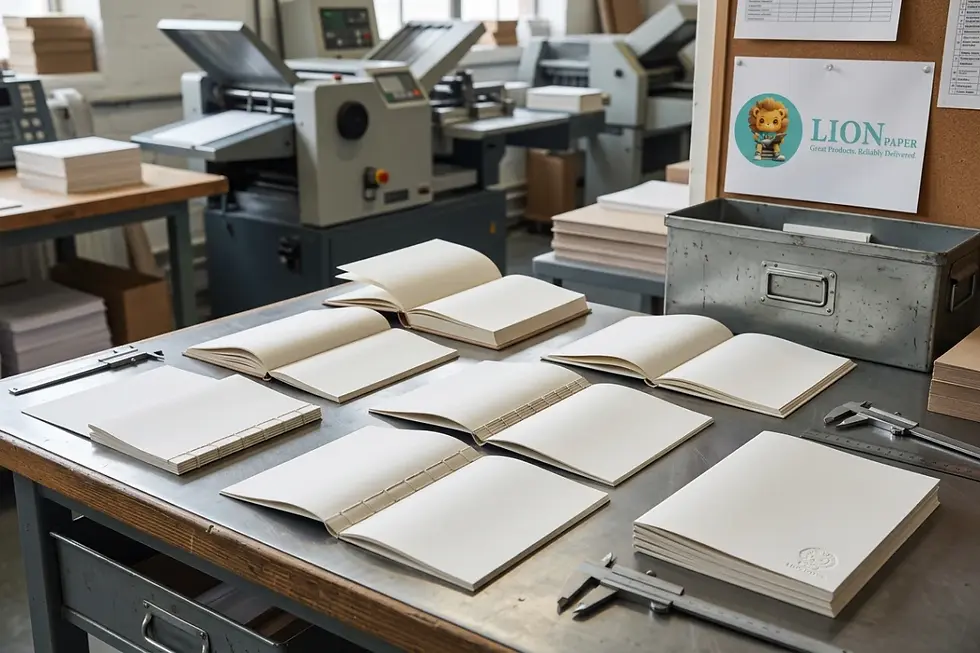
Evaluating Smyth-sewn vs PUR binding methods to ensure structural integrity and lay-flat functionality.
How should interior paper stocks, page counts, and printing grids be detailed?
Interior page execution represents a major percentage of raw material weight and directly determines the end-user writing experience. A reference image cannot convey tactile friction, ink absorbency, or opacity; these characteristics must be translated into explicit paper engineering terms.
Defining Paper Stock and Basis Weight
70 gsm to 80 gsm Woodfree Offset Paper: Standard for mass-market exercise books and lightweight everyday planners. Economic and functional, though prone to show-through with wet ink pens.
100 gsm to 120 gsm Premium Uncoated Woodfree Paper: The standard for mid-to-high-end journals and stationery brands. Provides high opacity, minimal ghosting, and smooth ink laydown for gel pens, rollerballs, and standard fountain pen inks.
140 gsm to 160 gsm Heavyweight Art / Bamboo Paper: Essential for bullet journaling, sketching, multi-media lettering, and heavy ink application where zero bleed-through is mandatory.
Recycled and FSC-Certified Stocks: Post-consumer waste (PCW) recycled offset papers (e.g., 30%, 50%, or 100% recycled content) or 100% FSC Mix / FSC Recycled certified wood pulp.
Clarifying Page Counts vs. Leaf Counts
Manufacturing confusion frequently arises over "pages" versus "leaves" (sheets). A leaf is an individual piece of paper; each leaf contains two pages (front and back). Always specify both values in your RFQ: for example, "192 pages / 96 leaves (plus 8 endpapers)." Note that for sewn binding, the total page count of the text block must be divisible by 8 or 16 to conform to standard folding signatures.
Printing Formats and Ruling Specifications
Define the text block interior artwork parameters: 1-color (e.g., Pantone Cool Gray 4U or 60% black) double-sided offset printing for dot grid, 7mm lined, 5mm graph, or undated planning layouts. Specify whether pages include edge perforations, sequential numbering, or gilded/sprayed page edges.
What surface embellishments and accessory specifications should be included in the RFQ?
Decorative surface treatments and physical accessories visible in reference photos require exact technical constraints, material callouts, and area coverage percentages to enable precise factory tooling and labor cost estimation.
Foil Stamping (Hot Stamping): State the foil type (metallic gold, silver, rose gold, matte pigment, holographic), foil brand series if specific adhesion is needed, and the estimated surface area dimensions (e.g., 50 mm x 80 mm on front cover).
Blind Debossing / Embossing: Specify whether the tooling requires single-level magnesium dies, multi-level CNC brass dies for contoured 3D relief, or heated thermal debossing on reactive PU.
Spot UV & Raised 3D Varnishing: State the coverage percentage (e.g., 15% coverage on front cover) and thickness (standard screen-printed spot UV vs. high-build 3D tactile varnish).
Ribbon Bookmarks: Detail ribbon material (single-face satin, double-face satin, grosgrain, or woven cotton), width (typically 5 mm to 8 mm), quantity (1 or 2 ribbons), and overhang extension length (standardly 25 mm past the bottom corner).
Elastic Closure Bands: Specify flat elastic band width (typically 8 mm, 10 mm, or 12 mm), placement (vertical right edge or horizontal), and whether it requires metal eyelet anchor crimps or flush internal casing beneath the rear endpaper.
Expandable Back Pocket: Call out a gusseted accordion pocket affixed to the inside back cover, specifying the paper stock (e.g., 250 gsm white kraft or greyboard-reinforced art paper) and cloth/paper fabric side gussets.

Specifying precise dimensions, tooling dies, and accessory tolerances for notebook RFQs.
What essential checklist should your notebook tech pack and RFQ contain?
To streamline communication with OEM manufacturers and ensure rapid, accurate quotation turnaround, organize your parameters into a comprehensive tech pack. A professional notebook tech pack development document synthesizes all structural, material, and packaging parameters into an unambiguous specification sheet.
Product Overview: Notebook title, internal SKU, intended target retail channel, and annual/batch order volumes (e.g., MOQ 1,000 / 3,000 / 5,000 / 10,000 units).
Finished Dimensions: Finished closed size (Width x Height x Spine Depth in mm or inches, e.g., A5 148 x 210 mm) and open flat size.
Cover Construction: Substrate thickness, wrap material, lamination type, corner radius, and edge finishing method.
Interior Block: Paper stock type, basis weight (gsm), certified pulp source (FSC Mix/Recycled), exact page/leaf count, trim size, and interior printing colors (Pantone codes or CMYK).
Binding Method: Thread-sewn casebound, softcover flexi, wire-o diameter/pitch, or PUR perfect bound, confirming spine configuration (round vs. square back).
Finishes & Embellishments: Explicit tooling dimensions and locations for foil stamping, debossing, silkscreen printing, spot UV, or edge coloration.
Accessories: Specifications for ribbons, elastic bands, elastic pen loops, and expandable pockets.
Packaging & Labeling: Individual shrink-wrap, polybag with warning text, barcode/UPC sticker placement, custom belly band sleeve (paper weight and finish), inner carton packs, and export master carton drop-test standards.
Regulatory & Testing Compliance: Mandated certifications including ISO 9001 quality management, FSC chain-of-custody, SMETA/WCA ethical audits, GSV security compliance, or CPSIA/FAMA standards.
How does Lion Paper facilitate design-to-manufacturing integration from sketch to shipment?
Translating aesthetic concepts into high-volume, compliant retail goods requires an integrated supply-chain partner rather than a transactional printer. Founded in 2015 in Jiaxing, Zhejiang, Lion Paper Products (Jiaxing) Co., Ltd. operates as a specialized supply-chain partner for customized paper products, journals, planners, and lifestyle paper goods.
Lion Paper resolves the gap between design mockups and physical mass production through our China–Cambodia dual-site synergy. Our 3,000-square-meter Jiaxing facility concentrates on product engineering, structural innovation, rapid physical sampling, and technical customer support. Once specifications and prototypes are validated, high-volume production can transition seamlessly to our 10,000-square-meter automated Cambodia manufacturing facility, delivering optimized landed cost, risk diversification, and consistent quality.
With an annual notebook production capacity exceeding 5 million units, Lion Paper provides complete end-to-end management across eight core product categories—including eco-friendly paper goods, hardcover and softcover notebooks, planners, stationery sets, and customized gift packaging. Our manufacturing operations enforce rigorous unified SOPs, AQL sampling protocols, and defect catalogs aligned with ISO 9001, FSC, SMETA, WCA, GSV, FAMA, and CPSIA frameworks.
Whether you are an established stationery brand, an e-commerce retailer, or a creative lifestyle label, our engineering team works directly with your visual references to engineer cost-efficient, retail-ready products. Explore the Lion Paper interactive mockup and design collection, then share your selected visual mockup and detailed product specifications with our team to initiate professional engineering reviews and rapid pre-production samples.
FAQ
What is the minimum information needed to get an initial OEM notebook manufacturing quote?
To provide an initial quotation, manufacturers require the finished notebook dimensions (e.g., A5 or 5.5 x 8.5 in), estimated order quantity per design, cover type (hardcover with board caliper or softcover cardstock), binding method (thread-sewn casebound, wire-o, or perfect bound), interior paper basis weight (e.g., 80 gsm vs. 120 gsm woodfree), total page count, interior print color format (1-color lined or multi-color), and basic accessory requirements (ribbon, elastic band, or pocket).
How does paper basis weight (gsm) affect fountain pen and heavy ink performance?
Paper basis weight (gsm) combined with surface sizing determines ink absorption and opacity. Standard 70 gsm to 80 gsm offset paper is suitable for ballpoint and standard dry pens but will exhibit ghosting and feathering with wet inks. For fountain pen friendly, marker, or bullet journaling applications, specify 100 gsm to 160 gsm uncoated woodfree or bamboo paper with high-density surface sizing to prevent ink bleed-through.
Why is total page count required to be divisible by 8 or 16 for sewn notebooks?
Thread-sewn (Smyth-sewn) casebound notebooks are constructed by folding large printed sheets into multi-page booklets called signatures. Standard industrial printing and folding equipment processes signatures in groupings of 8, 16, or 32 pages. Specifying a page count divisible by 16 ensures full signature utilization, eliminates blank filler sheets, maximizes production speed, and minimizes manufacturing cost.
How does Lion Paper manage sampling and transition to mass production?
Lion Paper utilizes its 3,000-square-meter Jiaxing facility for design engineering, material sourcing, and rapid physical pre-production sampling. Once the client approves the structural dummy and finished color sample, mass production is transitioned to automated production lines—either in China or at our 10,000-square-meter Cambodia facility—ensuring scalable output, tariff optimization, and strict adherence to ISO 9001 and AQL inspection standards.


Comments