


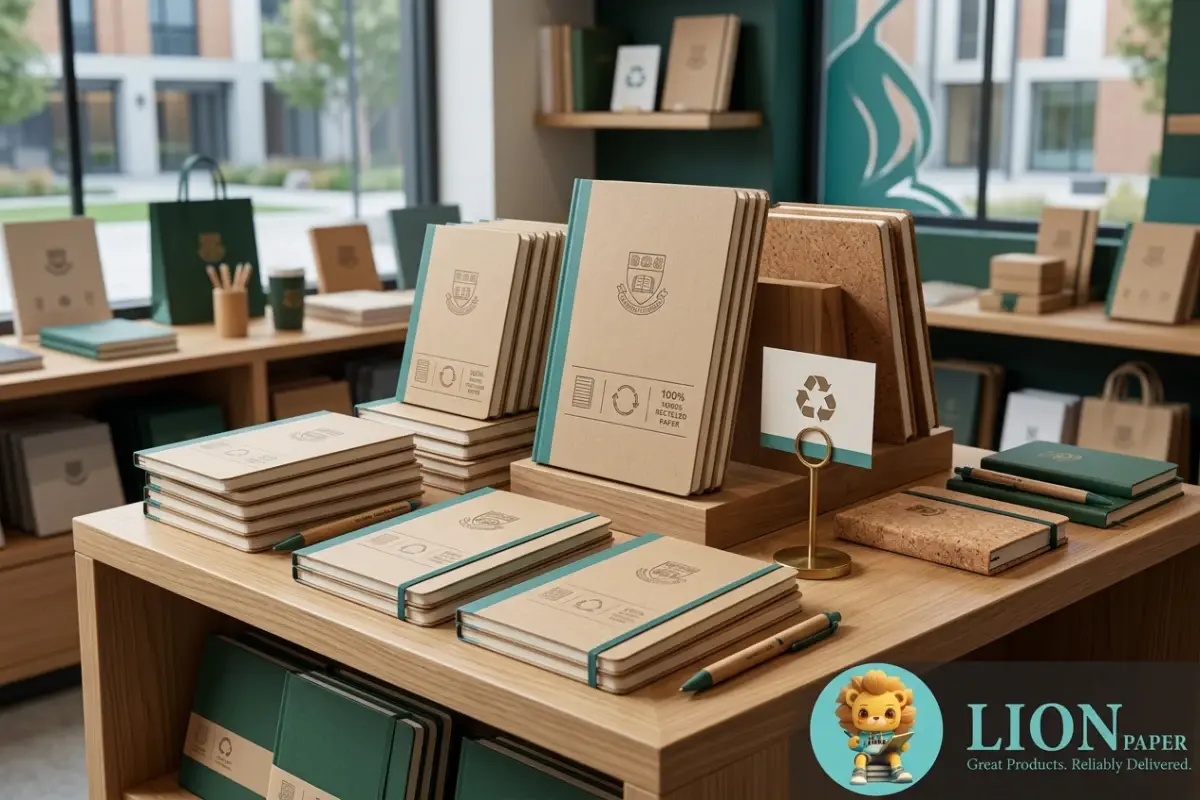
Recycled Notebooks for School Stores: Sourcing, Quality, and Procurement Guide
Sourcing recycled notebooks for school stores requires balancing post-consumer waste (PCW) paper performance with strict retail price ceilings, ensuring reliable bleed resistance, durable binding, and verified chain-of-custody compliance. Institutional campus buyers must evaluate sheet opacity, cover endurance, and supply chain transparency to deliver functional, cost-effective stationery that meets modern sustainability standards without compromising the student writing experience.
Why Are Campus Bookstores Prioritizing Recycled Notebooks for School Stores?
Campus bookstores and university retail shops operate at the intersection of institutional sustainability commitments and price-sensitive consumer behavior. Today’s student body actively demands eco-conscious goods, turning everyday stationery into an indicator of university environmental stewardship. Transitioning to recycled notebooks for school stores allows collegiate retailers to meet campus carbon reduction mandates while satisfying growing student preference for circular products.
Educational retail purchasing managers face distinct operational parameters compared to standard commercial stationery buyers:
Visible Institutional Alignment: Campus stores often stock items bearing school crests or departmental marks. Using sustainable school stationery procurement reinforces university environmental policy.
High Inventory Turnover: Back-to-school purchasing cycles create sharp demand spikes, requiring stable manufacturing schedules and dependable replenishment.
Margin Protection: Academic retailers must preserve healthy gross margins while keeping shelf prices accessible for undergraduate and graduate budgets.
Cross-Departmental Utility: Notebooks must serve diverse disciplines, from stem-focused lab computations using grid paper to humanities lecture notes requiring wide or college ruling.
By integrating eco friendly notebooks wholesale for schools into core retail assortments, campus stores transform basic consumable supplies into branded statements of sustainability.
How Does Recycled Paper Quality Affect Writing Performance and Durability?
Historical concerns regarding recycled stationery often focused on rough textures, dull gray coloring, and heavy ink bleeding. Modern fiber recovery and de-inking technologies have resolved these issues, enabling recycled paper notebooks bulk manufacturing that matches virgin wood-pulp paper in smoothness and tensile strength.

Modern recycled paper provides smooth surface texture and high opacity for clean, bleed-resistant note-taking.
When evaluating inner text pages made from recycled pulp, procurement teams must assess three physical parameters:
1. Paper Weight and Caliper
Standard educational notebooks typically utilize 70 gsm to 80 gsm sheets. For premium campus bookstore lines or art-heavy courses, upgrading to 100 gsm or 120 gsm recycled paper prevents show-through when students use rollerball pens, highlighters, or fountain pens.
2. Post-Consumer Waste (PCW) vs. Pre-Consumer Waste
Pre-consumer waste originates from manufacturing trimmings and overruns, while post-consumer waste (PCW) is collected from municipal recycling streams. Higher PCW percentages (e.g., 30%, 55%, 100%) maximize environmental impact by diverting landfill waste, though pulp sizing must be precisely calibrated to maintain fiber cohesion and prevent feathering.
3. Opacity and Brightness Ratings
Recycled paper does not need to be stark white to deliver excellent legibility. Natural white or soft cream tones with an ISO brightness rating between 80% and 90% reduce glare under library lighting, supporting extended study sessions.
Technical Metric | Standard Virgin Paper | Commercial Recycled Paper (55% PCW) | Premium Recycled Paper (100% PCW) |
|---|---|---|---|
:--- | :--- | :--- | :--- |
Standard Basis Weight | 70–80 gsm | 80–100 gsm | 80–120 gsm |
ISO Brightness Range | 92% – 98% | 82% – 88% | 80% – 86% |
Ink Feathering Resistance | High | High (with synthetic sizing) | Moderate to High |
Pulp Sourcing Origin | Virgin Kraft Pulp | De-inked Office Waste + Mill Broke | Municipal Post-Consumer Paper |
Surface Texture (Bekk) | Smooth (150–250 s) | Medium-Smooth (100–180 s) | Natural Vellum (80–150 s) |
What Cover Materials and Bindings Work Best for High-Traffic School Stationery?
Campus notebooks experience intense physical wear. They are repeatedly shoved into backpacks, laid flat on lecture hall desks, and folded over during field studies. Selecting resilient structural elements is vital when developing custom recycled notebooks for campus stores.
Structural Cover Substrates
Recycled Kraft Paperboard (350–600 gsm): Delivers an authentic, unbleached aesthetic that signals eco-friendly credentials immediately to retail shoppers.
Recycled Greyboard with Paper Wrap (1.5–2.5 mm): Provides rigid support for durable hardcovers, ideal for campus planners, specialized lab notebooks, and executive alumni journals.
FSC-Certified Coated Board: Enables high-resolution four-color process printing for vibrant campus athletics graphics while maintaining responsible fiber sourcing.
Post-Consumer Recycled Polypropylene or RPET: Offers water-resistant protection for chemistry laboratory manuals and engineering notebooks used outdoors.
Functional Binding Methods
Twin-Ring Wire-O and Spiral Binding: Allows pages to rotate a full 360 degrees and lie completely flat on compact lecture hall armrests. Coated wire options made from recycled steel further lower environmental footprints.
Smyth-Sewn (Case Bound) Binding: Provides maximum longevity for multi-semester use. Thread-bound signatures prevent single pages from detaching under rough handling.
Thread-Stitched Softcover (Singer Stitch / Saddle Stitch): Best suited for lightweight, slim exercise books and supplementary exam booklets where low unit cost and minimal bulk are required.
How Can Institutional Buyers Balance Recycled Content Percentages and Landed Unit Costs?
Procurement managers must manage tight margins. Because recycled pulp processing involves de-inking, screening, and specialized sizing agents, raw sheet costs can carry a minor variance compared to standard virgin sheets. However, experienced supply-chain partners mitigate this variance through bulk material aggregation, automated finishing lines, and balanced production planning.
Sourcing Tier | Primary Material Composition | Target Campus Retail Price Range | Ideal Institutional Use Case |
|---|---|---|---|
:--- | :--- | :--- | :--- |
Value Line (Bulk Assortment) | 30% Recycled Kraft Cover, 70 gsm 30% PCW Inner Pages | $1.99 – $3.99 | High-volume introductory lecture notebooks, blue books, daily test pads |
Core Campus Line | 400 gsm Recycled Board, 80 gsm 55% PCW Inner Pages | $4.99 – $8.99 | Standard bookstore branded notebooks, spiral campus journals, subject dividers |
Premium Heritage Collection | Hardcover Recycled Greyboard, 100 gsm 100% PCW Paper | $12.99 – $22.99 | Alumni gifts, faculty executive planners, graduation merchandise, co-branded bookstore series |
To keep landed costs predictable, educational retail buyers should consolidate orders across multiple sizes (such as A5, B5, and standard US Letter 8.5 x 11 inches) into a single production run. Sharing the same inner text block specification while varying cover artwork across departments allows retail buyers to achieve higher factory tier volume discounts.
Which Environmental Certifications and Compliance Standards Are Essential for School Sourcing?
Institutional purchasers face strict verification requirements from university procurement boards and regional education authorities. Marketing claims must be backed by traceable documentation and verified chain-of-custody audits.

Strict quality control procedures ensure consistent binding durability, trim precision, and chain-of-custody compliance.
Key compliance frameworks for campus paper product manufacturing include:
Forest Stewardship Council (FSC): FSC Recycled certification verifies that all wood fibers originate from pre-consumer or post-consumer reclaimed materials, providing end-to-end traceability from pulp mill to campus retail shelf.
CPSIA (Consumer Product Safety Improvement Act): Critical for school goods, confirming that cover inks, coatings, and binding wires are tested for heavy metals and phthalates.
Low-Impact Printing Standards: Utilizing soy-based or vegetable-based inks eliminates volatile organic compounds (VOCs) and ensures that notebooks remain fully recyclable after student use.
Social & Factory Compliance (SMETA / WCA / ISO 9001): University licensing programs require ethical manufacturing environments with verified labor safety, wage standards, and structured quality management systems.
Working with an integrated manufacturing partner that holds active audit credentials simplifies university licensing approval and protects campus retailers from regulatory or reputational risk.
How Does Lion Paper Optimize Recycled Notebook Supply via Dual-Site Synergy?
Lion Paper Products (Jiaxing) Co., Ltd. operates as an integrated supply-chain partner for customized paper goods and creative stationery, offering comprehensive support from first sketch to first shipment. With manufacturing operations spanning facilities in China and Cambodia, Lion Paper provides a balanced approach to sustainable school stationery procurement.
Dual-Site Operational Structure
Jiaxing Base (3,000 sqm): Focuses on product engineering, sustainable material research, rapid prototyping, structural packaging optimization, and customer service.
Cambodia Production Base (10,000 sqm): Designed for high-volume automated manufacturing, cost efficiency, and export delivery across global retail channels.
| LION PAPER SUPPLY PIPELINE |
| 1. DESIGN & SOURCING (Jiaxing R&D) | | - Recycled pulp testing & FSC material traceability | | - Rapid sampling & structural cover prototyping | | - Scenario-based product engineering for campus stores |
| v
| 2. SCALED MANUFACTURING (Cambodia Facility) | | - Automated binding & precision high-speed lines | | - 5M+ annual notebook production capacity | | - Total-cost efficiency & global tariff optimization |
| v
| 3. QUALITY & COMPLIANCE VERIFICATION | | - Standardized SOPs & AQL defect management | | - ISO 9001, FSC, SMETA, WCA, and CPSIA alignment | | - Retail-ready barcode, packing & pallet optimization |
This cross-border synergy allows educational retail buyers to develop custom recycled notebooks for campus stores with rapid sampling turnarounds in Jiaxing while securing tariff-efficient, high-volume production out of Cambodia. With an annual notebook output exceeding 5 million units, Lion Paper combines agile design support with institutional supply reliability.
What Should Educational Procurement Teams Include in an RFQ for Custom Recycled Notebooks?
Drafting a thorough Request for Quotation (RFQ) prevents costly production revisions and ensures accurate pricing comparisons across suppliers. Campus store category managers should specify exact material grades, functional hardware, and packaging requirements.

Selecting the right mix of bindings, trims, and paper weights allows campus stores to target diverse student and faculty needs.
| Specification Category | Core Decision Variables | Recommended Educational Standard | | :--- | :--- | :--- | | | Trim Dimensions | Standard US Letter, A4, B5, A5, Pocket (3.5 x 5.5") | US Letter (8.5 x 11") for lecture use; A5 for daily planning | | Interior Page Count | 60, 80, 100, or 120 leaves (120–240 pages) | 80 leaves (160 pages) for single-semester coursework | | Ruling Layout | College ruled (7.1 mm), Wide ruled (8.7 mm), 5 mm Dot Grid, Plain | 7.1 mm College ruled with left margin line | | Paper Material | PCW %, Basis Weight (gsm), Tint (White / Cream) | 80 gsm, 55%–100% PCW, FSC Recycled certified | | Cover Treatment | Foil stamping, debossing, spot UV, soy-ink litho | Debossed campus seal or 2-color soy ink on recycled kraft | | Functional Add-ons | Expandable back pocket, elastic band, ribbon marker | Recycled kraft document pocket for syllabus inserts | | Packaging & Barcoding | Shrink wrap, paper belly band, master carton packout | Recyclable kraft belly band with scannable retail UPC |
Providing exact packaging and retail-ready requirements upfront allows factories to optimize pallet utilization and ocean container loading, directly reducing landed shipping costs per unit.
How Can Campus Stores Build Sustainable Stationery Programs?
Transitioning to an eco-forward product assortment requires thoughtful merchandising and category integration. Rather than treating recycled notebooks as standalone specialty items, campus stores achieve stronger sell-through rates by positioning sustainable goods across core academic supply displays.
Strategic Merchandising Best Practices
Clear Value Messaging: Use informative shelf signage explaining the material composition (e.g., "Made with 100% post-consumer recycled paper and non-toxic soy inks").
Coordinated Study Sets: Merchandise recycled notebooks alongside matching paper folders, eco-friendly sticky notes, and bamboo pens to lift average basket sizes.
Departmental Customization: Partner with individual academic departments, law schools, or medical programs to produce customized, course-specific notebooks featuring departmental emblems.
Semester Re-ordering Automation: Establish recurring replenishment schedules timed ahead of peak fall and spring intake periods to avoid stockouts during orientation weeks.
Partnering with a dedicated stationery supply-chain provider enables educational retail buyers to maintain consistent quality, compliant documentation, and reliable delivery across every academic term.
If your university bookstore or campus retail group is updating its stationery assortment, contact our procurement specialists to submit your desired cover materials, paper specifications, order quantities, and compliance guidelines for a comprehensive sourcing evaluation and quotation.
FAQ
What is the typical minimum order quantity (MOQ) for custom recycled notebooks for campus stores?
Custom recycled notebooks generally start at an MOQ of 1,000 to 3,000 units per style, depending on the level of cover customization, specialty foil debossing, and specific recycled paper weights. Standard catalog designs with simple custom belly bands can often be procured at lower initial thresholds.
Can recycled paper notebooks withstand heavy highlighter and fountain pen use without bleeding?
Yes. When engineered with appropriate basis weights (80 gsm to 100 gsm or higher) and specialized surface sizing agents, recycled paper sheets provide excellent opacity and fiber density, effectively preventing ink feathering and show-through from standard campus pens and highlighters.
How does dual-site manufacturing benefit school bookstore sourcing teams?
Dual-site manufacturing combines centralized product design, sustainable material testing, and rapid prototyping (at our Jiaxing facility) with scalable mass production and cost optimization (at our Cambodia base). This structure gives campus retail buyers flexible volume capacity, tariff advantages, and reliable seasonal delivery.