


Recycled Notebook Tender Requirements: Technical Specifications, Compliance Documentation, and Sourcing Guide

Meeting recycled notebook tender requirements requires matching specific environmental claims—such as verifiable post-consumer waste percentages, FSC chain-of-custody certification, and non-toxic vegetable-based inks—with validated third-party audit documentation, precise technical material specifications, and compliant multi-tier manufacturing evidence. Public institutions and corporate buyers mandate clear verification pathways to eliminate greenwashing risks while ensuring structural durability, smooth writing performance, and predictable mass production timelines across global distribution channels.
What Core Trade-Offs Define Recycled Paper Notebook Procurement?
Procurement officers managing corporate stationery tenders encounter distinct mechanical and optical challenges when replacing virgin wood pulp with recycled paper stock. Balancing sustainability targets against end-user performance requires balancing paper brightness, fiber strength, ink bleed-through resistance, and overall manufacturing yield.
Optical Brightness versus De-Inking Chemical Intensity: Standard virgin wood-free paper achieves ISO brightness ratings of 95% to 105% using optical brightening agents (OBAs). Conversely, 100% post-consumer waste (PCW) recycled sheets typically yield an ISO brightness between 75% and 88%. Specifying excessively high brightness on recycled sheets forces raw material mills to execute aggressive bleaching or excessive chemical de-inking, which negates the ecological benefit of the recycled content.
Fiber Length versus Tensile and Tear Resistance: Repeated mechanical recycling shortens cellulose fibers. This degradation reduces tensile strength by 15% to 25% compared to virgin fibers. For notebook covers, spine hinges, and spiral-bound hole punching, tender specifications must compensate for lower tear resistance by increasing paper substance weight (basis weight in gsm) or applying structural reinforcements like woven cloth spines or higher-density backing boards.
Ink Absorption versus Fountain Pen Bleed-Through: Recycled fibers feature higher surface porosity and variable capillary absorption. If internal sizing agents (such as alkyl ketene dimer, or AKD) and surface starch calendering are insufficient, standard water-based or gel inks will feather and bleed through 70 gsm or 80 gsm recycled sheets. Tenders must define clear Cobb60 water absorption limits (typically 20 to 30 g/m²) and surface smoothness metrics (Bekk smoothness between 25 and 50 seconds).
Cost Efficiency versus Sourcing Locality: Pure post-consumer waste streams processed in accordance with strict international standards often carry a 5% to 15% cost premium over standard wood-free offset sheets due to collection, sorting, and intensive de-inking steps. Tender evaluation models must calculate total cost of ownership, accounting for bulk material aggregation, manufacturing yields, and shipping container load optimizations.
Technical Parameter | Standard Virgin Wood-Free Paper | 100% Post-Consumer Recycled Paper | Blended Eco-Grade (30%–50% PCW) |
|---|---|---|---|
:--- | :--- | :--- | :--- |
ISO Brightness (%) | 95% – 105% | 75% – 88% | 85% – 92% |
Opacity (%) | 88% – 92% (at 80 gsm) | 92% – 96% (at 80 gsm) | 90% – 94% (at 80 gsm) |
Tear Index (mN·m²/g) | 6.5 – 8.5 | 4.2 – 5.8 | 5.5 – 7.0 |
Cobb60 Value (g/m²) | 18 – 25 | 22 – 32 | 20 – 28 |
Caliper / Bulk (cm³/g) | 1.15 – 1.25 | 1.28 – 1.40 | 1.22 – 1.32 |
Ink Feathering Risk | Very Low | Moderate to High without Sizing | Low to Moderate |

Evaluating paper weight, fiber distribution, and opacity parameters ensures recycled notebooks meet institutional performance standards.
How Do You Map Environmental Claims to Sustainable Stationery Tender Documentation?
Every environmental claim in a tender submission must be corroborated by standardized, third-party audit documentation. Generic marketing statements such as "environmentally friendly" or "100% eco-conscious" are disqualifying in structured institutional tenders. Buyers require precise traceability from the raw material pulp mill down to the primary conversion facility.
FSC Chain of Custody (CoC) Certification: Tender requirements typically mandate FSC 100%, FSC Mix, or FSC Recycled claims under standard FSC-STD-40-004. Bidders must supply their valid FSC Certificate Code and ensure that their sub-tier raw paper converters and primary assemblers maintain active chain-of-custody status verified via the public FSC database. Invoices and delivery bills must carry explicit FSC claim categories and certificate numbers.
Post-Consumer Waste (PCW) vs. Post-Industrial Waste (PIW): PCW refers to paper products collected from end-users through municipal recycling programs, whereas PIW consists of manufacturing trimmings and scrap. Tenders specifying ISO 14021 standards require explicit percentage declarations for PCW. Proof must include raw paper mill declarations, material safety data sheets (MSDS), and audited mass balance reconciliation records.
Chemical Safety and Hazardous Substances Compliance: Notebooks intended for educational institutions, corporate gifting, or retail channels must comply with regional product safety directives. In the United States, materials must meet CPSIA requirements for lead and phthalates, alongside California Proposition 65 limits. In the European Union, compliance with REACH Regulation (EC) No 1907/2006 regarding Substances of Very High Concern (SVHC) and heavy metal limits under EN 71-3 is mandatory.
Printing Inks and Glues: Standard mineral-oil-based inks contain volatile organic compounds (VOCs) that undermine recycled paper biodegradability. Tender documentation must mandate soy-based or vegetable-oil-based offset inks (conforming to DIN ISO 2846-1) and water-based, solvent-free adhesives for spine binding and hardback cover lamination.
Sustainability Claim | Verification Standard | Mandatory Tender Documentation | Audit / Verification Pathway |
|---|---|---|---|
:--- | :--- | :--- | :--- |
Recycled Content | ISO 14021 / EN 17085 | Mill Fiber Furnish Declaration, Mass Balance Log | Third-party mill audit & CoC trace |
Forest Stewardship | FSC-STD-40-004 / PEFC ST 2002 | Valid CoC Certificate, Invoice Claim Match | Public FSC / PEFC online database check |
Low VOC Printing | ASTM D3960 / ISO 11890-2 | Ink Manufacturer Safety Data Sheet (SDS) | Laboratory gas chromatography test |
Chemical Safety | REACH SVHC / CPSIA / Prop 65 | Intertek / SGS / TÜV Test Reports (<12 mo old) | ICP-OES / GC-MS laboratory testing |
Compostability / Recyclability | EN 13430 / PTS Method 002/98 | Pulpability & De-inkability Test Certificates | Standard laboratory pulper test report |
What Are the Mandatory FSC Certified Notebook Specifications and Material Parameters?
Tender technical sheets must delineate precise structural components to guarantee mechanical reliability during high-frequency classroom or workplace use. Recycled paper notebook procurement involves establishing distinct specifications across four primary elements: cover substrates, internal text blocks, binding mechanisms, and finishing coatings.
Cover Material Formats and Basis Weights:
Hardcover Books: 1.5 mm to 3.0 mm high-density greyboard manufactured from 100% post-consumer recycled fiber, laminated with 120 gsm to 157 gsm FSC Recycled art paper, uncoated kraft paper, or water-resistant recycled book cloth.
Softcover / Flexible Books: 250 gsm to 400 gsm unbleached virgin/PCW blend kraft cardstock, duplex grey-backed chipboard, or 100% recycled folding box board (FBB) with high creasing flexibility to prevent spine cracking.
Internal Text Block Specifications:
Basis Weight: 70 gsm to 100 gsm recycled wood-free or bamboo-blend paper.
Opacity: Minimum 90% opacity for 80 gsm sheets to prevent page-to-page show-through of rollerball, ballpoint, and high-pigment gel pens.
Ruling and Line Grid: Printed with soy-based inks using 10% to 20% grey tint values to minimize ink usage while ensuring visible guidelines for users.
Sheet Count: Standardized at 80 sheets (160 pages), 96 sheets (192 pages), or 120 sheets (240 pages), collated in 16-page signatures.
Binding Structural Options:
Section Sewn Casebound (Hardcover): Smth-sewn signatures linked with high-tensile unbleached cotton thread, reinforced with a spine gauze (mull) and flexible, non-toxic animal-free synthetic resin adhesive.
Spiral and Twin-Wire Binding: Coated steel wire (double-loop Wire-O) or uncoated recyclable aluminum, with hole pitch standardized at 3:1 or 2:1. Micro-perforated inner pages must yield a tear-out retention force between 1.5 N and 3.5 N.
Perfect Bound / Saddle Stitch: Flexible PUR (polyurethane reactive) hot-melt adhesive applied at 0.3 mm to 0.5 mm thickness to provide superior lay-flat durability, or two unplated/zinc-free steel wire staples for thin exercise notebooks.
Surface Finishes and Embellishments:
Water-Based Varnishing: Replacement of non-biodegradable OPP/PET plastic laminations with recyclable water-based dispersion varnishes (matte or gloss).
Debossing and Foil Stamping: Deep blind debossing or cold-transfer plastic-free foil embellishments, eliminating non-recyclable hot-stamping film matrices from cover boards.

Standardized automated assembly and strict in-line quality controls ensure structural durability across high-volume production batches.
What Audit Trails and Verification Are Mandatory for Eco-Friendly Corporate Notebook Sourcing?
Meeting recycled notebook tender requirements requires transparent operational governance extending across upstream pulp processing, conversion factories, and global logistics nodes. Corporate compliance departments and governmental procurement offices conduct rigorous multi-tiered verification audits prior to contract award.
Social and Ethical Governance Audits: Tier-1 manufacturing facilities must maintain active social compliance audit reports executed within the preceding 12 months. Standard accepted frameworks include SMETA (Sedex Members Ethical Trade Audit) 2-Pillar or 4-Pillar audits, WCA (Workplace Conditions Assessment), and Disney FAMA (Facility and Merchandise Authorization) standards. Audit reports must show zero unresolved critical non-conformances regarding labor standards, workplace health and safety, and environmental stewardship.
Quality Management System Verification: Consistent execution of large-scale tenders requires ISO 9001:2015 certification. Suppliers must demonstrate robust standard operating procedures (SOPs), in-line process quality checks, and calibrated laboratory testing equipment (bursting strength testers, Cobb sizing testers, folding endurance testers).
In-Process and Pre-Shipment Inspection Protocols: Production batches must undergo acceptance quality limit (AQL) inspections according to ISO 2859-1 (ANSI/ASQ Z1.4). Standard tender parameters specify:
Critical Defects (Safety / Legal non-compliance): AQL 0 (zero tolerance for metal burrs on wire binding, toxic coatings, or missing safety labeling).
Major Defects (Structural / Functional failures): AQL 1.5 to 2.5 (broken spine sewing, misaligned page ruling >1.5 mm, delaminated cover board, severe paper dusting).
Minor Defects (Cosmetic imperfections): AQL 4.0 (minor surface scuffs, slight color variation within Delta E < 2.0, minor corner rounding deviations).
Chain of Custody and Mass Balance Verification: For tenders requiring high recycled percentages, bidders must facilitate batch-specific material tracing. This includes raw paper reel purchase receipts, warehouse stock entries, printing press log sheets, and finished product packaging declarations matching the net mass balance of the ordered volume.
What Essential RFQ Questions Filter Qualified Suppliers for Recycled Notebook Tenders?
Procurement managers should include targeted, technically rigorous questions within their Request for Quotation (RFQ) packages. These questions swiftly separate experienced paper conversion supply chain partners from trading intermediaries unable to guarantee batch stability or compliance continuity.
Material Origin and Fiber Verification:
What exact percentage of post-consumer waste (PCW) versus pre-consumer industrial scrap is utilized in the specified text block and cover paper?
Can the supplier provide mill-level raw material furnish declarations and third-party laboratory test reports validating heavy metal content under EN 71-3 / CPSIA?
Is the paper sourced from FSC-certified paper mills holding active Chain of Custody certifications verifiable via the FSC online portal?
Manufacturing Infrastructure and Dual-Site Coordination:
What automated manufacturing machinery is deployed for spine gluing, case-making, signature sewing, and automated corner rounding?
Does the supplier offer multi-location manufacturing agility (such as rapid prototyping and sample development integrated with large-scale mass production facilities) to mitigate geopolitical, tariff, and shipping bottlenecks?
What is the facility’s demonstrated annual output capacity for hardback, wire-bound, and softcover notebooks (e.g., scale exceeding 5 million units annually)?
Packaging, Retail Optimization, and Transit Protection:
Are outer cartons constructed from 100% recycled single-wall or double-wall corrugated board (tested for Edge Crush Resistance and Box Compression Test standards)?
Does the packaging configuration eliminate single-use plastic shrink wrap in favor of biodegradable paper belly bands, FSC tissue wrap, or recyclable paper envelopes?
What are the exact palletization dimensions, stacking configurations, and container utilization rates designed to reduce total landed carbon footprint per unit?
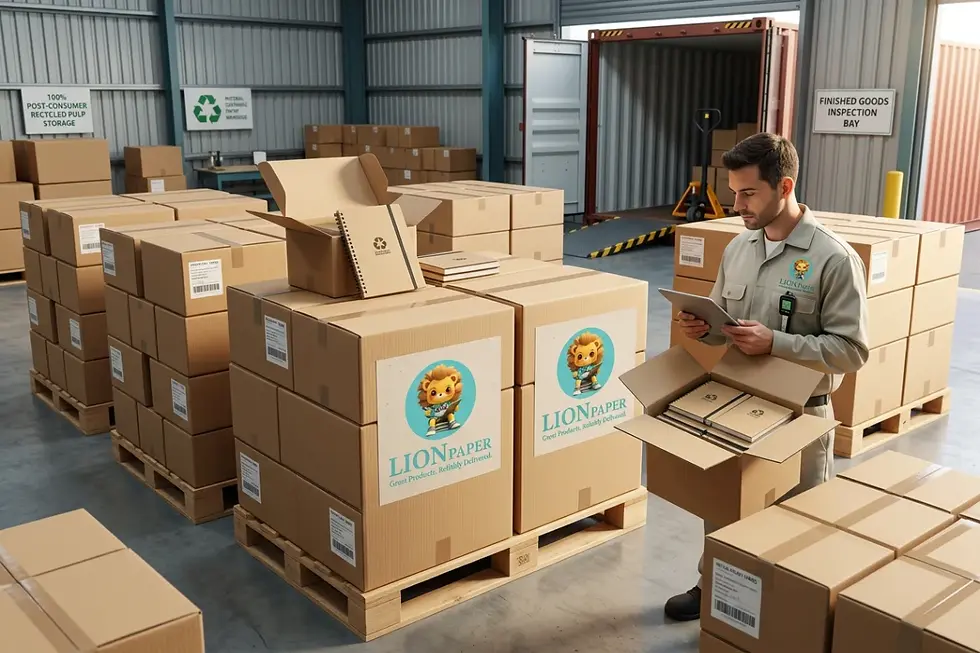
Retail-ready, plastic-free packaging and optimized palletization configurations reduce landed costs and transport emissions.
How Can Global Supply Chain Models Mitigate Compliance and Delivery Risks in Large-Scale Tenders?
Executing high-volume, multi-market sustainable stationery tenders requires balancing agile design engineering with cost-effective, scalable production capacity. Enterprises face changing customs regulations, import tariffs, and variable lead-time constraints when sourcing substantial volumes of custom stationery.
Integrated supply chain partners bridge these operational challenges by leveraging cross-border operational synergy. Lion Paper Products (Jiaxing) Co., Ltd. operates a dual-site manufacturing network designed to manage end-to-end procurement cycles. A dedicated 3,000-square-meter Jiaxing facility manages rapid product conceptualization, structural design, material validation, sample prototyping, and customer technical support. For scalable mass production, an expansive 10,000-square-meter production site in Cambodia executes volume conversion, automated binding, assembly, and global freight dispatch.
Operating with automated production lines, standardized SOP quality cards, and an annual notebook production capacity exceeding 5 million units, this dual-hub infrastructure allows corporate buyers to de-risk their supply chain. Organizations achieve tight development cycles from early sketches to physical pilot samples, followed by tariff-advantaged, cost-optimized containerized shipments to North America, Europe, Australia, and the Middle East.
To begin reviewing technical feasibility, tooling parameters, and documentation compliance for your upcoming stationery procurement contracts, contact our engineering and tender advisory team with your material specifications, target destination markets, and mandatory evidence checklists to evaluate suitable notebook configurations and retail-ready packaging options.
FAQ
What is the difference between FSC Recycled and FSC Mix in notebook tenders?
FSC Recycled indicates that 100% of the timber or paper fiber used in the notebook is derived from post-consumer or pre-consumer reclaimed materials. FSC Mix indicates that the product contains a combination of FSC-certified virgin fiber from responsibly managed forests, controlled wood sources, and recycled materials. Tenders must state whether an FSC Mix claim is acceptable or if pure FSC Recycled is strictly required.
How does recycled paper affect fountain pen and high-pigment gel pen performance?
Because recycled cellulose fibers are shorter and more porous than virgin fibers, untreated recycled paper may suffer from ink feathering and show-through. To ensure smooth writing without bleed-through, notebook specifications should mandate internal sizing (AKD) and a smooth surface starch calendar finish, with paper basis weights specified between 80 gsm and 100 gsm and a Cobb60 absorption value under 30 g/m².
What documentation is required to verify plastic-free packaging in sustainable stationery tenders?
Suppliers must submit material composition declarations confirming the absence of plastic shrink-wrap, BOPP laminates, and synthetic adhesive tapes. In their place, acceptable documentation includes certified recyclable kraft paper bands, unbleached tissue wraps, water-based dispersal varnishes, and 100% recycled corrugated carton test reports conforming to ASTM D4727 or EN 13430.


Comments