


Recycled Notebook Covers vs Pages: Technical Sourcing and Material Guide

Recycled notebook covers prioritize structural rigidity, impact resistance, and tactile shelf presence using high-density post-consumer waste board, whereas recycled inner pages require refined fiber processing to ensure opacity, surface smoothness, and bleed resistance across various writing instruments. Sourcing balanced eco-notebooks requires specifying distinct fiber grades, basis weights, and finishes for covers versus text leaves to achieve durability without compromising everyday writing performance.
What Are the Core Structural and Material Differences Between Recycled Covers and Recycled Pages?
The functional demands of a notebook cover differ fundamentally from those of its inner writing block. In sustainable product development, notebook components are divided into rigid protective substrates (covers) and functional writing substrates (pages). Each component utilizes specialized grades of recycled pulp that serve distinct mechanical and visual purposes.
Recycled Notebook Covers: Typically manufactured from heavy greyboard, chipboard, kraft paperboard, or coated duplex board ranging from 300 GSM (softcover) to over 1,800 GSM / 2.5 mm thickness (hardcover). Cover stock is optimized for high tensile stiffness, burst resistance, and edge durability to protect the inner contents from daily transit wear.
Recycled Inner Text Stock: Designed for two-sided legibility and tactile comfort, using uncoated woodfree paper, book offset paper, or bleached/unbleached kraft writing stock ranging from 70 GSM to 120 GSM. Text stock prioritizes caliper uniformity, ink absorption control, high opacity, and smooth sheet formation.
Technical Metric | Post-Consumer Waste Cover Board | Recycled Inner Text Stock | |
|---|---|---|---|
:--- | :--- | :--- | :--- |
Typical Basis Weight | 300 – 2,000+ GSM (or 0.5 mm – 3.0 mm caliper) | 70 – 120 GSM (typically 80 – 100 GSM) | |
Primary Raw Materials | Mixed recovered paper, recycled corrugated containers (OCC), unbleached kraft | De-inked post-consumer pulp (PCW), pre-consumer mill broke, refined post-industrial waste | |
Key Performance Indicator | Taber stiffness, Mullen burst strength, warp resistance | Cobb sizing value, Parker print smoothness, opacity percentage | |
Surface Texture | Matte, toothy, embossed, or film-laminated | Calendered smooth, micro-toothed, or sized for minimal drag | |
Primary Manufacturing Function | Structural enclosure, drop protection, bindery hinge support | Ink acceptance, zero show-through, comfortable leaf-turning |
Selecting the right combination ensures that the outer shell can withstand mechanical stress while the inner block provides clean, feather-resistant writing.
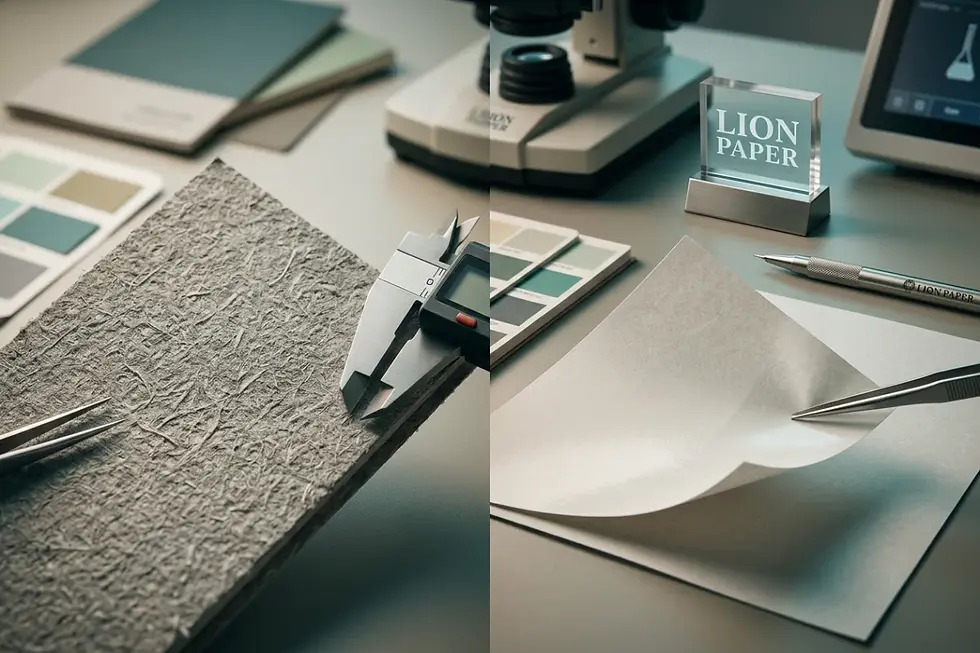
Fiber density and thickness differentiation between multi-ply cover board and calendered inner pages.
How Does Fiber Length and Processing Differ Between Post-Consumer Waste Cover Board and Recycled Inner Text Stock?
The structural integrity of any paper product depends on fiber morphology. When wood fibers undergo repeated recycling, they shorten, become brittle, and lose hydrogen-bonding capacity. Manufacturers manage these physical changes differently depending on whether the pulp is intended for rigid board or thin writing sheets.
Cover Board Processing (PCW Greyboard and Kraft)
Cover board relies heavily on layered density rather than long individual fibers. Post-consumer waste cover board is built using multi-ply cylinder board machines:
Hydropulping: Mixed paper streams and old corrugated containers (OCC) are pulped with minimal chemical de-inking, preserving bulk fiber density.
Multi-Ply Layering: Fibers are deposited in stratified plies. The interior core plies utilize heavier, unbleached recovered fibers to generate structural bulk, while outer liner plies utilize cleaner recycled kraft or coated white paper.
Heavy Calendering: Heavy heated rollers compress the plies under high pressure, driving out trapped air and maximizing density (typically 0.65 to 0.85 g/cm³) to prevent the notebook spine and corners from crushing.
Inner Text Stock Processing (Recycled Offset and Woodfree Paper)
Inner text stock cannot tolerate fiber clumps, chemical impurities, or excessive surface roughness. Creating reliable recycled inner text stock involves a far more intensive refining sequence:
De-Inking and Washing: Post-consumer office paper and books undergo flotation de-inking to remove printing inks, toners, adhesives, and coatings.
Fiber Fractionation and Refining: Short, broken fines are filtered out, while remaining fibers are mechanically refined (fibrillated) to increase surface area and restore fiber-to-fiber bonding.
Internal and Surface Sizing: Specialized sizing agents (such as alkyl ketene dimer - AKD) and surface starches are applied. This prevents water-based writing inks from feathering into the sheet while maintaining internal fiber cohesion.
Soft-Nip Calendering: The paper passes through precision calender rolls to deliver a uniform thickness and an even writing surface without crushing sheet bulk or reducing visual opacity.
How Do Writing Performance and Ink Compatibility Compare Across Inner Stock Options?
When managing recycled paper notebook sourcing, paper buyers frequently encounter trade-offs between recycled content percentage and writing performance. Virgin woodfree sheets naturally exhibit high brightness and consistent ink holdout, whereas recycled inner pages require strict chemical sizing to prevent bleed-through.
Fountain Pen Inks: Water-based dye inks easily penetrate low-grade recycled paper, causing spider-web feathering and backside bleed-through. To support fountain pens, 100% PCW text stock must be treated with surface sizing agents and specified at a minimum basis weight of 100 GSM.
Gel Pens and Rollerballs: Highly fluid gel inks require balanced drying times. Smooth-calendered 80–90 GSM recycled woodfree sheets provide sufficient absorption to prevent surface smudging while retaining clear line definition.
Ballpoint and Graphite: Everyday ballpoint pens and graphite pencils perform well on standard 70–80 GSM recycled paper, where micro-toothed surfaces facilitate controlled pigment transfer.
Color Matching and Opacity: Higher recycled content often yields a lower CIE whiteness index (ranging from 75 to 95 ISO whiteness compared to 105+ for virgin stock), resulting in warmer, natural off-white, cream, or speckled aesthetic tones. High-opacity text stocks (exceeding 92% opacity) are essential for double-sided note-taking.
Understanding these performance nuances allows brands to select inner paper formulations tailored to specific target audiences, whether for utilitarian office documentation or premium journaling collections.
What Sustainable Notebook Material Comparison Factors Matter Most for Brand Durability and Shelf Appeal?
Balancing sustainability with retail shelf appeal requires evaluating how covers and pages endure real-world handling. A notebook cover must resist scuffing, edge splitting, and environmental warping, while the text block must turn smoothly without tearing along binding perforations.
Cover Board Warp Resistance: Recycled cover board is more sensitive to ambient humidity shifts than virgin synthetic covers. In hardcover casebound notebooks, the cover board must be laminated with matched moisture-barrier balance papers on both sides (outer wrap and inside endsheet) to prevent bowing.
Corner Durability and Edge Splitting: Unwrapped post-consumer waste board covers are susceptible to corner blunt-impact fraying. Applying rounded corner dies (typically 6 mm to 10 mm radius) or wrapping the greyboard with premium post-consumer kraft or recycled bookcloth significantly reduces edge wear.
Embossing and Foil Stamping Definition: Recycled board possesses distinct surface compressibility. Deep blind debossing yields crisp, tactile reliefs on thick recycled kraft and dyed post-consumer boards, while metallic hot stamping requires customized heat dwell times and harder stamping dies to maintain fine linework.
Page Tensile and Tear Strength: Thread-sewn (Smyth sewn) notebooks place continuous mechanical tension on inner page folds. Because recycled fibers have lower tear indexes than long virgin fibers, inner leaves should maintain balanced machine-direction (MD) and cross-direction (CD) tear strengths to prevent page detachment.

Writing compatibility testing across various ink types on high-grade recycled inner text stock.
Which Certifications and Chain of Custody Standards Apply to Recycled Sourcing?
Validating environmental claims requires third-party chain of custody certifications. Sourcing claims should specify exact material classifications to maintain compliance and build consumer trust across North American and European markets.
FSC Recycled 100%: Certifies that 100% of the fiber content originates from reclaimed post-consumer or pre-consumer inputs verified through a complete Forest Stewardship Council supply chain.
FSC Mix (with Post-Consumer Waste): Common for notebooks combining FSC-certified virgin fiber matrices with defined proportions (e.g., 30%, 50%, or 70%) of verified post-consumer recycled pulp.
Post-Consumer Waste (PCW) vs. Post-Industrial Waste (PIW): PCW originates from end-user discarded paper items (office waste, used newsprint, discarded boxes) and delivers the highest environmental benefit. PIW consists of industrial converting trimmings, mill overruns, and unprinted scrap.
Global Recycling Standard (GRS): Tracks recycled material flows and enforces strict environmental processing and chemical management standards across supply-chain facilities.
Chemical and Heavy Metal Compliance: Recycled notebook substrates must comply with safety frameworks including CPSIA, EU REACH Regulation (EC No 1907/2006), and California Proposition 65 to verify the absence of hazardous de-inking residues, heavy metals, or phthalates.
Lion Paper maintains complete chain-of-custody documentation across its manufacturing hubs, ensuring raw materials comply with international standards such as ISO 9001, FSC, SMETA, WCA, GSV, FAMA, and CPSIA.
How Do Cost Structures, Minimum Order Quantities, and Scrap Rates Compare?
Sourcing recycled paper components involves balancing material surcharges against manufacturing yield rates. Because recycled boards and papers process differently through automated press and bindery lines, buyers must account for cost variables across each component tier.
Material Cost Breakdown Index (Baseline Virgin Woodfree = 1.00): Standard Virgin Woodfree Paper: 1.00 Recycled Inner Text Stock (30% PCW): 1.05 - 1.12 Recycled Inner Text Stock (100% PCW De-inked): 1.18 - 1.35 Standard Greyboard Core (Post-Industrial): 0.70 - 0.85 Premium Solid-Dyed Post-Consumer Cover Board: 1.15 - 1.40
Cover Board Economics: Standard recycled greyboard cores are cost-effective due to wide raw material availability and lower refining requirements. However, premium colored post-consumer specialty cover boards command a 15% to 40% price premium over standard grades due to specialized pigmenting and fiber-washing protocols.
Inner Stock Surcharges: High-grade, de-inked 100% PCW writing paper carries higher production costs than virgin paper due to chemical de-inking, wastewater treatment, and yield loss during fiber refining.
Converting and Trimming Scrap: Recycled inner pages can generate 2% to 4% higher scrap rates during high-speed web folding and three-knife trimming due to lower tensile strength. Automated binderies adjust feeding tension and folder nip pressure to maintain standard run rates.
Scale and Minimum Order Quantities (MOQs): Standard post-consumer greyboards have low MOQs because mill inventory is broadly standardized. In contrast, specialized weights of 100% recycled smooth inner paper often require master roll mill runs of 3,000 kg to 5,000 kg (equivalent to 5,000 to 15,000 finished notebooks depending on page count).
Manufacturing at scale helps mitigate these cost premiums. Lion Paper leverages dual-site coordination—integrating rapid design, material prototyping, and sampling from its 3,000 sqm Jiaxing hub with large-scale production across its 10,000 sqm Cambodia facility—to optimize bill-of-materials costs and ensure consistent, high-volume delivery exceeding 5 million units annually.
How Should Buyers Specify Materials in an RFQ for Sustainable Notebooks?
To ensure accurate vendor pricing and avoid quality discrepancies during mass production, request-for-quotation (RFQ) documents should delineate cover and inner page specifications with technical precision.
Step-by-Step Specification Checklist
Cover Construction Type: Detail whether the build is a flexible softcover (e.g., 350 GSM 100% PCW unbleached kraft board), a wrapped hardcover (e.g., 1,200 GSM recycled greyboard core wrapped with 120 GSM recycled art paper), or an exposed-spine board.
Inner Text Stock Specifics: Define the exact basis weight (e.g., 80 GSM vs. 100 GSM), the precise recycled proportion (e.g., 100% FSC Recycled PCW vs. 30% recycled blend), surface finish (calendered smooth or natural vellum), and target shade (natural white, cream, or unbleached).
Binding Compatibility: Specify the binding structure (Smyth sewn with rounded spine, thread-stitched lay-flat, double-wire wire-o, or casebound) and align spine reinforcement materials with overall sustainability goals.
Printing and Embellishment Parameters: Clarify eco-friendly ink requirements (such as soy-based or vegetable-oil-based offset inks) and define surface embellishments (e.g., blind debossing, foil stamping, water-based protective varnish, or plastic-free coating).
Chain of Custody and Audit Mandates: State required certification logos (FSC Recycled, FSC Mix), factory social audit standards (SMETA, WCA), and end-use retail testing protocols (CPSIA, EN 71-3).

Retail-ready sustainable notebooks combining rigid post-consumer covers with certified recycled inner pages.
Frequently Asked Questions on Recycled Notebook Sourcing
Can 100% recycled inner pages support wet writing instruments without ghosting?
Yes, provided the paper has undergone sufficient internal and surface sizing (such as AKD treatment) and has a basis weight of 100 GSM to 120 GSM. These specifications control ink absorption rates and prevent wet fountain pen inks or heavy rollerball pigments from striking through to the reverse side.
Why is post-consumer waste cover board generally thicker than virgin cardstock?
Recycled fibers are shorter and possess less natural tensile strength than virgin fibers. To achieve equivalent rigidity, warp resistance, and corner strength, recycled board is produced at higher calipers and densities, resulting in a sturdier, weightier cover structure.
What is the most cost-effective way to market an eco-friendly notebook line?
A common, highly viable approach is pairing a 100% post-consumer waste recycled cover board with a 30% to 50% recycled or FSC Mix inner text block. This combination delivers distinct, tactile sustainable branding on the exterior while optimizing production costs and maintaining everyday writing performance on the interior pages.
How does recycled paper affect binding durability in Smyth sewn journals?
Because recycled paper fibers have lower tear strength, fold creases can weaken if sewn too tightly. Experienced manufacturers calibrate thread tension, utilize specialized spine gauze, and select flexible water-based adhesives to ensure thread-sewn bindings remain durable throughout repeated lay-flat use.
What documentation is required to verify claims on consumer packaging?
Brands must secure an unbroken FSC Chain of Custody (CoC) certificate from their manufacturer, along with material declarations confirming PCW percentages, to legally display the FSC Recycled label or specific post-consumer content claims on retail packaging.
Planning a new sustainable notebook collection requires balancing raw material properties, bindery techniques, and regulatory compliance. Request a Material Sourcing Review to submit your preferred cover and paper specifications, target production quantities, and certification requirements for a detailed manufacturing evaluation.
FAQ
Can 100% recycled inner pages support wet writing instruments without ghosting?
Yes, provided the paper has undergone sufficient internal and surface sizing (such as AKD treatment) and has a basis weight of 100 GSM to 120 GSM. These specifications control ink absorption rates and prevent wet fountain pen inks or heavy rollerball pigments from striking through to the reverse side.
Why is post-consumer waste cover board generally thicker than virgin cardstock?
Recycled fibers are shorter and possess less natural tensile strength than virgin fibers. To achieve equivalent rigidity, warp resistance, and corner strength, recycled board is produced at higher calipers and densities, resulting in a sturdier, weightier cover structure.
What is the most cost-effective way to market an eco-friendly notebook line?
A common, highly viable approach is pairing a 100% post-consumer waste recycled cover board with a 30% to 50% recycled or FSC Mix inner text block. This combination delivers distinct, tactile sustainable branding on the exterior while optimizing production costs and maintaining everyday writing performance on the interior pages.
How does recycled paper affect binding durability in Smyth sewn journals?
Because recycled paper fibers have lower tear strength, fold creases can weaken if sewn too tightly. Experienced manufacturers calibrate thread tension, utilize specialized spine gauze, and select flexible water-based adhesives to ensure thread-sewn bindings remain durable throughout repeated lay-flat use.
What documentation is required to verify claims on consumer packaging?
Brands must secure an unbroken FSC Chain of Custody (CoC) certificate from their manufacturer, along with material declarations confirming PCW percentages, to legally display the FSC Recycled label or specific post-consumer content claims on retail packaging.


Comments