


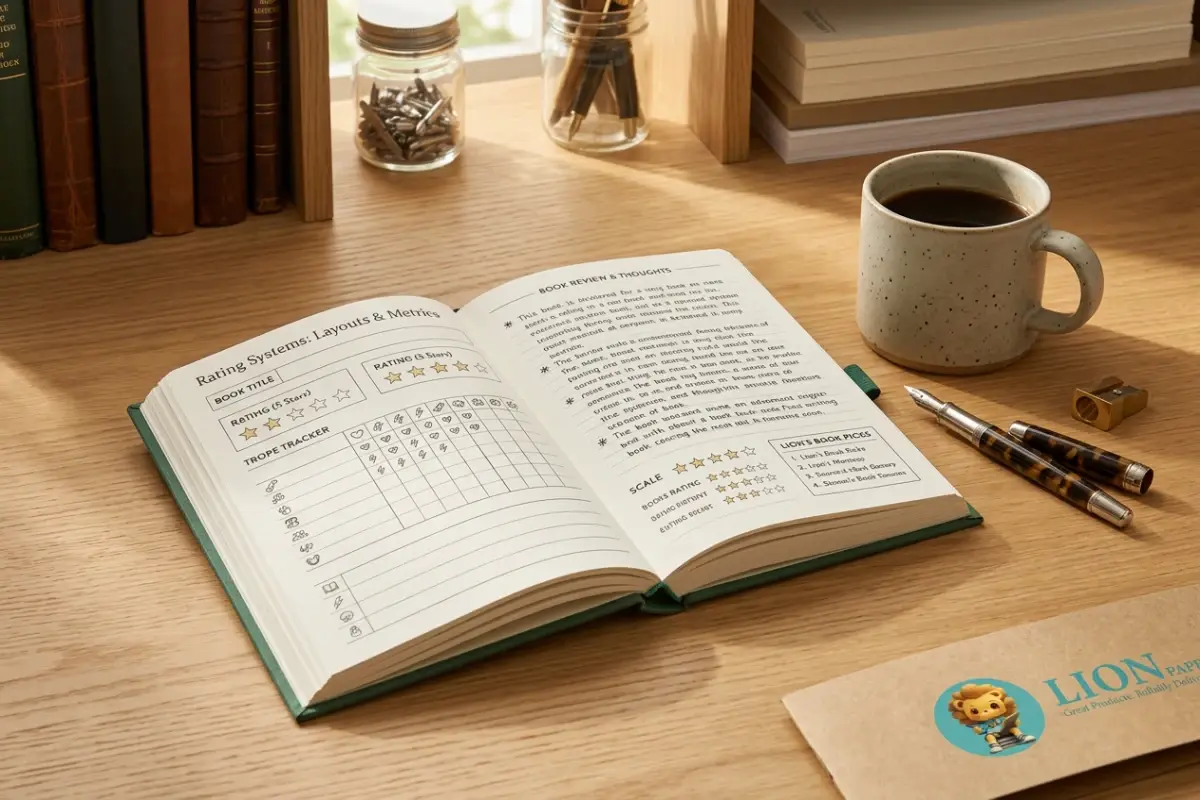
Reading Journal Rating Systems: Layouts, Metrics, and Production Guide

The most effective reading journal rating systems combine quick-scoring visual metrics like 5-star or spice scales with structured 3-line thematic prompts and open reflection space, balancing rapid logging with deep engagement to maximize long-term reuse and retail value. Modern book lovers demand nuanced metrics that record not only overall enjoyment, but also pacing, emotional resonance, character development, and world-building.
What Are the Core Reading Journal Rating Formats and Visual Scales?
Commercial reading journals use three primary rating formats: numerical star scales, thematic sub-category scores, and graphic iconography. Selecting the right combination depends on your target audience, such as casual book club readers, genre-specific enthusiasts (like romance or fantasy communities), or academic reviewers.
Traditional 5-Star Scales: The universal standard for book cataloging. It allows instant comparisons with digital tracking platforms like Goodreads or StoryGraph. Most layouts incorporate half-star increments or 10-point breakdowns to allow finer granularity.
Thematic Sub-Category Ratings: Instead of a single composite score, layouts break evaluation into discrete criteria. Typical sub-metrics include Writing Quality, Plot & Pacing, Character Depth, Emotional Impact, and World-Building or Dialogue.
Graphic & Trope Trackers: Popularized by BookTok and Bookstagram communities, these use visual icons (such as flame or chili pepper symbols for romance spice levels, swords for fantasy world complexity, or tissues for tear-jerker emotional intensity).
Mood & Vibe Indicators: Circular dial gauges, spectrum sliders (e.g., Character-Driven vs. Plot-Driven, Dark vs. Uplifting), and color-coded tag clusters that record subjective impressions quickly.
Rating System Type | Target Reader Persona | Key Structural Elements | Logging Time | Analytical Depth |
|---|---|---|---|---|
:--- | :--- | :--- | :--- | :--- |
Classic 5-Star Grid | General Fiction / Non-Fiction Readers | Outline stars, 0.5-increment tick marks, date read | < 30 seconds | Moderate |
Multi-Axis Radar Matrix | Literary Fiction / Book Club Members | 5-point pentagon chart (Plot, Characters, Prose, Theme, Pacing) | 1–2 minutes | Very High |
Trope & Spice Visual Scale | Romance / Romantasy / YA Readers | Chili/flame outlines (1–5), trope checklist boxes, mood badges | < 1 minute | High (Emotional/Genre) |
Hybrid Log Entry | Power Readers / Content Creators | Star rating + 3 sub-metrics + favorite quote bar + summary | 2–3 minutes | Balanced |

Core rating formats provide tailored logging metrics for different reader personas and genres.
How Do You Balance Structured Prompts and Open Reflection Space in Custom Reading Journal Layouts?
Balancing structured prompts with open reflection space is essential for user retention. When a book review log interior design imposes too many rigid form fields, readers experience logging fatigue and abandon the journal. Conversely, completely unguided blank pages cause blank-page paralysis.
Commercial reading companion stationery design achieves balance through structured visual hierarchy. The optimal page architecture divides a single review entry into three functional tiers:
Metadata & Score Header (Top 20–25% of Page): Fast-fill data fields including Book Title, Author, Genre, Page Count, Format (Audio/Physical/E-book), Start/Finish Dates, and the primary reading journal rating systems visual score.
Targeted Micro-Prompts (Middle 25–30% of Page): Compact fields that guide critical thinking without demanding lengthy paragraphs. Standard inclusions feature: Key Tropes/Themes, Three-Word Impression, Favorite Character, and Impact Rating.
Unstructured Reflection & Quote Area (Bottom 45–55% of Page): A subtle 5mm light-grey dot grid or 7mm ruled section dedicated to memorable quotes, detailed critiques, and creative marginalia.
This hybrid architecture allows a reader to complete an entry in 45 seconds when short on time, while offering ample room for extensive reviews after completing impactful reads.
What Are the Key Page Architecture and Interior Layout Specifications for Reading Logs?
A successful reading tracker journal requires a cohesive ecosystem of complementary record-keeping spreads beyond standalone review pages. Commercial production models typically feature 160 to 224 pages, balancing physical thickness with sufficient logging capacity.
Annual Reading Goals & Tracker Spread (Pages 4–7): Visual bookshelf templates where users write book titles on blank illustrated book spines, accompanied by 12-month visual progress graphs or habit trackers.
Master Index and Library Log (Pages 8–15): Numbered row logs capturing entry index numbers, book titles, genres, and final star ratings to facilitate quick reference across the notebook.
Single-Page vs. Two-Page Review Entries (Pages 16–190): Single-page layouts accommodate 100+ book reviews for high-volume readers. Two-page spreads provide dedicated left-hand pages for structured metrics and right-hand pages for creative scrapbooking, ephemera pasting, or extensive quote capture.
Did Not Finish (DNF) & Bracket Challenges (Pages 191–205): Dedicated tracking for abandoned books with drop-down reason checklists, plus tournament-style bracket pages for "Book of the Year" competitions.
Genre & Lending Logs (Pages 206–220): Specialized spreads tracking borrowed/lent books, favorite bookstore wishlists, and annual genre distribution pie charts.

Balanced page architecture integrates structured data fields with open dot-grid reflection space.
Which Paper Grades and Printing Specifications Prevent Bleed-Through from Annotating Pens?
Book lovers and journal enthusiasts frequently use heavy-ink writing instruments, including fountain pens, gel rollers, water-based brush markers, and mildliner highlighters. Specifying correct paper grades during book tracker journal manufacturing directly prevents ghosting, feathering, and bleed-through.
Optimal Paper Weight: Specify 100 gsm to 120 gsm wood-free paper or 140 gsm bamboo/recycled paper. Standard 70–80 gsm commercial notebook paper is insufficient for multi-color highlighting and fountain pen inks.
Surface Sizing and Smoothness: A smooth, calendered wood-free sheet with balanced sizing prevents ink feathering while maintaining quick ink drying times to prevent smudging during fast reviews.
Paper Shade & Readability: Cream, warm white, or ivory paper stocks (ISO brightness 80–85%) offer significantly lower optical fatigue during prolonged reading sessions compared to high-glare bleached white sheets (ISO brightness 95%+).
Grid and Line Contrast: Interior grid lines and star rating iconography must be printed in subtle neutral tones (such as Pantone Cool Gray 3U or 4U at 40–60% screen tint). Heavy black lines distract from handwritten notes and make colored highlighters look muddy.
Eco-Material Compliance: FSC-certified wood-free paper, vegetable-based soy inks, and recycled cover stocks ensure alignment with international environmental regulations and consumer sustainability expectations.
What Cost and Quality Control Risks Arise in Multi-Element Journal Production?
Publishing brands and stationery creators often face yield loss and unexpected cost inflation when manufacturing complex journals. Specialized reading journals contain diverse accessories, specialized binding structures, and multiple ribbon markers that introduce distinct manufacturing failure points.
Binding Stress from Tipping and Taping: Readers often paste book cover stickers, printouts, or sticky notes into reading logs. Smyth-sewn (casebound) binding or flexible lay-flat binding is mandatory. Weak perfect-bound glue spines will crack and split under the added physical bulk of tipped-in ephemera.
Multi-Ribbon Fraying and Assembly: Reading journals often require 2 or 3 distinct colored ribbon markers (e.g., for the active review page, master index, and annual challenge spread). Ribbon ends must undergo ultrasonic heat-sealing to prevent fraying over repeated use.
Expanded Gusseted Back Pockets: Back pockets must be engineered with reinforced cloth or durable kraft gussets to hold sticker sheets, reading tabs, and book club notes without tearing away from the back endpaper.
Registration Alignment Across Spreads: Visual tracking spreads that span across two facing pages require micro-tolerance folding and binding registration. Misalignments larger than 0.5 mm disrupt illustrated bookshelf artwork and progress matrices.
Manufacturing Component | Standard Specification | Common Risk Point | Quality Control / SOP Verification |
|---|---|---|---|
:--- | :--- | :--- | :--- |
Binding Structure | Smyth-Sewn Casebound with Lay-Flat Spine | Spine rupture or failure to lay flat at 180° | Pull-strength testing on signatures; 180° flat-opening verification |
Interior Paper | 120 gsm FSC Wood-free Cream | Ink feathering and see-through bleed | Standardized ink absorption tests with fountain pens and markers |
Ribbon Markers | Dual/Triple Grosgrain or Satin Ribbons (7mm) | Ribbon detachment and edge unraveling | Ultrasonic edge-cutting; minimum 5 kg anchor pull test at spine |
Cover Treatment | PU Leather / Linen / 157 gsm Foil-Stamped Paper | Foil flaking, warping, or scuffing | 3M tape adhesion test; humidity-controlled board pressing |
Back Pocket | Reinforced Gusseted Envelope on Rear Endpaper | Side gusset tearing under capacity load | Expanded capacity stress testing with 50 gsm accessory payload |

Smyth-sewn lay-flat binding and reinforced gusseted pockets prevent wear from heavy journaling.
How Should Brands Execute RFQ, Prototyping, and Sampling for Reading Companion Systems?
Taking a customized reading journal from concept to commercial volume requires a structured design-to-manufacturing workflow. Working with an integrated supply-chain partner allows brands to refine layouts, validate structural ergonomics, and control total landing costs before committing to mass production.
Define Core Product Specifications in the RFQ: Specify page count, trim size (standard sizes: A5, B6, or 7x9 inches), cover material (e.g., vegan leather, bookcloth linen, or printed hardcover), interior paper stock (e.g., 120 gsm FSC cream), binding mechanism, and accessory sets (elastic band, pen loop, ribbon count, sticker sheets).
Digital Dieline and Pagination Pre-Flight: Ensure all inner rating icons, star fills, and grid lines sit outside critical margin cut lines (minimum 12 mm inner gutter margin for comfortable lay-flat writing).
White-Body Structural Prototyping: Request unprinted blank mockups using the exact specified board thickness and 120 gsm paper stock to evaluate spine flexibility, pocket depth, and overall physical weight.
Digital Color Proofing & Live Material Sampling: Validate foil stamping clarity on cover fabrics and check interior grey grid contrast using digital and wet proofing sheets.
Batch Production and Compliance Testing: Transition to dual-site manufacturing where pre-production sampling and engineering are coordinated in dedicated development facilities, followed by scalable mass production adhering to ISO 9001, FSC, and CPSIA consumer safety standards.
To build a cohesive reading companion collection, you can share your reader use case, target format, paper specifications, page architecture, and accessory-set ideas with Lion Paper for a comprehensive Reading Companion development review.
FAQ
What is the standard trim size for a commercial reading journal?
A5 (148 x 210 mm) is the international standard for commercial reading journals because it balances portable desk space with sufficient room for detailed reviews. B6 (125 x 176 mm) is popular for compact on-the-go logs, while 7 x 9 inches (178 x 228 mm) is widely favored in North American retail markets for comprehensive two-page reading planners.
How many books should a standard reading tracker journal accommodate?
Most commercial reading logs are engineered to track between 52 and 104 books. A 52-book capacity supports the common 'one book per week' reading goal on single- or double-page spreads, while a 100-book capacity caters to power readers within a standard 160-to-224 page notebook format.
What is the best binding method for reading journals that readers write in frequently?
Smyth-sewn casebound binding with a flexible spine is the optimal method. It allows the journal to open 180 degrees completely flat on a table, ensuring effortless writing across both left and right inner gutters without the spine breaking or pages detaching.
Can custom reading journals incorporate themed accessory sets?
Yes. Custom reading companion projects frequently bundle coordinated stationery accessories, including themed sticker sheets for rating highlights, colored index tabs for genre tagging, elastic closure bands, custom metal page clips, and matching ribbon bookmarks.


Comments