


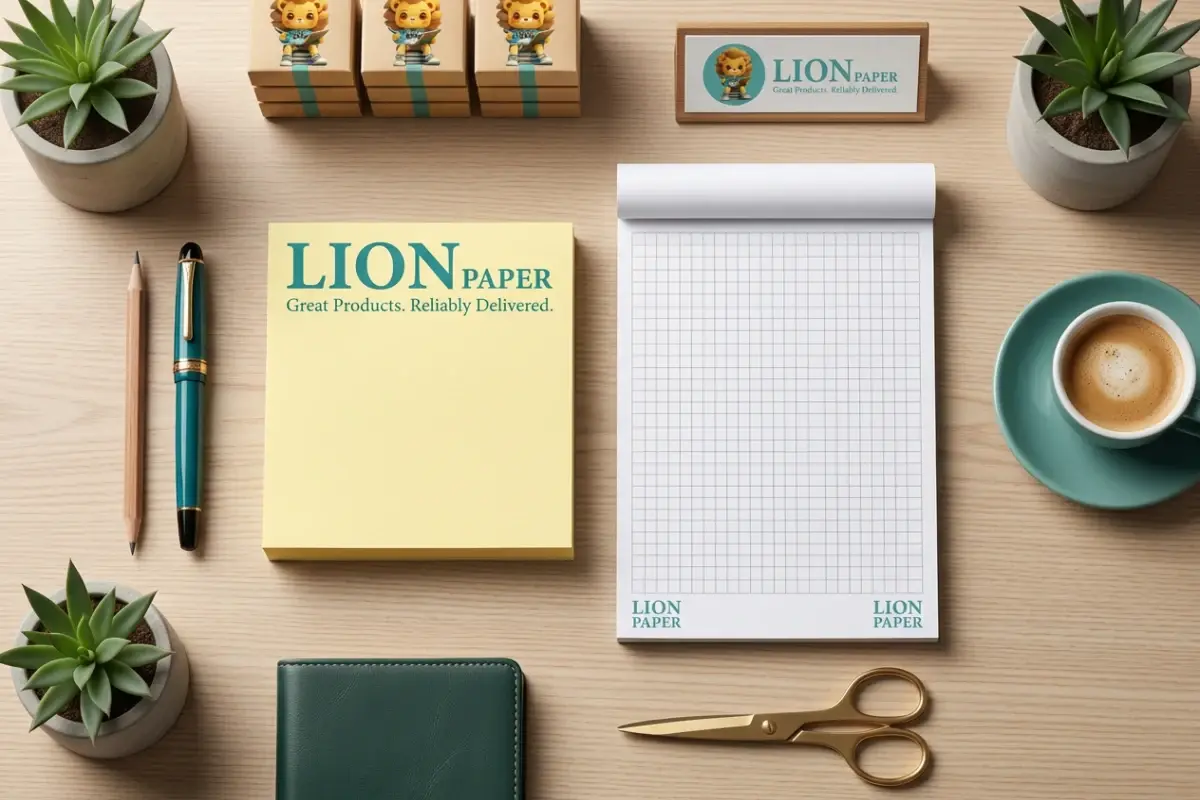
Promotional Sticky Notes vs. Notepads: Sourcing Comparison Guide

Promotional sticky notes deliver high-frequency visual placement across monitors, documents, and shared collaborative surfaces, whereas custom tear-off notepads provide expansive writing space, structured layout capacity, and extended promotional longevity for desk workflows and meeting notes. Selecting between them depends on whether your marketing objective prioritizes repositionable dynamic visibility or sustained, structured desk utility.
What Are the Key Functional Differences Between Sticky Notes and Notepads?
When evaluating promotional sticky notes vs notepads for brand marketing or retail programs, the primary distinction lies in how the end-user interacts with each sheet after removal. Sticky notes utilize a repositionable adhesive strip on the reverse side, turning every individual sheet into a mobile reminder that adheres to computer monitors, refrigerator doors, planners, and office partitions. This dynamic movement ensures repetitive brand impressions across high-traffic visual zones.
In contrast, promotional memo pads and custom tear-off notepads use a top-edge padding compound (glue binding) applied directly over a backing board without individual strip adhesives. Once torn from the pad, notepads function as standalone loose sheets or remain bound until filled. Notepads offer substantial writing surface areas, making them the standard choice for structured note-taking, to-do lists, meeting agendas, and executive desk planning where extended text legibility is mandatory.
Primary Interaction Mode: Sticky notes offer repositionable micro-messaging; notepads offer stationary, long-form writing.
Desk Footprint: Sticky notes occupy compact spaces (typically 3x3 inches or 4x3 inches); notepads occupy active work zones (such as 4x6 inches, 5x7 inches, or standard A5/letter sizes).
Substrate Requirements: Sticky notes require balanced paper sizing to prevent adhesive bleed; notepads allow heavier uncoated or textured specialty papers.
User Retention: Sticky note sheets migrate across surfaces for temporary reminders; notepads remain anchored on workstations across multi-month lifecycles.

Structural adhesive strip compared to cold-padding tear-off compound binding.
How Do Technical Specifications Compare: Adhesive Placement vs. Bound Tear-Off Durability?
Understanding the structural composition of each format prevents production failures and ensures paper stationery performs consistently in varied office and home environments. Lion Paper Products manufactures both categories across its dual-site production network, applying standardized SOPs to control adhesive tack, sheet separation tension, and edge squareness.
The adhesive applied to branded sticky notes bulk programs requires specialized water-based microsphere technology. This chemical formulation allows clean peel without leaving tacky residue on delicate surfaces, while resisting curl when peeled upwards. Tear-off notepads rely on flexible polyvinyl acetate (PVA) cold-padding glues applied to stacked sheets under mechanical compression, paired with sturdy backing boards to maintain pad rigidity.
Technical Parameter | Branded Sticky Notes | Custom Tear-Off Notepads |
|---|---|---|
:--- | :--- | :--- |
Standard Paper Basis Weight | 70 gsm to 80 gsm offset paper | 70 gsm, 80 gsm, 100 gsm, or 120 gsm uncoated woodfree |
Binding / Attachment Method | Repositionable microsphere adhesive strip | Cold-padding compound with rigid backing board |
Standard Sheet Count | 25, 50, or 100 sheets per pad | 25, 50, 75, or 100 sheets per pad |
Backing Substrate | Optional coated cover / 120 gsm release backer | 600 gsm to 1200 gsm greyboard or chipboard |
Custom Finishing Capabilities | Die-cut shapes, cover wraps, neon paper | Edge-gilding, magnetic backing, perforated stubs |
Printing Alignment Needs | Light screen tinting to maintain writeability | Full CMYK, spot Pantone, precise ruled gridlines |
Manufacturing Sensitivity | Relative humidity & adhesive cure time control | Cutting clamp pressure & glue penetration depth |
Which Campaign Scenarios Best Fit Each Paper Stationery Format?
Sourcing managers must evaluate user context to ensure high promotional return on investment. Selecting the right pad style depends directly on target audience workflows, distribution channels, and packaging configurations.
Branded sticky notes excel in high-volume trade show giveaways, corporate welcome kits, tech workstation outfitting, and direct mail campaigns where low unit weight minimizes shipping freight. Because individual notes are shared across colleagues during collaborative sessions, brand visibility extends organically beyond the initial recipient.
Custom tear-off notepads are better suited for medical representative drops, hotel room amenities, legal and financial consultation desks, conference training packets, and retail stationery collections. The expansive canvas allows for functional layouts, such as daily prioritization quadrants, hourly schedules, lined checklist grids, or dual-branded corporate partner logos.
Corporate Office Onboarding: Sticky note cubes and multi-colored tab sets provide immediate utility for desktop workflows.
Medical & Pharmaceutical Detailing: Notepads with pre-printed prescription blanks, dosage charts, or diagnostic rubrics anchor clinical messaging.
Retail & Creator Merchandise: Die-cut shaped notepads featuring illustrated headers, luxury foil accents, and shrink-wrapped backing boards deliver strong shelf appeal.
Trade Show Mass Distribution: Slim 25-sheet flat sticky pads maximize brand impressions per dollar while keeping logistics footprints light.

Functional use scenarios: structured desk planning versus dynamic screen reminders.
Buyer Decision Matrix: Sheet Count, Visibility, and Unit Cost Trade-offs
Balancing budget allocations requires analyzing the balance between unit manufacturing cost, usable product life, and brand exposure frequency. In custom paper stationery sourcing, higher sheet counts reduce the per-sheet production cost but increase freight volume and raw material consumption.
A 50-sheet sticky pad provides 50 individual touchpoints that migrate across an office environment, creating decentralized impressions. A 100-sheet memo pad provides a persistent workstation presence that can remain on a buyer's desk for three to six months. Lion Paper Products leverages its Jiaxing design and sampling facility alongside its 10,000-square-meter Cambodia manufacturing plant to optimize these cost curves across large-scale runs.
| SOURCING SELECTION MATRIX |
+-----------------------------------+----------------------+ | Campaign Priority | Recommended Format | Key Economic Benefit |
+-----------------------------------+----------------------+ | High Distribution Volume | 25-Sheet 3"x3" Sticky Note Pad | Lowest landed cost | | Maximum Workstation Stay | 50-Sheet 5"x8" Chipboard Notepad | Longest active life | | Executive & VIP Gifting | Hardcover Sticky Note Booklet Set | High perceived value | | Retail SKU Merchandising | 100-Sheet Illustrated Desk Pad | Strong shelf pricing |
+-----------------------------------+----------------------+
When calculating total procurement expenditure, consider shipping density. Because tear-off notepads incorporate heavy backing chipboard, their pallet weight is higher than equivalent sheet quantities of sticky notes. Conversely, sticky notes require controlled carton sealing to protect specialized pressure-sensitive adhesives from ambient moisture during international ocean transit.
What Technical Specifications Are Needed for Bulk Sourcing and RFQs?
To ensure rapid quote turnaround and accurate manufacturing tolerances when initiating a request for quotation (RFQ), procurement teams should define structural parameters systematically. Clear technical briefs eliminate engineering ambiguities during the pre-press proofing stage.
Lion Paper applies comprehensive ISO 9001 and AQL inspection protocols across paper sourcing, sheet printing, gluing, trimming, and packaging. Providing the following variables upfront allows supply-chain engineers to recommend optimal paper weights and production routing between our China prototyping and Cambodia volume manufacturing lines:
Pad Dimensions: Specify exact trim width and height in millimeters or inches (e.g., 76x76mm for sticky notes, 148x210mm A5 for notepads).
Sheet Count & Block Thickness: Detail sheets per pad (25, 50, 80, or 100 sheets) and required bulk height.
Substrate Grade: Select between standard FSC-certified woodfree offset paper (70–100 gsm) or post-consumer recycled paper stocks.
Adhesive Position: For sticky notes, confirm whether the adhesive strip runs along the top width or side edge, and specify adhesive strip width.
Backing Board Grade: For notepads, specify greyboard caliper (e.g., 800 gsm / 1.2mm) or white duplex cardstock backing.
Print Color Specifications: Define CMYK process versus Pantone spot colors for sheet printing, watermark screens, and edge printing.
Packaging Formats: Detail individual polybagging, shrink-wrapping with retail barcode labels, or multi-pack belly bands.

Precision trimming and quality control standards in bulk paper pad manufacturing.
Ready to engineer your next stationery project? Share pad size, sheet count, artwork, target volume and packaging needs for a custom notepad feasibility review via our stationery engineering inquiry page to receive comprehensive structural recommendations and landed pricing estimates.
Frequently Asked Questions on Promotional Paper Pads
Can branded sticky notes be customized into custom die-cut shapes?
Yes. Sticky note stacks can be die-cut into circles, speech bubbles, geometric silhouettes, or custom product outlines. However, the repositionable adhesive strip must be positioned across a solid, continuous edge of the die-cut profile to ensure the sheets peel flat without tearing.
What paper weight is recommended to prevent ink bleed-through on custom notepads?
For standard ballpoint and rollerball pens, 80 gsm uncoated woodfree paper is sufficient. For executive gift notepads or applications where fountain pens, heavy gel pens, and markers are used, a 100 gsm to 120 gsm premium offset paper is recommended to prevent ghosting and feathering.
How does paper certification impact international stationery procurement?
Utilizing FSC-certified (Forest Stewardship Council) paper ensures raw pulp is harvested from responsibly managed forests with complete chain-of-custody tracking. Retailers and corporate buyers in North America and Europe increasingly require FSC, SMETA, or CPSIA compliance documentation for customs clearance and ESG auditing.
FAQ
Can branded sticky notes be customized into custom die-cut shapes?
Yes. Sticky note stacks can be die-cut into circles, speech bubbles, geometric silhouettes, or custom product outlines. However, the repositionable adhesive strip must be positioned across a solid, continuous edge of the die-cut profile to ensure the sheets peel flat without tearing.
What paper weight is recommended to prevent ink bleed-through on custom notepads?
For standard ballpoint and rollerball pens, 80 gsm uncoated woodfree paper is sufficient. For executive gift notepads or applications where fountain pens, heavy gel pens, and markers are used, a 100 gsm to 120 gsm premium offset paper is recommended to prevent ghosting and feathering.
How does paper certification impact international stationery procurement?
Utilizing FSC-certified (Forest Stewardship Council) paper ensures raw pulp is harvested from responsibly managed forests with complete chain-of-custody tracking. Retailers and corporate buyers in North America and Europe increasingly require FSC, SMETA, or CPSIA compliance documentation for customs clearance and ESG auditing.


Comments