


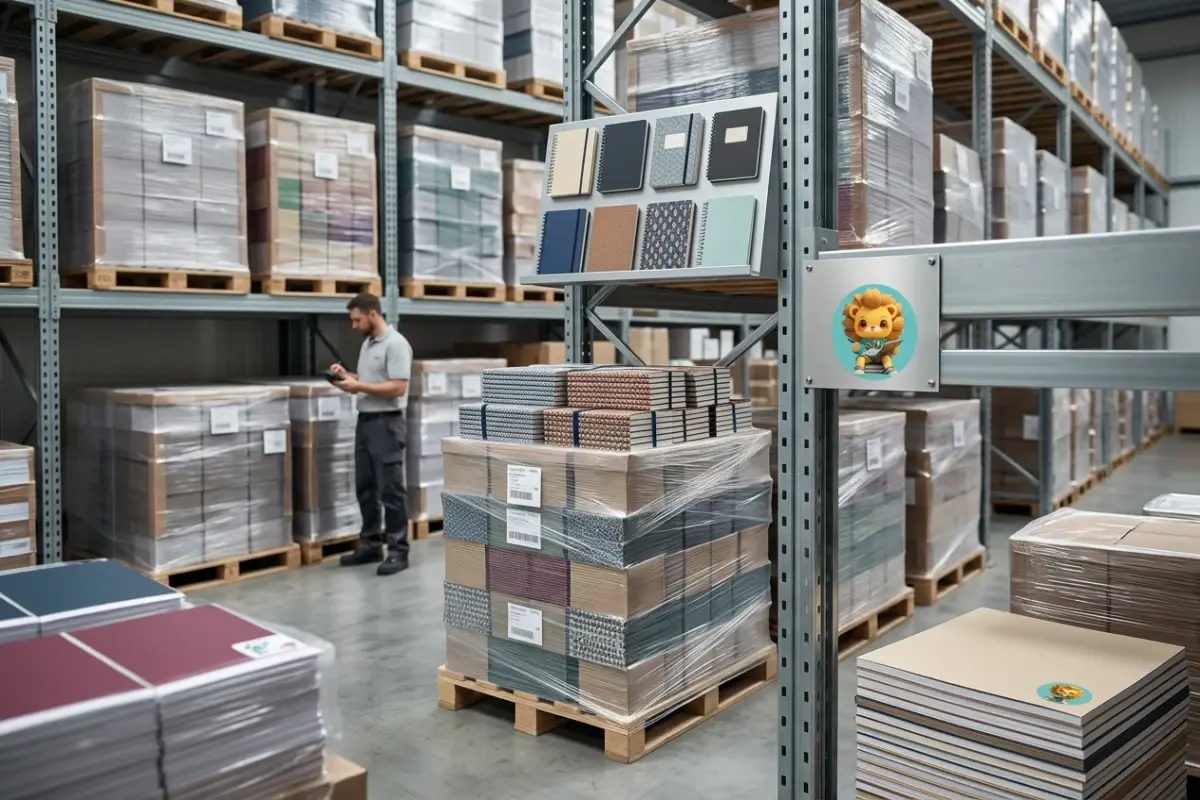
A Complete Guide to Printed Notebook Cover Inventory Holding and Call-Off Manufacturing

Yes, OEM notebook manufacturers can print and store cover inventory in advance for scheduled replenishment runs, provided that storage conditions, obsolescence liabilities, and minimum call-off timelines are clearly defined in contractual agreements. This hybrid strategy allows stationery brands to lock in bulk offset printing economies of scale while deferring interior text block binding, customization, and packaging until actual market demand materializes.
How Does Holding Preprinted Notebook Covers Differ from Holding Finished Goods Inventory?
Managing inventory in custom stationery programs involves balancing unit manufacturing costs against cash commitment and storage footprint. Holding printed notebook cover inventory represents an intermediate inventory posture between holding raw materials and warehousing fully finished notebooks. When an OEM holds preprinted covers, the high-setup-cost lithographic or special finishing processes—such as 4-color offset printing, metallic foil stamping, spot UV, soft-touch matte lamination, and structural embossing—are executed upfront in an optimal volume run. However, the subsequent conversion steps, including text block folding, collating, thread sewing, casing-in, or wire-o binding, remain uncommitted.
This postponement strategy delivers several distinct supply chain advantages compared to traditional finished goods warehousing:
Capital Preservation: Preprinted covers, paperboards, or book cloth wraps represent only 15% to 30% of the total finished notebook cost. Storing covers ties up significantly less working capital than stocking finished, boxed units.
Interior Flexibility: Brands can bind the identical preprinted cover design over multiple interior layout variations—such as lined, dot grid, undated planner grids, or blank sketch pages—based on real-time channel sales data.
Volumetric Space Efficiency: Flat or pre-creased covers occupy up to 85% less warehouse cube space than assembled, boxed, and palletized hardcovers, dramatically lowering monthly holding and handling expenses.
Rapid Lead-Time Conversion: While starting a custom notebook from raw paper requires 45 to 60 days of offset printing, coating curing, and sheet stabilization, binding pre-staged covers with ready-printed standard inner blocks reduces final delivery lead time to 10 to 15 days.
Inventory Metric | Raw Paperboard & Sheets | Preprinted Cover Inventory | Finished Notebook Goods |
|---|---|---|---|
:--- | :--- | :--- | :--- |
Working Capital Exposure | Lowest (10–15% of BOM) | Low to Moderate (20–30% of BOM) | Highest (100% of finished landed cost) |
Design Commitment | Zero (fully uncommitted) | High on exterior graphics, zero on interior format | Absolute (fixed artwork, rulings, and packaging) |
Replenishment Velocity | Slow (45–60 days to bind & ship) | Rapid (10–15 days to bind & ship) | Immediate (dependent on dock-to-door transit) |
Physical Storage Volume | Minimal (dense flat pallet stacks) | Compact (flat sheets or pressed cases) | Bulky (assembled 3D books with protective cartons) |
Obsolescence Liability | Minimal (raw paper can be repurposed) | Moderate (limited to cover production run) | Severe (dead inventory must be discounted or pulped) |

Bulk printing of notebook covers captures volume economies of scale prior to final book assembly.
When Does a Printed Notebook Cover Inventory Holding Strategy Make Commercial Sense?
Implementing a printed notebook cover inventory holding model is not necessary for every SKU, but it provides measurable return on investment under specific commercial and operational conditions. The primary economic justification arises from the cost curves associated with commercial sheetfed offset printing and specialized embellishment tooling.
High-Plate and Tooling Amortization: Setup costs for 6-color offset presses, custom thermal debossing dies, and foil stamping cylinders are fixed regardless of run size. Printing 20,000 covers in a single press pass reduces the per-unit cover cost by up to 60% compared to four fragmented print runs of 5,000 units.
Multi-SKU Interior Postponement: If a publisher or retail stationery brand offers a flagship cover illustration across college-ruled, dot-grid, daily planner, and French-ruled inner formats, printing the consolidated cover volume upfront prevents forecasting errors across individual internal formats.
Surge and Seasonal Replenishment: Retailers experiencing compressed fourth-quarter holiday peaks or Back-to-School surges can maintain cover stock at an OEM facility. When initial sell-through reports arrive in September, the brand triggers a high-speed notebook cover stock replenishment strategy to assemble only the winning SKUs without paying spot air freight or enduring full print-production lead times.
Omnichannel Private Label and POD Programs: E-commerce platforms offering localized personalization, monogramming, or custom gift bundling leverage preprinted cover blanks to sustain low minimum order quantities (MOQs) on final assembled units while preserving wholesale margins.
What Are the Key Preprinted Cover Storage Risks and Environmental Control Standards?
Paper is an organic, hygroscopic material that continuously exchanges moisture with its surrounding atmosphere. When storing unmounted printed sheets, coated art papers, specialty book cloth, or mounted hardcover cases over extended windows (ranging from 3 to 12 months), uncontrolled warehouse environments can compromise the physical integrity and binding compatibility of the inventory. Identifying and mitigating preprinted cover storage risks is essential for maintaining strict yield and aesthetic standards.
Moisture Hygroexpansion and Edge Curling: Fluctuations in relative humidity (RH) cause paper fibers to expand across their grain direction. Unbound cover sheets stored in humid conditions absorb moisture, leading to wavy edges, while overly dry conditions cause tight, curled edges that jam high-speed automatic casing-in machines.
Adhesive and Lamination Delamination: Film laminates (such as BOPP matte, gloss, or anti-scratch thermal films) utilize heat-activated adhesive polymers. Long-term exposure to ambient temperatures exceeding 35°C, or sudden thermal cycling, can degrade the chemical bond, resulting in micro-tunneling, edge lifting, or blistering along the book spine crease during final mechanical folding.
Coating Oxidation and Metallic Pigment Tarnishing: Inexpensive foil formulations and unvarnished metallic inks can oxidize or interact with atmospheric sulfur and moisture over time, leading to color shifts, loss of reflectivity, or scuffing.
Surface Pressure Marking and Blocking: In heavy pallet stacks, excessive compressive load can cause printed ink films or soft-touch varnishes to transfer onto the reverse side of adjacent sheets—a defect known in commercial printing as blocking.
| OEM PREPRINTED COVER PRESERVATION STANDARDS |
| Ambient Climate: 18°C – 24°C (64°F – 75°F) with 45% – 55% Relative Humidity | | Pallet Barrier: Moisture-impermeable polyethylene stretch wrap + top sheet | | Stacking Configurations: Heavy rigid bottom boards, max pallet height 1.2m, no double | | Aging Verification: Periodic Dyne surface-energy test & 180° fold-crease checks |
To safeguard material stability, professional paper converters maintain climate-controlled storage zones. Preprinted cover stocks must be wrapped in moisture-barrier polymer films immediately after drying and conditioning. Pallets must remain elevated off concrete floors and undergo quarterly quality audits before entering the binding line.

Rigorous environmental monitoring and adhesion testing protect stored covers against warping and delamination.
What Essential Terms Must Be Included in Custom Stationery Call-Off Production Agreements?
To prevent commercial disputes regarding unused stock, carrying costs, and production yields, brands and manufacturers must establish comprehensive custom stationery call-off production agreements prior to initiating bulk sheet production. An OEM agreement should explicitly separate raw/semi-finished material purchase obligations from final assembly purchase orders.
Key OEM notebook material commitment terms include:
Defined Holding Window and Sunset Clauses: Agreements must state the maximum storage duration the OEM will warehouse the preprinted covers at zero or fixed holding fees—typically 6, 9, or 12 months. The clause specifies what occurs when the window expires: either mandatory automatic binding of remaining stock, billing of an agreed monthly storage fee per pallet, or scrap recycling authorization.
Minimum Call-Off Quantity (MOQ per Release): While the brand pre-buys 20,000 covers, the contract defines the minimum economic lot size the factory will bind in a single release (e.g., 2,500 units per interior variant). Smaller call-offs may incur a machine setup surcharge.
Setup Scrap and Yield Allowances: Mechanized folding, sewing, and gluing lines consume setup waste on every separate binding run. If an OEM executes four separate call-off batches from a single print run, total conversion scrap will be higher (typically 3% to 5% per release) than in a single consolidated run. The contract must assign financial responsibility for standard manufacturing scrap margins.
Invoicing Milestones and Title Transfer: The agreement specifies whether the brand pays for 100% of the printed cover component upfront or pays a deposit (e.g., 30% to 50% of the component value) upon print completion, with the balance invoiced upon final assembled shipment.
Obsolescence and Product Redesign Liability: If a brand changes its branding, logo, or dimensional specifications before exhausting the staged cover stock, the contract must establish that the buyer bears full financial liability for the unused bespoke inventory.
How Should Brands Structure RFQ and PO Specifications for Cover Holding Programs?
When issuing a Request for Quotation (RFQ) or Purchase Order (PO) that incorporates staged cover inventory, precision in technical specifications ensures accurate quoting and prevents manufacturing misalignment. The RFQ should present a two-tier cost breakdown: the Master Material Component Order and the Subsequent Release / Assembly Orders.
| STRUCTURED RFQ FRAMEWORK FOR STAGED COVER PROGRAMS |
| SECTION A: MASTER MATERIAL RUN (UPFRONT PRINTING & STAGING) | | * Cover Substrate: 157 gsm C2S Art Paper mounted over 2.5mm Greyboard / PU | | * Print & Embellishment: 4C/0C Offset + Matte Polypropylene Film + Gold Foil Stamp | | * Total Production Run: 25,000 master cover units | | * Storage Protocol: Moisture-sealed pallets, climate-controlled zone, max 9 mos |
| SECTION B: CALL-OFF BINDING RELEASES (ON-DEMAND ASSEMBLY) | | * Minimum Call-Off Lot: 5,000 finished notebooks per release | | * Interior Options: Option 1: 100 gsm FSC Woodfree Paper, 5mm Dot Grid (80 lvs) | | Option 2: 80 gsm Recycled Paper, 7mm College Ruled (96 lvs) | | * Binding & Packaging: Thread sewn, casebound, ribbon marker, individual polybag | | * Turnaround SLA: 12 working days from digital Call-Off PO release to port |
Structuring the procurement documents this way allows brands to capture volume discounts on paper sourcing, offset printing, and tooling, while maintaining clear budget control and operational clarity for factory planning.

Staged cover stock feeding into automated binding lines reduces finished notebook lead times to 10–15 days.
How Can Brands Evaluate an OEM Notebook Supplier's Warehousing and Inventory Tracking Capabilities?
Not all paper products manufacturers possess the infrastructure required to manage long-term printed notebook cover inventory holding without quality degradation or tracking discrepancies. When auditing a contract manufacturer for flexible replenishment programs, buyers should evaluate key operational criteria:
WMS and Real-Time Batch Traceability: The factory should utilize an Enterprise Resource Planning (ERP) or Warehouse Management System (WMS) that tags each staged pallet with unique barcode identifiers, tracking exact print run dates, batch numbers, paper lot origins, and remaining unit balances.
Storage Facility Environmental Safeguards: Verify that the OEM operates designated dry-storage areas equipped with industrial dehumidifiers, thermometer/hygrometer monitoring, UV-filtered lighting, and raised pallet racking to avoid floor-level moisture transfer.
Dual-Site Manufacturing Synergy: Scaled manufacturers with multi-regional footprints provide superior agility. For instance, Lion Paper Products leverages its 3,000-square-meter facility in Jiaxing, Zhejiang for rapid design prototyping, sampling, and high-precision short runs, alongside its 10,000-square-meter Cambodia manufacturing hub for large-scale production, cost-effective high-volume assembly, and tariff-optimized global shipping.
Certified Quality and Social Compliance: Ensure the supplier operates under rigorous standardized quality systems, demonstrated by certifications and audits such as ISO 9001 for quality consistency, FSC for paper traceability, and SMETA, WCA, GSV, FAMA, or CPSIA for regulatory compliance.
Pre-Binding Re-Inspection Protocols: The manufacturer must maintain clear Standard Operating Procedures (SOPs) requiring technician inspection of staged cover stocks (evaluating flatness, adhesive tack, and surface cleanability) before feeding them into mass binding machinery.
Evaluating these technical and operational safeguards ensures your brand establishes a reliable, low-risk, and cost-efficient notebook replenishment pipeline.
To build a resilient and cost-effective notebook line tailored to your retail or direct-to-consumer channels, contact our OEM paper supply team to share your notebook specifications, expected volumes, sample requirements, and proposed order terms for an OEM sourcing discussion.
FAQ
What is the standard maximum duration an OEM will hold preprinted cover inventory?
Most contract stationery manufacturers agree to hold preprinted cover stock for 6 to 12 months under standard call-off production agreements. Storing covers beyond 12 months typically requires an amended agreement, pallet storage fee, or an authorization to bind and ship the remaining balance to prevent material aging.
Who pays for the unused cover inventory if an SKU is discontinued?
Under standard OEM notebook material commitment terms, the brand assumes 100% financial liability for all custom-printed, bespoke, or non-reusable materials ordered on its behalf. If a product line is cancelled before all staged covers are converted, the buyer must settle the outstanding balance for the stored components.
How does staging cover stock impact machine setup scrap during binding?
Dividing a single print run of covers across multiple smaller binding releases increases cumulative setup waste. High-speed casing-in and binding lines typically require 3% to 5% setup scrap per machine calibration run. Procurement agreements should account for this yield variance across fragmented call-offs.


Comments