


How to Prevent A3 Desk Pad Curling: Engineering Guide for Flatness and Stability

To prevent A3 desk pad curling, manufacturers must align the paper grain parallel to the bound spine, pair the pad block with a balanced, high-density greyboard backer (1.8 mm to 2.5 mm), apply low-moisture or reactive polyurethane adhesives, and seal finished goods in protective moisture-barrier shrink films. These engineering controls counteract environmental relative humidity swings and eliminate structural tension across large-format paper surfaces.
What Causes Edge Curling and Dimensional Warping in Large A3 Desk Pads?
Large-format paper products, particularly A3 desk pads measuring 297 x 420 mm (11.7 x 16.5 inches) or standard US tabloid sheets (11 x 17 inches), are physically vulnerable to environmental distortion. Paper is an anisotropic, hygroscopic material composed of natural cellulose fibers. When relative humidity fluctuates, these individual fibers absorb or release ambient moisture, swelling or contracting at rates three to five times greater across their diameter than along their length. In a single loose sheet, this dimensional shift may appear as mild wave formation. However, once 30 to 60 sheets are bound together into a desk blotter and anchored to a rigid backing board, differential hygroscopic expansion creates powerful mechanical moments that cause upward corner curling, edge rippling, or permanent convex bowing.
Curling and warping in large format pads stem from five primary root causes across material selection and pad converting:
Cross-Grain Cutting: When the paper's machine direction runs perpendicular to the bound edge, moisture-induced expansion pushes sheets outward against the fixed binding line, resulting in rippling, localized buckling, and severe edge lift.
Asymmetrical Moisture Absorption: The uppermost sheet of an open desk pad interacts continuously with ambient office air and skin contact, while the underlying sheets remain insulated against the backer. This steep vertical moisture gradient creates uneven surface tension across the sheet stack.
Water-Based Adhesive Penetration: Standard polyvinyl acetate (PVA) cold glues contain up to 55% water. When applied along the head or foot edge, excess liquid wicks 5 to 15 mm into the paper block. As the glue line cures and evaporates, the paper shrinks unevenly, pulling sheet corners inward.
Inadequate Backing Board Caliper: Specifying lightweight chipboard under 1.2 mm (800 gsm) fails to provide sufficient structural resistance against the cumulative tension exerted by 50 or more sheets of 100–120 gsm text paper.
Heat-Tunnel and Packaging Tension: Excessive tunnel heat during retail shrink-wrapping or high-tension polyolefin wrapping films compress pad perimeters before the paper reaches ambient equilibrium, locking in permanent convex or concave curl.
Addressing these root causes requires stationery brands, product developers, and converting engineers to resolve dimensional instability at the raw material specification stage rather than attempting corrective measures after mass assembly.
How Does Paper Grain Alignment and Greyboard Caliper Control Desk Blotter Flatness?
Paper fiber physics dictate the stability of any large stationery format. During industrial papermaking, pulp fibers align predominantly in the machine direction (MD). Paper expands roughly 3 to 5 times more across its cross direction (CD) than along its machine direction when relative humidity shifts between 25% and 85%.
For effective desk blotter warping prevention, the grain direction of all internal text sheets must run long-grain, meaning the fiber orientation runs parallel to the glued or bound spine. When the grain is parallel to the binding edge, hygroexpansion occurs down toward the open, unconstrained foot of the pad rather than pushing against the rigid adhesive line.
Specification Factor | Correct Long-Grain Setup | Incorrect Short-Grain Setup |
|---|---|---|
:--- | :--- | :--- |
Fiber Orientation | Machine direction parallel to 420 mm bound edge | Machine direction perpendicular to bound edge |
Expansion Vector | Expands freely toward the unconstrained foot edge | Expands directly against the rigid glue line |
Edge Curl Tendency | Minimal (< 1.5 mm lift under ambient shifts) | Severe (> 6.0 mm wavy ripples along edges) |
Writing Flatness | Completely flat across 98% of usable surface | Center-zone buckling and corner lift |
Backing board rigidity must be matched mathematically to the total grammage and sheet count of the pad block. A standard 52-sheet A3 desk planner using 100 gsm or 120 gsm uncoated wood-free paper exerts significant mechanical pull during dry winter conditions. If paired with an undersized 1.0 mm chipboard, the backing board will bow upward under the tensile load of the drying paper block.
To ensure flat desktop presentation across different product tiers, engineering guidelines recommend the following backing specifications:
30-Sheet Desk Pads (80–100 gsm paper): Minimum 1.5 mm (950 gsm) high-density greyboard.
50–60 Sheet Desk Planners (100–120 gsm paper): Minimum 1.8 mm to 2.0 mm (1200–1350 gsm) rigid greyboard.
Multi-Section Desk Blotters (with corner pockets): Minimum 2.0 mm to 2.5 mm (1350–1600 gsm) board lined with 120 gsm balancing liner paper on the reverse side.
Applying a balancing liner paper to the reverse side of the heavy greyboard is critical. Applying adhesive and text paper to only one side of an unlined board introduces structural asymmetry; counter-lining the reverse side neutralizes internal board stress and guarantees balanced dimensional stability across varying room climates.

Aligning paper grain parallel to the bound edge prevents edge ripple and dimensional warping.
Which Binding Methods and Adhesive Formulas Prevent Tension Imbalance in Desk Planners?
Large format notepad binding quality depends heavily on glue chemistry, adhesive application thickness, and mechanical pad construction. In A3 desk planner manufacturing, standard commercial cold white glues introduce liquid water directly into the paper fibers, causing localized fiber swelling followed by uneven drying shrinkage that curls sheet corners at the spine.
Binding Technology | Water Content | Flexibility Profile | Warping Risk Level |
|---|---|---|---|
:--- | :--- | :--- | :--- |
Standard Cold PVA Emulsion | 45% - 55% Water | Rigid when dry | High (Requires long clamp/cure times) |
High-Solids Modified PVA | 30% - 35% Water | Moderate flex | Low to Moderate |
Reactive PUR (Polyurethane) | 0% Water | High elasticity | Minimal (Zero water wicking) |
Head-Stitched with Cloth Tape | 0% Water on sheet block | Mechanical hold | Very Low |
Mechanical Corner Pockets Only | 0% Adhesive at head | Removable hold | Zero Adhesive-Induced Curl |
To eliminate adhesive-induced tension and secure smooth tear-off performance:
Formulate Low-Moisture Adhesives: When using cold emulsion glues for clean tear-off functionality, specify high-solids modified PVA compounds containing at least 60% to 65% solid resin content. This limits liquid migration into the sheet margins while maintaining residue-free sheet separation when tearing away daily or weekly pages.
Calibrate Adhesive Film Caliper: Glue film thickness should be maintained strictly between 0.08 mm and 0.12 mm. Excessive adhesive application pools between individual sheet edges, creating hard, inflexible, and curled corners along the head strip.
Incorporate Structural Corner Guards: Integrating bonded PU leatherette, clear PVC, or reinforced heavy kraft paper corner pockets at the bottom two corners (or all four corners) holds sheet edges flat against the board during everyday desktop use, protecting pages from sleeve friction and ambient air exposure.
Micro-Perforated Stitched Headers: For executive and premium retail planners, replacing wet-glued edges with a wire-stitched or cloth-taped header combined with ultra-fine micro-perforations (18 to 22 teeth per inch) eliminates moisture completely from the binding process, guaranteeing flat presentation.
What Factory Quality Control Standards and Stress-Testing Protocols Guarantee Pad Flatness?
Establishing clear desk pad quality control standards requires rigorous empirical stress testing under controlled environmental conditions. Factory quality assurance cannot rely solely on visual inspection at the end of the converting line; paper stationery must maintain structural integrity after container ocean shipping and prolonged warehouse storage.
Test Procedure | Environmental Chamber Parameters | Acceptance Criteria |
|---|---|---|
:--- | :--- | :--- |
Baseline Flatness Check | 22°C (±2°C), 50% RH (±5%) | Edge lift < 1.5 mm across all pad perimeters |
High-Humidity Exposure | 38°C (±2°C), 85% RH for 48 hours | Edge ripple < 3.0 mm; zero glue delamination |
Low-Humidity Dry-Down | 25°C (±2°C), 20% RH for 48 hours | Backing board convex bow < 2.5 mm |
Thermal Shock Cycling | -10°C to +45°C (4 cycles over 24 hours) | Binding spine intact; zero adhesive embrittlement |
Sheet Separation Force | Pull test at 90-degree angle | Smooth peel force between 150 and 350 grams |
During mass production, QA inspectors pull finished units according to ISO 2859-1 (AQL Standard General Inspection Level II, Major 1.5, Minor 4.0). Key inspection checkpoints include:
Caliper and Density Verification: Measure greyboard thickness across all four corners using digital micrometers to prevent density variation across large sheet areas.
Fiber Alignment Verification: Confirm long-grain orientation across paper stock via tear-angle and wetting tests prior to sheet-fed offset printing and slitting.
Precision Surface Plate Inspection: Position unpacked test samples on a certified granite surface plate. Measure maximum clearance between the flat granite surface and the pad edges using calibrated feeler gauges to ensure compliance with strict dimensional tolerances.

Rigid quality control checks ensure corner lift remains well below 1.5 mm tolerances.
How Does Dual-Site Manufacturing Coordinate Prototyping and Mass Converting for A3 Desk Planners?
Balancing complex engineering requirements with competitive unit costs requires integrated coordination across design, prototyping, and automated mass manufacturing. Lion Paper Products operates a synchronized China–Cambodia dual-site production model to bridge product development and high-volume delivery.
Operational Base | Facility Scope & Equipment | Core Manufacturing Role |
|---|---|---|
:--- | :--- | :--- |
Jiaxing, China Facility | 3,000 m² R&D, Lab & Prototyping Hub; Precision Sampling Lines; Climate Chambers | * Concept & structural layout engineering* Paper, board & adhesive R&D testing* Fast sampling & pilot validation |
Sihanoukville, Cambodia Facility | 10,000 m² High-Volume Converting Facility; Automated Ruling, Binding, & Packaging Lines | * High-speed automated printing & cutting* Inline pad gluing, clamping & drying* Large-scale export packing & ocean freight |
This operational synergy addresses key supply chain challenges for global stationery brands:
Rapid Prototyping and Climate Simulation in Jiaxing: Design concepts, specialty paper stocks, custom pocket tooling, and perforation profiles are engineered and pre-tested in environmental chambers at the Jiaxing center. This fast-turn sampling stage validates grain direction and adhesive compatibility before mass tooling investment.
Mass Converting and Scale Efficiency in Cambodia: Once technical parameters are verified, the 10,000-square-meter Cambodian facility handles high-volume automated printing, precision cross-cutting, automated spine gluing, and controlled drying. Standardized SOPs ensure clamping pressures and adhesive open times remain consistent across millions of units.
Comprehensive Compliance Framework: Manufacturing facilities operate under ISO 9001 quality management systems and support FSC chain-of-custody tracking. International third-party audits including SMETA, WCA, GSV, FAMA, and CPSIA compliance protocols ensure products meet stringent North American and European retail standards.
What Packaging, Sealing, and Palletization Protocols Prevent Moisture Warping During Ocean Transit?
Even a properly manufactured desk pad will warp if exposed to uncontrolled atmospheric moisture inside shipping containers. Ocean freight regularly encounters relative humidity levels exceeding 90% and dramatic temperature swings (container sweat). Protective transit packaging must serve as a dependable moisture and physical barrier.
Packaging Layer | Specification Standard | Protective Function |
|---|---|---|
:--- | :--- | :--- |
Individual Unit Wrapping | 25–35 micron POF shrink film or sealed polybag | Seals pad against ambient moisture ingress; prevents surface scuffing |
Desiccant Integration | 2–5g food-grade silica gel pouch per unit/carton | Absorbs residual moisture within inner packaging during transit |
Master Shipping Cartons | 5-ply double-wall corrugated board (ECT 44 / 275 lb) | Resists compression; inner polyethylene liner prevents water vapor penetration |
Pallet Stacking Profile | Full-surface flat stacking, max 1.1 m height | Zero carton overhang to eliminate localized edge crushing and board bowing |
Pallet Outer Wrap | 5 layers stretch wrap + heavy cardboard V-edge guards | Stabilizes pallet columns and protects corner edges during container handling |
To preserve pad flatness from the factory floor to the customer's retail shelf or fulfillment center:
Controlled Cooling After Heat Shrinking: Allow shrink-wrapped pads to cool completely on flat support trays before packing into master cartons. Boxing warm pads traps residual heat, creating a localized vacuum that pulls edges upward as the air cools.
Zero-Overhang Palletizing: When master cartons overhang wooden pallet edges, unsupported weight creates a permanent bend throughout lower carton tiers. Master cartons must sit flush with pallet borders and be secured with rigid vertical edge protectors.
Container-Level Desiccant Controls: Hang 1.0 kg active clay or silica desiccant bags inside shipping containers to regulate container relative humidity throughout transit across tropical ocean routes.
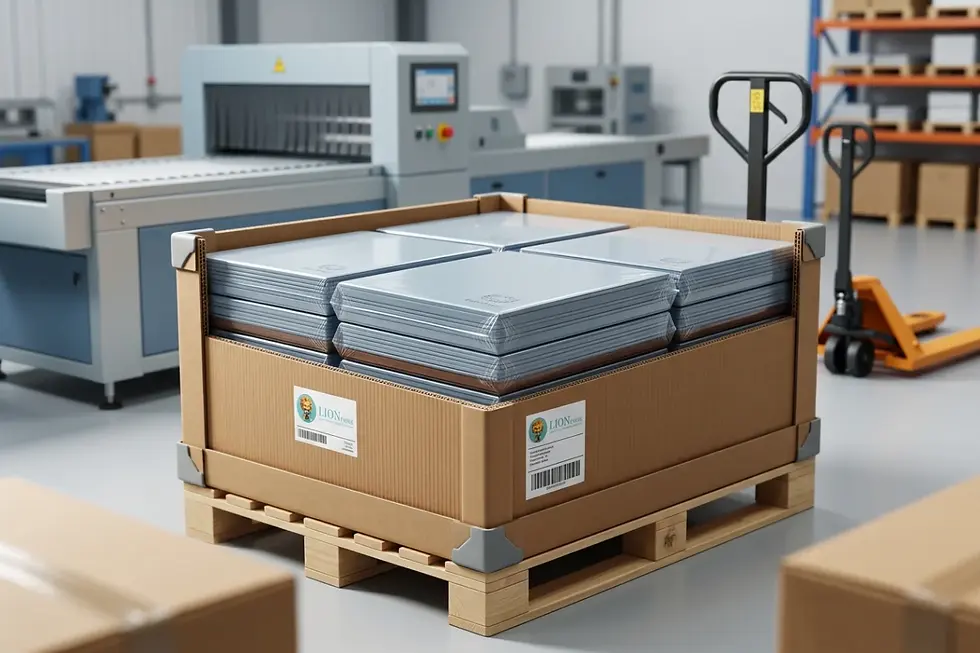
Proper palletization and moisture-barrier shrink packaging preserve pad flatness during ocean transit.
What Technical Specifications Are Required for Custom A3 Desk Pad Sampling and Bulk Production?
Before initiating commercial tooling and paper conversion, stationery brands and procurement teams must establish a comprehensive technical specification sheet. Defining exact physical parameters upfront prevents costly revisions, production delays, and unexpected quality variances.
Use this structured framework to define product requirements:
Finished Dimensions: Specify exact trim dimensions (e.g., standard ISO A3: 297 x 420 mm, US Tabloid: 11 x 17 inches / 279 x 432 mm, or custom desktop sizes).
Sheet Count & Paper Substance: Define page count (commonly 30, 52, or 60 leaves) and paper basis weight (80 gsm, 100 gsm, or 120 gsm wood-free, FSC-certified, or post-consumer recycled paper).
Page Layout & Inks: Single or double-sided printing, dot grid, ruled, or weekly planner layouts using low-VOC soy inks or low-impact water-based inks.
Backing Board Construction: Specify greyboard thickness (1.5 mm to 2.5 mm), density, and whether the reverse side requires white balancing paper or anti-slip backing (felt or textured paper).
Binding Method: Top head-glued (flexible tear-off PVA), micro-perforated tear-off with binding strip, or mechanical bottom corner pockets (PU leatherette, clear PVC, or thick cardstock).
Retail & Transit Packaging: Flat polybag, shrink wrap with printed retail insert card, or corrugated individual mailer box for direct-to-consumer (DTC) fulfillment.
To evaluate physical paper stiffness, adhesive tear behavior, and environmental flatness across your custom stationery lines, Share desk-pad size, layout, sheet count, backing, tear-off method and packaging; request an A3 desk-pad specification and sample plan.
FAQ
Why does my A3 desk pad curl upward only after a few weeks of use on an office desk?
Post-use curling occurs because the top sheet absorbs ambient room humidity and moisture from users' hands while the lower sheets remain dry. Pads manufactured without long-grain paper orientation or adequate backer rigidity (under 1.5 mm greyboard) cannot resist this asymmetric surface tension.
Can corner pockets completely replace head gluing to prevent curling?
Yes. Using bottom or four-corner pockets made from PU, PVC, or heavy cardstock allows the inner paper sheets to float freely without adhesive tension, completely eliminating glue-induced warping while holding large sheets securely in place.
What is the recommended minimum greyboard thickness for a 52-sheet weekly A3 planner?
For a 52-sheet A3 weekly planner using 100 gsm or 120 gsm text paper, a backing board thickness of 1.8 mm to 2.0 mm (1200–1350 gsm) is strongly recommended to balance sheet pull and guarantee long-term desktop flatness.
How does Lion Paper verify flatness before shipping international orders?
Lion Paper tests production samples in environmental chambers across extreme humidity (85% RH) and dry conditions (20% RH), verifying that edge lift remains below strict AQL thresholds on certified flatbed inspection plates prior to packaging.


Comments