


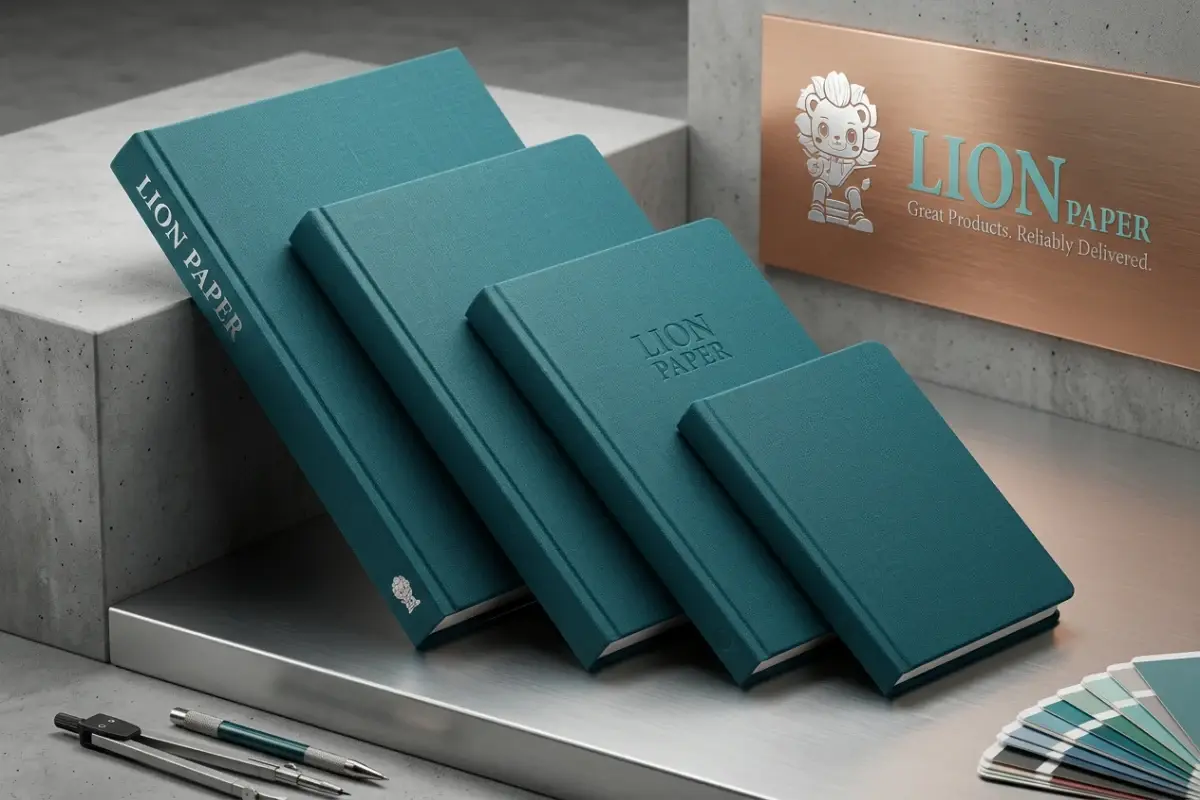
Engineering a Premium Notebook Size Ladder: Portfolio Architecture, Production Yields, and Commercial Strategy

A premium notebook size ladder is a structured multi-format product architecture—typically spanning Desktop (A4/Letter), Executive (B5/Semi-B5), Core Journal (A5/Medium), and Pocket (A6/Passport)—engineered with standardized materials, ruling systems, and binding methods to maximize paper yield, streamline production tooling, reduce blended MOQs, and establish tiered retail price points across diverse consumer use cases.
What Is a Premium Notebook Size Ladder and Why Does Portfolio Architecture Matter?
A premium notebook size ladder is the deliberate structural framework that stationery brands, luxury lifestyle publishers, and enterprise buyers use to organize their product catalog into harmonized, purpose-built formats. Rather than treating an A5 hardcover journal, a B5 executive softcover planner, and an A6 pocket notepad as disparate custom manufacturing projects, an engineered notebook size portfolio architecture integrates them into a unified production matrix.
From a brand positioning perspective, a well-defined notebook size ladder establishes clear utility tiers for end consumers:
Desktop & Workshop Tier (A4 / US Letter / 210 x 297 mm to 216 x 279 mm): Engineered for desk-bound deep work, wireframe sketching, master corporate planning, and studio drafting where expansive flat surface area is paramount.
Executive & Hybrid Tier (B5 / Semi-B5 / 176 x 250 mm to 190 x 250 mm): Positioned between desktop dominance and portable convenience, preferred by executives, project managers, and digital tablet converters who find standard medium formats too restrictive.
Core Journaling Tier (A5 / Medium / 145 x 210 mm to 148 x 210 mm): The global retail anchor format that captures between 45% and 60% of total commercial volume, serving everyday note-taking, creative journaling, and personal productivity.
Pocket & Travel Tier (A6 / Pocket / Passport / 105 x 148 mm to 89 x 124 mm): Built for high portability, quick memos, pocket carry, and impulse retail checkout attachment.
Implementing a disciplined sizing ladder prevents catalog cannibalization. Each format satisfies a distinct physical usage environment while sharing core design vernaculars—such as cover materials, spine treatments, ribbon markers, paper weights, and ruling geometries. Furthermore, this structural hierarchy allows supply chain managers to consolidate base material procurement, standardize bulk master rolls, and leverage shared finishing assets.

Precision dimensional grading and standardized inner ruling grids across multi-format notebook lines.
What Are the Technical Sizing Specifications Across Standard Formats?
Executing custom notebook size grading requires precise dimensional harmonization between international metric standards (ISO 216 A-series and B-series), North American traditional publishing cuts, and Asian stationery traditions. The selection of finished trim size directly governs inner book block layout, grid proportions, spine caliper, and board wrap overhang.
The following technical comparison outlines the core specifications across a four-tier portfolio architecture:
Specification Attribute | Desktop (A4 / US Letter) | Executive (B5 / Semi-B5) | Core Journal (A5) | Pocket (A6 / Field) |
|---|---|---|---|---|
:--- | :--- | :--- | :--- | :--- |
Finished Trim Dimensions | 210 x 297 mm / 8.5 x 11.0 in | 176 x 250 mm / 7.0 x 9.8 in | 145 x 210 mm / 5.7 x 8.25 in | 102 x 148 mm / 4.0 x 5.8 in |
Recommended Page Count | 160 – 240 pages (80–120 sheets) | 192 – 256 pages (96–128 sheets) | 192 – 256 pages (96–128 sheets) | 96 – 160 pages (48–80 sheets) |
Inner Paper Basis Weight | 100 – 120 gsm Woodfree / FSC | 100 – 120 gsm FSC / Uncoated | 100 – 120 gsm Premium FSC | 80 – 100 gsm Lightweight |
Primary Binding Type | Thread-sewn Hardcover / Twin-Wire | Smyth-sewn Flexi / Softcover | Smyth-sewn Casebound / Flat-Lay | Center-sewn / Saddle / Softcover |
Cover Board Thickness | 2.5 mm – 3.0 mm Greyboard | 1.8 mm – 2.0 mm Board / Flex PU | 2.0 mm – 2.5 mm Greyboard | 0.8 mm – 1.2 mm Board or Card |
Standard Ruling Systems | 7.0 mm Ruled / 5.0 mm Dot Grid | 7.0 mm Ruled / 5.0 mm Dot Grid | 5.0 mm Dot Grid / 6.0 mm Ruled | 3.5 mm / 5.0 mm Dot / Blank |
Core Consumer Role | Studio, Desk, Architecture | Hybrid Office, C-Suite, Strategy | Daily Habit, Creative, Long-form | Field Work, EDC, Quick Capture |
Volume Share Target | 10% – 15% | 15% – 25% | 45% – 60% | 15% – 20% |
Standardizing inner layout grids across the ladder ensures visual cohesion. For example, maintaining a consistent 5.0 mm dot grid pitch across A5, B5, and A4 formats allows users to transition between notebooks without recalibrating their writing or plotting scale, while pocket formats frequently compress margins or utilize a 3.5 mm grid to optimize limited printable surface area.
How Does Multi-Format Notebook Manufacturing Optimize Sheet Imposition and Scrap?
In custom stationery production, raw paper substrate represents 45% to 65% of the total unit cost. Developing an end-to-end multi-format notebook manufacturing workflow allows production engineers to gang-run imposition layouts and optimize sheet cutting schemes from standard parent reels or master sheets, dramatically driving down scrap rates.
Master paper sheets commonly sourced in international manufacturing include 787 x 1092 mm, 889 x 1194 mm, and 700 x 1000 mm. When a brand orders isolated, ad-hoc sizes, cutting efficiency frequently falls below 82%, generating expensive trim waste that inflates unit costs. By synchronizing a size ladder across a single production schedule, imposition layouts achieve raw material utilization rates exceeding 92% to 96%:
889 x 1194 mm Imposition: Perfectly yields 16-page or 32-page signatures for standard A5 (148 x 210 mm) book blocks with virtually zero parent trim loss, while accommodating A6 formats via 2-up folding and slit operations.
700 x 1000 mm Imposition: Optimized for European B5 (176 x 250 mm) signatures and A4 case wraps, minimizing offcut waste along the cross-grain dimension.
Nested Gang Printing: Combining A6 pocket memo interior pages alongside A4 desktop supplementary sheets within the same printing plate layout eliminates underutilized web or sheet capacity on commercial offset presses.
Beyond sheet geometry, multi-format coordination slashes tooling overhead. Case-making machines, Smyth-sewing line gatherers, automated ribbon inserters, and corner-rounding modules utilize modular changeparts. When an entire size ladder utilizes unified mechanical parameters—such as consistent endpaper grammage, uniform spine tape reinforcement, and shared headband fabric reels—machine changeover downtime is reduced by up to 40% on automated production lines.

Multi-format sheet imposition optimizes parent paper yield and eliminates offcut waste.
How Do Brands Structure Notebook Sizing MOQ and Pricing Tiers?
A primary challenge for brand managers is meeting minimum order quantities (MOQs) across low-volume formats (such as A4 desktop) without overextending working capital or accumulating obsolete inventory. Establishing strategic notebook sizing MOQ and pricing tiers relies on material pooling and tiered retail price architecture.
By unifying core specifications—such as a custom 120 gsm FSC ivory acid-free text block and a signature PU vegan leather cover material—brands can negotiate aggregate raw material minimums across their entire portfolio. Instead of meeting a 3,000-unit requirement per individual SKU, manufacturing lines can balance multi-format runs against total paper consumption.
The commercial economics across a standard 4-tier portfolio typically reflect the following financial architecture:
Portfolio Tier | Benchmark Size | Tooling / Setup Ratio | Unit Landed Cost Index | Suggested Retail MSRP | Target Gross Margin |
|---|---|---|---|---|---|
:--- | :--- | :--- | :--- | :--- | :--- |
Pocket (A6 / Passport) | 102 x 148 mm | Low (Base die/cut) | 1.0x (Baseline) | $12.00 – $16.00 | 68% – 75% |
Core Journal (A5) | 145 x 210 mm | Moderate (Automated line) | 1.7x – 1.9x | $24.00 – $32.00 | 72% – 78% |
Executive (B5) | 176 x 250 mm | Moderate-High (Smyth setup) | 2.2x – 2.5x | $32.00 – $40.00 | 70% – 76% |
Desktop (A4) | 210 x 297 mm | High (Large caseboard die) | 3.0x – 3.4x | $42.00 – $54.00 | 66% – 72% |
Under this pricing architecture, the Core Journal (A5) acts as the high-volume profit engine, absorbing baseline operational overhead. The Pocket (A6) generates rapid inventory turnover and lower checkout friction, serving as an entry point for customer acquisition. Meanwhile, Executive (B5) and Desktop (A4) capture high-margin prestige value, establishing the brand's luxury and professional authority in enterprise and executive retail channels.
What Are the Optimal Launch Ratios and Merchandising Strategies Across Retail Channels?
Determining initial SKU production ratios requires aligning format utility with specific sales channel dynamics. Direct-to-consumer (DTC) e-commerce, physical specialty stationery boutiques, and corporate B2B gifting demand divergent size distributions.
To prevent overstocking outlier sizes during an initial product line launch, brands should utilize standardized initial production volume splits:
Direct-to-Consumer (DTC) Mix: 55% A5 Core Journal, 20% B5 Executive, 15% A6 Pocket, 10% A4 Desktop. DTC buyers heavily favor versatile everyday carry formats, with high responsiveness to multi-size bundle packs (e.g., "Master Desk + Pocket Travel" duos).
Brick-and-Mortar Retail Mix: 45% A5 Core Journal, 25% B5 Executive, 20% A6 Pocket, 10% A4 Desktop. Physical retail requires substantial pocket presence near cash wraps, while the B5 format commands eye-level shelf presence due to its balanced visual stature.
Corporate B2B & Executive Gifting Mix: 40% B5 Executive, 35% A5 Core Journal, 20% A4 Desktop, 5% A6 Pocket. Corporate procurement teams prioritize expansive, professional presentation surfaces that fit laptop bags and executive conference tables.
Cross-format bundling represents an effective merchandising strategy. Offering a "Trio System" (A4 Desk Planner + A5 Daily Journal + A6 Field Memo) packaged in a rigid presentation gift box not only lifts average order value (AOV) by 35% to 50%, but also enables the brand to liquidate auxiliary sizes at full commercial margins without single-unit discounting.
What Technical Dimensional Tolerances and Quality Control Standards Apply to Size Ladders?
Multi-format collections amplify quality control complexities. Small dimensional discrepancies that go unnoticed on a standalone notebook become instantly visible when products are stacked or merchandised side-by-side in a branded display. Establishing rigorous dimensional tolerances and quality assurance protocols is essential.
Key quality control parameters required for premium multi-size production include:
Finished Dimension Variance: Trim tolerances must remain within ±0.5 mm for width and height across all formats. Any skew along the outer trim edge compromises visual alignment when items are shrink-wrapped or boxed as nested sets.
Spine Caliper and Squareness: Spine thickness variance must not exceed ±0.3 mm from nominal spec. For Smyth-sewn casebound products, back-rounding or square-backing must maintain 90-degree corner precision without spine twist or hollow gaping.
Cover Board Overhang (Squares): The protective board margin extending past the trimmed book block (the square) must be held strictly to 3.0 mm ± 0.3 mm on A5/B5/A4 formats, and 2.0 mm ± 0.2 mm on A6 formats. Inconsistent overhang results in asymmetrical edge wear and misaligned elastic closure bands.
Paper Grain Direction Alignment: Text pages, endpapers, and spine board core must strictly run grain-parallel to the spine fold. Cross-grain execution causes internal page buckling, moisture warping, and compromised lay-flat performance across different ambient humidity levels.
AQL Inspection Thresholds: Enterprise production runs are verified against ISO 2859-1 (ANSI/ASQ Z1.4) standards, utilizing Level II Normal Sampling with strict Acceptance Quality Limits (Critical: 0, Major: 1.5, Minor: 4.0) covering foil debossing depth, ribbon heat-sealing, and pocket envelope glue adherence.

Strict AQL dimensional inspection ensures seamless visual alignment across retail size ladders.
How Should Brands Prepare a Specification RFQ for a Multi-Size Notebook Collection?
To obtain rapid, cost-optimized engineering assessments and accurate commercial proposals, brand sourcing managers should structure their Request for Quotation (RFQ) around a complete portfolio matrix rather than fragmented single-size inquiries. Combining size requirements upfront allows manufacturing engineers to immediately model yield impositions, evaluate dual-site production allocations, and optimize container packing density.
A complete multi-format specification brief should include the following parameters:
Target Size Matrix: Explicit trim dimensions (width x height x depth in mm) for each planned tier.
Inner Page Architecture: Total page counts, paper type (e.g., 120 gsm FSC woodfree ivory), ruling type (dot, line, grid, blank), and number of print colors.
Binding & Structure: Casebound hardcover, soft flexi-cover, wire-o, or saddle stitch, specifying flat-lay Smyth-sewn requirements.
Cover Material & Embellishment: PU leather grade, bookbinding cloth, or specialty art paper, including foil stamping, debossing, screen printing, or edge gilding details.
Integrated Accessories: Number and width of grosgrain ribbons, elastic closure bands, pen loops, and expandable back-pocket gussets.
Packaging & Palletization: Single-unit shrink-wrap, belly bands, retail barcoding, inner master cartons, and direct retail-ready shipping standards.
By consolidating your product development through an integrated supply-chain partner with dual-facility capabilities—leveraging rapid prototyping, design-for-manufacturing engineering, and large-scale manufacturing across China and Cambodia—brands can de-risk their launch timeline while achieving maximum cost efficiency from pilot run to multi-container replenishment.
To begin engineering your brand's next multi-format stationery collection, Share target sizes, rulings, paper, cover materials, price tiers, launch ratios and annual volume with Lion Paper for a multi-size portfolio brief.
FAQ
What is the standard volume distribution across a four-size notebook ladder?
For most commercial stationery and lifestyle brands, the typical sales volume distribution is 45%–60% for A5 Core Journals, 15%–25% for B5 Executive formats, 15%–20% for A6 Pocket notebooks, and 10%–15% for A4 Desktop formats. DTC brands often see higher A5 and bundle demand, whereas B2B and corporate procurement shifts heavier toward B5 and A4 formats.
How does creating a size ladder reduce overall manufacturing costs?
A size ladder reduces total cost by consolidating raw material purchasing (such as sharing the same 120 gsm text paper master rolls and cover PU across all sizes), enabling gang-run sheet imposition layouts that boost paper yield above 94%, and minimizing machine changeover downtime across automated Smyth-sewing and case-making production lines.
What is the key difference between ISO B5 and Japanese/Semi-B5 in notebook grading?
International ISO B5 measures 176 x 250 mm (6.9 x 9.8 inches), whereas Japanese B5 (JIS B5) and traditional Semi-B5 measure approximately 182 x 257 mm (7.17 x 10.12 inches) or 190 x 250 mm in custom lifestyle formats. ISO B5 aligns more efficiently with standard European and global paper converting sheets (such as 700 x 1000 mm), while Semi-B5 is favored in North American and East Asian retail for a slightly wider aspect ratio.
Can different notebook sizes share the same minimum order quantity (MOQ)?
Yes. When notebooks across the size ladder share the same core paper stock, cover material, and structural styling, manufacturers can evaluate MOQs based on aggregate material consumption rather than strict per-SKU machine runs. This allows brands to run lower quantities of niche formats (like A4 or A6) alongside high-volume core runs (like A5).


Comments