


Planner Deboss Depth: Engineering Guidelines, Material Limits, and Manufacturing Quality Standards

The optimal planner deboss depth typically ranges between 0.3 mm and 0.8 mm depending on the cover substrate, ensuring crisp tactile definition without cracking outer materials, crushing internal greyboard, or weakening structural adhesives. Precise calibration of temperature, pressure, dwell time, and die angle guarantees clean edge definition while maintaining total structural integrity across mass production runs.
What is the Optimal Planner Deboss Depth Across Common Cover Materials?
The ideal deboss depth is strictly dictated by the physical properties of the chosen cover material, including its caliper, surface elasticity, backing fabric, and the density of the underlying binding board. Selecting the correct depth creates an elegant visual shadow and tactile feel without causing substrate deformation.
Cover materials react differently under thermal and mechanical force. Below are the engineering standards across standard planner substrates:
Thermo-Reactive PU Leather (0.4 mm – 0.8 mm depth): Premium thermo-PU changes shade when exposed to heat, requiring a moderate-to-deep indentation to activate the color change while depressing the underlying polyurethane foam layer without puncturing the surface skin.
Standard PU and Faux Leather (0.3 mm – 0.6 mm depth): Non-thermal synthetic leathers focus on physical displacement rather than chemical color shifts, requiring moderate depth to prevent tearing the surface film or delaminating the non-woven backing.
Bookcloth and Woven Textiles (0.2 mm – 0.4 mm depth): Woven fabrics feature rigid thread structures backed by paper liners. Debossing must remain shallow to prevent fraying individual threads, snapping the backing paper, or exposing board adhesives.
Laminated Paperboard and Specialty Art Paper (0.2 mm – 0.4 mm depth): Coated and uncoated paper wraps over board require controlled shallow indentation. Excessive depth causes micro-tears in the matte/gloss lamination film or paper surface fibers.
Genuine Bonded or Top-Grain Leather (0.5 mm – 0.9 mm depth): Natural hide fibers accommodate greater compression and retention, allowing deep impressions if die temperature is balanced to prevent scorch marks.
Cover Material | Caliper / Board Base | Target Deboss Depth | Die Temperature Range | Dwell Time |
|---|---|---|---|---|
:--- | :--- | :--- | :--- | :--- |
Thermo-Reactive PU | 1.0–1.2 mm on 2.0 mm Board | 0.5 mm – 0.8 mm | 140°C – 165°C | 1.2 – 2.0 sec |
Standard Soft-Touch PU | 0.8–1.0 mm on 2.0 mm Board | 0.3 mm – 0.5 mm | 110°C – 130°C | 0.8 – 1.2 sec |
Natural Bookcloth | 0.35 mm on 2.5 mm Board | 0.2 mm – 0.35 mm | 95°C – 115°C | 0.6 – 1.0 sec |
Coated Art Paper (157 gsm) | Laminated on 2.0 mm Board | 0.2 mm – 0.4 mm | 85°C – 105°C | 0.5 – 0.8 sec |
Bonded Leather | 1.2–1.5 mm on 2.5 mm Board | 0.5 mm – 0.8 mm | 130°C – 150°C | 1.5 – 2.5 sec |
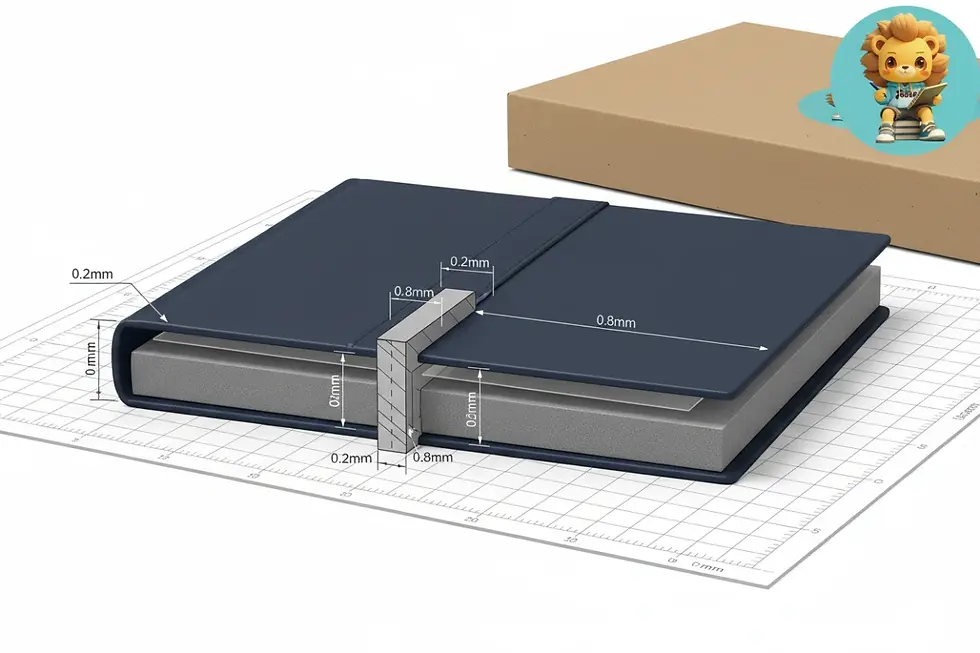
Hardcover debossing specifications require balancing die penetration depth against board core density.
What Structural Risks Occur When Deboss Depth Exceeds Planner Cover Material Limits?
Exceeding planner cover material limits compromises the aesthetics, tactile experience, and mechanical durability of the final product. Over-pressing a die into multi-layered cover structures causes cumulative failures that become apparent during transit, retail display, or consumer use.
Structural failures triggered by excessive debossing include:
Board Core Crushing and Concave Warping: When stamping pressure exceeds the compressive strength of the 1.5 mm–3.0 mm high-density greyboard core, the structural cellulose fibers fracture. This leaves a permanent internal cavity, causing the surrounding hardcover surface to bow outward or dish inward.
Adhesive Degradation and Cover Bubbling: Hot stamping dies transfer intense heat through thin cover substrates. When heat penetrates too deeply, it melts or crystallizes the water-based laminating adhesives (white glue or hot-melt polyurethane) bonding the cover material to the board, causing edge delamination and air pockets.
Surface Shearing and Micro-Cracking: For rigid textiles and coated papers, forcing a metal die past the material's elasticity threshold shears the fibers along sharp die edges. This exposes the light-colored internal paper core or textile backing along the deboss perimeter.
Ghosting and Liner Impression: On flexible softcover planners (such as slipcase journals or flexi-bound planners lacking dense core boards), aggressive pressure creates unintended raised indentations on the reverse inner cover or endpapers, degrading interior presentation.
How Do Temperature, Pressure, and Dwell Time Govern PU Leather Deboss Pressure?
Achieving precise tactile clarity requires harmonizing three interdependent mechanical variables: temperature, pressure, and dwell time. In automated industrial production lines, PU leather deboss pressure is calibrated not as an isolated setting, but in direct relation to die metallurgy, heat conductivity, and press stroke speed.
Hydraulic and Pneumatic Pressure (15 to 35 kg/cm²): Hydraulic stamping presses apply steady vertical force across the entire die surface area. Large silhouette logos demand greater total tonnage to maintain consistent PSI compared to fine, 0.5 pt serif typography.
Die Surface Temperature (90°C to 165°C): Heat plasticizes synthetic PU resins, allowing the synthetic polyurethane to mold into the die shape without snapping. If the die is too cold, the deboss rebounds and flattens within days; if too hot, the PU surface melts, glazes, or burns.
Dwell Time (0.5 to 2.5 seconds): Dwell time refers to the duration the heated die holds contact at peak downward stroke. This pause allows heat to set the compressed polymers, fixing the indentation permanently into the substrate matrix.
Die Bevel Angle Calibration (30° to 60° Draft Angle): High-precision CNC magnesium, brass, or copper dies incorporate drafted sidewalls. A 35° to 45° bevel allows clean tool release without pulling the compressed PU upward during the retraction stroke.

Consistent dwell time, temperature, and hydraulic pressure control prevent cover warping and board crushing.
How Do Hardcover Debossing Specifications Differ for Blind Debossing vs. Foil Stamping?
Custom planner blind debossing differs from hot foil stamping in tooling geometry, temperature control, and depth tolerances. While blind debossing relies on depth and shadow contrast, foil stamping relies on chemical release and heat-activated sizing adhesion.
Custom Planner Blind Debossing Engineering:
Tooling Profile: Utilizes brass or copper dies with deeper profile reliefs (typically 1.5 mm to 2.5 mm die plate depth) and crisp shoulder cuts to maximize optical shadow inside the impression.
Depth Targets: Deeper standard indentation (0.4 mm to 0.8 mm) provides distinctive tactile prominence.
Thermal Control: Higher heat ranges (130°C to 165°C on thermo-PU) to activate resin color change and set permanent physical compression.
Foil Stamping Hardcover Debossing Specifications:
Tooling Profile: Utilizes flatter die relief (0.8 mm to 1.5 mm plate depth) with micro-chamfered edges to prevent slicing the carrier film.
Depth Targets: Shallower controlled depth (0.15 mm to 0.35 mm). Excessive depth pinches the foil carrier, causing flaky borders, adhesive bridge failures, and filled counters inside fine letters (such as the loops in 'e', 'a', and 'o').
Thermal Control: Lower operational temperatures (100°C to 125°C) calibrated to activate the release layer and thermal adhesive of metallic or pigment foils without scorching the pigment.
Combination Deboss and Stamping (Registered Foil Deboss):
Requires a two-pass stamping process or precision CNC micro-etched brass counter dies. The first pass seats the foil accurately at 0.2 mm, while a secondary blind pass deepens the interior contours to 0.5 mm without shredding the foil film.
How Do Sampling and Quality Control Protect Deboss Precision in Large-Scale Production?
Maintaining identical deboss quality from initial prototype sampling through millions of production units requires rigorous testing, controlled staging, and standardized inspection protocols.
Lion Paper applies systematic quality verification protocols across its China and Cambodia facilities:
Caliper and Density Verification of Greyboard Batches: High-density greyboard lots are tested for moisture content (stabilized between 8% and 12%) and compressive yield strength before casing-in assembly. Board density inconsistencies lead directly to uneven deboss depths across large sheets.
Material Stretch and Tensile Testing: PU leather and bookcloth rolls undergo automated elongation testing to verify that thermo-elastic properties match master production swatches.
Tooling and CNC Die Verification: Die depths, draft angles, and surface flatness are audited using digital micrometer gauges and optical comparators before mounting to press beds.
AQL Level II Inspection SOPs: Production lots undergo rigorous inline and post-stamping sampling per ISO 9001 and AQL standards. Defect classification catalogues identify rejects based on depth deviation (>0.15 mm variance), ghosting, foil bleed, color scorching, or substrate micro-cracks.
Accelerated Aging and Environmental Stress Testing: Samples undergo temperature and humidity chamber cycling (40°C at 90% RH for 72 hours) to verify that debossed impressions retain depth without rebounding or showing adhesive delamination.

Strict AQL quality control protocols measure deboss depth variance to maintain consistency across mass production runs.
How Lion Paper Validates Cover Integrity from Prototype to Mass Production
Founded in 2015 with headquarters in Jiaxing, China, Lion Paper Products Co., Ltd. operates as a specialized supply-chain partner for customized paper stationery, journals, and planners. Lion Paper bridges product design and automated manufacturing through a strategic dual-site network:
China Jiaxing Center (3,000 sq m): Focuses on concept R&D, structural engineering, rapid sampling, material testing, and pre-press validation.
Cambodia Production Facility (10,000 sq m): Delivers scalable volume manufacturing, cost efficiency, and export logistics, supporting annual notebook outputs exceeding 5 million units.
Through Design-to-Manufacturing Integration, Lion Paper's engineering teams assess material properties, greyboard calipers, and embellishment designs to recommend ideal deboss depths, die bevel geometries, and thermal settings before cutting mass tooling. This technical validation protects brand aesthetics, prevents structural defects, and delivers high consistency across global retail channels.
Looking to develop retail-ready custom planners with flawless cover craftsmanship? Send cover material, size and finishing target; request a planner-cover engineering and sample review.
Frequently Asked Questions
What is the minimum line thickness recommended for planner blind debossing?
For blind debossing on PU leather and hardcover board, the minimum recommended line stroke is 0.3 mm (approx. 0.85 pt) for positive lines and 0.4 mm (approx. 1.15 pt) for reverse (knockout) lines. Lines thinner than 0.3 mm cannot transfer sufficient surface pressure to depress the substrate, resulting in faint, uneven impressions. Reversed artwork with tight spacing risks pinching and fill-in under heat and compression.
Can deep debossing be achieved on spiral and wire-bound planner covers?
Yes, but deboss depth on wire-bound covers is governed by board thickness and the absence of internal foam padding. Single-layer rigid greyboard or coated art card covers (typically 1.5 mm to 2.5 mm) support deboss depths between 0.25 mm and 0.45 mm. To prevent visible indentation on the inside front cover, a wrapped two-ply pasted structure or mounted interior liner board is used to conceal reverse tool impressions.
Why does blind debossing sometimes rebound or fade after mass production?
Rebound occurs when the stamping press uses insufficient dwell time, incorrect die temperature, or inadequate pressure for the chosen polymer backing. Without proper thermal setting, the elastic memory of synthetic PU or paper fibers pulls the material back to its original resting state. Using CNC brass dies with a dwell time of at least 1.2 to 1.8 seconds at calibrated temperatures ensures permanent fiber compaction.
How does bookcloth weave density affect deboss depth and detail?
Coarse, open-weave bookcloths allow shallower deboss depths (0.15 mm to 0.25 mm) because heavy vertical pressure can break surface warp and weft threads. High-density, fine-spun fabrics like silk-finish cotton or coated buckram accommodate depths up to 0.4 mm, supporting sharper typographic definition and cleaner die release.
FAQ
What is the minimum line thickness recommended for planner blind debossing?
For blind debossing on PU leather and hardcover board, the minimum recommended line stroke is 0.3 mm (approx. 0.85 pt) for positive lines and 0.4 mm (approx. 1.15 pt) for reverse (knockout) lines. Lines thinner than 0.3 mm cannot transfer sufficient surface pressure to depress the substrate, resulting in faint, uneven impressions. Reversed artwork with tight spacing risks pinching and fill-in under heat and compression.
Can deep debossing be achieved on spiral and wire-bound planner covers?
Yes, but deboss depth on wire-bound covers is governed by board thickness and the absence of internal foam padding. Single-layer rigid greyboard or coated art card covers (typically 1.5 mm to 2.5 mm) support deboss depths between 0.25 mm and 0.45 mm. To prevent visible indentation on the inside front cover, a wrapped two-ply pasted structure or mounted interior liner board is used to conceal reverse tool impressions.
Why does blind debossing sometimes rebound or fade after mass production?
Rebound occurs when the stamping press uses insufficient dwell time, incorrect die temperature, or inadequate pressure for the chosen polymer backing. Without proper thermal setting, the elastic memory of synthetic PU or paper fibers pulls the material back to its original resting state. Using CNC brass dies with a dwell time of at least 1.2 to 1.8 seconds at calibrated temperatures ensures permanent fiber compaction.
How does bookcloth weave density affect deboss depth and detail?
Coarse, open-weave bookcloths allow shallower deboss depths (0.15 mm to 0.25 mm) because heavy vertical pressure can break surface warp and weft threads. High-density, fine-spun fabrics like silk-finish cotton or coated buckram accommodate depths up to 0.4 mm, supporting sharper typographic definition and cleaner die release.


Comments