


Personalized Notebook Fulfillment Model: Architecture, Production Workflows, and Supply Chain Integration

A personalized notebook fulfillment model balances production lead times, customization depth, and unit economics by choosing between regional embellishment of bulk pre-manufactured blanks (such as foil stamping, debossing, or UV printing) and end-to-end on-demand manufacturing. The optimal model depends directly on SKU complexity, order velocity, inventory holding tolerances, and the required degree of interior page versus exterior cover personalization.
What Are the Core Fulfillment Models for Personalized Notebook Programs?
Selecting the correct operational architecture determines the margin profile and fulfillment speed of customized stationery lines. In commercial practice, brands utilize three distinct fulfillment configurations based on their order volumes and customization scope:
The Post-Production Embellishment Model (Blank-to-Order): In this setup, standardized finished notebooks—complete with bound text blocks, ribbon markers, elastic bands, and blank covers—are manufactured in high-volume bulk runs (typically 3,000 to 50,000 units) and held in localized fulfillment hubs. When an end consumer or corporate client places an order, the blank cover is customized via foil stamping, digital UV flatbed printing, or laser engraving. This approach yields fast dispatch times (24 to 72 hours) and low per-order setup costs, though it restricts personalization strictly to the outer cover surface.
The Fully Integrated Make-to-Order (MTO) Model: This method executes custom journal on-demand fulfillment from raw roll stock or parent sheets for every incoming order. Digital presses print custom variable interior pages, personalized nameplates, bespoke section dividers, and printed cover wraps in single-unit quantities before automated casing-in, wire-binding, or perfect binding lines assemble the final product. While offering infinite personalization options across both cover and content, it requires substantial capital equipment, commands higher per-unit manufacturing costs, and generally involves a 5- to 10-day production window.
The Hybrid Personalization Supply Chain Model: The hybrid personalization supply chain combines overseas mass production of base components with agile local finishing. Pre-printed variable covers or standardized text blocks are staged upstream. For instance, inner book blocks with specialized grid formats or FSC-certified paper grades are mass-produced offshore at high yield, while regional finishing cells bind or deboss customer-specific covers on demand. This model optimizes inventory exposure while protecting gross margins on customized stationery collections.

Digital flatbed UV printing allows direct variable-data personalization without dedicated physical tooling.
How Do Personalization Technologies Compare in Manufacturing Workflows?
A core challenge in setting up a personalized stationery manufacturing workflow is matching the decorative technology to the substrate, cycle time, and production scale. Each finishing technique imposes specific mechanical constraints on factory layout, throughput speed, and material prepress requirements:
Personalization Method | Compatible Substrates | Average Cycle Time per Unit | Tooling / Setup Requirement | Minimum Efficient Batch Size | Variable Data Capability |
|---|---|---|---|---|---|
:--- | :--- | :--- | :--- | :--- | :--- |
Digital Flatbed UV Printing | PU leather, bookcloth, coated artboard, kraft paper | 30–60 seconds per piece | Zero physical tooling; digital RIP setup only | 1 unit | High (full color, alphanumeric names, photographic artwork) |
Digital Foil Transfer / Sleeking | Coated paperboards, soft-touch laminated covers | 15–30 seconds per piece | Foil roll feeding, heated digital transfer head | 1 unit | High (single-color metallic foils, individual names) |
Batch Debossed Notebook Fulfillment | Thermo-reactive PU, genuine leather, heavy pulp board | 10–20 seconds (post-setup) | CNC brass/magnesium dies or movable metal typesetting | 25–100 units per die change | Low to Moderate (requires dynamic typesetting jigs for names) |
Hot Foil Stamping | Bookcloth, hardback board, PU leather | 10–25 seconds (post-setup) | Custom metal engraving die and mechanical heat press | 50–500 units per die | Low (best for fixed brand logos + static variable batches) |
Laser Engraving / Etching | Genuine leather, faux leather, wood veneer, hard plastics | 45–90 seconds per piece | Vector CAD file alignment; zero tooling | 1 unit | High (monograms, vector patterns, variable text) |
In batch debossed notebook fulfillment, tooling setups dictate workflow grouping. When handling enterprise gifting or tiered subscriber drops, industrial factories use multi-character chase systems. These systems allow operators to manually set alphanumeric letterpress blocks into heated platens, enabling low-cost name debossing without creating standalone CNC etched dies for each recipient.
What Are the Cost, MOQ, and Margin Trade-offs Across Fulfillment Strategies?
Balancing landed production costs against domestic labor rates is the primary economic calculation when configuring a fulfillment framework. High-touch manual embellishment in domestic warehouses quickly erodes retail margins if scrap rates and cycle times are not engineered out of the process.
Unit Cost Structure: Sourcing a fully finished hardcover notebook through high-volume contract manufacturing typically costs between $1.80 and $3.50 per unit (depending on specifications such as page count, paper weight, and cover material). Applying a localized digital UV print or laser monogram to that pre-made blank adds $2.50 to $5.00 in domestic handling and machine operation costs. Conversely, producing the entire unit purely on-demand via single-piece domestic digital printing lines frequently pushes baseline unit production costs to $8.00–$14.00, narrowing the gross profit margin on retail price points under $25.00.
Minimum Order Quantity (MOQ) Hurdles: Offshore contract manufacturing of bespoke component blanks requires baseline raw material MOQs—such as 1,000 to 3,000 units per cover colorway or interior ruling style—to maximize paper mill cutting yields. Localized embellishment operations run at an MOQ of 1. Successful brands navigate this divide by investing in baseline inventory of versatile core SKUs (such as black, navy, and sage PU covers with 100gsm dot-grid interiors) and fulfilling personalization downstream.
Scrap and Defect Rates: In standard notebook manufacturing, inline paper binding defects average 0.5% to 1.5%. However, when custom text or monograms are added during localized fulfillment, human entry errors, print-head misalignments, or temperature variances during debossing can trigger defect scrap rates of 3% to 6%. Because the underlying blank notebook already carries accumulated manufacturing costs, any personalization error ruins a complete, high-value finished product. Robust operational SOPs must incorporate automated barcode validation before any embellishment cycle starts.
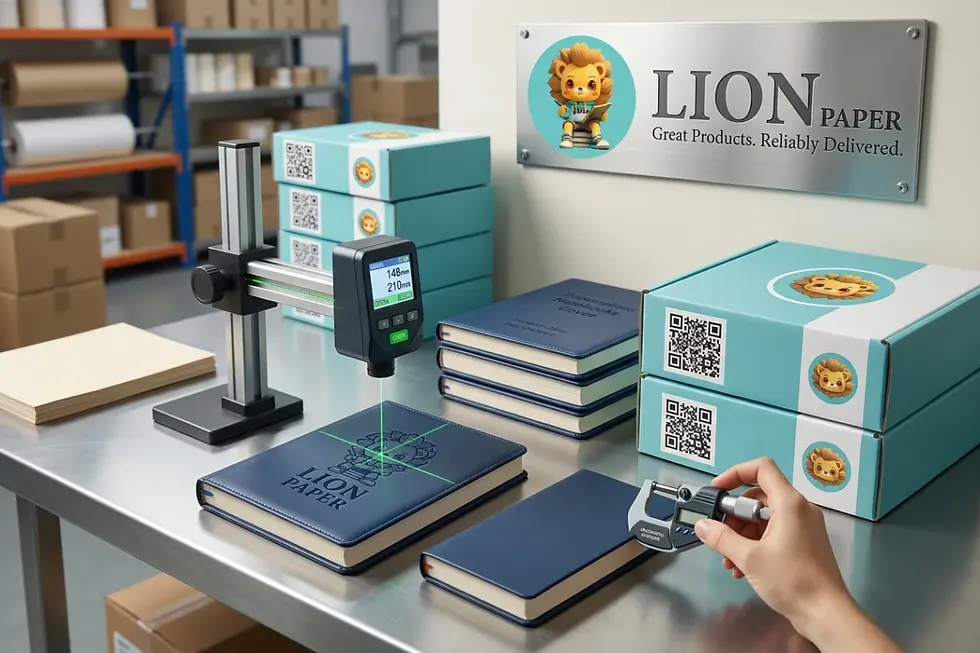
Standardized AQL inspection gates and barcode tracking ensure accuracy across variable personalization batches.
How Do Packaging, Labeling, and Retail-Ready Distribution Systems Integrate?
Fulfillment operations for personalized stationery must address downstream logistics, retail presentation, and multi-channel parcel distribution without increasing handling times or transit damage.
Dynamic Barcode Matching and SKU Serialization: Custom items cannot rely on static UPC barcodes. Production workflows must assign a 2D Data Matrix or QR code to the job jacket, which accompanies the notebook through unwrapping, embellishment, visual inspection, and boxing. Automated scanning systems verify that the personalized cover text precisely matches the customer packing slip and outer carton label.
Protective Individual Packaging: Hardcover notebooks with debossed foil or delicate matte PU finishes are susceptible to scuffing in transit. Fulfillment centers employ form-fitting shrink wrap, semi-rigid poly sleeves, or custom-folded kraft belly bands. For luxury gift tiers, rigid two-piece gift boxes with die-cut EVA or paperboard trays protect corners during direct-to-consumer parcel shipping.
E-Commerce and Retail Compliance: Drop-shipped items must comply with carrier dimensional weight thresholds while maintaining high unboxing presentation. For bulk corporate fulfillment, notebooks must be packed in master cartons that follow ISTA 3A transit standards, complete with desiccants, double-wall corrugated edge protectors, and standardized palletization configurations (such as standard 48x40-inch four-way pallets with stretch-wrap corner supports).
What Sampling Protocols and Quality Control Gates Ensure Consistency?
Executing variable-data personalization at scale requires rigorous quality assurance protocols to prevent mismatches, typographical errors, and physical construction failures.
Pre-Production Digital Proofing: Automated rendering software must generate vector-accurate visual proofs during order capture. These digital proofs freeze font parameters, line spacing, foil alignment boundaries, and safe print zones to ensure that what the end client approves is precisely rendered by the production equipment.
Pre-Flight Mechanical Jigs: Factory floor operators utilize mechanical positioning jigs engineered specifically for each notebook chassis size (such as A5, B5, or 7x9 inches). These custom aluminum or 3D-printed locating fixtures lock the notebook into exact coordinates on the machine bed, eliminating skew and rotation errors across multi-piece runs.
Adhesion and Durability Testing: Applied embellishments must withstand continuous mechanical handling. Standard QA procedures mandate Cross-Hatch Tape Testing (ASTM D3359) for UV inks to evaluate ink adhesion to coated PU materials, along with rub tests (using Sutherland Rub Testers) to verify that foil stamping does not flake under friction against inner packaging.
In-Process AQL Inspection: Large batch personalization programs utilize ISO 2859-1 (AQL 1.5/4.0) sampling plans to inspect cover alignment, debossing depth uniformity, binding squareness, spine integrity, and sheet cleanliness. Any visual defect—such as glue bleed, foil bridging between fine letters, or edge misregistration exceeding 0.5mm—results in immediate line containment.

Dual-site manufacturing infrastructure supports large-scale component production and flexible custom finishing.
How Does Lion Paper’s Dual-Site Model Scale Custom Journal Fulfillment?
Optimizing custom notebook production requires balancing cost structures, prototyping agility, and mass manufacturing capacities. Lion Paper Products (Jiaxing) Co., Ltd., founded in 2015, operates an integrated supply-chain model engineered specifically to support brands, retail channels, POD platforms, and corporate buyers.
Strategic China–Cambodia Dual-Site Synergy: Lion Paper integrates a 3,000-square-meter facility in Jiaxing, China, with a 10,000-square-meter facility in Cambodia. The Jiaxing operation serves as the technical development, structural engineering, rapid sampling, and fast-turnaround hub. The Cambodia facility provides automated, high-volume manufacturing lines designed to maximize landed cost efficiencies and stable global export deliveries.
Comprehensive Engineering and Customization Scope: With an annual notebook manufacturing capacity exceeding 5 million units, Lion Paper provides design-to-manufacturing support across eight core categories: Eco Paper Products, Notebooks & Journals, Planners & Calendars, Stationery & Office, Bags & Organizers, Accessories, Gift & Packaging, and Home & Living. Available constructions include hardcover, softcover, wire-bound, spiral, flexi-bound, and slipcased formats.
Manufacturing Standards and Compliance: Lion Paper operates under standardized SOPs and maintains audit readiness across global retail benchmarks, including ISO 9001, FSC, SMETA, WCA, GSV, FAMA, and CPSIA compliance. All materials—ranging from FSC-traceable paper stocks and post-consumer recycled covers to vegan PU leathers and low-impact vegetable inks—are engineered for structural stability across downstream personalized embellishment processes.
How Can Brands Structure an RFQ for Custom Notebook Programs?
To establish an efficient, scalable personalized notebook production line, brands must supply clear technical specifications during the quoting and engineering phase. Outlining structural requirements early ensures accurate factory planning, material compatibility testing, and balanced landed costs.
Chassis Format: Specify binding style (case-bound, wire-o, exposed spine), trim size (A5, standard 5.5x8.5", custom), page count, and corner radiuses.
Material Matrix: Detail cover substrate (PU leather weight, bookcloth grade, CCNB paperboard density) and interior paper specifications (FSC woodfree paper, 80–120gsm, dot grid, lined, or custom printed layout).
Personalization Scope: Define the exact embellishment mechanism (UV print, hot stamp, blind deboss, individual names vs. static art), total SKU variations, and estimated order batching.
Packaging and Delivery: Outline unit packaging (shrink wrap, kraft belly band, rigid presentation box), master carton drop testing requirements, and target destination ports.
Frequently Asked Questions
What is the most cost-effective method for personalizing individual names on notebooks?
Digital flatbed UV printing and movable metal chase debossing are the most cost-effective methods for variable names. Digital UV printing requires zero custom physical tooling, reading names directly from a variable data print spreadsheet. For classic blind debossing, using an interchangeable alphanumeric typesetting chase avoids the cost of machining individual brass dies for every unique name.
How does cover material selection affect personalized debossing depth and clarity?
Thermo-reactive (heat-burnish) polyurethane (PU) delivers the highest debossing clarity and contrast, as the heat changes the surface color to create a natural two-tone effect without ink. Coated paperboards and bookcloth require precise platen temperatures and pressure regulation to prevent surface tearing, paper delamination, or shallow, indistinct impressions.
Can recycled and FSC-certified papers withstand on-demand printing and binding?
Yes. High-quality FSC-certified uncoated woodfree papers (such as 100gsm or 120gsm grades) and recycled post-consumer waste (PCW) stocks are fully compatible with digital variable presses and commercial binding equipment. Specifying the correct grain direction (grain parallel to the spine) is essential during sheet conversion to prevent page wave and ensure smooth lay-flat opening.
FAQ
What is the most cost-effective method for personalizing individual names on notebooks?
Digital flatbed UV printing and movable metal chase debossing are the most cost-effective methods for variable names. Digital UV printing requires zero custom physical tooling, reading names directly from a variable data print spreadsheet. For classic blind debossing, using an interchangeable alphanumeric typesetting chase avoids the cost of machining individual brass dies for every unique name.
How does cover material selection affect personalized debossing depth and clarity?
Thermo-reactive (heat-burnish) polyurethane (PU) delivers the highest debossing clarity and contrast, as the heat changes the surface color to create a natural two-tone effect without ink. Coated paperboards and bookcloth require precise platen temperatures and pressure regulation to prevent surface tearing, paper delamination, or shallow, indistinct impressions.
Can recycled and FSC-certified papers withstand on-demand printing and binding?
Yes. High-quality FSC-certified uncoated woodfree papers (such as 100gsm or 120gsm grades) and recycled post-consumer waste (PCW) stocks are fully compatible with digital variable presses and commercial binding equipment. Specifying the correct grain direction (grain parallel to the spine) is essential during sheet conversion to prevent page wave and ensure smooth lay-flat opening.


Comments