


Perforated Coloring Pages vs Bound Pages: Comprehensive Manufacturing, Paper, and Binding Guide

Perforated coloring pages allow clean sheet removal for framing, sharing, and marker bleed isolation at a slight cost premium, whereas standard bound pages provide maximum spine durability, compact archiving, and lower unit manufacturing costs. The optimal structural choice depends directly on coloring medium compatibility, intended retail display requirements, target audience ergonomics, and total production run economics.
What Is the Structural Difference Between Perforated and Bound Coloring Pages?
The primary structural difference between perforated coloring pages vs bound pages lies in how the inner leaves interface with the spine and how the end user interacts with completed artwork.
Perforated coloring books incorporate an ultra-fine, mechanically die-cut or rotary-perforated line parallel to the spine—typically positioned 8 mm to 15 mm inward from the gutter. This mechanical scoring allows individual sheets to detach cleanly without ripping the printed image or compromising the structural integrity of the remaining book block. The micro-perforation reduces tensile resistance along a single axis while preserving sufficient strength during automated binding, trimming, and retail transit.
In contrast, standard non-perforated bound coloring books secure full continuous sheets directly into the spine using mechanical fasteners, thread, or hot-melt adhesives. The pages remain permanently anchored inside the casing. This architecture creates an all-in-one keepsake format where illustrations remain sequenced and protected over long-term handling, but users cannot easily remove individual drawings without tearing the paper unevenly or loosening adjacent spreads.
Engineering Dimension | Perforated Coloring Pages | Standard Bound Pages |
|---|---|---|
:--- | :--- | :--- |
Sheet Removal Mechanism | Precision mechanical score line (micro-perforation) | None (destructive manual tearing required) |
Book Spine Stress | Low (detaching reduces levered page strain) | High (flattening spreads creates spine fatigue) |
Completed Art Utility | Individual display, framing, classroom distribution | Kept inside volume as permanent chronological archive |
Manufacturing Complexity | Adds inline/offline micro-perforating step | Standard single-pass folding, gathering, and binding |
Average Cost Variance | Base + 4% to 8% processing premium | Base cost benchmark |
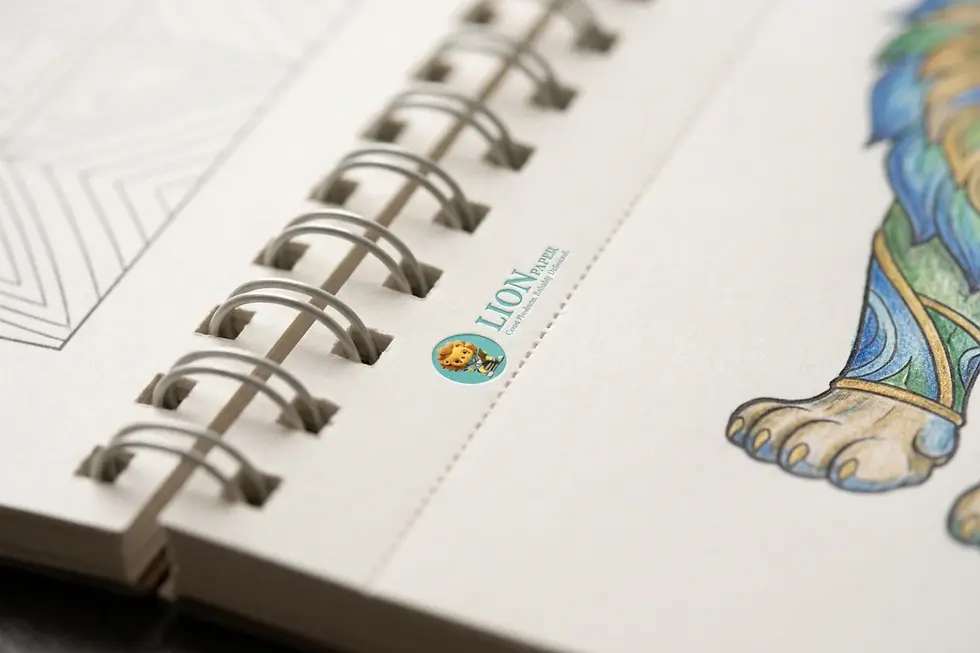
Precision micro-perforations allow clean sheet detachment without damaging the remaining binding structure.
Which Coloring Book Binding Options Work Best for Perforated and Non-Perforated Formats?
Selecting the right coloring book binding options requires matching the page attachment method to the functional physics of the opening spread. A flat-laying surface is essential for coloring precision.
Wire-O and Spiral Binding: Wire-O and double-loop plastic spirals allow 360-degree rotation and lie completely flat on any work surface. When paired with tear out coloring pages manufacturing, wire binding enables the user to fold the front cover behind the book, isolate a single page, color comfortably, and tear along the perforation without spine distortion.
Perfect Binding (PUR / EVA): Standard softcover perfect binding utilizes polyurethan reactive (PUR) or ethylene-vinyl acetate (EVA) adhesives. Because perfect-bound books feature a tight adhesive gutter, adding micro-perforations at least 12 mm from the spine prevents users from cracking the spine adhesive when attempting to open the book flat. PUR is strongly recommended over standard EVA due to its higher page-pull strength and flexible glue hinge.
Saddle Stitching: Saddle stitching secures folded signatures along the central spine with wire staples. For thin to medium custom activity book printing projects (typically 16 to 64 pages), saddle stitch books can accommodate perforations on inner pages. However, perforations must be calibrated carefully; if the perforation pitch is too aggressive, sheets can detach prematurely during automated signature folding.
Case-Bound Hardcover: Hardcover formats position coloring books as premium collectible gifts. Integrating perforated leaves into a case-bound format gives users a luxurious canvas cover paired with easily removable, heavyweight artist sheets.
What Coloring Book Paper Specifications Prevent Bleed-Through and Support Clean Tearing?
Coloring book paper specifications dictate not only medium compatibility—such as colored pencils, water-based markers, alcohol markers, and gouache—but also the structural yield of the tear line.
Woodfree Uncoated Offset Paper (100–140 GSM): The standard benchmark for mass-market children and adult coloring books. Uncoated surface tooth accepts graphite, wax crayons, and colored pencils efficiently while maintaining high opacity.
Heavyweight Artist Drawing Paper (160–200 GSM): Critical for alcohol markers, brush pens, and light wet media. Heavy stock resists buckling. For perforated lines, higher GSM stocks require wider cut-to-tie ratios (e.g., 2 mm cut / 1 mm tie) to prevent tearing resistance from ripping across the grain.
Wood Pulp vs. Cotton Content: Wood pulp fibers arranged along the grain line yield cleaner linear tears. Perforations cut parallel to the paper grain run smoothly, whereas cross-grain perforations require tighter pitch precision to avoid feathering edges.
Single-Sided vs. Double-Sided Printing: When manufacturing tear-out pages, single-sided printing is the industry best practice. When a user extracts a colored page for display, single-sided layouts ensure no artwork on the reverse side is sacrificed or marred by potential ink strike-through.

Standardized inline quality checks ensure consistent tensile strength and tear performance across production batches.
How Does the Tear Out Coloring Pages Manufacturing Process Impact Production Economics and Quality Control?
Executing tear out coloring pages manufacturing introduces distinct technical stages within the press and post-press workflow, directly influencing scrap rates and machine throughput.
During rotary or flatbed micro-perforating, the machine cuts alternating slits and unbroken paper bridges (ties). Precision tooling calibration is vital:
Under-Perforation (Ties Too Wide): The user applies excessive manual torque, causing the paper to rip diagonally into the artwork rather than along the perforated channel.
Over-Perforation (Ties Too Narrow): The sheets prematurely separate during automated signature collating, high-speed pocket feeding, or three-knife trimming, resulting in jam-related downtime and line scrap.
From a total cost efficiency standpoint, adding inline micro-perforations during folding operations incurs minimal secondary machine setup. However, offline sheet-fed perforations for complex multi-page layouts or heavy board stocks add separate setup time, plate tooling costs, and secondary inspection passes. Dual-site manufacturing models leverage rapid prototyping and engineering verification at dedicated developmental facilities before transitioning repeat, high-volume production lines to automated mass-manufacturing hubs to balance unit economics.
Manufacturing Factor | Perforated Coloring Sheets | Non-Perforated Bound Sheets |
|---|---|---|
:--- | :--- | :--- |
Tooling & Setup | Requires micro-perf wheels or die rules | Standard folding and binding makeready |
Press Run Speeds | Standard (inline) to -10% (offline rotary) | Maximum automated line velocity |
Collation Scrap Risk | Low-to-Medium (requires precise suction feed) | Low (full structural sheet stability) |
Landed Unit Cost | +$0.04 to +$0.15 per unit depending on run size | Optimized baseline manufacturing cost |
How Do You Select Between Perforated and Bound Pages for Specific Retail Use Scenarios?
Aligning format architecture with consumer use scenarios and distribution channels maximizes commercial success and reduces customer return rates.
Adult Wellness and Art Therapy Lines: Adult colorists frequently invest hours blending colored pencils and alcohol markers. Perforated, single-sided pages printed on 140+ GSM woodfree paper provide high retail value by enabling artists to place blotter sheets behind pages and frame finished illustrations.
Classroom, Travel, and Educational Activity Books: Teachers and parents prefer perforated pages to distribute individual activity sheets among multiple children simultaneously without purchasing duplicate copies. Spiral binding paired with perforations offers maximum utility in on-the-go scenarios.
High-Volume Mass-Market Children's Books: Bound, double-sided saddle-stitched or softcover books minimize bill-of-materials expenditure. They are optimized for crayons and standard wax media where page extraction is not a core product requirement.
E-Commerce and Subscription Box Merchandising: Premium presentation sets incorporating rigid gift boxes, bookmark ribbons, and thick tear-out pages command premium price points while lowering transit-damage risks when protected by retail-ready shrink-wrapping or custom tuck cartons.

Perforated formats allow finished illustrations to be detached, shared, or framed without raw edges.
What Technical Specifications Should You Include in an Activity Book RFQ?
To ensure rapid quote turnaround and precise manufacturability evaluation, supply chain teams and brand developers should compile a standardized Request for Quotation (RFQ) checklist:
Trim Size & Page Extent: Document closed and flat dimensions (e.g., 8.5 x 11 inches, A4, 210 x 210 mm) alongside total interior page counts plus cover.
Target Coloring Media: Define whether the target consumer uses wax crayons, dry colored pencils, water-based fine liners, or solvent markers to establish correct paper opacity and GSM.
Binding Style: Specify Perfect Bound (PUR), Wire-O, Spiral, Saddle Stitch, or Case Bound Hardcover.
Perforation Distance & Position: Specify distance from the inner spine gutter (e.g., 10 mm from spine fold) and single-sided versus double-sided interior sheet format.
Finishing & Embellishments: Outline cover enhancements such as soft-touch matte lamination, spot UV, holographic foil stamping, or embossed titles.
Compliance and Environmental Standards: Identify necessary certification benchmarks such as FSC-certified chain of custody, CPSIA, or low-VOC soy inks.
If you are planning an upcoming custom activity book printing program, send your target trim size, page count, intended coloring medium, preferred binding structure, artwork files, and packaging requirements to Lion Paper for a manufacturability and costing review.
FAQ
Will perforations cause coloring book pages to fall out accidentally during shipping?
No. When correctly engineered with appropriate cut-to-tie ratios (such as 1.5 mm cut with 0.8 mm tie for 120 GSM paper), micro-perforations maintain sufficient tensile strength to endure automated handling, transport vibration, and normal page turning without premature sheet loss.
What is the standard distance between the perforation line and the book spine?
The industry standard perforation margin is 8 mm to 12 mm from the binding gutter for Wire-O and spiral formats, and 12 mm to 15 mm for PUR perfect-bound books. This clearance prevents spine glue contact and ensures easy manual tearing.
Can single-sided perforated pages prevent marker bleed onto underlying illustrations?
Perforated sheets make it easy for users to remove the active page entirely or slide a protective blotter card behind it, completely shielding downstream illustrations from aggressive alcohol-marker solvent strike-through.


Comments