


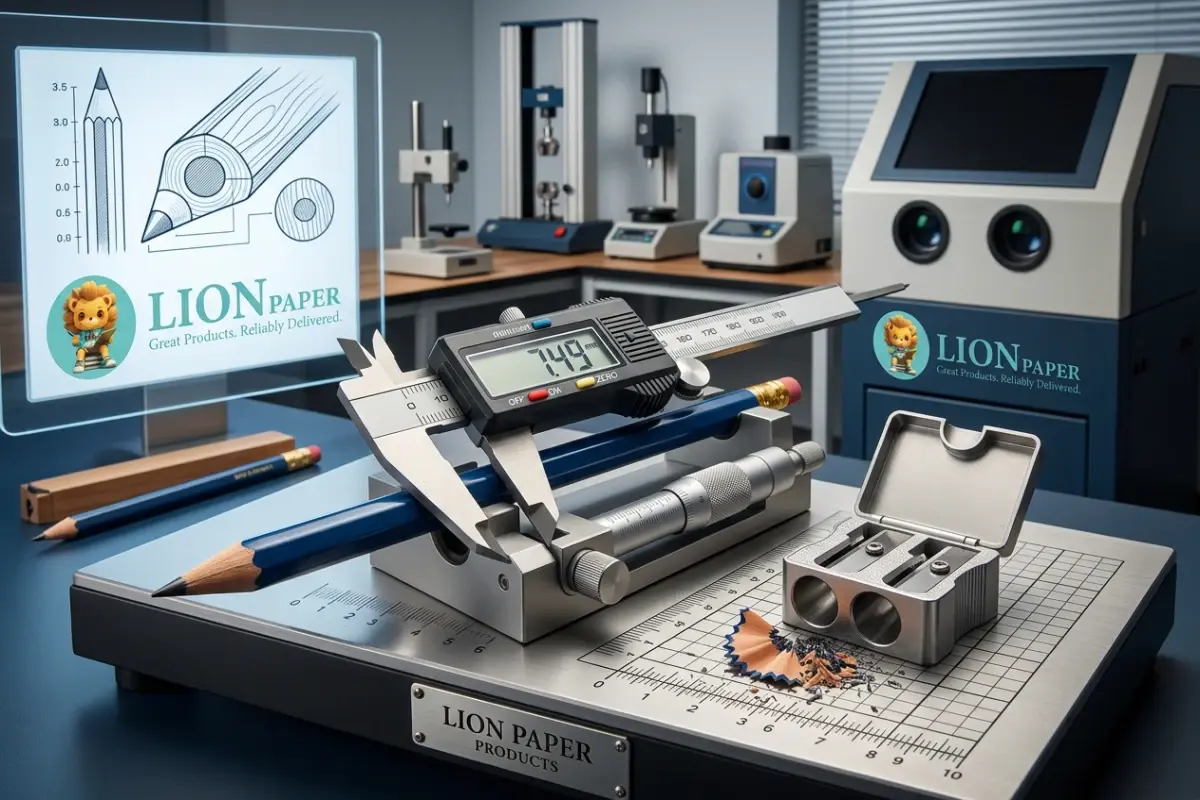
Pencil Sharpener Compatibility Testing: Technical Protocols and Quality Control Guide

Pencil sharpener compatibility testing is a standardized quality assurance protocol that evaluates blade angle, pencil barrel diameter tolerance, lead core hardness, and casing materials to prevent breakage, jamming, and uneven sharpening across retail stationery lines. Implementing systematic pencil sharpener quality control ensures flawless integration between writing instruments, sharpeners, and multi-piece stationery sets across diverse consumer channels.
What Parameters Determine Pencil Sharpener Compatibility?
Achieving seamless compatibility between sharpeners and writing instruments requires balancing mechanical geometry, material science, and manufacturing tolerances. A sharpener designed for standard graphite pencils will quickly fail, jam, or break if paired with wax-based colored cores, soft cosmetic sticks, or oversized hexagonal barrels. Technical evaluations must assess five physical parameters before approving production tooling:
Barrel Diameter and Cross-Sectional Geometry: Pencils range from standard 7.0 mm round graphite barrels to 11.5 mm triangular or jumbo hexagonal casings. The sharpener entry throat must maintain a clearance tolerance of +0.15 mm to +0.30 mm to guide the pencil steadily without lateral wobble, which causes off-center point grinding.
Taper Angle and Cone Depth: Standard writing pencils require a shallow taper (typically 20° to 23°) to maximize tip longevity, whereas artistic sketching pencils demand an acute angle (14° to 17°) to expose more graphite. Cosmetic pencils frequently use blunt 30° tapers. The internal cone of the sharpener must precisely match the intended lead exposure length.
Blade Bevel Angle and Micro-Hardness: Carbon steel or SK5 alloy blades typically feature an asymmetric primary grind between 18° and 22°, hardened to 58–62 HRC. If the cutting edge is too steep, cutting resistance spikes; if it is too acute, micro-chipping occurs when cutting dense timbers.
Core Hardness and Binder Chemistry: Graphite bonded with clay (from 9H down to 9B), polymer-infused leads, soft oil-based colored cores, and high-wax formulations impose completely different shear resistance forces against the cutting edge.
Casing Substrate Composition: Linden wood (basswood), incense cedar, composite recycled wood pulp, extruded plastic, and rolled paper barrels exert differing friction and chip-curling characteristics during rotation.
Pencil Classification | Typical Barrel Diameter (mm) | Core Diameter (mm) | Recommended Taper Angle (°) | Target Wood Shear Resistance |
|---|---|---|---|---|
:--- | :--- | :--- | :--- | :--- |
Standard Graphite (HB–2B) | 7.0 – 7.4 mm | 2.0 – 2.4 mm | 21° – 23° | Medium (Basswood / Cedar) |
Jumbo / Primary Grade | 9.5 – 10.5 mm | 3.5 – 4.2 mm | 22° – 25° | Medium-High (Basswood) |
Colored Core (Wax/Oil Base) | 7.2 – 7.8 mm | 3.0 – 3.8 mm | 18° – 21° | Low-Medium (Soft Cedar) |
Triangular Ergonomic | 7.5 – 8.2 mm (Apex-Base) | 2.5 – 3.0 mm | 20° – 22° | Medium (Basswood) |
Rolled Paper Barrel | 7.2 – 7.6 mm | 2.2 – 2.8 mm | 20° – 24° | High (Dense Fiber Layers) |

Detailed evaluation of cutting angle and shaving curl continuity during stationery accessory testing protocol.
What Is the Step-by-Step Stationery Accessory Testing Protocol for Sharpeners?
A robust stationery accessory testing protocol validates performance across simulated lifecycle conditions before releasing mass-manufactured sharpeners to commercial retail markets. Testing must combine dimensional verification, ergonomic torque assessment, and destructive continuous-use endurance runs.
1. Dimensional Ingress and Go/No-Go Gauge Testing
Technicians use calibrated steel pin gauges to verify the inner diameter of the entry collar and cutting throat. The minimum entrance diameter must allow the maximum specified pencil barrel diameter tolerance to insert smoothly without surface scoring, while the maximum entrance diameter must restrict angular tilt beyond 1.5 degrees during rotation.
2. Rotational Torque and Insertion Force Measurement
Using a digital torque transducer bench, test samples measure the rotational effort required to complete three full continuous sharpening cycles. Peak rotational torque should not exceed 0.35 N·m for standard consumer sharpeners and 0.45 N·m for jumbo formats. Insertion force along the axial plane must remain below 4.0 N to prevent user fatigue and avoid crushing brittle internal cores.
3. Shaving Ejection and Jamming Evaluation
During the sharpening cycle, wood and graphite waste must curl continuously along the blade relief channel and discharge freely into the collection canister. The test protocol measures whether shaving ribbons fracture into compacted powder that wedges under the blade heel, a common failure mode when sharpening oily colored pencils or fibrous paper barrels.
4. Point Geometry and Core Centering Inspection
After sharpening to a completed mechanical stop, the pencil tip is examined under an optical comparator at 10x magnification. Technicians verify three geometric criteria:
Point Concentricity: The graphite core tip must deviate no more than 0.20 mm from the central axis of the wood cone.
Collar Shoulder Smoothness: The transition shoulder between the bare wood taper and the painted barrel finish must be smooth, without ragged splintering or jagged tear-outs.
Lead Tip Sharpness Index: The final tip radius must measure consistently within 0.10 mm to 0.25 mm for fine-point applications.
5. Multi-Cycle Accelerated Wear Endurance Testing
To evaluate blade edge retention, test units undergo automated or manual continuous sharpening runs of 50 to 100 consecutive full pencils (equivalent to approximately 500 to 1,000 sharpening strokes). Technicians record cutting torque degradation, burr formation on the blade edge, and core breakage rates at regular 20-pencil intervals.
What Are the Common Failure Modes and Root Causes in Sharpener Quality Control?
During pencil sharpener quality control, engineers frequently encounter functional defects that compromise user experience and lead to product returns. Identifying the root mechanical causes allows rapid corrective action before mass shipment.
Core Snapping at Mechanical Stop: If the graphite core regularly snaps off inside the cone during the final revolutions, the root cause is typically an excessive gap between the blade tip and the bottom cone stop, allowing the unsupported lead to bend under lateral pressure.
Spiral Barrel Grooving and Faceting: When a pencil emerges with spiral cuts or faceted flat surfaces instead of a smooth conical taper, the blade is vibrating due to loose mounting screw torque or an insufficiently rigid plastic housing frame.
Wood Splintering and Tear-Out: Ragged wooden collars indicate a dull blade bevel, blade edge micro-burrs left during factory stamping, or a blade mounting angle offset exceeding ±0.5° from the housing datum plane.
Core Glazing and Blade Slippage: When sharpening wax-based colored pencils, wax residue can smear across the blade cutting edge, causing it to skate over the wood without biting. Corrective design requires micro-textured chip breakers or non-stick blade surface treatments.
Canister Latch Failure and Powder Leakage: On enclosed pocket sharpeners, loose friction tabs or poor ultrasonic welding on the shavings reservoir allow fine graphite dust to escape into pencil cases, backpacks, and organizer bags.

Rigorous bulk sharpener defect inspection conducted under standardized AQL sampling protocols.
How Is Bulk Sharpener Defect Inspection Conducted Using AQL Sampling?
Quality assurance during mass manufacturing relies on standardized ISO 2859-1 / ANSI/ASQ Z1.4 sampling systems. A rigorous bulk sharpener defect inspection categorizes non-conformances into Critical, Major, and Minor tiers, enforcing strict Acceptable Quality Limit (AQL) thresholds across production lots.
Defect Severity Tier | AQL Standard | Defect Classification Criteria | Practical Defect Examples |
|---|---|---|---|
:--- | :--- | :--- | :--- |
Critical Defects | 0.0 | Issues causing personal safety hazards or legal non-compliance. | Exposed loose razor blades; unfastened screws falling into packaging; sharp burrs on outer plastic case; toxic heavy metals exceeding regulatory limits. |
Major Defects | 1.5 | Functional failures that render the sharpener unusable or significantly degraded. | Broken or missing blades; cracked body castings; entry hole undersized causing pencil jam; graphite lead snapping on >10% of test sharpenings; loose canister lid detaching spontaneously. |
Minor Defects | 4.0 | Cosmetic imperfections that do not impair mechanical operation. | Minor surface scuffs on molded plastic; faint logo tampo print misregistration (<0.5 mm); slight color tone variance from approved pantone swatch; minor flash on non-functional mold seams. |
In-Line and Final Pre-Shipment Inspection Workflow
Inspectors draw random sample sizes based on General Inspection Level II. The bulk sharpener defect inspection follows an operational sequence:
Visual and Physical Integrity Check: Verification of exterior housing, screw tightness torque (minimum 0.15 N·m pull-resistance), lid latch retention, and clear transparency of shavings reservoirs.
Dimensional Tolerance Verification: Digital caliper assessment of entry throat diameter, overall envelope dimensions, and blister card or box fitment dimensions.
Dynamic Function Verification: 100% functional test on the drawn AQL sample lot using baseline client pencils across five continuous sharpening cycles per sample unit.
Drop and Packaging Stress Testing: Packed cartons undergo standard ISTA 1A drop tests (10 drops from 76 cm height) to ensure blades do not dislodge from housing screws under transit vibration.
What Material and Regulatory Standards Govern Pencil Sharpeners in Global Markets?
Pencil sharpeners sold as standalone stationery accessories or bundled into custom notebooks, planner sets, and kids' creative kits must comply with strict international consumer safety directives. Regulatory standards vary across North America, the European Union, the United Kingdom, and Australia.
Heavy Metals and Substrate Safety (CPSIA & ASTM F963): In the United States, children's sharpeners must comply with Consumer Product Safety Improvement Act (CPSIA) restrictions, capping total lead content in substrate plastics, painted coatings, and zinc alloy castings at under 100 ppm, alongside strict phthalate restrictions (under 0.1% for DEHP, DBP, BBP, DINP, DIBP, DPENP, DHEXP, and DCHP).
Mechanical Safety and Edge Hazard Evaluation (EN 71-1 & ISO 8124-1): In the European Union and international markets, children's sharpeners undergo mechanical testing to ensure cutting blades cannot be accessed by a child's finger through entry orifices or easily detached without specialized tools. Tamper-proof reverse-threaded or star-drive screws are often required.
Chemical Migration and Chemical Safety (REACH Annex XVII & EN 71-3): Metal components must not release nickel above allowable migration limits, and all polymeric housings must pass 19-element heavy metal migration testing under EN 71-3.
Blade Anti-Corrosion Standards: Sharpeners undergo 24-hour salt spray corrosion testing (ASTM B117) to verify that carbon steel and stainless steel blades resist oxidation during ocean container freight and extended warehouse storage in humid climates.

Integrated manufacturing and kitting ensure complete functional compatibility across stationery accessory collections.
How Does Dual-Site Manufacturing Streamline Sharpener Development and Bundled Kitting?
Integrating sharpener sourcing into larger stationery programs—such as branded journals, school supply packs, sketch sets, and organizer bags—demands seamless collaboration between design engineering and mass production. Operating across a dual-site China and Cambodia supply network provides distinct advantages for global stationery brands, retail chains, and e-commerce platforms.
China Facility: Rapid Prototyping, Tooling Engineering, and Material Matching
At the Jiaxing product development hub, engineering teams create custom-molded housings, optimize blade bevel angles, and execute rapid 3D prototyping and bench testing. When brands develop bespoke pencils with unique barrel cross-sections or sustainable rolled-paper compositions, the development team adjusts entry throat tolerances, tests blade hardness, and coordinates specialized surface coatings before mass tooling begins. This integrated approach aligns paper stationery, pencil casings, and sharpener accessories into a unified development cycle.
Cambodia Facility: High-Efficiency Mass Production, Kitting, and Global Delivery
Once design tooling and QA standards are locked, scalable assembly, automated packaging, and multi-component kitting transition smoothly to the large-scale production facility in Cambodia. Standardized Operating Procedures (SOPs), automated blister packaging lines, and unified AQL inspection protocols guarantee that every batch meets identical quality benchmarks. Dual-site synergy optimizes tariff structures, mitigates supply chain risks, and ensures reliable, on-time delivery to North American and European retail distribution networks.
Whether launching an artist sketch set featuring heavy-weight FSC-certified sketchbooks, graphite cores, and precision zinc sharpeners, or a back-to-school stationery bundle complete with spiral notebooks and dual-hole sharpeners, integrated manufacturing ensures zero compatibility friction from the first sketch to the final shipment.
Ready to engineer and manufacture flawless stationery accessories for your upcoming product launch? Share pencil diameters, target channel, sharpener format and pack concept; request a sharpener compatibility and sampling plan.
FAQ
What is the standard tolerance range for pencil sharpener entry holes?
The standard clearance tolerance for pencil sharpener entry holes is +0.15 mm to +0.30 mm over the maximum pencil barrel diameter. For standard 7.2 mm pencils, the sharpener throat is typically machined between 7.35 mm and 7.50 mm to prevent barrel jamming while restricting lateral wobble.
Why do colored pencil cores break more frequently in standard sharpeners?
Colored pencils feature soft cores formulated with waxes, oils, and pigments rather than rigid clay-graphite matrices. Standard graphite sharpeners use steeper blade angles (21°–23°) that generate excessive lateral cutting pressure, snapping fragile colored cores. Colored pencils require acute cutting angles (18°–20°) and sharp SK5 blades with non-stick relief channels.
How many sharpening cycles should a commercial sharpener withstand during QA testing?
During standard multi-cycle wear endurance testing, retail-grade manual sharpeners must complete a minimum of 50 to 100 full pencil sharpening cycles (500 to 1,000 rotational strokes) without blade micro-chipping, structural housing cracking, or point centering deviation exceeding 0.20 mm.
Which international safety tests are mandatory for sharpeners included in children's stationery sets?
Sharpeners intended for children must pass CPSIA total lead (<100 ppm) and phthalate testing in the US, ASTM F963 / EN 71-1 mechanical safety assessments (inaccessible blades and small parts compliance), and EN 71-3 heavy metal migration limits in the EU.


Comments