


Pencil Case Zipper Track Length: Engineering, Sizing Ratios, and Manufacturing Guide

Pencil case zipper track length determines internal opening clearance and structural rigidity, typically engineered 20 to 50 mm longer than the pouch body for straight top-zip styles, or spanning 400 to 600 mm across three perimeter edges for flat-lay clamshell organizers. Proper track sizing ensures stationery clearance, prevents corner seam blowouts, and balances automated sewing efficiency against landed unit costs.
What Determines the Optimal Pencil Case Zipper Track Length and Opening Clearance?
Pencil case zipper track length is determined by the target stationery envelope, shell textile elasticity, sewing seam allowances, and the intended opening angle. Standard stationery items—such as 180 mm dual-tip art markers, 150 mm triangular rulers, and standard 175 mm graphite pencils—dictate the minimum linear clearance required to insert and extract tools without snagging the zipper teeth.
In functional pencil pouch zipper specifications, raw opening length is distinct from the functional mouth clearance. When a zipper tape is sewn into a pouch, standard seam allowances consume 8 to 12 mm at each end. Inset zipper stops and terminal bar tacks further reduce the accessible opening by 15 to 25 mm. Consequently, a pencil case with an external physical length of 200 mm must utilize a total zipper track length of 220 to 240 mm if engineered as an extended-end top-zip, or up to 210 mm if set flush with recessed fabric end-tabs.
To calculate the optimal track length for straight-opening pouches, industrial pattern makers apply standard opening clearance formulas:
Minimum Functional Opening = Longest Internal Item Length + 25 mm Insertion Buffer
Finished Zipper Track Length = Minimum Functional Opening + Terminal Stop Allowances (2 x 10 mm)
Cut Zipper Chain Raw Length = Finished Track Length + Seam Turn-In Margins (2 x 15 mm)
Clearance Sizing Benchmarks by Content Type:
Standard Pen Pouch (175 mm content): 200 mm case body requires a 220 mm raw cut zipper chain, yielding a 185 mm functional opening.
Extended Marker Organizer (190 mm content): 225 mm case body requires a 250 mm raw cut zipper chain, yielding a 210 mm functional opening.
Multi-Layer Drafting Case (210 mm content): 240 mm case body requires a 270 mm raw cut zipper chain, yielding a 225 mm functional opening.
Compact Travel Sleeve (150 mm content): 170 mm case body requires an 185 mm raw cut zipper chain, yielding a 155 mm functional opening.
When structural pencil case manufacturing zipper selection is neglected, short tracks create high mechanical stress points at the terminal stops, leading to premature seam failure, lining pinch, and consumer dissatisfaction. Conversely, excessive track length on non-extended designs creates fabric puckering, tape distortion, and misaligned corners during sewing assembly.

Top-zip extended tracks provide linear clearance while perimeter clamshell tracks allow full 180-degree flat-lay access.
How Do Top-Zip, Clamshell, and Gusseted Pouch Configurations Compare in Zipper Track Architecture?
Stationery case zipper opening design falls into three primary structural profiles: horizontal top-zip, perimeter wrap-around clamshell, and expandable gusseted configurations. Each architecture imposes unique requirements on zipper track curve radii, chain flexibility, and corner tape allowances.
Design Category | Typical Case Dimensions (L x W x H) | Zipper Track Length Range | Zipper Opening Angle | Ideal Zipper Gauge & Type | Primary Ergonomic Benefit |
|---|---|---|---|---|---|
:--- | :--- | :--- | :--- | :--- | :--- |
Top-Zip Barrel or Flat Pouch | 200 x 60 x 50 mm | 220 – 250 mm | 45° to 60° linear mouth | Compact footprint, low fabric consumption, fast single-zip access | |
Three-Sided Clamshell | 220 x 110 x 40 mm | 480 – 560 mm | 180° complete flat-lay | #5 Nylon Coil / Reverse Coil | Full visual inspection, dual-panel elastic loops, structured storage |
Expandable Base Gusset | 215 x 100 x 30/65 mm | 520 – 620 mm (dual track) | Variable capacity flap | Dual-mode operation: ultra-slim commuter profile or high-capacity desk tub | |
U-Shape Front Access | 210 x 90 x 60 mm | 340 – 400 mm | 90° drop-down access | #5 Nylon or Vislon Resin | Easy desktop extraction without disturbing upper compartment |
End-to-End Extended Pouch | 205 x 75 x 75 mm | 260 – 290 mm | 90° structured apex | #5 Metal or Chunky Plastic | Wide boxy opening held open by extended snap-down ends |
In three-sided clamshell and perimeter wraps, custom zipper track length engineering must account for corner curve radiuses. Standard 90-degree corners require a minimum curve radius of 18 to 25 mm. If the radius is too tight (under 15 mm), the zipper slider encounters excessive friction, leading to tooth misalignment and slider jamming. Wider radii (30 to 40 mm) ensure smooth slider travel but reduce the internal corner volume for square stationery items like sticky note pads and mini calculators.
Expandable gusseted cases utilize a dual-track approach: a primary top-access track (220 to 250 mm) for daily access, and a secondary perimeter zipper track (480 to 580 mm) that compresses an accordion gusset. Engineering these parallel tracks demands tight manufacturing tolerances so the compressed pouch remains symmetrical without warping the outer textile shell.
Standing pencil cups or telescopic pop-down pouches use vertical or partial circumferential tracks (140 to 180 mm) combined with elasticized side panels. The zipper track must withstand vertical pulling forces when the upper fabric sleeve is retracted down to expose pens on a desktop.
How Do Zipper Gauge, Shell Fabrics, and Lining Interlock During Track Engineering?
The mechanical performance of a pencil case zipper track depends on the interplay between zipper tooth gauge, tape material, outer shell fabric weight, and inner lining construction. Mismatched materials result in wave deformities (puckering), zipper track stiffening, or fabric edge fraying along the stitch line.
1. Zipper Gauge Selection Guidelines
#3 Nylon Coil (3.9–4.5 mm chain width): Ideal for lightweight, compact pouches, flat pencil sleeves, and internal mesh divider pockets. Offers minimal bulk and maximum flexibility, but lacks rigidity along wide 3-sided openings.
#5 Nylon Coil & Reverse Coil (5.8–6.5 mm chain width): The industry standard for lifestyle, retail, and corporate stationery organizers. Delivers optimal crosswise tensile strength (exceeding 450 N), smooth corner navigation, and compatibility with water-repellent PU matte coatings.
#5 & #8 Chunky Plastic (Vislon / Resin): Preferred for youth, back-to-school, and streetwear-inspired cases. The molded teeth provide high impact resistance and vibrant color-contrast options, though they require a larger corner curve radius (minimum 25 mm).
#3 & #5 Metal Teeth (Brass / Antique Copper / Aluminum): Selected for heritage, corporate executive, and luxury leatherette stationery bags. Metal tracks add structural weight and high aesthetic appeal, but require protective end-stop covers to prevent scratching contents or hands.
2. Fabric Weight and Backing Compatibility
Outer materials ranging from 600D recycled polyester (rPET) and 12-ounce organic cotton canvas to PU leather and clear TPU film interact differently with zipper tape tension. Heavier fabrics (above 300 gsm) require a wider zipper tape (14 to 16 mm per side) to provide adequate seam bite for double-needle topstitching.
When pairing structured canvas or laminated PU with lightweight #3 zipper tape, the tape can ripple under tension. Factory technical teams prevent this by laminating non-woven reinforcement tape or thermal adhesive interlining along the zipper allowance before stitch assembly.
3. Lining Integration and Clearance Margins
Inner linings—typically 150D to 210D polyester or recycled RPET taffeta—must be stitched with a minimum 3 to 4 mm clearance from the zipper coil edge. Insufficient margin allows the lining to catch in the zipper slider during rapid closure. High-performance construction incorporates bound seam tape or folded-edge inner facing along the entire zipper track to guarantee clean, obstruction-free sliding.
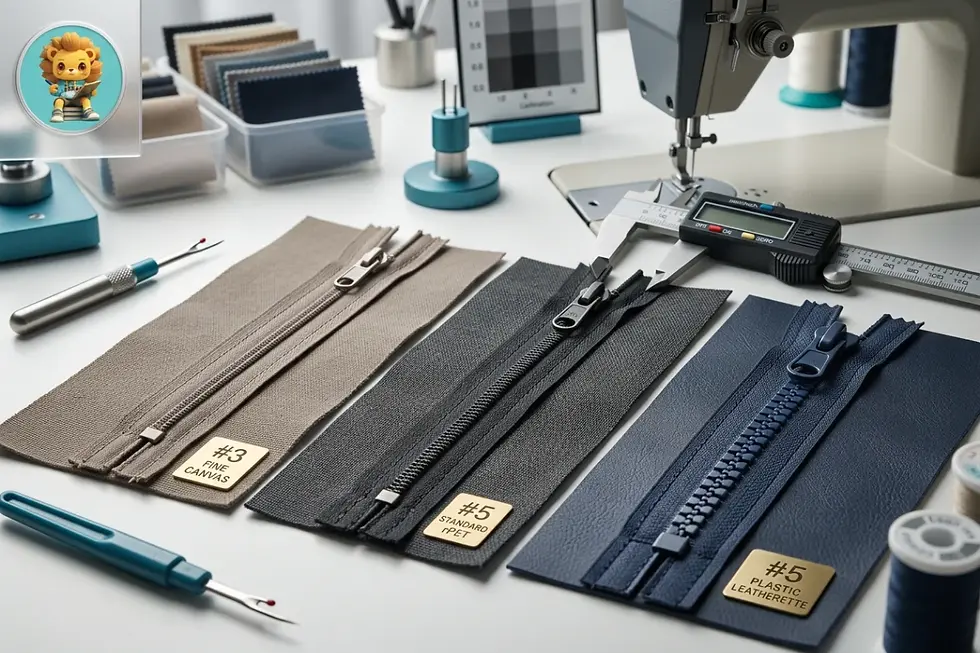
Matching zipper gauge and tape elasticity to shell fabrics prevents puckering and slider snagging.
What Are the Manufacturing, MOQ, and Cost Trade-Offs in Custom Zipper Track Length Engineering?
Procuring zipper tracks for stationery pouch production involves balancing continuous zipper chain against pre-cut finished zippers, custom lengths, puller tooling, and minimum order quantities (MOQs).
Sourcing Parameter | Continuous Zipper Chain Roll | Pre-Cut Finished Zipper Units |
|---|---|---|
:--- | :--- | :--- |
Target Application | High-volume straight top-zips | Multi-compartment and clamshells |
Length Customization | Infinite (cut on sewing line) | Fixed custom lengths (such as 515 mm) |
Tape and Chain Scrap Waste | 4% to 7% cut-off scrap | Less than 1% factory installation waste |
Unit Cost Impact | 15% to 25% lower base component price | Higher unit cost due to pre-installed stops |
Slider Assembly Method | Manual or semi-automated line insertion | Pre-installed by zipper supplier |
Supplier MOQ Threshold | 1,000 to 2,000 meters per color | 2,000 to 5,000 finished pieces per length |
Production Lead Time | 7 to 10 days for standard stock tape | 14 to 21 days for custom dyed lengths |
When brands develop bespoke pencil cases with unusual track lengths (for example, a 535 mm perimeter wrap on a dual-sided artist organizer), pre-cut finished zippers eliminate on-line manual stop crimping. However, custom pre-cut zipper orders require precise dye-to-match (DTM) batching and longer component lead times. Continuous rolls allow agile cut-and-sew adaptation in the factory, making them ideal for agile product launches and multi-SKU stationery collections.
For custom pullers—such as molded silicone tabs, embossed zinc-alloy hardware, woven cord pullers, or branded vegan leather fobs—tooling amortization occurs across production runs. Standard pullers incur zero mold costs, while custom-shaped metal hardware requires a dedicated mold fee and a minimum threshold of 3,000 to 5,000 units. Optimizing zipper chain specifications during initial CAD drafting allows brands to avoid non-standard tape widths and costly special tooling.
How Does Zipper Track Geometry Impact Packaging Efficiency, Retail Presentation, and Landed Costs?
Zipper track positioning directly governs how flat a pencil case can compress for shipping, determining volumetric weight, container packing density, and retail shelf footprint.
Packaging Density and Display Performance Across Zipper Profiles:
Straight Top-Zip (Center Apex):
Compression: Collapses 100% flat (10 to 15 mm flat thickness).
Inner Master Carton: 120 to 150 pieces per carton (approximately 0.045 CBM).
Retail Display: Pegboard hang hole on polybag, hanging header card, or counter display box.
Logistical Benefit: Lowest landed freight cost per unit due to minimal dead air.
Structured Clamshell (3-Sided Perimeter Track):
Compression: Semi-rigid; folds flat only if inner EVA shell is articulated.
Inner Master Carton: 40 to 60 pieces per carton (approximately 0.065 CBM with paper stuffing).
Retail Display: Standalone upright box, belly band wrap, or window gift box.
Logistical Benefit: High perceived value with moderate volumetric shipping impact.
Rigid Box-Profile (Full Wrap Zipper with Inner Trays):
Compression: Non-collapsible without structural deformation.
Inner Master Carton: 24 to 36 pieces per carton (air shipping cost multiplier of 2.0x to 2.5x).
Retail Display: Premium retail shelf-ready carton (PDQ) or gift sleeve.
Logistical Benefit: Maximum in-store visual impact and executive gift presentation.
A straight top-zip case with a 230 mm track packs flat without internal paper stuffing, reducing inbound ocean freight and air cargo volumetric multipliers. In contrast, a clamshell case with a 540 mm perimeter zipper track maintains semi-rigid sidewalls. To prevent crushing during transoceanic shipping, factories insert recyclable tissue paper or inflatable air bladders, increasing pack-out volume by 40% to 70%.
For direct-to-consumer (DTC) and retail display optimization, perimeter-zip cases can be engineered with soft-hinge bottom gussets. This structural feature allows the case to ship flat to distribution hubs and pop into its three-dimensional box profile when filled at retail, delivering high shelf presence while controlling transpacific shipping costs.
What Technical Specifications and AQL Quality Control Standards Apply to Pencil Pouch Zipper Selection?
To ensure commercial durability and compliance across international retail markets, pencil case zippers must undergo rigorous physical testing and inspection against international standards (such as ASTM D2061 for zipper strength and CPSIA/EN 71 for physical and chemical safety).
Standard Quality Control Testing Benchmarks:
Reciprocating Durability / Fatigue Test: Greater than 1,500 continuous cycles without teeth skipping or slider detachment.
Crosswise Chain Tensile Strength (#5 Coil): Greater than 450 N before lateral tooth separation.
Slider Pull-Off Puller Strength: Greater than 150 N for adult retail; greater than 200 N for CPSIA children's standards.
Slider Lock Holding Strength: Greater than 35 N slip resistance under direct track tension.
Seam Bursting Strength: Greater than 180 N at terminal bar tack reinforcement points.
Color Fastness to Rubbing (Dry and Wet): Grade 4.0 minimum under AATCC 8 / ISO 105-X12 testing.
Salt Spray Corrosion Resistance: 24 to 48 hours exposure for metal components without visible oxidation.
During high-volume cut-and-sew production, factory quality assurance teams enforce Acceptable Quality Limit (AQL) 1.5 / 4.0 inspection standards. Common critical, major, and minor zipper defect checklists include:
Major Defect (AQL 2.5/1.5): Zipper teeth skipping or disengaging under light lateral pressure; slider sticking at corner radiuses; missing top or bottom metal stops; needle penetration through the zipper coil causing slider seizure; sharp edges on metal pullers.
Minor Defect (AQL 4.0): Untrimmed thread tails exceeding 5 mm near zipper tape; slight color shading between zipper tape and shell fabric (below Grade 4 grey scale); minor wave puckering along topstitch lines not affecting glide.
Safety & Compliance Testing: For school and children's stationery products, all metal zipper sliders, teeth, and pulls must comply with CPSIA total lead limits (under 90 ppm for surface coatings, under 100 ppm for substrates), ASTM F963 small parts choking hazard pull tests (70 N tension test on pulls), and EN 71-3 heavy metal migration limits.

Standardized AQL tensile pull and cycle testing verify zipper durability before commercial retail shipment.
How Does Lion Paper Deliver End-to-End Pouch Development Through China-Cambodia Dual-Base Synergy?
Lion Paper Products (Jiaxing) Co., Ltd., established in 2015 in Jiaxing, Zhejiang, operates as an integrated supply-chain solution provider for customized paper goods, stationery organizers, and creative lifestyle products. Lion Paper moves beyond traditional manufacturing by providing end-to-end design-to-manufacturing integration—guiding brand owners, lifestyle stationery labels, major retailers, and e-commerce enterprises from first sketch to first shipment.
Our manufacturing ecosystem leverages the distinct strengths of our dual-site production model:
Jiaxing R&D and Prototyping Hub (3,000 sqm): Focuses on concept generation, precision structural CAD drafting, zipper curve engineering, rapid sampling (3 to 5 business days), small-batch validation, and direct customer support.
Cambodia Mass Production Facility (10,000 sqm): Designed for scale manufacturing, automated cut-and-sew lines, high-yield efficiency, tariff-optimized export delivery, and reliable fulfillment for major retail and seasonal back-to-school programs.
Lion Paper integrates product categories across Eco Paper Products, Notebooks & Journals, Planners & Calendars, Stationery & Office, Bags & Organizers, Accessories, Gift & Packaging, and Home & Living. This breadth allows brand owners to develop complete, color-coordinated stationery suites—pairing custom-engineered pencil cases with matching journals, planners, desk accessories, and gift boxes under one roof.
Our facilities adhere to comprehensive international standards, maintaining audit readiness and compliance support across ISO 9001, FSC, SMETA, WCA, GSV, FAMA, and CPSIA frameworks. With automated cutting machinery, standardized SOPs, defect mapping, and rigorous AQL quality checkpoints, Lion Paper delivers total-cost efficiency, sustainable paper and fabric sourcing (including FSC-certified papers and GRS-certified recycled PET textiles), and strict client confidentiality across global markets in North America, Europe, Australia, the Middle East, and Southeast Asia.
Frequently Asked Questions (FAQ)
What is the standard zipper track length for a basic school pencil pouch?
The standard zipper track length for a single-compartment top-zip school pencil pouch is between 220 mm and 240 mm for a 200 mm case body. This provides an effective opening mouth of 180 to 190 mm, comfortably clearing standard 175 mm unsharpened pencils, ballpoint pens, and 15 cm rulers.
Can a #3 zipper be used for a 3-sided clamshell pencil case?
While a #3 nylon coil zipper can technically be sewn into a clamshell case, a #5 nylon coil or reverse coil zipper is strongly recommended. Three-sided clamshell cases place constant lateral tension on corner curves when packed with pens; #3 coils are prone to tooth separation, slider friction, and premature wear around corners under heavy loads.
How much clearance should be left between the zipper teeth and inner lining?
Production standards require a 3 mm to 4 mm clearance margin between the inner edge of the zipper teeth/coil and the lining fabric topstitch line. If sewn closer than 2.5 mm, the slider flange will frequently catch the interior lining fabric, leading to snagging and fabric tearing.
What is the difference between regular nylon coil and reverse coil zippers on pencil pouches?
A regular nylon coil zipper exposes the teeth on the outside of the pouch with the flat tape beneath. A reverse coil zipper is sewn inside out, showing only the smooth, flat tape on the exterior while hiding the teeth inside. Reverse coil zippers provide a clean, modern aesthetic and allow water-resistant PU matte coatings to be applied across the outer seam.
FAQ
What is the standard zipper track length for a basic school pencil pouch?
The standard zipper track length for a single-compartment top-zip school pencil pouch is between 220 mm and 240 mm for a 200 mm case body. This provides an effective opening mouth of 180 to 190 mm, comfortably clearing standard 175 mm unsharpened pencils, ballpoint pens, and 15 cm rulers.
Can a #3 zipper be used for a 3-sided clamshell pencil case?
While a #3 nylon coil zipper can technically be sewn into a clamshell case, a #5 nylon coil or reverse coil zipper is strongly recommended. Three-sided clamshell cases place constant lateral tension on corner curves when packed with pens; #3 coils are prone to tooth separation, slider friction, and premature wear around corners under heavy loads.
How much clearance should be left between the zipper teeth and inner lining?
Production standards require a 3 mm to 4 mm clearance margin between the inner edge of the zipper teeth/coil and the lining fabric topstitch line. If sewn closer than 2.5 mm, the slider flange will frequently catch the interior lining fabric, leading to snagging and fabric tearing.
What is the difference between regular nylon coil and reverse coil zippers on pencil pouches?
A regular nylon coil zipper exposes the teeth on the outside of the pouch with the flat tape beneath. A reverse coil zipper is sewn inside out, showing only the smooth, flat tape on the exterior while hiding the teeth inside. Reverse coil zippers provide a clean, modern aesthetic and allow water-resistant PU matte coatings to be applied across the outer seam.


Comments