


Pencil Case Zipper Specification: The Complete Technical Guide for Brands and Retailers

A pencil case zipper specification defines the tooth material, gauge size, tape fabric, puller design, and performance tolerances required to ensure a pouch withstands continuous daily school or office use without failure. Typically specifying #3 or #5 gauges, it details tensile strength thresholds, reciprocating cycle life, and strict chemical safety requirements. Setting these physical and chemical metrics guarantees that the finished stationery accessory remains durable, safe, and retail-ready.
Why is the Pencil Case Zipper Specification Critical in Product Development?
When global brands and distributors design customized stationery storage, the hardware often represents the most vulnerable point of failure. A poorly defined pencil case zipper specification results in split zipper tracks, broken pull tabs, or jammed teeth. For retail-bound products, a defective zipper directly translates into customer returns and brand damage.
From a technical perspective, the zipper must withstand tension from overpacking, frequent lateral pull forces, and exposure to dirt or pencil shavings. By clearly specifying physical tolerances prior to production, procurement teams can match their designs with reliable raw materials. This is particularly vital in bulk school pouch zipper quality, where school-age children subject organizers to high-impact daily wear. Clear technical guidelines ensure that every component—from the polyester tape to the zinc-alloy slider—meets standardized mechanical thresholds before shipping.
Furthermore, setting precise specs from the outset streamlines the transition from prototyping to volume manufacturing. Brands can accurately calculate raw material costs, ensure compliance with domestic and international safety standards, and minimize product defect rates during final inspection stages.
What Are the Primary Pencil Pouch Zipper Types and Their Applications?
Selecting the correct closure mechanism depends on the design, material weight, and targeted price point of the pouch. There are three primary pencil pouch zipper types utilized in modern stationery manufacturing:
Nylon Coil Zippers: These are formed by spiral plastic elements sewn onto the zipper tape. Highly flexible and resilient, nylon coil zippers feature a self-healing property; if a tooth gets misaligned, zipping it backward and forward often restores the track automatically. This makes them ideal for curved cases and everyday school pouches.
Vislon (Plastic Molded) Zippers: Constructed from individual polyacetal (POM) teeth molded directly onto the zipper tape. Vislon zippers are robust, smooth to operate, and offer a distinct sporty or retro aesthetic. Their thick profile is highly resistant to dust and grime.
Metal Zippers: Featuring teeth made of brass, aluminum, or nickel-plated metals clamped onto the tape. Metal options provide a premium, luxury aesthetic suited for executive leather organizers, though they run slightly heavier and have higher friction than synthetic alternatives.
Zipper Type | Core Material | Key Strengths | Best Use Case |
|---|---|---|---|
:--- | :--- | :--- | :--- |
Nylon Coil | Polyester Filament | High flexibility, self-healing, cost-effective | Standard school cases, multi-compartment pouches |
Plastic Molded (Vislon) | Polyacetal (POM) resin | Bold aesthetic, smooth gliding, clog-resistant | Heavy-duty organizers, canvas canvas cases, kids' pouches |
Metal | Brass, Aluminum, Nickel | Premium look, high puncture resistance, rigidity | Executive stationery, genuine leather cases, artist portfolios |

Which Zipper Sizes and Gauges Are Recommended for Stationery Pouches?
Zipper size is defined by the width of the interlocked teeth in millimeters when closed. In stationery manufacturing, the two most prominent sizes are #3 and #5, though specialty designs may utilize #8 for oversized utility cases.
The #3 Zipper Gauge
With a tooth width of approximately 3.0 to 4.5 mm, the #3 zipper is slim and discreet. It is best suited for delicate internal compartments, mesh zippered pockets, and lightweight pen sleeves where bulk must be minimized. Its low profile prevents the pencil case from looking overly chunky.
The #5 Zipper Gauge
Measuring approximately 5.0 to 6.5 mm across the closed teeth, the #5 zipper is the standard choice for the main closure of standard school and office pencil cases. It offers a balanced ratio of tensile strength to weight. This gauge provides the structural integrity needed to support heavier, multi-layered organizers loaded with pens, rulers, scissors, and calculators.
Selecting the correct size directly influences bulk school pouch zipper quality. A pouch constructed with a #3 main zipper that is constantly overstuffed will quickly burst its seams, whereas a #5 main zipper handles structural expansion without teeth separation. Conversely, utilizing a heavy #8 zipper on a soft canvas pouch can cause the fabric to sag under the zipper's weight.
What Are the Key Physical Performance Metrics and Stationery Pouch Manufacturing Standards?
To ensure consistent quality, mass-produced stationery cases must undergo strict testing. Standard physical metrics are evaluated against international regulatory bodies (such as ASTM D2061 and BS 3084). Key parameters include:
Crosswise Chain Strength: Measures the lateral force (in Newtons) required to pull the locked zipper chain apart. For #3 zippers, a minimum of 200N is standard; for #5, a minimum of 400N is recommended.
Top and Bottom Stop Holding Strength: Evaluates the force needed to pull the slider over the metallic or plastic stoppers at the ends of the zipper track. This prevents the slider from flying off when zipped with force.
Slider Puller Pull-off Strength (Tension): The resistance of the pull tab to separating from the slider body. This must typically exceed 150N to prevent choking hazards or broken pullers.
Reciprocating Fatigue Test: The zipper is opened and closed under constant lateral and longitudinal tension for a set number of cycles (usually 2,000 to 5,000 cycles). A high-quality zipper should show zero teeth deformation or skipping after testing.

Beyond mechanical tests, stationery pouch manufacturing standards require strict compliance with chemical safety codes. Since pencil cases are heavily handled by students, materials must meet CPSIA (Consumer Product Safety Improvement Act) and Reach regulations. Lead content in the metal alloy slider or paint coatings must remain below 90 ppm, and phthalate plasticizers in vinyl tapes or pullers must conform to safe, non-toxic legal limits.
What Customization Options Exist for Brand-Focused Custom Pencil Case Wholesale?
Customization plays a vital role when designing branded products. In custom pencil case wholesale markets, buyers can customize various components to elevate their brand's identity and usability:
Puller Customization
Instead of standard metal tabs, brands can develop customized pullers. Options include molded PVC or silicone pullers featuring 3D embossed logos, woven cord pullers for an outdoor aesthetic, or custom-engraved die-cast zinc alloy tabs. Soft-molded PVC pullers are highly popular for children's stationery due to their tactile feel and vibrant color execution.
Tape and Teeth Colors
Zippers can be dyed to match any Pantone color to harmonize with the main body fabric. Manufacturers can also apply multi-colored rainbow teeth, metallic electroplated plastic, or contrasting high-visibility neon tapes to create striking visual focal points.
Functional and Ecological Enhancements
Waterproof Tapes: Applying a thermoplastic polyurethane (TPU) matte coating over the zipper tape seals out moisture, protecting expensive markers or artistic tools from spills.
Eco-Friendly Tapes: Brands focusing on sustainability can specify recycled polyester (RPET) zipper tapes made from post-consumer plastic bottles. This aligns with modern corporate ESG targets and meets FSC-traceable or recycled material consumer demands.
How Does Lion Paper Ensure Quality Control for High-Volume Zipper Pouch Production?
Lion Paper Products (Jiaxing) Co., Ltd., founded in 2015, bridges the gap between high-level structural design and flawless, high-volume manufacturing. By leveraging a dual-site supply chain strategy, Lion Paper offers clients flexible production capacity without compromising quality control standards.
Our Jiaxing R&D Center (3,000 sqm) handles product engineering, material sourcing, and rapid prototyping. Here, technicians draft exact pencil case zipper specifications and create physical mockups. This design-to-manufacturing integration ensures that the chosen zipper gauge, slide tension, and fabric seams are physically optimized before reaching the factory floor.
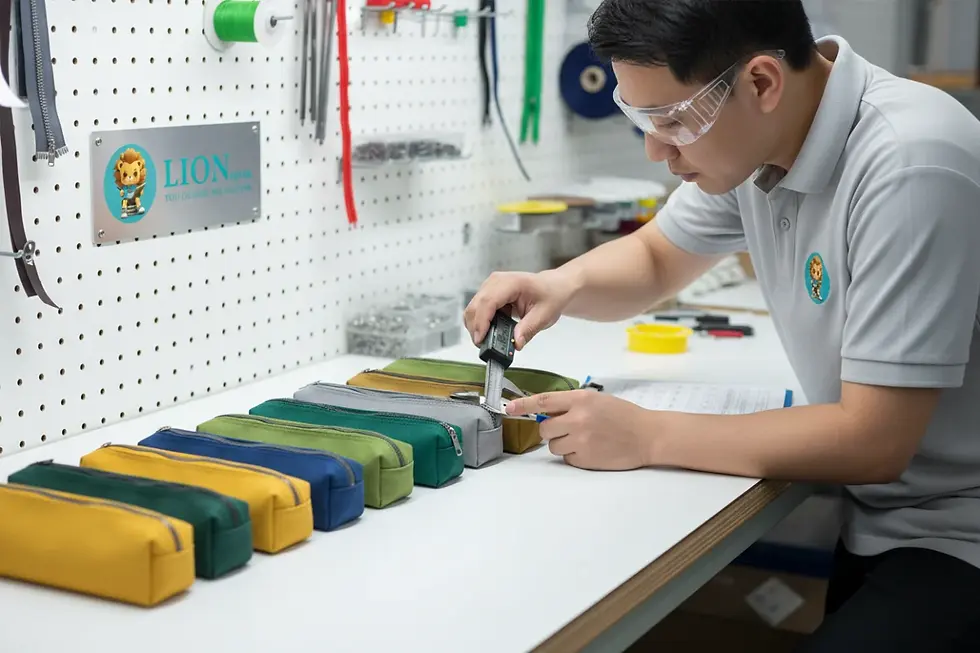
Our Cambodia Production Facility (10,000 sqm) executes large-scale manufacturing under strict standardized SOPs. Equipped with automated sewing lines and specialized testing equipment, the Cambodia plant ensures that high-volume orders remain cost-efficient and tariff-optimized. Our quality assurance program involves AQL 2.5/4.0 sampling, in-line tension tests, and chemical screening to guarantee compliance with ISO 9001, SMETA, FSC, FAMA, and CPSIA frameworks.
How to Format a Comprehensive Zipper Specification Sheet for an RFQ?
When sending a Request for Quotation (RFQ) to a stationery manufacturer, providing a detailed specification sheet prevents communication errors and ensures accurate pricing. A complete zipper specification checklist should outline the following variables:
Zipper Type: Nylon Coil, Vislon (Plastic Molded), or Metal.
Construction Style: Closed-end (standard for pencil pouches) or open-end.
Tape Material: Standard Polyester, RPET (Recycled Polyester), or TPU-coated Waterproof.
Slider & Puller Specs: Zinc alloy, lead-free painted, custom molded rubber/PVC, or cord pull.
Color Codes: Specify Pantone TPX/TCX numbers for the tape, teeth, and slider.
Compliance Standards: Specify if the hardware must pass CPSIA (lead/phthalates), EN71-3, REACH, or specific pull strength tests.
By documenting these technical expectations, procurement managers can secure consistent quality, realistic factory pricing, and highly durable stationery products for their seasonal retail collections.
FAQ
What is the difference between open-end and closed-end zippers for pencil pouches?
Pencil cases almost exclusively use closed-end zippers. A closed-end zipper features a bottom stop that permanently joins both sides of the zipper tape, preventing the slider from separating or leaving the track. Open-end zippers, commonly found in jackets, allow the two halves of the tape to separate completely.
Are nylon coil zippers better than metal zippers for children's school pencil cases?
Yes, nylon coil zippers are generally preferred for children's stationery. They are more flexible, less prone to snagging or catching on skin, and lightweight. Nylon coils also possess 'self-healing' properties, allowing them to recover from minor tooth misalignments, whereas metal teeth can bend or become sharp over time.
How can brands ensure that zipper hardware complies with safety regulations like CPSIA?
Brands must specify lead-free electroplating, non-toxic paint, and phthalate-free raw materials in their zipper specifications. Trustworthy manufacturers like Lion Paper submit metal sliders, PVC pullers, and polyester tapes to accredited third-party labs (such as SGS or Intertek) to verify lead levels are under 90 ppm and phthalates are compliant with CPSIA and REACH standards.


Comments