


Pencil Case Zipper Corner Radius Engineering and Manufacturing Guide

The optimal pencil case zipper corner radius typically ranges between 15 mm and 25 mm (R15 to R25) for rectangular and clamshell pouch silhouettes. This curve radius ensures smooth slider glide without mechanical binding, prevents fabric tape puckering or tooth misalignment, and maximizes internal clearance for standard 15 cm to 20 cm stationery instruments across textile, synthetic leather, and semi-rigid constructions.
What Is the Standard Zipper Corner Radius Specification for Pencil Cases?
A standard zipper corner radius specification defines the minimum arc dimension required for a continuous zipper chain to navigate a geometric turn along the perimeter of a pencil pouch or stationery case. For rectangular, three-sided, or full perimeter clamshell openings, maintaining an engineering radius between R15 and R25 is the industry standard for consumer stationery goods and organizational pouches.
When a zipper bends around a corner, the outer tape edge is subjected to tensile elongation while the inner teeth or coils experience compressive stress. If the corner radius is engineered under 10 mm (R10), the mechanical teeth bunch together, narrowing the inter-tooth pitch and causing the slider to jam, bind, or derail under repeated usage. Conversely, designing a corner radius larger than 30 mm (R30) compromises the rectangular silhouette of the pouch, reducing usable interior corner volume and preventing long items like technical drafting pens, highlighters, or 20 cm rulers from sitting flush against the case perimeter.
Pencil Case Silhouette | Recommended Zipper Corner Radius | Common Zipper Gauge | Primary Structural Function |
|---|---|---|---|
:--- | :--- | :--- | :--- |
Flat Top-Zip Pouch with Extended Ends | R0 to R8 (Turndown Tab) | Minimal curvature; zipper terminates in side seams or folded tabs | |
3-Sided Clamshell (Book-Style) | R18 to R25 | #5 Nylon Coil / Reversed Coil | 180-degree lay-flat opening with fluid corner transit |
3D Brick / Box Pencil Case | R15 to R22 | Maintains rectangular wall structure while preventing slider snag | |
Gusseted Standing Desk Pouch | R20 to R28 | #5 Nylon Coil | Bridges base expansion to vertical side wall transition smoothly |
Hard-Shell EVA Molded Case | R22 to R30 | #5 Reversed Coil / Waterproof PU Tape | Matches CNC mold cavity tolerances and perimeter track depth |
Minimalist Curved-Top Pen Sleeve | R12 to R16 | #3 Nylon Coil | Compact contouring around single-layer stationery clusters |
Selecting the appropriate radius depends on case depth, opening configuration, and target closure resistance. For everyday school and office cases, an R20 baseline offers an optimal balance between industrial sewing speed and ergonomic slider pulling force.
Impact of different corner radius profiles on zipper tape smoothness and slider travel.
How Do Zipper Gauges and Shell Materials Impact Pouch Zipper Corner Radius Engineering?
Pouch zipper corner radius engineering requires calculating the combined flexural rigidity of the zipper chain, backing tape, seam binding, and the outer laminate package. The three primary zipper families—nylon coil, plastic molded (Vislon), and metal—behave differently when shaped across tight radial paths.
Zipper Gauge and Type Dynamics
#3 Nylon Coil: Features a narrow tape width (24 mm total, 12 mm per side) and tightly wound polyester monofilament coils. It handles tighter corner radii (down to R12–R15) with minimal tape strain, making it suitable for lightweight inner divider sleeves and compact pen cases.
#5 Nylon Coil: The benchmark for main exterior closures in school and office organizers. Its standard tape width (30–32 mm) requires a minimum R18–R22 to prevent coil tilting, lateral pitch compression, and slider friction.
#5 Plastic Molded (POM/Vislon): Individual polyacetal teeth are injected directly onto the tape fabric. Because the teeth do not bend flexibly like continuous coils, acute curves force individual teeth to fan out radially, creating tooth spacing anomalies. The absolute minimum radius for #5 Vislon is R25 to R30.
Metal Zippers (#3 / #5 Brass or Aluminum): Symmetrical metal teeth can bind and scratch slider flanges under rotational torque. Curves should be kept at or above R25, paired with specialized curved-zipper sewing feet to avoid misaligned meshing.
Substrate Flexibility and Multi-Layer Lamination
The shell material's bending resistance directly influences zipper corner geometry. As material thickness and stiffness increase, the effective turning radius must expand to prevent unsightly puckering and seam displacement.
Canvas & Woven Polyester (300D to 900D): Highly flexible and forgiving. Standard woven backing adapts well to R15–R20 curves. If laminated with thick thermal backing, EVA foam sheets, or waterproof PVC coatings, the minimum radius should increase by 3 mm to 5 mm.
Polyurethane (PU) & Vegan Leather: Susceptible to micro-cracking and visible wrinkling on the inner compression arc. Designing for R20–R25 prevents material bunching and seam tension lines around exterior corners.
EVA Foam Laminates (Semi-Rigid): Thermoformed EVA shells require explicit mold cavity tracks. The pencil pouch zipper curve radius in the mold tooling must be R22 or greater to ensure consistent machine-stitching along the flange groove without needle deflection.
Clear TPU and PVC Film: High surface friction makes slider movement stiffer at corners. Radii below R20 often cause the slider pull to drag, necessitating an R22–R26 profile paired with silicone-lubricated zipper teeth.
What Are the Critical Pencil Case Zipper Sewing Tolerances and Manufacturing Constraints?
Achieving consistent quality across high-volume production runs requires tightly controlled pencil case zipper sewing tolerances. Even an engineered pattern radius of R20 will fail in final use if stitching margins deviate during manual fabric feeding.
Target Dimension / Metric | Standard Production Tolerance | High-Precision Retail Tolerance | Impact of Out-of-Tolerance Variation |
|---|---|---|---|
:--- | :--- | :--- | :--- |
Seam Allowance Margin | ± 1.0 mm | ± 0.5 mm | Width shifts alter tooth distance from edge, causing slider jamming |
Stitch Density (Stitches per Inch) | 7 to 8 SPI (2.8 to 3.2 SPM) | 8 SPI constant | Uneven stitch pitch causes localized tape bunching around turns |
Zipper Tape Margin Offset | ± 0.8 mm | ± 0.4 mm | Asymmetric feed causes wave distortion on one side of the pouch |
Perimeter Corner Radius Variance | ± 2.0 mm | ± 1.0 mm | Distorts rectangular shell silhouette and creates unequal tension |
Slider Pull Operating Force | < 4.5 N at corner apex | < 3.5 N smooth transit | Excessive pull force leads to consumer complaints and pull-tab failure |

Precision corner stitching using dedicated presser tooling to maintain seam allowance tolerances.
Tooling and Pattern Execution
To maintain tight tolerances during volume manufacturing, skilled factory operations utilize standardized SOPs and dedicated tooling fixtures:
Laser-Cut Alignment Notches: Exterior panels and zipper tapes receive micro-notches (0.5 mm depth) at the tangent points where curves begin and end. This ensures machine operators match fabric feed rates without stretching the tape unevenly.
Corner Relief Snipping: For enclosed inner seams, the seam allowance around the curve must be notched or V-cut at 3 mm intervals to release hoop stress when the pouch is inverted right-side out.
Specialized Sewing Machine Presser Feet: Operators use compensating presser feet or narrow left/right zipper feet with smooth undercut grooves, preventing the foot from pushing the zipper coil out of vertical alignment around the curve.
Automatic CNC Pattern Sewing: For rigid EVA cases and high-volume structured organizers, automated programmable clamping fixtures move the pouch shell along a fixed CNC path. This completely eliminates manual variance along the zipper corner radius.
At Lion Paper's prototyping facility in Jiaxing, China, initial paper and textile patterns undergo strict dimensional verification before tooling dies are released to the mass-production facility in Cambodia. This dual-site synergy ensures prototyping precision translates directly into scalable production stability.
How Does Pencil Pouch Zipper Curve Radius Affect Usable Volume and Production Economics?
The curvature of the zipper track directly impacts two critical product dimensions: internal volumetric storage and per-unit production cost.
Volumetric Clearance vs. Corner Curvature
Stationery products—such as triangular geometric rulers, boxed lead refills, and graphic markers—feature sharp 90-degree corners. When a pencil case incorporates an excessively large pencil pouch zipper curve radius (e.g., R35), the dead space in the four exterior corners expands significantly.
Sharp Corner Design (R0 with Drop-Down Ends): 100% volumetric corner utility, but requires extra assembly steps for side tabs and zipper end-stops.
Engineered Balance (R18 to R22): 92% to 95% usable volumetric corner utility. Allows standard 15 cm boxed stationery items to rest completely inside while providing effortless, single-hand zipper operation.
Overly Swept Corner (R30+): Drops corner utility to below 80%, requiring the entire pouch envelope to be enlarged by 15 mm to 20 mm in total length to accommodate standard items.

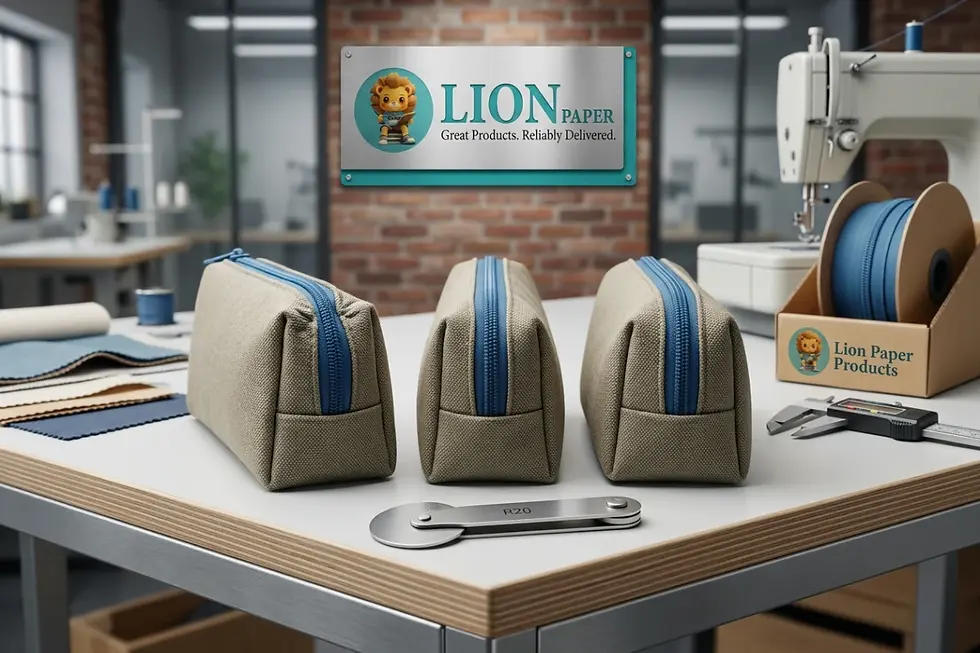
Pre-shipment quality verification of pencil case zipper corner curvature and dimensional accuracy.
Production Feasibility and Commercial Cost Drivers
In cut-and-sew manufacturing, curved seams require greater operational skill and slower sewing speeds than straight linear passes. Understanding how geometry affects labor cycles helps brands optimize manufacturing costs across volume tiers:
Cycle Time Impact: Stitching a straight zipper seam takes an average operator 12 to 15 seconds. Guiding a continuous zipper through two 90-degree corners (R15 to R20) increases cycle time to 28 to 35 seconds per side to maintain margin consistency.
Defect and Rework Rates: On manual production lines without automated tooling, tight curves under R15 generate a 4% to 7% reject rate due to zipper tape waviness, stitch skips, or puckering. Shifting to an R20 to R25 standard reduces production fallout to below 0.8%.
Lining Integration Complexity: An inner lining must match the shell’s curve radius with a calibrated negative offset (typically -1.5 mm to -2.0 mm per layer). If the lining is cut to the same radius as the shell, excess lining fabric bunches inside the corner curve, catching in the zipper teeth during closure.
What Pre-Production Protocols and QC Inspection Checklists Prevent Zipper Corner Failures?
To ensure flawless retail execution, B2B product developers and quality assurance teams should implement strict quality control standards during both initial sampling and mass assembly.
RFQ and Technical Drawing Callout Best Practices
When preparing a tech pack or design brief for manufacturer development, avoid vague notations such as "rounded zipper corner." Specify the technical parameters precisely:
Zipper Specification: e.g., "#5 Reversed Nylon Coil Zipper, water-repellent matte PU coating, matching D-slider with auto-lock."
Corner Geometry: e.g., "Corner profile R20 mm ± 1.0 mm on exterior pattern edge."
Internal Ease Allowance: e.g., "Inner 210D polyester lining pattern offset -1.5 mm radial tolerance."
Binding Tape Method: e.g., "Perimeter seam enclosed with 20 mm herringbone polyester tape, continuous bias cut around curves."
Factory Floor QC Inspection Checklist
During inline and final pre-shipment inspections (under AQL 1.5/4.0 standards), verify zipper corners against the following structural benchmarks:
Dynamic Slider Transit Test: Pull the slider through the entire corner curve five consecutive times. The slider must glide continuously without sticking, catching on lining edges, or requiring a secondary stabilizing pull.
Tape Waviness & Puckering Check: Inspect the fabric along the outer seam allowance. No visible rippling, bubble folding, or wave distortion exceeding 0.5 mm in crest height is permitted.
Crosswise Seam Strength (ASTM D2061 Standard): Ensure the stitched zipper corner can withstand lateral pull forces of at least 80 N to 120 N without seam separation or tooth displacement.
Symmetry and Profile Verification: Place the pouch against a transparent acrylic template containing the calibrated R-curve profile to confirm both left and right corners match within ± 1.5 mm.
By uniting design-to-manufacturing integration with unified SOP work cards, standardized defect spectrums, and rigorous AQL inspections, Lion Paper Products manages complex pencil case and organizer pouch programs from initial creative concept through to scalable, compliant bulk delivery.
For custom stationery bags, multi-compartment organizers, and creative retail pouch lines, Share target pencil-case size, capacity, material, zipper type, lining, quantity and price target with Lion Paper for a pouch development brief.
FAQ
Why does a pencil case zipper slider stick or catch specifically at the corners?
Zipper sticking at corners is primarily caused by an excessively sharp corner radius (below R15 for #5 zippers), improper sewing tension that misaligns zipper tooth pitch, or excess internal lining fabric that bunches into the slider path during the turning transit.
Can I use a #5 metal zipper on a tight clamshell pencil case corner?
While possible, metal zippers are significantly stiffer than nylon coil zippers and require a minimum corner radius of R25 to R30. Radii below R25 with metal teeth frequently cause high operating friction, slider sticking, and premature tooth wear.
What is the recommended seam allowance offset when stitching curved zipper tracks?
The industry standard seam allowance is 5 mm to 8 mm (1/4 inch to 5/16 inch) with a tight manufacturing tolerance of ± 0.5 mm to ± 1.0 mm. Inside the radial curve, the seam allowance should be notched to prevent tension buildup once inverted.
How does Lion Paper ensure consistent zipper corner performance across large production volumes?
Lion Paper uses standardized SOPs, laser-notched pattern markers, automated CNC pattern sewing where applicable, and comprehensive AQL 1.5/4.0 inline inspections across its China prototyping and Cambodia volume manufacturing facilities to ensure identical batch-to-batch curvature and slider pull force.


Comments