


Understanding Pencil Case MOQ: A Sourcing Guide for Brands

The typical minimum order quantity (MOQ) for custom pencil cases ranges from 1,000 to 3,000 units per style or color. This standard enables brands, corporate buyers, and e-commerce retailers to optimize unit costs. This volume is dictated by fabric roll lengths, custom hardware minimums, and setup times required by machinery on the production floor.
What is the Standard Pencil Case MOQ and Why Does It Vary?
An established pencil pouch minimum order quantity is not an arbitrary number. Instead, it is dictated by the upstream supply chain of raw materials and manufacturing setup times. When a stationery pouch manufacturer initiates a custom production run, raw fabrics (like canvas, nylon, polyester, or PU leather) must be ordered from textile mills. These mills sell materials in standard industrial rolls, typically requiring a minimum dyeing or printing run of 1,000 meters per color. If a brand requests a specific custom color or custom-printed pattern, the textile supplier’s fabric MOQ naturally scales down to a yield of 1,000 to 2,000 finished pencil cases.
Additionally, modern high-volume manufacturing utilizes specialized equipment such as die-cutting presses and automated sewing machines. Setting up this machinery for a specific shape, pocket configuration, and size requires significant labor and mechanical adjustment. If the order volume is too small, these setup costs cannot be amortized effectively, driving the individual unit cost too high for retail. Thus, a standard pencil case MOQ of 1,000 to 3,000 units is the industry benchmark that ensures raw material waste is minimized, machinery setups are optimized, and the final unit price remains highly competitive for the buyer. Choosing in-stock fabrics can sometimes offer slight flexibility, but custom designs require adhering to these standard minimums.
Pencil Case MOQ Comparison Matrix: Materials, Construction, and Volume Requirements
To help sourcing managers and retail buyers align their creative goals with manufacturing realities, the matrix below outlines how material choices and construction styles directly impact volume requirements when purchasing bulk pencil cases.
Material Type | Typical MOQ (Units) | Primary Customization Options | Primary Retail Channels | Key Cost Drivers |
|---|---|---|---|---|
:--- | :--- | :--- | :--- | :--- |
Heavyweight Cotton Canvas | 1,000 - 1,500 | Silk-screen printing, heavy embroidery, custom woven labels | Premium boutiques, museum gift shops, creative brands | Fabric weight (oz), specialty wash treatments |
Vegan PU Leather | 2,000 - 3,000 | Deep debossing, hot foil stamping, custom-colored linings | Corporate gifting, executive desk ranges, luxury retail | Custom embossing roller molds, synthetic thickness |
Clear TPU / Matte PVC | 2,000 - 3,000 | UV digital printing, color-tinted sheets, custom piping | Youth markets, travel accessory brands, trendy retail | High-frequency welding machinery setup, eco-grade plastics |
600D/900D Polyester | 3,000+ | All-over sublimation printing, multi-compartment setups | Mass market school supplies, durable outdoor brands | Polyester weave density, internal PU water-resistant coating |
Recycled PET (rPET) | 3,000+ | Low-impact water-based printing, recycled label stitching | Certified eco-friendly brands, corporate ESG campaigns | Certified post-consumer sourcing, GRS tracking |
By selecting materials that match your budget and market expectations, you can plan product launches that stay within standard manufacturing frameworks without incurring heavy cost premiums for under-MOQ production runs.
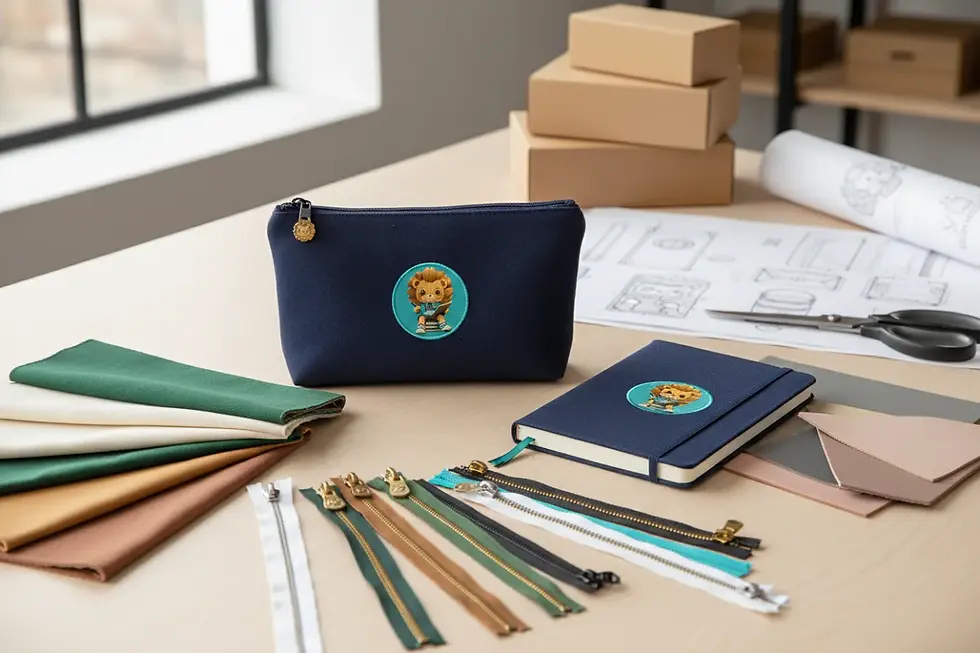
What Fabric, Zipper Hardware, and Decoration Options Affect Bulk Pencil Cases Production?
To customize bulk pencil cases successfully, sourcing teams must understand how specific components influence the overall manufacturing workflow. Every variable—from the primary textile to the zipper teeth—adds a layer of complexity that can affect both the unit cost and the required minimum order volume.
Fabric Grade and Weight: Selecting raw fabrics determines the durability of the pouch. For canvas, weights range from lightweight 8oz up to thick 16oz options. Polyester is measured in Denier (e.g., 600D, 900D). Higher-density materials are stronger but require heavy-duty sewing needles and stronger thread tension, which can affect assembly speed.
Zipper and Hardware Quality: The zipper is the highest-wear component of any stationery pouch. Standard nylon coil zippers are cost-effective and available in many stock colors. However, upgrading to premium metal zippers, water-resistant taped zippers, or custom-molded silicone pull-tabs with a debossed logo requires specialized tooling. Hardware suppliers typically mandate high individual MOQs for custom-molded pullers, which directly impacts the minimum order size of the finished case.
Decoration Techniques: Customizing the exterior of the case can be achieved through multiple methods. Silk-screen printing is perfect for solid-color logos, while sublimation is the standard for complex, multi-colored photographic patterns on polyester. For high-end branding, embroidery, rubber patches, or woven labels are stitched directly onto the panels before assembly. Because each method requires unique plate setups or digitization programming, larger runs are essential to absorb these initial design fees and keep the project financially viable for both the stationery pouch manufacturer and the brand.
How Can Brands Coordinate Custom Notebooks and Stationery Pouches into Cohesive Gift Collections?
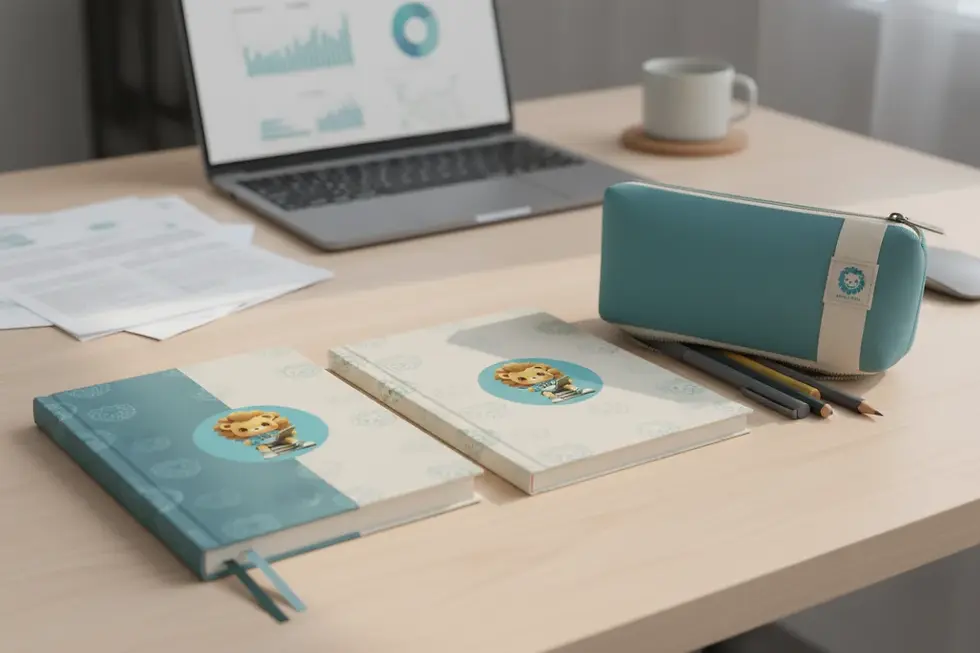
In today's highly competitive retail and e-commerce landscapes, offering standalone products can limit average order values. Leading stationery brands and gift buyers routinely design unified product families, pairing custom notebooks, journals, and planners with matching wholesale pencil cases custom orders to form highly appealing retail collections.
However, coordinating paper goods with textile-based organizers presents significant supply-chain hurdles when handled across separate manufacturers. Color variations frequently occur because paper inks and textile dyes reflect light differently. Furthermore, packaging mismatch, inconsistent structural sizing, and fragmented delivery schedules can delay seasonal product launches.
By utilizing an integrated supply chain partner that manages both paper fabrication and soft-goods sewing, brands can guarantee cross-category consistency. For example, a design featuring a specific floral pattern or corporate brand color can be precisely calibrated using Pantone matching systems for both the FSC-certified hardcover planner and the coordinating canvas zippered pouch. A single partner can also engineer custom-fit gift boxes or retail-ready paper sleeves that house both items securely. This integrated design-to-manufacturing approach reduces packaging material waste, optimizes shipping volumes, and delivers a premium, highly cohesive unboxing experience that drives brand loyalty and retail conversions.
What Quality Control Standards and Retail Compliance Guidelines Should a Stationery Pouch Manufacturer Meet?
Because stationery pouch products are widely used by children, students, and professionals alike, they are subject to strict international consumer safety regulations. A world-class stationery pouch manufacturer must enforce rigorous quality control measures and maintain compliant manufacturing spaces to protect brands from catastrophic recalls or customs delays.
Compliance begins with raw material sourcing. Every dye, fabric, metal zipper teeth, and plastic backing must be tested to ensure compliance with standards like the Consumer Product Safety Improvement Act (CPSIA) in North America and REACH in Europe. This testing verifies that all materials are completely free of harmful levels of lead, cadmium, phthalates, and restricted azo dyes.
On the manufacturing floor, quality control is maintained through standardized operating procedures (SOPs). A reliable factory utilizes detailed quality checkpoints, including incoming material inspections, inline stitching tension verification, and final packing audits based on industry-standard Acceptable Quality Limits (AQL 2.5/4.0). Key physical tests include zipper cycle testing (opening and closing the zipper hundreds of times to ensure smooth operation), seam strength testing, and colorfastness tests to verify that the fabric dye will not transfer onto clothes or books. Furthermore, factory social compliance must be backed by recognized audits such as SMETA, BSCI, or FAMA, ensuring that ethical labor practices are maintained at every stage of production.

What is the Essential Checklist of Specifications to Prepare Before Requesting a Pencil Case Quote?
To obtain a rapid, accurate, and competitive quotation from your manufacturing partner, it is vital to provide a highly detailed specification sheet. Vague inquiries often lead to prolonged negotiation cycles and inaccurate pricing. Sourcing departments should prepare a comprehensive tech pack containing the following critical details before launching an RFQ:
Finished Dimensions: Provide exact measurements for length, width, and depth (height), along with sizes for internal pockets, elastic pen loops, or mesh compartments.
Material Matrix: Specify the exact weight and type of the outer fabric, inner lining material, and any middle padding layers (such as protective EPE foam).
Zipper Specifications: Define the zipper material (e.g., nylon, plastic, brass), sizing (e.g., #3 or #5), and pull-tab details (plain metal, cord loop, or customized molded silicone).
Decoration Details: Provide vector artwork (AI or PDF) showing print/embroidery placement, dimensions, and precise Pantone Color Matching System (PMS) codes.
Packaging and Labeling: Detail whether you require individual biodegradable polybags, retail hangtags, custom UPC barcode labels, or heavy-duty shipping cartons.
Target Order Volume: Clarify your intended production run per colorway and style, ensuring it aligns with standard pencil case MOQ expectations to secure the best possible volume discounts.
How Does Lion Paper’s Dual-Site Synergy Support Seamless Scaling from Sampling to Mass Delivery?
For global brands navigating tight product launch windows, managing the transition from an initial sketch to large-scale mass delivery is highly challenging. Lion Paper Products addresses this friction by providing a unified, two-nation supply chain strategy designed to optimize product development speed, quality assurance, and overall cost structure.
Our China Prototyping and R&D Hub: Based in Jiaxing, Zhejiang, our 3,000-square-meter facility houses our design, engineering, and rapid prototyping teams. This location allows us to tap directly into the world’s most advanced textile and hardware raw material markets. We can source custom fabrics, unique zippers, and innovative closures to develop physical, retail-ready samples within days, giving brands a fast path to product visualization.
Our Cambodia Mass Production Base: Once a design is approved and ready for mass distribution, production can scale into our expansive 10,000-square-meter facility in Cambodia. This site features advanced automated cutting machines, standardized production lines, and highly trained sewing teams optimized for high-volume manufacturing of custom bags and organizers. By shifting mass assembly to Cambodia, clients benefit from highly competitive labor costs and duty-free export structures to major global markets, while maintaining strict adherence to our unified, ISO-compliant quality standards.
Whether you are an established global retail chain, a fast-growing e-commerce boutique, or a creative brand looking to expand your stationery sets, we deliver a smooth path from concept to delivery. To begin designing your next custom collection, Send your target product, material, decoration and quantity; Lion Paper can propose a retail-ready construction and sampling route.
FAQ
Can the pencil case MOQ be split across multiple colors or designs?
Generally, the minimum order quantity of 1,000 to 3,000 units is set per style and per color. This is because raw fabric suppliers require minimum dye runs for each specific color roll. However, if your design utilizes standard, in-stock fabrics and off-the-shelf colorways, we can often split the MOQ across 2 or 3 colors. Custom patterns or custom-dyed colors must strictly meet the fabric supplier's raw material minimums.
What is the typical lead time for custom pencil case prototyping and mass production?
Prototyping and physical pre-production sampling typically require 7 to 14 days, depending on the complexity of your design and material availability. Once the pre-production sample is approved, bulk manufacturing and quality control inspections take approximately 35 to 45 days, depending on order size, customization details, and seasonal factory capacity.
Are the materials used in your pencil cases certified safe for retail environments?
Yes, we prioritize safety and environmental sustainability. All textiles, zippers, lining materials, and inks can be tested to meet strict CPSIA, REACH, and California Proposition 65 regulations. We also offer certified eco-friendly options, such as GRS-certified recycled PET (rPET), organic cotton canvas, and FSC-certified paper materials for coordinated stationery gift sets.


Comments