


Complete Guide to Pen Restart Performance and Cap-Off Time Testing Standards

Pen restart performance measures a writing instrument's ability to resume smooth, skip-free ink delivery immediately after being left uncapped or idle, serving as a critical quality benchmark for tip sealing, ink formulation, and mass-production reliability. Consistent restart performance prevents dry-out, railroading, and hard starting during intermittent writing across diverse storage environments, temperature shifts, and relative humidity conditions.
What Is Pen Restart Performance and How Is Cap-Off Time Benchmarked?
Pen restart performance defines whether a pen writes instantaneously on the very first stroke after remaining uncapped or inactive for a designated duration. In commercial stationery manufacturing and writing instrument quality control, this performance metric reflects the delicate chemical equilibrium of volatile carrier solvents within the ink reservoir, the integrity of humectant additives, and the precision mechanical fit of the rolling ball within its tip socket.
Cap-off time represents the exact duration a pen can stay exposed to ambient atmospheric conditions (typically calibrated at 20°C to 23°C and 50% relative humidity) while still maintaining the capacity to initiate an unbroken line within a defined distance—usually within the first 5 to 10 millimeters of paper contact. When a writing instrument is left uncapped, volatile solvents at the exposed tip begin to evaporate. If the ink formulation lacks sufficient non-volatile humectants or if the mechanical clearance around the rolling ball is excessive, the fluid vehicle flashes off rapidly. This evaporation leaves behind high-viscosity sludge or crystallized dye polymers that coat the ball seat, preventing free ball rotation and halting capillary ink draw. The resulting failure modes include hard starting, stroke skipping, railroading, or permanent tip seizure.
Different writing instrument technologies and ink systems exhibit distinctly different baseline cap-off thresholds:
Traditional Oil-Based Ballpoint Inks: Exhibit the longest cap-off tolerance across the industry, routinely sustaining 48 to 120 hours without a cap. Their high-viscosity formulations rely on heavy, non-volatile solvent carriers that resist rapid atmospheric evaporation.
Hybrid and Low-Viscosity Ballpoint Inks: Combine low-friction writing feel with moderate drying rates. These formulations use blended organic solvent systems, maintaining reliable restart performance within a standard 4 to 24-hour uncapped window.
Water-Based Gel Inks: Feature thixotropic viscosity modifiers and water-soluble humectants such as glycols. Standard private-label gel refills require robust tip sealing and generally tolerate 30 minutes to 4 hours of cap-off exposure before encountering hard starting.
Liquid Rollerball and Fineliner Inks: Utilize low-viscosity dye or pigment solutions that penetrate paper fibers rapidly. Because these liquid formulations dry quickly on open surfaces, they dry out at the exposed tip within 2 to 15 minutes unless fortified with specialized non-dry additives or housed in specialized spring-loaded airtight barrel caps.

Consistent pen restart performance depends on sub-micron tip tolerances and balanced ink humectant formulations.
What Standardized Testing Protocols Evaluate Writing Instrument Restart Reliability?
Accurate validation of pen restart performance demands repeatable, mechanized laboratory protocols rather than subjective manual scribbling. Leading international standards—such as ISO 12757-1/2 for ball point pens and refills, ISO 14145-1/2 for roller ball pens and refills, and ISO 27668-1/2 for gel ink ball pens—establish quantitative testing criteria to ensure repeatable evaluation across production lots.
Test Parameter | Gel Ink Refills (ISO 27668 Compliance) | Hybrid / Ballpoint Refills (ISO 12757 Compliance) | Liquid Rollerball Refills (ISO 14145 Compliance) |
|---|---|---|---|
:--- | :--- | :--- | :--- |
Standard Cap-Off Exposure | 30 minutes / 2 hours / 24 hours | 24 hours / 72 hours / 120 hours | 5 minutes / 15 minutes / 60 minutes |
Writing Angle & Load | 60° to 70° at 1.0 N to 1.5 N downward load | 60° to 70° at 1.5 N to 2.0 N downward load | 60° to 65° at 0.8 N to 1.2 N downward load |
Writing Substrate | 80 gsm calibrated woodfree bond paper | 80 gsm calibrated woodfree bond paper | 80 gsm calibrated woodfree bond paper |
Restart Stroke Benchmark | Continuous line laydown within ≤ 10 mm | Continuous line laydown within ≤ 5 mm | Continuous line laydown within ≤ 10 mm |
Continuous Write-Off Speed | 4.5 m/min to 9.0 m/min on spiral tester | 4.5 m/min to 9.0 m/min on spiral tester | 4.5 m/min to 9.0 m/min on spiral tester |
Post-Cap Recovery Rate | Re-capped for 1 hour; 100% stroke yield | Re-capped for 1 hour; 100% stroke yield | Re-capped for 1 hour; 100% stroke yield |
A standardized pen cap-off time testing sequence follows five rigorous operational phases:
Baseline Run-In Cycle: The sample refill or assembled pen is loaded onto an automated spiral writing machine and run for 50 continuous meters to eliminate micro-burrs on the ball socket, establish hydraulic ink flow, and confirm baseline line density.
Uncapped Environmental Conditioning: Pens are positioned horizontally in a climate-controlled test chamber maintained strictly at 23°C ± 2°C and 50% ± 5% relative humidity, protected from direct drafts and forced air circulation.
Timed Restart Actuation: At specified test intervals (such as 15 minutes, 1 hour, 4 hours, and 24 hours), the test arm lowers the pen tip onto moving test paper under standardized downward pressure and fixed contact angles.
Optical Stroke Measurement: High-resolution optical sensors or reticle measuring microscopes calculate the exact interrupted distance from the point of initial surface contact to the beginning of a continuous, full-density ink line.
Capped Recovery Verification: Pens that show restart hesitation beyond allowable limits are re-capped and stored for 60 minutes, after which they are retested to verify whether the internal humectant chemistry can re-dissolve dry surface film without mechanical intervention.
What Are the Primary Root Causes of Pen Restart Failure in Mass Production?
When writing instruments exhibit high failure rates during restart testing, the problem rarely originates from a single manufacturing defect. In high-volume production, restart failure typically stems from complex interactions among chemical ink formulations, precision component tolerances, and mechanical sealing structures.
1. Solvent Evaporation and Inadequate Humectant Balance
Writing ink formulations consist of colorants, polymeric resins, wetting agents, and volatile solvent systems. In lower-tier refill manufacturing, cutting costs by reducing slow-evaporating humectants (such as glycerin, propylene glycol, or polyethylene glycol derivatives) causes rapid solvent loss at the exposed meniscus. As the solvent evaporates, the remaining resin binders dry into an adhesive film, locking the tungsten carbide ball inside the socket and preventing rotation upon paper contact.
2. Ball-Socket Gap Machining Tolerances
The clearance between the rotating sphere and the cold-formed stainless steel or nickel silver tip socket is engineered at sub-micron levels, typically between 0.5 and 1.5 microns. Precision deviations create two distinct failure modes:
Excessive Clearance: Allows atmospheric air to migrate past the ball and enter the internal tip reservoir, forming air bubbles that break the capillary fluid column.
Insufficient Clearance: Restricts fluid replenishment around the front hemisphere of the ball, causing even minor surface drying to seize the ball entirely.
3. Substandard Secondary and Cap Enclosure Sealing
Many restart failures occur while pens are stored in capped or retracted configurations. In capped pens, the absence of an elastomeric inner cap seal allows ambient air to circulate continuously around the nib. In retractable click or twist pens, loose nosecone apertures or inadequate inner retraction travel expose the tip to constant airflow, accelerating evaporation during warehouse storage.
4. Capillary Follower and Follower Gel Separation
In gel pens and hybrid rollerballs, a transparent, high-viscosity follower gel sits directly behind the ink column in the refill tube. If this follower gel experiences separation, air voids, or chemical breakdown due to temperature cycling or transit shock, hydraulic pressure collapses. Without back-end hydrostatic containment, the ink column retracts away from the tip, preventing spontaneous restart.

Standardized AQL sampling and defect classification prevent bulk writing failure and dry-out across global shipments.
How Do Procurement Teams Establish Measurable Pass/Fail Criteria and Defect Limits?
To safeguard brand reputation and minimize customer returns, B2B procurement managers and brand buyers must replace vague descriptions like "smooth ink flow" with precise, measurable pen refill testing standards. Quantifiable defect limits and Acceptable Quality Level (AQL) frameworks ensure that mass-manufactured writing instruments meet strict retail performance expectations.
Quality assurance teams categorize writing performance defects into three distinct severity levels:
Critical Defects (AQL 0.0): Chemical ink leakage that stains barrels or breaches primary packaging; total absence of non-toxic compliance documentation (such as CPSIA, ASTM D-4236, or EN 71-3); or sharp metallic burrs on clips and nosecones that present consumer safety risks.
Major Defects (AQL 1.0 to 1.5): Complete failure to restart after standard cap-off limits; dry-out occurring within 10 minutes on capped gel pens; severe railroading exceeding 15% of a continuous test line; cracked elastomeric cap seals; or broken click-retraction springs.
Minor Defects (AQL 2.5 to 4.0): Initial restart delay measuring between 5 mm and 15 mm on the first stroke that resolves immediately; minor cosmetic micro-scratches on electroplated barrel finishes; or slight acoustic variance during click-mechanism actuation.
Standard AQL Inspection Sampling Framework
For an order lot size ranging from 10,000 to 35,000 units, standard General Inspection Level II sampling establishes the following inspection criteria:
Sample Size: 315 units selected randomly across all production cartons.
Critical Defect Threshold (AQL 0.0): 0 defects allowed. Any critical defect triggers immediate lot rejection.
Major Defect Threshold (AQL 1.5): Maximum 10 defective units permitted for batch acceptance; 11 or more defective units trigger lot rejection and rework.
Minor Defect Threshold (AQL 4.0): Maximum 21 defective units permitted for batch acceptance; 22 or more defective units trigger batch rejection.
Cap-Off Sub-Sample Validation: A randomized sub-sample of 32 units undergoes dedicated 24-hour cap-off testing, requiring 100% stroke yield within 10 mm on standard bond paper.
What Pre-Production Checkpoints Validate Refill Sourcing and Component Tolerances?
Preventing writing performance defects begins long before mass assembly lines start running. A comprehensive stationery accessory QA checklist verifies mechanical, chemical, and dimensional parameters during the prototyping, tooling validation, and pre-production approval stages.
An effective pre-production engineering evaluation covers four vital checkpoints:
Refill Sourcing and Tip Ball Metallurgy: Verify that the refill manufacturer utilizes precision-ground tungsten carbide balls paired with corrosion-resistant stainless steel housings. Require supplier certification proving that ink batch viscosity remains within ±50 mPa·s of approved formulation targets.
Airtight Cap Enclosure Testing: Subject capped assemblies to negative pressure vacuum decay testing. The internal cap chamber must sustain a vacuum of -20 kPa for 30 consecutive seconds without pressure loss to ensure that the elastomeric seal isolates the tip from ambient air.
Retraction Depth and Spring Tension: For retractable pens, measure internal spring rate and tip retraction depth. The mechanism must pull the tip at least 2.5 mm behind the nosecone opening to minimize convective air movement across the ball orifice when carried in pockets or bags.
Substrate Interoperability Testing: Test pen restart performance across a representative range of paper stocks, including 80 gsm woodfree sheets, 100 gsm offset journal paper, 120 gsm coated bamboo paper, and 160 gsm heavy mixed-media stock. This ensures that surface sizing agents, mineral fillers, and calendered coatings do not transfer onto the ball socket and inhibit ink laydown.
How Are In-Line QC, AQL Inspections, and Storage Stress Testing Managed for Global Shipments?
Mass production quality assurance bridges the gap between pre-production sample approval and large-scale ocean freight delivery. Because writing instruments experience severe pressure drops, temperature extremes, and vibration during global transit, packaging and component resilience must be validated through rigorous environmental stress testing.
Comprehensive Pre-Shipment Transit and Climate Stress Protocol
Thermal Shock and High-Temperature Incubation: Packaged pens are placed in a thermal testing chamber at 50°C and 75% relative humidity for 72 hours. This test verifies that follower gels maintain cohesion, volatile solvents do not expand past tip seals, and plastic barrels resist warpage.
Low-Temperature Freeze-Thaw Testing: Samples are conditioned at -10°C for 48 hours and allowed to return naturally to room temperature. This confirms that ink colorants do not crystallize, tip metal does not fracture, and restart performance recovers fully within 5 mm of contact.
Vacuum Depressurization Testing: Assembled pens and refills are tested in a vacuum chamber at 0.6 bar (60 kPa) for 30 minutes to simulate unpressurized aircraft cargo holds and high-altitude ground transport, confirming that internal seals prevent barrel blowouts and tip weeping.
Vibration and Drop Simulation: Packaged cartons undergo ISTA 1A drop and vibration shaker testing to confirm that mechanical click mechanisms remain seated and follower gels do not separate under transport turbulence.
Post-Stress Automated Write-Out Verification: After completing environmental conditioning, samples are tested on automated spiral equipment to ensure immediate restart and uniform line continuity.
In-line quality control inspectors pull production units every two hours directly from assembly belts to execute immediate cap-off spot checks. If any production lot fails thermal recovery or restart standards, the entire batch is quarantined for root-cause analysis, preventing defective refills from reaching final packaging.
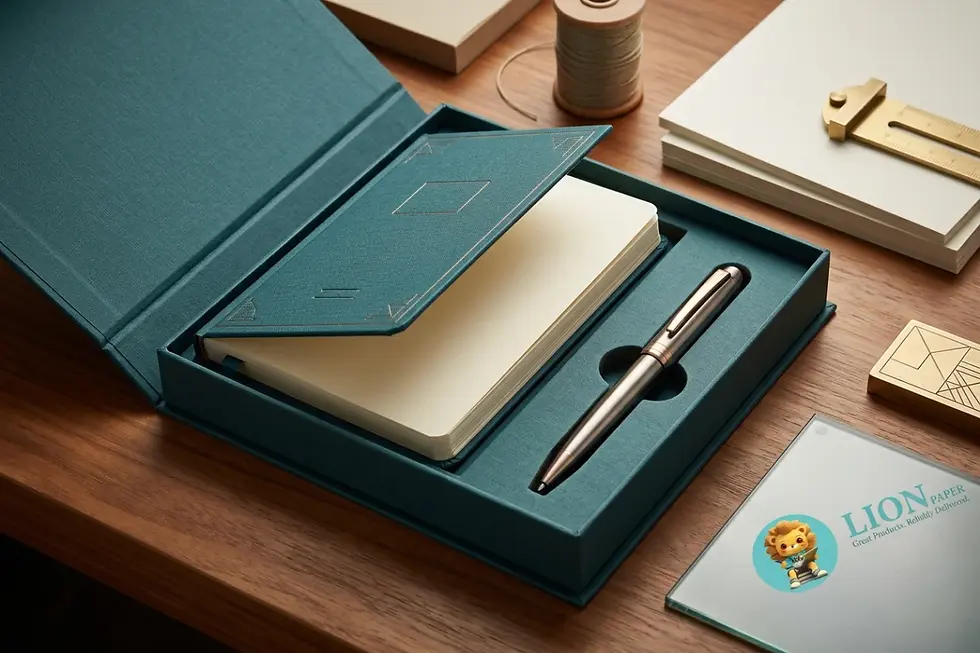
Integrating rigorously tested pens with custom paper products ensures seamless paper compatibility and flawless write-out performance.
How Does Lion Paper Integrate Quality-Controlled Writing Instruments into Custom Stationery Sets?
Integrating custom writing instruments into high-end notebooks, journals, and executive gift packaging requires synchronized engineering between paper manufacturing, accessory sourcing, and structural packaging. Founded in 2015 in Jiaxing, Zhejiang, Lion Paper Products (Jiaxing) Co., Ltd. serves as an integrated supply-chain partner for customized paper goods and creative stationery collections.
Lion Paper operates through a dual-site manufacturing model combining a 3,000-square-meter design, R&D, and rapid sampling facility in Jiaxing, China, with a 10,000-square-meter mass-production campus in Cambodia. This dual-base footprint delivers agile product development alongside cost-effective, scalable production. Producing over 5 million notebooks annually, Lion Paper manages end-to-end supply chain integration—from creative concept and structural design to accessory sourcing, packaging engineering, and global delivery across North America, Europe, Australia, the Middle East, and Southeast Asia.
Through internal design-to-manufacturing workflows, Lion Paper enforces rigorous compliance and quality benchmarks across all eight product categories, including Eco Paper Products, Notebooks & Journals, Planners & Calendars, Stationery & Office, Bags & Organizers, Accessories, Gift & Packaging, and Home & Living. Holding ISO 9001, FSC, SMETA, WCA, GSV, FAMA, and CPSIA audit and certification capabilities, the company pairs custom-bound journals with pre-tested, high-reliability writing instruments. Every matched pen is engineered to perform harmoniously on specific paper sizing formulations without ghosting, feathering, hard-starting, or tip drying.
To ensure your next retail collection or private-label stationery program balances smooth writing performance, compliant packaging, and landed cost efficiency, Share target retail price, pen type, refill, performance standard and packaging; request a private-label pen specification and sample test plan.
Frequently Asked Questions
How long should a quality gel pen write after being left uncapped?
A quality private-label gel pen engineered with standard humectants and airtight tip geometry should tolerate between 30 minutes and 2 hours of uncapped exposure in standard room conditions (20°C to 23°C, 50% RH) and still restart within 10 mm of stroke contact. Specialized non-dry ink formulations can extend this cap-off performance to 24 to 72 hours.
Why do retractable pens dry out faster than capped pens?
Retractable pens lack the airtight internal chamber provided by a dedicated elastomeric cap liner. The small circular gap between the tip and the barrel nosecone allows ambient air to circulate around the retracted tip. Overcoming this requires higher-viscosity solvent systems, specialized spring seal boots, or dynamic vapor barrier coatings inside the barrel tip chamber.
How does ambient humidity and temperature affect pen restart benchmarks?
High temperatures accelerate volatile solvent evaporation at the exposed tip, drastically shortening cap-off duration. Low relative humidity (below 30% RH) rapidly extracts moisture from water-based gel and liquid inks, creating crystallized ink plugs. Testing standards normalize these variables by requiring testing within strict atmospheric parameters (23°C ± 2°C and 50% ± 5% RH).
What is the difference between railroading and hard starting?
Hard starting occurs on the initial stroke when the pen tip fails to deposit ink upon contacting paper due to tip dry-out or air pockets. Railroading occurs during continuous writing when ink flow is partially restricted, producing two thin parallel tracks along the outer edges of the ball path while leaving the center un-inked.
FAQ
How long should a quality gel pen write after being left uncapped?
A quality private-label gel pen engineered with standard humectants and airtight tip geometry should tolerate between 30 minutes and 2 hours of uncapped exposure in standard room conditions (20°C to 23°C, 50% RH) and still restart within 10 mm of stroke contact. Specialized non-dry ink formulations can extend this cap-off performance to 24 to 72 hours.
Why do retractable pens dry out faster than capped pens?
Retractable pens lack the airtight internal chamber provided by a dedicated elastomeric cap liner. The small circular gap between the tip and the barrel nosecone allows ambient air to circulate around the retracted tip. Overcoming this requires higher-viscosity solvent systems, specialized spring seal boots, or dynamic vapor barrier coatings inside the barrel tip chamber.
How does ambient humidity and temperature affect pen restart benchmarks?
High temperatures accelerate volatile solvent evaporation at the exposed tip, drastically shortening cap-off duration. Low relative humidity (below 30% RH) rapidly extracts moisture from water-based gel and liquid inks, creating crystallized ink plugs. Testing standards normalize these variables by requiring testing within strict atmospheric parameters (23°C ± 2°C and 50% ± 5% RH).
What is the difference between railroading and hard starting?
Hard starting occurs on the initial stroke when the pen tip fails to deposit ink upon contacting paper due to tip dry-out or air pockets. Railroading occurs during continuous writing when ink flow is partially restricted, producing two thin parallel tracks along the outer edges of the ball path while leaving the center un-inked.


Comments