


Pen Drop Testing: Protocols, Standards, and Quality Control Guide

Pen drop testing is a standardized quality assurance protocol that evaluates structural integrity, internal mechanism durability, and ink flow continuity by releasing writing instruments from specified heights across multiple impact orientations. This testing verifies that pens withstand transit vibrations, warehouse handling, and everyday consumer accidents without barrel cracking, ink leaking, tip dislodgement, or click-mechanism failure before reaching retail shelves.
What Is Pen Drop Testing and Why Is It Vital for Consumer Stationery?
Pen drop testing is a controlled physical stress assessment designed to evaluate how writing instruments respond to gravitational impacts against rigid surfaces. In commercial retail and private-label stationery supply chains, pens endure mechanical shocks throughout transit, automated warehousing, shelf stocking, and daily end-user handling. When a consumer drops a pen from desk height, the product must retain both structural stability and functional writing capability.
Stationery brands, corporate procurement teams, and e-commerce sellers implement writing instrument impact testing to identify structural vulnerabilities before batch production. A pen that writes smoothly in pristine condition may fail entirely after a single 1-meter fall if its internal components are not engineered to absorb kinetic energy. The primary business objectives of drop testing include:
Preventing high customer return rates caused by pens leaking, skipping, or seizing after domestic shipping;
Protecting brand reputation across brick-and-mortar retail channels and direct-to-consumer e-commerce platforms;
Verifying resin impact toughness, metal plating adhesion, threading strength, and spring mechanism resilience under sudden shock loads;
Ensuring compliance with international stationery safety and physical performance benchmarks;
Optimizing primary packaging, blister cards, and master carton packaging to buffer against distribution drops.
By establishing repeatable testing parameters, manufacturers evaluate whether failures stem from raw material brittleness, substandard mold tolerances, improper ink formulation, or assembly clearances. Rigorous impact testing eliminates costly post-launch quality disputes and ensures uniform product reliability across high-volume production runs.
What Are the Standard Stationery Drop Test Protocols for Heights, Surfaces, and Angles?
Reliable stationery drop test standards require controlled test environments to eliminate human variability. Standard testing procedures specify the release height, landing surface, orientation of impact, and total drop cycles.
In standard commercial stationery quality audits, testing utilizes an automated drop fixture with a pneumatic or mechanical clamp to ensure clean, non-rotational releases. Free-fall testing typically ranges from 0.8 meters (table height) to 1.5 meters (standing drop height) onto a non-yielding impact plate.
Test Parameter | Standard Specification | Severe / Transit Specification |
|---|---|---|
:--- | :--- | :--- |
Release Height | 1.0 Meter (39.4 in) | 1.2 to 1.5 Meters (47.2 to 59.0 in) |
Impact Surface | Smooth Concrete or Hardwood on Concrete | 6.35 mm (1/4 in) Polished Solid Steel Plate |
Primary Angle | Vertical Tip-First (90° perpendicular) | Vertical Tip-First (90° perpendicular) |
Secondary Angle | Vertical Tail-First (180° orientation) | Inverted Tail / Retractor Impact |
Lateral Angle | Horizontal Flat (0° barrel parallel) | Horizontal Barrel Side Impact |
Oblique Angle | 45° Angle onto Tip and Collar | 45° Angle onto Pocket Clip and Joint Ring |
Drop Cycles | 1 Drop per orientation (3–5 total drops) | 3 Consecutive Drops per orientation |
Environmental Conditioning | 23°C (±2°C) at 50% relative humidity for 24 hours | Thermal cycling (-10°C to 45°C) prior to mechanical drop |
During vertical tip-first testing, the mechanical shock concentrates directly on the writing point, the tungsten carbide ball, or the ceramic rollerball seat. Lateral drops evaluate the bending stiffness of the barrel, structural weld seams, and the tensile strength of pocket clips. Tail-first drops test the internal latch, cam follower tracks, spring retention, and push-button assembly of retractable pens.

Standardized drop test setups assess pen impact performance across vertical, lateral, and oblique drop angles.
How Do Quality Inspectors Evaluate Post-Drop Defects and Performance Failures?
Following impact, quality control teams conduct a multi-point ballpoint pen defect inspection to verify both cosmetic integrity and writing performance. A drop test failure is rarely limited to catastrophic exterior breakage; minor internal dislodgements can permanently impair ink flow.
Inspectors execute a step-by-step physical and optical evaluation:
Visual and Microscopic Inspection: The pen barrel, grip section, clip, and tip collar are examined under 10x to 30x magnification to detect hairline fractures, stress whitening on plastics, loose threads, or bent metal components.
Nib and Ball Seat Check: Technicians inspect the writing ball housing. If the rim of the tip has crimped inwards, the ball cannot rotate freely. If the rim has expanded, the ball may loosen, causing ink flooding.
Ink Leakage and Capillary Hermeticity: The refill is removed and checked for back-end follower plug displacement, ink separation, or leakage around the tip crimp.
Mechanism Functionality: For retractable click or twist pens, the mechanism is cycled 20 to 50 times post-impact to confirm that internal cam followers and return springs have not jammed, deformed, or popped out of alignment.
Continuous Writing Machine Test: The pen is placed into a standardized spiral writing machine (following ISO 12757-1/2 or ISO 14145-1/2 guidelines) to draw continuous line patterns across standard test paper for 100 meters at a 65° to 70° writing angle with 1.0 N to 1.5 N downward force.
Pass and fail classifications are strictly categorized based on retail impact severity:
Critical Defect: Shattered barrel exposing sharp edges, severe ink leakage that can stain garments or skin, or loose small parts that present a choking hazard.
Major Defect: Complete failure to write, permanent ball seizure, ink starvation/skipping exceeding 10% of the test line, or broken push mechanism.
Minor Defect: Superficial scuffs on the barrel, minor cosmetic paint chipping, or slight clip loosening that does not affect pen retention.
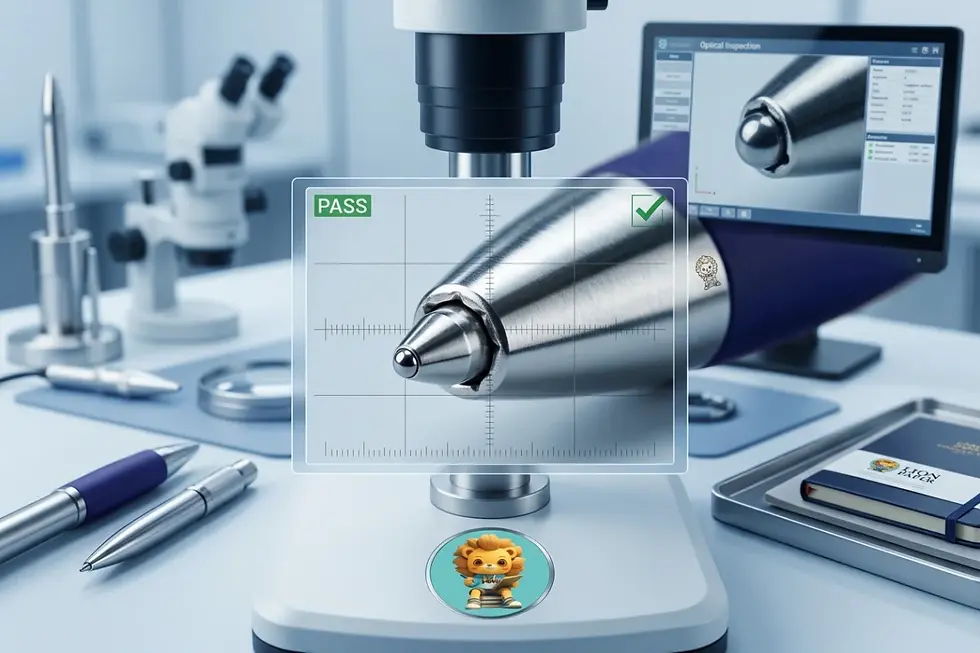
Post-impact optical inspection verifies that the pen tip crimp and rollerball remain aligned to prevent ink leaks.
Which Engineering and Material Factors Prevent Pen Breakage During Impact?
Impact resistance is determined during the early design and material selection phase. A well-designed pen balances aesthetic appeal, weight, center of gravity, and kinetic shock absorption.
Resin Selection and Modulus of Elasticity
Brittle polymers such as standard polystyrene (GPPS) or unmodified acrylics fracture easily under drop stress. In contrast, engineered resins offer superior impact resistance:
Acrylonitrile Butadiene Styrene (ABS): Provides a balanced combination of surface hardness, dimensional stability, and impact toughness, making it the industry standard for commercial pen barrels.
Polycarbonate (PC): Delivers high impact strength and transparency, suitable for clear demonstrator pens and high-stress internal click cams.
Polypropylene (PP) and Polyethylene (PE): Flexible polymers frequently used for internal ink reservoirs and refill tubes to prevent hydraulic shock ruptures.
Post-Consumer Recycled (PCR) Plastics: Requires careful compounding with impact modifiers to maintain shatter resistance without compromising tensile strength.
Wall Thickness and Structural Ribbing
Barrels with uniform wall thickness (ideally between 1.0 mm and 1.8 mm) distribute impact energy evenly. Abrupt thickness transitions create localized stress concentration zones. Internal longitudinal ribs provide structural rigidity without significantly increasing raw material mass or weight.
Refill Damping and Tip Collar Design
In retractable ballpoint and gel pens, the internal spring serves a dual function: returning the refill and acting as a shock damper during tip-first drops. Quality designs incorporate a stepped brass or stainless steel tip collar that supports the refill neck, preventing lateral shearing when dropped at a 45-degree angle.
How Does a Comprehensive Pen Quality Control Protocol Incorporate AQL Sampling?
A robust pen quality control protocol bridges laboratory testing and mass manufacturing. Quality assurance teams use international acceptance sampling systems, such as ANSI/ASQ Z1.4 and ISO 2859-1 (Single Sampling Plans, Normal Inspection Level II), to inspect incoming lots.
Quality Inspection Flow Across the Supply Chain
Incoming Raw Materials (IQC): Resin melt flow rate inspection, writing tip dimensional tolerance verification, spring compression rate testing, and ink dynamic viscosity profiling.
In-Process Assembly (IPQC): Barrel thread assembly torque monitoring, mechanism cycle endurance tests, and real-time drop sampling on unscheduled hourly batches.
Final Pre-Shipment Inspection (PSI / FQC): Statistical AQL sampling for cosmetic visual defects, physical drop durability audits, automated continuous spiral line-writing validation, and master carton transit drop verification.
During pre-shipment inspections, sample batches are selected at random from finished production lots. The drop testing sample size generally follows Special Inspection Levels (S-2 or S-3) to ensure adequate destructive testing without reducing shipment volume unnecessarily.
Inspection Stage | Test Frequency | Target AQL Acceptance Criteria |
|---|---|---|
:--- | :--- | :--- |
Incoming Tips & Refills | Per raw material batch | 0 Critical, 0.65 Major, 1.5 Minor |
In-Line Molded Barrels | Every 2 hours per cavity | 0 Critical, 1.0 Major, 2.5 Minor |
In-Process Assembly | Random 50 units per shift | 0 Mechanism Jamming / 0 Cracks |
Pre-Shipment Inspection (PSI) | ISO 2859-1 Level II / S-3 | 0 Critical, 1.5 Major, 4.0 Minor |
Packaging Drop (ISTA 1A/2A) | 1 Full Master Carton per lot | 0 Damage to inner retail packaging |
Integrating drop durability into routine quality assurance guarantees that production lots produced across different shifts or manufacturing facilities adhere to identical performance specifications.

Continuous line writing machines confirm smooth, uninterrupted ink delivery following mechanical drop evaluations.
How Does Lion Paper Ensure Writing Instrument Durability and Supply-Chain Stability?
Lion Paper Products (Jiaxing) Co., Ltd., founded in 2015, operates as an integrated supply-chain partner delivering customized paper goods and creative accessories. For stationery brands, corporate gift buyers, and multi-channel retailers, Lion Paper provides end-to-end design-to-manufacturing support that includes pens, custom notebooks, planners, organizer bags, and complete retail-ready kits.
By leveraging dual-site synergy between its 3,000-square-meter design, R&D, and prototyping facility in Jiaxing, China, and its 10,000-square-meter mass manufacturing facility in Cambodia, Lion Paper balances rapid product development with cost-efficient, large-scale production. With an annual notebook output exceeding 5 million units and comprehensive accessory integration capabilities, Lion Paper applies rigorous quality control protocols across every product tier.
All writing instruments and stationery sets undergo strict incoming component verification, AQL-based process inspections, drop testing, and continuous line-writing assessments. Lion Paper's operational framework aligns with ISO 9001, FSC, SMETA, WCA, GSV, FAMA, and CPSIA requirements, ensuring that every private-label program meets global retail, safety, and physical durability standards.
To develop reliable, retail-ready writing instruments engineered to withstand distribution and consumer use, Share target retail price, pen type, refill, performance standard and packaging; request a private-label pen specification and sample test plan.
FAQ
What is the standard drop height for commercial pen testing?
The industry standard drop height for consumer pens is 1.0 meter (approximately 39.4 inches) onto a flat hardwood or steel plate, simulating a drop from desk height. Specialized or heavy-duty pens may undergo 1.2-meter to 1.5-meter drop testing to evaluate extreme transit and handling conditions.
Why do gel pens stop writing after being dropped?
Gel pens often stop writing after a drop because impact shock can dislodge the follower silicone plug, introduce air bubbles into the capillary tube, or slightly crimp the ball socket. When air reaches the ball interface, it breaks the hydraulic vacuum necessary for continuous gel ink delivery.
How does packaging drop testing differ from individual pen drop testing?
Individual pen drop testing evaluates component-level engineering, barrel shatter resistance, and refill integrity in free fall. In contrast, packaging drop testing (such as ISTA 1A or 2A protocols) evaluates full retail boxes and corrugated master cartons to ensure shipping packaging absorbs transit vibration and pallet impacts.
What is the difference between AQL General Inspection Level II and Special Levels in pen testing?
General Inspection Level II is used for non-destructive evaluations like visual checks, barcode readability, and mechanism activation across a larger sample size. Special Inspection Levels (S-2 or S-3) are applied to destructive protocols, such as drop testing and 100-meter line write-out tests, to assess batch quality without destroying unnecessary inventory.


Comments