


Paperboard Pencil Box Wall Thickness: Engineering Specifications, GSM Guidelines, and Structural Design

The standard paperboard pencil box wall thickness ranges between 1.5 mm and 2.5 mm, corresponding to 1000 GSM to 1800 GSM greyboard wrapped in 128 GSM to 157 GSM coated art paper or specialty lining. For compact student pencil cases, 1.5 mm to 1.8 mm delivers adequate structural rigidity, whereas premium executive cases and multi-tiered retail gift boxes require 2.0 mm to 2.5 mm core board to prevent warping, support magnetic closures, and withstand shipping pressure.
What Are the Standard Wall Thickness and Greyboard GSM Specifications for Pencil Boxes?
Specifying paperboard pencil box wall thickness requires a clear understanding of the conversion between board caliper (thickness in millimeters or points) and basis weight (grams per square meter, or GSM). Unlike flexible folding cartons made from thin folding boxboard (FBB) or solid bleached sulfate (SBS), a rigid pencil box utilizes high-density chipboard or greyboard as its primary core substrate. This core is subsequently laminated on both exterior and interior surfaces with decorative and protective liners.
To engineer a durable pencil case, structural packaging engineers evaluate the relationship between greyboard caliper, density, wrapping wrap paper, and total finished wall thickness.
Greyboard Caliper (mm) | Greyboard Basis Weight (GSM) | Wrapping Paper Weight (GSM) | Finished Wall Thickness (mm) | Recommended Stationery Applications |
|---|---|---|---|---|
:--- | :--- | :--- | :--- | :--- |
1.2 mm (48 pt) | 800 – 900 GSM | 128 GSM Art Paper + 100 GSM Liner | ~1.40 mm – 1.45 mm | Lightweight promotional pencil sleeves, small utility cases, budget retail inserts |
1.5 mm (60 pt) | 1000 – 1100 GSM | 128 GSM Art Paper + 120 GSM Liner | ~1.70 mm – 1.75 mm | Standard student pencil cases, slide-drawer pen boxes, travel stationery packs |
1.8 mm (72 pt) | 1200 – 1300 GSM | 157 GSM Art Paper + 120 GSM Woodfree | ~2.00 mm – 2.05 mm | Heavy-duty school organizers, two-piece telescope boxes, artist sketch pencil boxes |
2.0 mm (80 pt) | 1400 – 1500 GSM | 157 GSM Coated Paper + 140 GSM Kraft | ~2.25 mm – 2.30 mm | Premium retail stationery sets, magnetic book-style pencil boxes, corporate gifting |
2.5 mm (100 pt) | 1700 – 1800 GSM | 157 GSM Art Paper + 157 GSM Art Paper | ~2.75 mm – 2.85 mm | Multi-tiered art sets, luxury writing instrument cases, collector-edition packaging |
3.0 mm (120 pt) | 2000 – 2200 GSM | 157 GSM Specialty Paper + Custom Liner | ~3.25 mm – 3.35 mm | Heavy display caskets, oversized multimedia drawing sets, archival heirloom cases |
When calculating pencil box greyboard GSM specifications, packaging designers must account for adhesive thickness. The wet lamination process introduces a water-based adhesive layer (such as vinyl acetate ethylene or modified starch-based glue) that adds approximately 0.05 mm to 0.10 mm to the combined structure once cured. As a result, specifying a 2.0 mm greyboard base yields an actual finished wall thickness of approximately 2.25 mm to 2.30 mm after dual-side wrapping.

Precision measurement of laminated greyboard wall thickness ensuring structural tolerance compliance.
How Does Wall Thickness Impact Rigid Paperboard Pencil Box Engineering and Structural Integrity?
Rigid paperboard pencil box engineering relies on calculating mechanical loads, edge compression resistance, bending stiffness, and corner-joint shear strength. Pencil cases present distinct structural challenges compared to standard rectangular retail gift boxes: they are long, relatively narrow, repeatedly opened and closed, and frequently subjected to dynamic drops inside student backpacks or commuter bags.
The mechanical performance of a paperboard pencil box correlates directly with core caliper across several key structural vectors:
Flexural Rigidity and Bending Resistance: Longer pencil boxes (exceeding 200 mm in length) exhibit higher deflection under top-load pressure when the wall thickness falls below 1.5 mm. Using 1.8 mm to 2.0 mm greyboard prevents mid-span flexing, which can otherwise cause the lid to bind against the base or pop open unexpectedly.
Corner Joint and V-Groove Durability: High-end rigid boxes utilize 90-degree or 120-degree V-grooving to achieve crisp, razor-sharp edges. A minimum board thickness of 1.8 mm is required for high-precision V-grooving; thinner boards (such as 1.2 mm) risk tearing at the outer paper hinge line during folding.
Impact and Drop Protection: Pens, mechanical pencils, erasers, and metal compasses exert localized internal shock when a box is dropped. A 2.0 mm wall provides sufficient shock dampening to prevent puncture from sharp metal pencil tips or compass needles.
Hygroscopic Stability and Warping Prevention: Recycled greyboard naturally absorbs and desorbs ambient moisture. Thin boards (under 1.5 mm) warp quickly if the tension between the exterior coated art paper and the interior offset liner paper is unbalanced. A thicker 2.0 mm to 2.5 mm core board provides the dimensional stability required to resist ambient humidity swings.
How Do Hinges, Closures, and Internal Dividers Dictate Custom Stationery Box Structural Design?
Stationery packaging encompasses diverse functional form factors, from book-style magnetic flap cases to three-piece telescoping boxes, sliding drawer sleeves, and multi-tier cantilever trays. Each closure and interior feature alters the baseline wall thickness requirements.
In custom stationery box structural design, the interaction between hardware components, paperboard thickness, and tolerance clearances determines mechanical reliability:
1. Magnetic Closures and Hidden Magnet Milling
Book-style flip cases frequently conceal neodymium disc magnets inside the board structure. To embed a 1.0 mm to 1.5 mm thick magnet flush with the greyboard surface, the front flap board must measure at least 1.8 mm to 2.0 mm thick. Milling into board thinner than 1.8 mm leaves a paper-thin residual core that tears or punctures under repeated magnetic snap cycles.
2. Paper Hinges vs. Fabric-Reinforced Joints
For attached-lid cases, the mechanical stress concentrates entirely along the rear hinge line. When working with 1.5 mm board, the exterior wrapping paper acts as the primary hinge, which can fatigue after 500 to 1,000 opening cycles. For heavy-use stationery cases, packaging engineers specify a 2.0 mm board with an internal woven textile or spunbond polypropylene reinforcement tape hidden beneath the liner paper.
3. Friction-Fit Tolerances on Slide Drawers and Neck Boxes
Shoulder-and-neck boxes and matchbox-style slide drawers require precise sliding friction. If a drawer outer sleeve uses 1.5 mm board, standard manufacturing variation (±0.1 mm) can cause the drawer to stick or slide out too loose. Upgrading the sleeve to 1.8 mm or 2.0 mm board guarantees structural consistency during automated folding and die-cutting.
4. Custom Internal Compartments and Fitments
The wall thickness of internal trays must balance payload weight against internal clearance. Rigid paper dividers generally utilize 1.0 mm to 1.2 mm chipboard wrapped in lightweight paper, whereas thermoformed PET trays or die-cut high-density EVA foam inserts interface best with rigid box sidewalls of 1.8 mm or thicker to maintain straight vertical wall geometry.
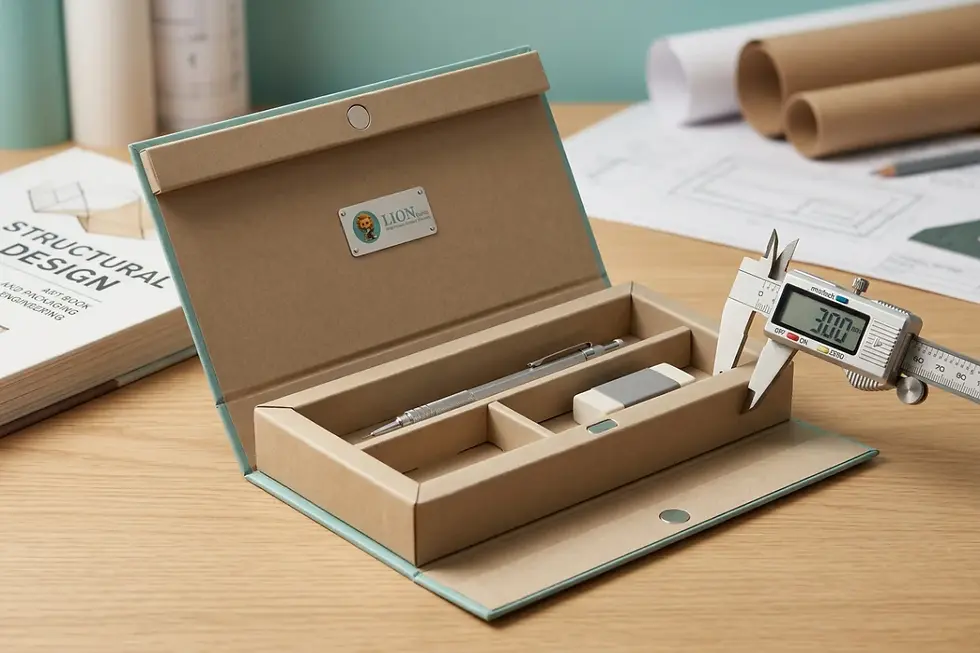
Book-style magnetic pencil box engineering demands accurate board thickness to embed magnets seamlessly.
What Are the Trade-Offs in Freight, Unit Cost, and Packaging Weight Across Board Calipers?
Balancing wall thickness against landed unit cost is a critical phase in commercial stationery product development. Choosing a heavier greyboard caliper increases rigidity and perceived brand value, but it directly affects raw material expenditure, shipping volume weight, and logistics budgets.
A thorough engineering evaluation balances structural targets against procurement economics:
Raw Material Sourcing Costs: Greyboard is commercially traded and priced per metric ton. Stepping up from 1000 GSM (1.5 mm) to 1800 GSM (2.5 mm) increases the raw paperboard substrate mass by 80%, which translates to an estimated 25% to 35% increase in total unit manufacturing cost prior to decorative embellishments.
Freight Volume and Tare Weight: Rigid pencil boxes cannot be shipped flat; they travel fully erected. A typical rigid box measuring 210 mm x 75 mm x 35 mm made from 1.5 mm board weighs approximately 110 grams, whereas the same box manufactured with 2.5 mm board weighs roughly 185 grams. For air freight shipments or direct-to-consumer (DTC) postal shipping, an additional 75 grams per unit elevates recurring postage tiers.
Pallet Density and Container Utilization: While the exterior outer dimensions of a pencil box remain relatively fixed regardless of board caliper, thicker sidewalls reduce internal usable volume. If the internal cavity must maintain a fixed capacity for 24 colored pencils, increasing the wall thickness by 1.0 mm on each side expands the external package footprint, reducing the total master carton count that fits on a standard 40-foot High Cube (40HC) container.
What Are the Essential Steps for Rigid Pencil Case Manufacturing Quality Control and Compliance?
Executing rigid pencil case manufacturing quality control requires systematic monitoring from raw material stabilization through automated assembly, final AQL inspection, and retail compliance testing. Deficiencies in board moisture or lamination pressure cause delamination, bubbling, lid warping, or corner splitting.
A robust manufacturing quality management plan incorporates standard operating procedures (SOPs) across critical control points:
Raw Board Conditioning (Moisture: 8–12%) ↳ Automated V-Grooving & Die-Cutting (Tolerance: ±0.2 mm) ↳ Gluing & Magnet Embedding (Adhesive solid content: 45–55%) ↳ Edge Wrapping & Visual Defect Inspection ↳ Curing & Palletization (AQL 1.0/2.5 Level II Standards)
1. Board Moisture Equilibrium
Raw greyboard sheets must undergo climate conditioning in the production workshop for at least 24 to 48 hours prior to die-cutting. The target moisture content must remain tightly controlled between 8% and 12%. If the board moisture exceeds 14%, enclosed packaging will develop fungal issues during ocean transit; if moisture drops below 7%, the board becomes brittle and cracks along fold lines.
2. Adhesive Application and Solid Content
Automated rigid box-making machinery must maintain adhesive viscosity and temperature within specified limits. Water-based glues with a solids content between 45% and 55% ensure rapid initial tack without over-saturating the paperboard fibers. Insufficient glue volume causes edge lifting, while excess moisture introduces surface warping.
3. V-Groove Depth and Angle Tolerances
V-grooving machines must calibrate cutter depth to leave an exact residual backing layer of 0.25 mm to 0.35 mm of board core attached to the outer liner. Cutting too deep severs the structural hinge, leading to ruptured corners; cutting too shallow creates flared, rounded edges that prevent flush lid closure.
4. International Retail Compliance and Safety Audits
Children's school pencil cases and global retail stationery products must satisfy stringent consumer safety regulations. Core greyboards and surface wrap papers must undergo third-party laboratory testing to confirm compliance with CPSIA (lead and phthalate limits), ASTM F963, and EN 71 safety benchmarks. Furthermore, modern brand supply chains demand responsible forestry verification, requiring full FSC (Forest Stewardship Council) chain-of-custody tracking from mill to finished package, alongside social compliance standards under SMETA or WCA factory audits.

Standardized manufacturing quality control protocols verify edge adhesion, moisture balance, and hinge durability.
How Does Lion Paper Support End-to-End Pencil Box Development Across Dual-Site Production?
Navigating the structural engineering, compliance verification, and cost optimization of paperboard pencil boxes requires an agile, manufacturing-integrated supply chain partner. Founded in 2015 in Jiaxing, Zhejiang, Lion Paper Products (Jiaxing) Co., Ltd. delivers comprehensive end-to-end solutions for custom paper goods, stationery organizers, and creative packaging.
Lion Paper integrates product ideation, structural design, materials development, precision sampling, and scaled manufacturing across a coordinated China–Cambodia dual-site production model:
Jiaxing Design and Prototyping Hub: Operating from a 3,000-square-meter facility in Jiaxing, China, in-house packaging engineers, structural designers, and material specialists transform creative concepts into production-ready CAD drawings, functional white samples, and rapid custom prototypes. Fast digital sampling allows brand owners and retail buyers to evaluate wall calipers, magnetic tactile feedback, and insert clearances prior to tooling investment.
Cambodia Scaled Mass Manufacturing: For high-volume retail orders and cost-sensitive international distribution, Lion Paper leverages its 10,000-square-meter manufacturing facility in Cambodia. Equipped with automated rigid box assembly lines, standardized SOPs, and unified quality checkpoints, this facility provides competitive landed costs, duty advantages, and dependable scheduling for global retail shipments.
Robust Compliance Framework: Lion Paper operates under a certified quality management system backed by ISO 9001, FSC chain-of-custody, FAMA, SMETA, WCA, GSV, and CPSIA compliance standards, ensuring every production run satisfies North American, European, and Asia-Pacific retail prerequisites.
Scenario-Fit Category Breadth: Beyond standalone pencil cases, Lion Paper develops unified product collections across eight core categories—including notebooks and journals (with an annual output exceeding 5 million units), planners, office stationery, eco-friendly paper packaging, and lifestyle organizers.
What Should Brands Include in an RFQ Checklist for Paperboard Pencil Boxes?
To expedite structural design reviews, tooling generation, and price estimation, procurement managers should compile a complete technical Request for Quotation (RFQ). Providing precise structural parameters avoids multiple prototyping iterations and ensures accurate cost modeling from the outset.
A comprehensive RFQ specification package should include the following core details:
Internal and External Dimensions: Provide exact inner cavity dimensions (Length x Width x Depth in mm) based on your product array, as well as allowable outer dimension limits for retail display or master carton packing.
Target Board Caliper and GSM: Specify the core greyboard thickness (e.g., 1.5 mm / 1000 GSM, 2.0 mm / 1400 GSM) or identify the required load capacity so structural engineers can calculate the optimal caliper.
Box Architecture and Closure Mechanics: Define the box style—such as a 2-piece base and lid, 3-piece neck box, book-style magnetic closure, slide drawer with ribbon pull, or multi-tier fold-out construction.
Cover Wrap and Interior Lining Papers: Detail the exterior paper stock (e.g., 157 GSM coated art paper, textured kraft paper, metallic paper, or soft-touch tactile paper) and interior liner specifications.
Surface Embellishments and Finishing: Indicate printing processes (CMYK offset, Pantone spot colors) and special decorative techniques (anti-scratch matte lamination, spot UV, blind embossing, hot foil stamping).
Internal Fitments and Inserts: Specify tray types, such as thermoformed recycled PET, die-cut high-density EVA foam wrapped in velvet, corrugated divider grids, or folded paperboard inserts.
Order Volume and Staged Delivery Timelines: State initial pilot run quantities, projected seasonal replenishment volumes, and target delivery destinations.
To begin your custom stationery packaging project, share your pencil-box dimensions, target board specifications, closure style, divider layout, artwork files, stationery set components, and forecasted volume with the engineering team at Lion Paper to request a professional paperboard box development review.
FAQ
What is the minimum greyboard thickness required to embed hidden magnetic closures in a pencil box?
To embed concealed neodymium disc magnets flush within the greyboard core, a minimum board thickness of 1.8 mm (approx. 1200 GSM) is required, though 2.0 mm (1400 GSM) is industry preferred. Using board below 1.8 mm leaves insufficient core backing material during router milling, which leads to surface tearing and visible bulging under magnetic tension.
How do you prevent paperboard pencil boxes from warping during maritime shipping?
Preventing box warping requires three critical engineering controls: maintaining raw greyboard moisture content between 8% and 12%, matching the basis weight and grain direction of the exterior wrap paper with the interior liner paper to balance surface tension, and utilizing water-based adhesives with a high solids content (45% to 55%) to minimize moisture introduction during automated wrapping.
Can rigid paperboard pencil boxes achieve full FSC and child-safety compliance?
Yes. Rigid pencil boxes can be produced using 100% FSC-certified recycled greyboard cores wrapped in FSC-certified art paper printed with soy-based inks. For retail safety, all materials, coatings, and adhesives undergo laboratory testing to verify compliance with CPSIA, ASTM F963, and EN 71 standards regarding total lead, heavy metals, and phthalate thresholds.


Comments