


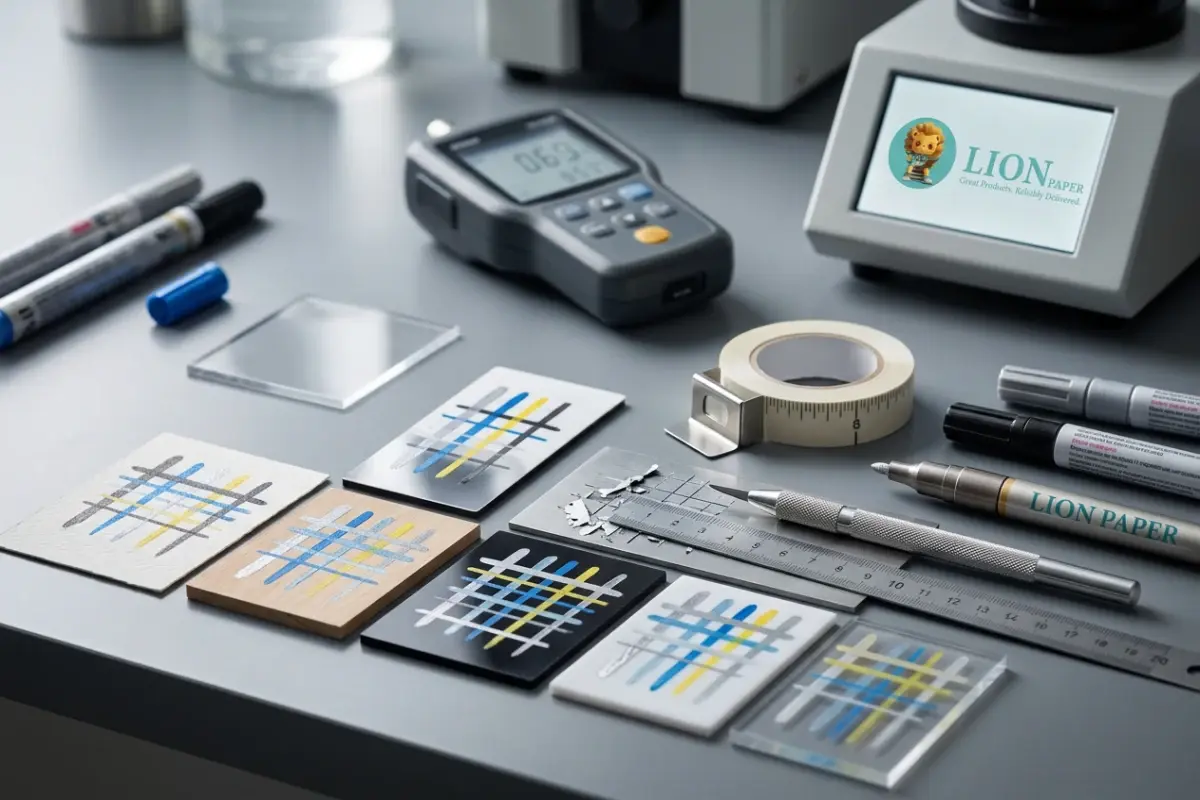
Paint Marker Adhesion Test: Protocols, Surface Compatibility, and QC Standards

A paint marker adhesion test evaluates ink bonding strength, film flexibility, and mechanical durability on target substrates using standardized cross-hatch, tape peel, and abrasion protocols. This test identifies adhesion failures, chipping, or flaking across coated paper, plastics, glass, wood, and metal before mass production, ensuring creative stationery and DIY craft kits maintain commercial performance, regulatory compliance, and long-term shelf stability.
Why Is Paint Marker Adhesion Testing Critical for Creative and Stationery Products?
Paint markers, acrylic paint pens, and multi-surface liquid markers have become cornerstone components in modern stationery collections, DIY craft sets, and retail activity kits. When a consumer uses a paint pen on a specialty journal cover, a wooden ornament, a ceramic mug, or a laminated calendar, they expect vibrant color deposition and permanent or semi-permanent film adhesion. If the dried ink film lifts, powders, flakes, or peels upon light handling, consumer satisfaction drops and product return rates escalate.
From a manufacturing and product development standpoint, adhesion is a complex interfacial phenomenon governed by surface energy, ink viscosity, binder chemistry, surface roughness, and curing dynamics. Implementing a rigorous paint marker adhesion test protocol during early product development protects brand reputation and prevents widespread commercial failure.
Key reasons why structured adhesion verification is essential include:
Preventing post-sale product failure: Eliminates customer complaints regarding premature chipping or rub-off during normal item use.
Ensuring packaging and transport integrity: Products packed in bulk or custom gift boxes often experience surface-to-surface vibration during transit; well-adhered ink resists frictional abrasion.
Verifying multi-component compatibility: When bundled inside craft kits, the supplied markers must bond reliably with every included substrate, whether coated artboard, glazed ceramics, canvas board, or acrylic plastic blanks.
Standardizing factory quality acceptance: Establishes quantitative pass/fail thresholds for incoming raw materials and finished goods within a formal paint marker quality control system.
Complying with retail distribution standards: Major North American and European retailers require physical performance verification alongside chemical safety audits to minimize return-to-vendor (RTV) penalties.
Which Standardized Test Protocols Evaluate Paint Pen Adhesion?
Standardized testing replaces subjective finger-rubbing with repeatable, instrumented procedures. Laboratory technicians and factory quality assurance teams rely on three primary methodologies to measure paint marker film bonding: cross-hatch lattice testing, pressure-sensitive tape adhesion testing, and mechanical rub/abrasion resistance.
1. Cross-Hatch Adhesion Testing (ASTM D3359 / ISO 2409)
The industry benchmark for film adhesion is cross hatch adhesion testing. This method evaluates the resistance of dried paint films to separation from substrates when a right-angle lattice pattern is cut into the film, penetrating entirely through to the surface beneath.
Tooling: Multi-blade cross-hatch cutter with standardized blade spacing (typically 1 mm spacing for coatings up to 50 μm thick, or 2 mm spacing for thicker coatings) and specialized pressure-sensitive tape conforming to ASTM D3359 standards.
Application: Paint marker ink is applied uniformly to the test plaque and allowed to achieve complete cure (typically 24 to 72 hours under standard room temperature or accelerated 60°C thermal conditions).
Execution: Two perpendicular cuts are made through the ink film to form a grid of 25 to 100 small squares. Loose debris is brushed away gently. Standardized adhesive tape is applied over the lattice, smoothed down firmly with a rubber eraser or roller, and removed rapidly at an angle close to 180 degrees (ASTM) or 60 degrees (ISO).
Rating Scale: The grid is visually inspected under 5x magnification and classified on a scale from 5B (no flaking; completely smooth cut edges) to 0B (greater than 65% lattice flaking).
2. Tape Peel Adhesion Testing (ASTM D3330 Adapted)
For thinner films or sensitive coated paper substrates where cross-hatching may tear the base material, direct tape pull-off testing is utilized.
Application: Uniform single-stroke and double-stroke swatches are drawn on target materials.
Execution: High-tack adhesive tape is applied across the swatch with consistent pressure (using a calibrated 2 kg rubber roller). After a dwell time of 60 seconds, the tape is pulled at a steady 90-degree or 180-degree angle.
Analysis: The percentage of ink transferred to the adhesive backing versus remaining on the substrate is measured gravimetrically or via digital image analysis.
3. Dry and Wet Rub Abrasion Resistance (ASTM D5264 / ISO 105-X12 Adapted)
Stationery items encounter constant frictional contact. Rub testing evaluates how dried marker films resist continuous mechanical friction.
Execution: A mechanical Crockmeter or Sutherland Rub Tester rubs a standard white cotton cloth or weighted felt pad across the ink swatch for 50 to 500 cycles.
Variables: Tests are conducted dry to measure handling wear, and wet (using distilled water, 70% isopropyl alcohol, or synthetic sweat solution) to evaluate moisture-induced film breakdown.
Test Method | Relevant Standard | Primary Purpose | Key Metric / Classification |
|---|---|---|---|
:--- | :--- | :--- | :--- |
Cross-Hatch Lattice | ASTM D3359 / ISO 2409 | Bond strength on rigid/semi-rigid surfaces | 5B to 0B (ASTM) / Class 0 to 5 (ISO) |
Direct Tape Peel | ASTM D3330 (Adapted) | Rapid peel resistance on paper/films | Area retention percentage (% intact) |
Dry Crockmeter Rub | ASTM D5264 / ISO 105-X12 | Mechanical wear & transport resistance | Number of double-rubs before substrate exposure |
Wet Solvent Rub | ASTM D5402 (Adapted) | Chemical barrier & moisture durability | Number of solvent rubs until breakdown |

Cross-hatch lattice testing measures interfacial bonding strength between ink film and target substrates.
How Does Paint Pen Surface Compatibility Vary Across Different Materials?
Achieving optimal paint pen surface compatibility requires balancing ink chemistry (water-based acrylic, alcohol-based solvent, or oil-based enamel) with the microscopic topography and chemical surface energy of the substrate. Adhesion depends on whether bonding is primarily mechanical (capillary absorption into porous structures) or chemical (intermolecular van der Waals and covalent bonding on smooth surfaces).
Porous Substrates: Uncoated Paperboard, Wood, and Canvas
Porous materials naturally facilitate mechanical interlocking as liquid carrier solvents draw the resin binder into surface pores and cellulose fibers before drying.
Uncoated Offset & Kraft Paper: Excellent natural adhesion. The primary risk is ink bleeding, feathering, or fiber swell rather than flaking.
Raw Wood & MDF Blanks: Natural grain absorbs acrylic and oil binders readily. However, high resin content or unsealed knots in natural timber can cause localized repulsion or yellowing.
Primed Cotton Canvas: Gesso-primed canvas provides a microscopic tooth that anchors water-based acrylic paint markers effectively.
Semi-Porous and Coated Substrates: Coated Artboard and Specialty Paper
High-end notebooks, planners, and retail gift boxes often feature coated art paper, soft-touch lamination, metallic foil stamping, or UV spot varnishes. These finishes alter surface properties dramatically.
Mineral-Coated Gloss/Matte Artboard: Clay coatings reduce porosity, requiring paint pens with specialized film-forming acrylic resins to prevent edge lifting.
Soft-Touch and BOPP Films: Polyolefin laminations possess low surface energy (often below 36 dynes/cm), causing water-based markers to bead up or peel away cleanly upon drying unless corona-treated or paired with alcohol/solvent formulations.
Non-Porous Substrates: Glass, Glazed Ceramics, Plastics, and Metals
Non-porous materials present the highest risk for adhesion failure because bonding relies entirely on chemical wetting and interfacial resin contact.
Glass & Glazed Ceramic: High surface energy but extremely smooth. Standard acrylic markers dry into a cohesive sheet that peels if exposed to moisture, unless formulated with silane adhesion promoters or cured via thermal baking.
Polypropylene (PP) & Polyethylene (PE): Highly non-polar plastics with low critical surface tension. Untreated PP/PE surfaces resist adhesion, requiring flame, plasma, or chemical primer pre-treatment.
Acrylic (PMMA) & Polycarbonate (PC): Moderately polar; alcohol-based and modified acrylic pens achieve strong adhesion, though aggressive solvents may cause localized micro-crazing on clear panels.
Coated Tinplate & Aluminum: Painted or anodized metal surfaces accept acrylic and oil markers well, provided surface oils and processing lubricants are degreased prior to marking.
Substrate Material | Surface Energy / Porosity Level | Recommended Marker Formulation | Key Adhesion Risk Factor |
|---|---|---|---|
:--- | :--- | :--- | :--- |
Uncoated Wood / Pulp Paper | High Porosity / High Absorbency | Water-based Acrylic / Oil-based | Fiber feathering, ink bleeding |
Laminated Paperboard (BOPP) | Non-Porous / Low Dynes (<36 dynes/cm) | Alcohol-based / Specialized Resin | Dewetting (beading), film peel-off |
Glass & Glazed Ceramics | Non-Porous / High Polar Energy | Bake-cured Acrylic / Solvent-based | Moisture delamination, scratching |
Rigid Plastics (PP / PE) | Non-Porous / Low Surface Energy | Solvent-based / Primer required | Lack of interfacial bonding |
Acrylic Sheets (PMMA) | Non-Porous / Moderate Energy | Water-based Acrylic / Alcohol-based | Solvent stress cracking (crazing) |
How Do You Interpret Adhesion Failure Modes and Define Pass/Fail Criteria?
To establish reliable quality standards, engineering and inspection teams must classify the exact mechanism of failure during testing. In a professional paint marker quality control workflow, failure modes are categorized into three distinct phenomena:
Interfacial Adhesive Failure: The ink cleanly separates from the substrate surface without leaving residue. This indicates insufficient surface preparation, mismatched surface energy, or inadequate chemical bonding.
Cohesive Failure: The ink film itself splits internally, leaving a layer of ink on the substrate while the top layer pulls away. This signals weak resin strength, over-pigmentation, improper binder-to-pigment ratio, or incomplete drying/cross-linking.
Substrate Delamination: The ink-to-substrate bond is stronger than the internal cohesive strength of the substrate, causing paper plies, top coatings, or wood veneers to tear away with the tape. This is rated as a substrate failure rather than an ink defect.

Quality control failure mode analysis establishes clear pass/fail thresholds for production batches.
Setting Commercial Pass/Fail Criteria
Pass/fail criteria must reflect the realistic retail use case, regulatory safety framework, and expected lifespan of the product. Craft kit ink adhesion standards vary by target category:
Premium Stationery & Journaling: Cross-hatch adhesion must achieve ASTM Class 4B or 5B on all cover materials, spine fabrics, and tab dividers. Dry Crockmeter rub testing must withstand 200 double-rubs with zero visible pigment transfer.
Children’s Craft Sets (CPSIA / EN71 Compliant): Focus centers on non-toxicity, water washability from skin, and non-flaking characteristics on kit components (wooden cutouts, paperboard crafts). Adhesion must achieve ASTM Class 3B or higher, ensuring dried ink does not produce loose paint flakes that present ingestion hazards.
Multi-Surface DIY Kits (Glass, Rock, Ceramic): Unbaked standard application should achieve 3B minimum; post-bake (for bakeable ceramics) must attain 5B cross-hatch retention and resist a 50-cycle dishwasher or hand-washing immersion soak without blistering.
How Should Brands Integrate Adhesion Verification into Sampling and Production SOPs?
Ensuring consistent batch-to-batch adhesion requires embedding verification into every milestone of the product lifecycle—from early material selection in China through mass packaging and assembly in Cambodia.
Phase 1: Prototyping & Formulation Matching (Design Stage)
During initial product planning, engineering teams match ink viscosities, nib porosity (acrylic fiber, polyester, or nylon), and resin binders against the specified substrates.
Substrate Dyne Testing: Measure surface tension of incoming plastics and laminated papers using certified dyne test pens to ensure levels exceed 42 dynes/cm before marker development begins.
Preliminary Compatibility Matrix: Create a grid testing 3 to 5 candidate ink chemistries across all kit components to identify potential adhesion issues before final tooling.
Phase 2: Pre-Production Validation & Environmental Conditioning
Before greenlighting volume production, pre-production samples (PPS) undergo rigorous accelerated aging to simulate shipping and storage environments.
Thermal & Humidity Cycling: Marked substrate samples are placed in environmental test chambers at 40°C and 85% relative humidity for 72 hours, followed by cross-hatch testing to ensure moisture does not degrade interfacial bonds.
Shelf Life & Nib Sealing Test: Marker barrels, valve systems, and cap seals are weighed before and after 30 days at 50°C to verify solvent retention and prevent ink dry-out.
Phase 3: Mass Production In-Line QC & AQL Sampling
During volume manufacturing, standardized SOPs and AQL (Acceptable Quality Limit) sampling protocols govern consistent output.
Batch In-Line Testing: For every batch of markers and substrate sets, QA technicians perform tape peel and dry rub tests every 2 hours on the production line.
Standardized Defect Catalogs: Visual defect libraries provide line inspectors with clear photographic references of acceptable (5B/4B) versus rejected (3B and below) cross-hatch results.
Turnkey Craft Kit Sourcing: Lion Paper's Surface Compatibility and QC Solutions
Successfully bringing multi-component stationery lines, creative journals, and DIY craft kits to market requires deep supply-chain integration. Lion Paper Products (Jiaxing) Co., Ltd. serves as an end-to-end supply chain solution provider, bridging product design, material science, and scalable manufacturing across its China and Cambodia dual-site infrastructure.

Integrated design, testing, and production SOPs ensure reliable paint marker surface compatibility across kit components.
Founded in 2015 in Jiaxing, Zhejiang, Lion Paper leverages its 3,000-square-meter Jiaxing facility for advanced design, prototyping, substrate matching, and customer support. For volume execution, Lion Paper operates a 10,000-square-meter manufacturing facility in Cambodia, delivering robust cost structures, tariff efficiencies, and an annual production capacity exceeding 5 million notebooks and integrated kits.
Lion Paper provides holistic quality management and manufacturing advantages across eight core product categories, spanning Eco Paper Products, Notebooks & Journals, Planners & Calendars, Stationery & Office, Bags & Organizers, Accessories, Gift & Packaging, and Home & Living. Our integrated engineering approach supports brand owners, DTC sellers, and global retailers through:
Design-to-Manufacturing Integration: In-house teams align custom marker nibs, valve mechanisms, and ink formulations with custom-engineered paperboards, fabric wraps, wooden accessories, and plastics.
Rigorous Quality Assurance Systems: Standardized SOP inspection cards, ISO 9001 quality frameworks, AQL sampling, and environmental testing protect product consistency across global distribution channels.
Certified Global Compliance: Products and facilities adhere to international auditing standards including FSC, SMETA, WCA, GSV, FAMA, and CPSIA consumer safety requirements.
Sustainable Material Innovation: Implementation of FSC-certified traceable papers, recycled substrates, low-impact non-toxic inks, and recyclable packaging architectures.
Whether developing a children's multi-surface coloring set, an artist-grade metallic marker journal, or a complex corporate gift kit, Lion Paper manages the entire journey from the first sketch to the first shipment.
Frequently Asked Questions
How long should paint marker ink dry before conducting an adhesion test?
Full curing time depends heavily on ink chemistry and ambient conditions. While water-based acrylic paint markers feel dry to the touch within 10 to 30 minutes, complete resin cross-linking and moisture evaporation require a full 24 to 72 hours at standard room temperature (20°C to 25°C, 50% RH). For rapid factory testing, accelerated curing can be achieved by conditioning test plaques in a convection oven at 50°C to 60°C for 30 minutes, followed by a 15-minute cooling period before tape or cross-hatch application.
What is the difference between an ASTM Class 5B and Class 0B cross-hatch rating?
Under the ASTM D3359 standard, Class 5B represents optimal adhesion where the cut edges are completely smooth and zero squares of the lattice grid show flaking or detachment after tape removal. Conversely, Class 0B represents total adhesion failure, defined as flaking and peeling along cut intersections and across squares that exceeds 65% of the total lattice area. Commercial stationery and retail craft kits typically require a minimum rating of Class 4B (less than 5% flaking) or Class 5B.
Why does acrylic paint marker ink flake off smooth plastic and glass surfaces?
Smooth plastics (such as untreated polypropylene) and glass have non-porous surfaces that prevent mechanical interlocking. If the liquid ink has a higher surface tension than the substrate's surface energy, it cannot wet the surface properly, leading to poor molecular contact. When dried, the acrylic resin forms a continuous polymer film that adheres to itself (high cohesion) but fails to bond chemically to the substrate (low adhesion). Adding silane coupling agents, using solvent/alcohol carrier systems, or pre-treating plastics with corona discharge resolves this flaking defect.
FAQ
How long should paint marker ink dry before conducting an adhesion test?
Full curing time depends on ink chemistry and ambient conditions. While water-based acrylic markers feel dry to the touch within 10 to 30 minutes, complete resin cross-linking requires 24 to 72 hours at standard room temperature. For rapid production testing, accelerated drying in an oven at 50°C to 60°C for 30 minutes followed by cooling provides accurate results.
What is the difference between an ASTM Class 5B and Class 0B cross-hatch rating?
Under ASTM D3359, Class 5B denotes perfect adhesion with completely smooth cut edges and 0% grid flaking after tape removal. Class 0B indicates severe adhesion failure with more than 65% of the lattice area flaking away. Retail craft sets and stationery kits generally require a Class 4B or 5B rating.
Why does acrylic paint marker ink flake off smooth plastic and glass surfaces?
Smooth plastics and glass lack porosity for mechanical bonding. If the ink's surface tension exceeds the substrate's surface energy, the dried resin forms a cohesive sheet that fails to bond to the substrate. Adding specialized resin promoters, choosing alcohol-based formulations, or pre-treating plastics resolves this flaking defect.


Comments