


Comprehensive Guide to Packaging Testing: Standards, Checklists, and Approval Workflows

Packaging testing evaluates structural durability, material safety, print precision, and transit performance against standardized protocols before mass production. It verifies that gift boxes, folding cartons, and retail paper packaging withstand physical drops, compression, temperature fluctuations, and supply chain handling while meeting global chemical safety and retail merchandising requirements without compromising aesthetic presentation.
What Are the Core Objectives of Pre-Production Packaging Testing?
Pre-production packaging testing establishes baseline performance parameters before committing raw materials to high-volume manufacturing. For brands, retailers, and custom stationery developers, testing acts as a preventative quality gate that mitigates transit damage, visual degradation, and regulatory non-compliance.
Rigorous packaging testing addresses four primary risk factors across modern supply chains:
Physical Protection: Ensuring structural integrity against dynamic shock, stacking loads, vibration, and puncturing during ocean freight, parcel distribution, and store handling.
Material Integrity and Safety: Verifying board density, folding endurance, adhesive bonds, non-toxic coatings, and heavy metal restrictions under CPSIA, REACH, and California Proposition 65.
Visual and Finish Stability: Testing scuff resistance, foil stamping adhesion, laminate bonding, and UV fade resistance under simulated retail display conditions.
Channel-Specific Compatibility: Optimizing structural profiles for brick-and-mortar shelf footprints, automated fulfillment sortation lines, and direct-to-consumer drop-shipping environments.
Integrating these verifications into a comprehensive gift packaging pre-production checklist prevents costly product recalls, customer returns, and packaging redesign delays.
Assessment Category | Primary Target Metric | Typical Failure Mode | Corrective Production Action |
|---|---|---|---|
:--- | :--- | :--- | :--- |
Structural Rigidity | Edge Crush Test (ECT) & Box Compression (BCT) | Box wall buckling, corner collapse | Increase paperboard grammage or modify flute structure |
Hinge & Closure Durability | Repeated flex cycles (50–100 openings) | Paper tearing, hinge splitting, magnetic detachment | Reinforce hinge cloth, adjust glue open time and density |
Surface Rub Resistance | Sutherland Ink Rub Test (50–200 cycles) | Ink transfer, coating marring, smudged foil | Apply anti-scratch matte lamination or protective aqueous coat |
Adhesive Strength | Fiber-tear adhesion under shear stress | Delamination of wrapped board or gift lining | Re-evaluate EVA/hot-melt glue formula and curing window |

Transit simulation testing validates packaging durability against dynamic drops, vibration, and stacking stress.
Which Packaging Transit Testing Standards Apply to Retail and E-Commerce Distribution?
Distribution channels present distinct physical hazards. Physical shock from automated sorting facilities, prolonged warehouse stacking, and cargo hold vibration require validated packaging transit testing standards to guarantee arrival integrity.
Standardized transit protocols are primarily governed by the International Safe Transit Association (ISTA) and ASTM International (ASTM D4169). Selecting the appropriate testing sequence depends on the intended shipping method, package geometry, and total shipment mass.
1. ISTA 1A and 1B: Baseline Integrity Testing
ISTA 1-series protocols assess basic durability for individual packaged products weighing up to 150 lb (68 kg) for 1A and over 150 lb for 1B. These tests provide non-simulation screening through:
Rotary or Random Vibration: Operating at predetermined frequencies (typically 1 inch double amplitude) to detect loosening components, surface rubbing, and structural loosening.
Free-Fall Drop Sequence: Exposing the package to 10 drops across specified faces, edges, and corners from heights calculated based on gross package weight.
2. ISTA 2A and 2B: Partial Simulation Testing
ISTA 2-series testing combines baseline elements with atmospheric conditioning. Packaged products undergo controlled temperature and relative humidity pre-conditioning (e.g., tropical 38°C at 85% RH or desert heat) prior to dynamic compression and vibration assessments, identifying adhesive crystallization or cardboard softening.
3. ISTA 3A: General Simulation for Parcel Delivery System Shipments
ISTA 3A represents the standard for single-parcel e-commerce distribution (such as FedEx, UPS, or Amazon fulfillment networks). The protocol simulates real-world distribution hazards through:
Atmospheric Pre-Conditioning: 12 to 24 hours under extreme thermal and humidity environments.
Top-Load Random Vibration: Testing with and without dead-weight top loads to simulate multi-parcel transit stacking.
Multi-Angle Drop Sequences: Drops conducted across specific fragile points, including flat drops, bottom edges, and top corners, at varying heights ranging from 12 to 18 inches.
Standard ISTA 3A Drop Sequence Structure:
Minimum Height Drop on Base Face
Corner Drop on the Weakest Critical Junction
Edge Drops across the 3 Most Vulnerable Perimeter Edges
Face Drops on Flat Top, Side, and End Panels
Adhering to recognized transit standards allows manufacturers to balance protective internal cushioning (such as molded pulp trays or precision EVA foam inserts) with material weight, supporting both cost efficiency and environmental sustainability.
How Do Manufacturers Conduct Material Verification and Chemical Compliance Checks?
Retail packaging quality control requires detailed verification of both physical substrate properties and chemical safety compliance before cutting and printing begin.
Physical Substrate Verification
Paper, rigid greyboard, specialty wrapping sheets, and lining textiles must meet rigorous dimensional and mechanical specifications:
Grammage and Caliper: Calibrated micrometer checks verify paperboard basis weight (GSM) and caliper thickness against approved tech packs.
Moisture Content Measurement: Substrate moisture is measured via electronic moisture meters. Baseline moisture must remain between 6% and 9% to prevent post-production board warping, curling, or mildew formation during ocean transit.
Bursting Strength (Mullen Test): Measures the hydrostatic pressure required to rupture corrugated cardboard or rigid outer paper wraps.
Tensile and Tear Resistance: Elmendorf tear testing ensures ribbons, handles, pull-tabs, and folding flap joints resist operational pull forces without fiber separation.
Chemical and Environmental Compliance Protocols
Paper products, stationery sets, and branded gift boxes entering international markets must comply with specific regional safety and chemical restrictions:
FSC® Chain-of-Custody Certification: Traceability verification ensuring wood fibers originate from responsibly managed forests (FSC-C100%, FSC-Mix, or FSC-Recycled).
Heavy Metal Screening (CPSIA & Toxics in Packaging Clearinghouse): Inductively Coupled Plasma (ICP) testing verifies combined lead, cadmium, mercury, and hexavalent chromium concentrations remain below 100 ppm across inks, adhesives, and boards.
Phthalate and Plasticizer Analysis: Ensuring plastic windows, synthetic leatherette wraps, and laminations meet global safety limits (under 0.1% / 1000 ppm).
Migration and VOC Testing: Verifying printed coatings do not release volatile organic compounds or transfer off-odors onto sensitive packaged stationery or lifestyle products.

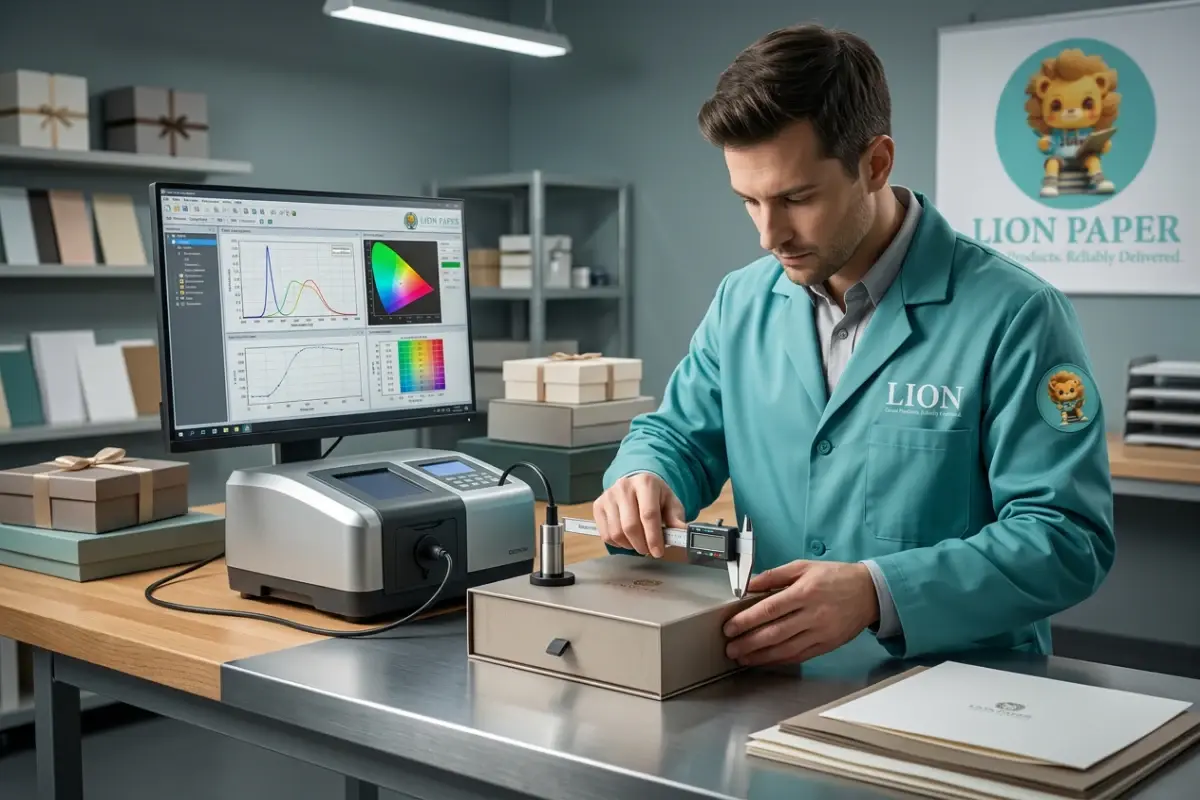
Calibrated light booths and spectrophotometers maintain color consistency across packaging runs.
How Are Print Fidelity, Color Accuracy, and Surface Finishes Inspected?
Aesthetic execution is paramount for premium packaging, stationery, and gift collections. Color mismatches or coating defects diminish brand value and shelf impact.
Visual quality verification relies on standardized optical metrics, environmental lighting booths, and mechanical adhesion assays:
1. Spectrophotometric Color Control
Color consistency is controlled using digital spectrophotometers measuring CIELAB coordinates ($L^*a^b^$). Standard production runs enforce a color tolerance threshold of $\Delta E < 2.0$ against customer-approved physical drawdowns or Pantone Master Digital Standards. This tight tolerance maintains visual continuity across separate production runs and paired accessories.
2. Standardized Lighting Inspection
Visual assessments occur within controlled light booths equipped with calibrated color rendering illumination:
D65 (Daylight): Primary retail and daylight baseline evaluation.
Store Light (CWF or TL84): Simulating North American and European department store and supermarket fluorescent illumination to eliminate metamerism (color shifting under different light sources).
Incandescent (Illuminant A): Simulating residential consumer opening environments.
3. Surface Finishing and Coating Adhesion Testing
Specialty embellishments—including hot foil stamping, spot UV varnish, soft-touch coatings, and metallic ink prints—undergo standardized mechanical adhesion checks:
Cross-Hatch Tape Adhesion (ASTM D3359 / ISO 2409): A precision grid pattern is cut through the finish, followed by pressure-sensitive tape application and rapid 180° removal. Class 4B/5B (minimal to zero flaking) is required for sign-off.
Sutherland Rub and Crockmeter Testing: Gauges the resistance of printed inks and varnishes against abrasive dry and wet rubbing forces.
Scratch and Gouge Resistance: Verifying anti-scratch films resist fingernail and abrasive contact during assembly line handling and packaging packing operations.
What Environmental Stress and Climate Conditioning Tests Protect Long-Term Shelf Life?
Paperboard and organic adhesives are naturally hygroscopic, making them susceptible to environmental changes. A package that maintains its integrity in a dry production facility may warp, peel, or collapse when exposed to high-humidity shipping containers or cold-chain warehousing.
Environmental testing protocols evaluate packaging behavior under simulated transit and retail shelf conditions:
High-Humidity Conditioning (Tropical Storage): Exposing assembled gift boxes to 40°C ± 2°C at 90% ± 5% Relative Humidity for 48 to 96 hours. This tests adhesive integrity, board warping resistance, and checks for mold spore germination.
Low-Temperature Freeze-Thaw Resistance: Subjecting packaging to -20°C for 24 hours, followed by rapid thawing at room temperature. This protocol uncovers glue embrittlement, cracked foil finishes, and PVC window delamination.
Thermal Shock Cycling: Alternating test specimens between extreme thermal environments (-10°C to +50°C) across rapid 4-hour intervals to assess differential expansion rates between wrapped paper and rigid backing boards.
UV Exposure and Light Fastness (Xenon Arc Testing): Evaluating color fading on outer wrappers, printed spine elements, and luxury gift boxes exposed to continuous simulated solar radiation under ASTM G155 standards.

Standardized inline inspection protocols and AQL sampling maintain batch-to-batch quality across high-volume production.
What Does a Standardized Gift Box Approval Workflow and Dual-Site QA Process Look Like?
A structured gift box approval workflow provides accountability at each milestone from initial concept rendering through final mass distribution. Implementing a dual-site operational framework—leveraging specialized prototyping facilities alongside high-capacity production lines—shortens turnaround cycles while maintaining consistent quality.
Standardized Packaging Approval Stage Gate:
3D Digital Proofing & Structural Dieline Approval
White-Body Structural Prototyping (Fit & Board Caliper Validation)
Fully Printed Pilot Sample (Color, Embellishment & Material Sign-off)
Pre-Production Performance Testing (ISTA Transit & Chemical Screen)
Mass Production In-Line QA via AQL Sampling (AQL 0.65 / 1.5 / 4.0)
Final Carton Loading, Palletization, and Outbound Inspection
Dual-Site Engineering Coordination
Lion Paper Products operates an integrated manufacturing network combining a 3,000-square-meter design, prototyping, and customer support center in Jiaxing, China, with a 10,000-square-meter mass manufacturing facility in Cambodia. This structure ensures:
Fast Structural Prototyping: China-based structural engineers generate precision white-body samples and digital proofs within 24–48 hours, conducting initial board caliper, drop, and fit verifications.
Standardized Mass Manufacturing SOPs: Cambodia production lines replicate the exact tooling, die-cut blades, and adhesive parameters validated during pre-production sign-off, delivering annual volumes exceeding 5 million units with consistent dimensional tolerances.
Comprehensive Audit Compliance: Dual-site operations run under unified ISO 9001 quality management systems, holding comprehensive audit and certification compliance across FSC, SMETA, WCA, GSV, FAMA, and CPSIA requirements.
Comprehensive Pre-Production Inspection Matrix
Phase | Quality Checkpoint | Assessment Method | Acceptance Threshold |
|---|---|---|---|
:--- | :--- | :--- | :--- |
Design Sign-off | Dieline & Fit Check | Dimensional dry run with product contents | ±0.5 mm tolerance on internal cavity |
Material Inbound | Board Moisture & Caliper | Micrometer gauge & digital moisture probe | Moisture 6%–9%; Caliper ±3% of spec |
Printing Phase | Spectrophotometric Color | CIELAB $\Delta E$ measurement | $\Delta E \le 2.0$ against approved target |
Finishing | Foil & Varnish Adhesion | Cross-hatch tape peel test (ASTM D3359) | Class 4B or 5B (no coating pickup) |
Assembly | Glue Bond & Hinge Integrity | 90° manual pull and 50-cycle hinge flex | 100% fiber tear; zero delamination |
Pre-Shipment | Outbound AQL Inspection | Visual defect catalog & drop verification | Critical: 0, Major: AQL 1.0, Minor: AQL 2.5 |
Standardizing your gift packaging pre-production checklist and verifying every structural, visual, and environmental parameter ensures retail-ready performance across every market.
Ready to elevate your product line with certified, high-performance packaging? Contact Lion Paper for custom packaging engineering and manufacturing solutions.
FAQ
What is the standard turnaround time for pre-production packaging testing?
Standard pre-production physical and structural testing typically takes 3 to 7 business days once physical prototypes are ready. Specialized third-party chemical compliance testing (such as CPSIA or REACH screening) or extended environmental climate chamber cycling requires approximately 7 to 14 business days depending on specific laboratory protocols.
How does packaging testing differ between e-commerce and retail shelf distribution?
Retail shelf packaging prioritizes visual impact, color fidelity, scratch resistance, and display footprint optimization under retail store lighting. E-commerce packaging prioritizes transit shock absorption, dimensional weight minimization, parcel drop resistance (under ISTA 3A protocols), and secure sealing to prevent internal product shifting during individual courier distribution.
Which AQL standard is typically used for luxury gift box inspections?
High-end gift packaging and stationery collections generally follow ISO 2859-1 (AQL) Level II Normal Sampling. The industry-standard acceptance thresholds are Critical Defect: 0 (non-acceptable), Major Defect: AQL 1.0 to 1.5 (visual flaws affecting salability), and Minor Defect: AQL 2.5 to 4.0 (minor cosmetic irregularities that do not impact function).


Comments