


How to Prevent Outdoor Sticker Edge Lift: Engineering, Material, and Sourcing Guide

Outdoor sticker edge lift is primarily caused by low-surface-energy substrate mismatch, inadequate initial tack, plasticizer migration and thermal shrinkage in calendered vinyl, or micro-stresses introduced by dull die-cutting tooling. Resolving edge lift requires selecting UV-stabilized polymeric or cast vinyl, high-tack permanent solvent-acrylic adhesives, balanced overlamination, and maintaining precision die-cut blade bevels to eliminate mechanical lip curl during converting.
What Are the Root Causes of Outdoor Sticker Edge Lift and Vinyl Failure?
Outdoor sticker edge lift—often leading to progressive waterproof sticker peeling—occurs when the mechanical lifting forces at the sticker boundary exceed the interfacial bond strength between the pressure-sensitive adhesive (PSA) and the application surface. In outdoor environments, this failure mode rarely stems from a single factor; rather, it is an intersection of adhesive rheology, polymer film physics, mechanical converting stresses, and environmental dynamics.
When evaluating outdoor vinyl adhesive failure, engineers categorize root causes into four primary failure mechanisms:
Substrate Surface Energy Mismatch: Standard permanent adhesives rely on intimate microscopic wet-out. On high-surface-energy (HSE) substrates like bare aluminum, stainless steel, or glass (>40 dynes/cm), adhesives flow easily. On low-surface-energy (LSE) plastics such as polyethylene (HDPE), polypropylene (PP), powder-coated metals, or textured plastics (<35 dynes/cm), standard emulsion acrylic adhesives fail to wet the surface, leading to localized bond failure at perimeter stress points.
Thermal Contraction and Plasticizer Migration: Monomeric PVC films contain volatile liquid plasticizers. Exposure to outdoor UV radiation and thermal cycling (-20°C to 70°C) causes plasticizer volatilization and film shrinkage. As the vinyl contracts inward, tensile shear stress concentrates directly on the perimeter edge, pulling the adhesive away from the substrate.
Moisture Ingress and Capillary Action: Water accumulation at cut edges penetrates the adhesive layer if the polymer lacks hydrolytic stability. Water-based emulsion adhesives re-emulsify when exposed to sustained moisture, rain, or dew cycles, completely neutralizing mechanical tack at the perimeter.
Die-Cutting Lip Curl (Mechanical Stresses): During flatbed or rotary die-cutting, dull cutting dies or incorrect bevel angles compress and displace the face film downward and inward against the liner, forming a microscopic rim or upward edge curl. This built-in mechanical memory acts as a lever, prying the perimeter edge upward once applied.
Failure Mechanism | Root Physical Cause | Visible Symptom | Vulnerable Material Combinations |
|---|---|---|---|
:--- | :--- | :--- | :--- |
Adhesive Wet-Out Failure | Low surface energy of substrate (<36 dynes/cm) | Sticker peels cleanly with no adhesive residue on surface | General-purpose emulsion acrylic on textured PP/PE |
Dimensional Shrinkage | Plasticizer migration & thermal UV degradation | Perimeter border retracts, leaving a sticky adhesive halo | Monomeric calendered vinyl on painted outdoor metal |
Hydrolytic Breakdown | Water emulsion swelling & moisture capillarity | Milky discoloration along edges followed by curl | Water-borne acrylics exposed to outdoor rain/snow |
Mechanical Memory Lift | Dull die blade bevel inducing upward edge deformation | Immediate edge lift along sharp corners within 24–48 hours | Thick laminate (>4 mil) cut with worn rotary dies |

Edge profile analysis highlights the difference between plasticizer-induced edge lift and a flush, balanced laminate bond.
How Do Material Selection and Adhesive Chemistry Prevent Waterproof Sticker Peeling?
Eliminating edge lift starts with matching the chemical properties of the facestock, laminate, and adhesive matrix to the specific environmental operating envelope.
1. Facestock Selection: Monomeric vs. Polymeric vs. Cast Vinyl
Vinyl films differ substantially in their dimensional stability and exterior durability:
Monomeric Calendered Vinyl (3–4 mil): Short-chain plasticizers. Expected outdoor lifespan: 6 to 12 months. Prone to severe shrinkage (up to 2% to 3% dimensional retraction), making it unsuitable for long-term outdoor equipment, automotive, or marine labeling.
Polymeric Calendered Vinyl (2.5–3.5 mil): Long-chain polymeric plasticizers. Expected lifespan: 3 to 5 years. Exhibits minimal shrinkage (<0.5%) and offers strong resistance to thermal contraction, making it the industry standard for retail merchandise, outdoor sports gear, and fleet decals.
Cast Vinyl (2.0 mil): Formulated from liquid resin without mechanical rolling stress. Zero dimensional shrinkage, highly conformable over compound curves and rivets, with outdoor lifespans ranging from 7 to 10 years.
Polyester (PET) and BOPP Films (1.5–2.0 mil): Dimensionally rigid with excellent chemical and thermal resistance. However, their high tensile modulus makes them unforgiving on curved surfaces; applying rigid PET to tight radii will instantly cause spring-back edge lift.
2. Adhesive Chemistry: Emulsion vs. Solvent Acrylic
Pressure-sensitive adhesives must provide sufficient viscoelastic flow during application followed by permanent cohesion:
Emulsion (Water-Based) Acrylic: Environmentally friendly and cost-effective, but vulnerable to moisture ingress, freezing temperatures, and high humidity. Subject to saponification and edge lifting when submerged or exposed to outdoor precipitation.
Solvent-Based Acrylic: Cross-linked polymer chains dissolved in organic solvents. Once cured, solvent acrylics provide high chemical resistance, zero water sensitivity, exceptional shear strength, and wide operating temperature ranges (-40°C to 120°C). Solvent acrylic is mandatory for durable outdoor applications.
Modified High-Tack LSE Adhesives: Formulated with tackifying resins to drop contact angles on difficult surfaces (e.g., roto-molded coolers, powder-coated frames, textured toolboxes). These adhesives achieve coat weights of 28–40 gsm (compared to standard 18–22 gsm) to bridge surface topography.
3. Lamination Tension and Thickness Balance
Overlaminates protect print graphics from UV fading and mechanical abrasion, but unbalanced laminates are a primary contributor to edge curl. If a 3 mil PVC laminate is applied over a 2 mil film under excessive web tension, the laminate acts as a stretched rubber band. Once die-cut, the laminate contracts faster than the base film, curling the edges upward. Overlaminate thickness must never exceed the base film thickness unless high-shear, high-coat-weight adhesives are utilized.
Material Spec | Outdoor Durability | Shrinkage Rate | Adhesive Compatibility | Optimal Application |
|---|---|---|---|---|
:--- | :--- | :--- | :--- | :--- |
Monomeric Vinyl + Emulsion Adhesive | 6–12 Months | High (1.5%–3.0%) | Standard surfaces (>42 dynes) | Short-term promotional giveaways, event stickers |
Polymeric Vinyl + Solvent Acrylic | 3–5 Years | Low (<0.4%) | HSE & medium LSE plastics | Brand retail stickers, automotive window decals |
Cast Vinyl + High-Cohesion Solvent | 7–10 Years | Negligible (0.0%) | Compound curves, rivets, metals | Fleet graphics, extreme environment machinery |
Top-Coated PET + High-Tack Acrylic | 2–5 Years | Negligible (0.0%) | Flat HSE metals & flat plastics | Industrial rating plates, appliance asset tags |
How Does Precision Die-Cutting Cause or Prevent Sticker Die Cut Edge Curl?
Converting and tool engineering play a decisive role in edge stability. A material specification can be chemically flawless, yet fail in the field due to mechanical flaws introduced during the die-cutting process.
When a die blade impacts the facestock, it exerts downward compressive force before shearing through the film, adhesive, and silicone release layer. This interaction creates distinct mechanical dynamics:
Blade Bevel Geometry: Standard die-cutting uses center-bevel blades (54° to 60° included angle). For thick laminated outdoor vinyl (5–8 mil total construction), a wide bevel wedge-pushes the cut edge downward, deforming the polymer matrix. Specifying narrow, single-bevel or asymmetrical 42° blades reduces displacement stress and leaves a perpendicular, stress-free cut edge.
Blade Dullness and Micro-Burrs: As cutting dies wear against abrasive glassine or PET liners, the blade tip rounds over. Instead of cleanly severing the film, a dull blade stretches the facestock until it fractures under tensile failure. This plastic deformation creates an upward-curled microscopic lip around the entire sticker perimeter. This defect—known as sticker die cut edge curl—prevents the adhesive at the very perimeter from making initial contact with the substrate, allowing dust and moisture to enter immediately.
Corner Radius Engineering: Sharp 90-degree outer corners focus peel stress onto an infinitely small apex. Outdoor decals should always incorporate a minimum corner radius of 1.5 mm to 3.0 mm (1/16" to 1/8"). Rounded corners distribute mechanical wind resistance, cleaning friction, and thermal contraction stress evenly across the perimeter.
Liner Release Force Optimization: If the silicone release liner has an excessively tight release profile (>30 g/inch), manual peel force stretches the vinyl during peeling prior to application. This pre-application stretch induces elastic recovery stress, causing the applied sticker edges to lift over the subsequent 72 hours.
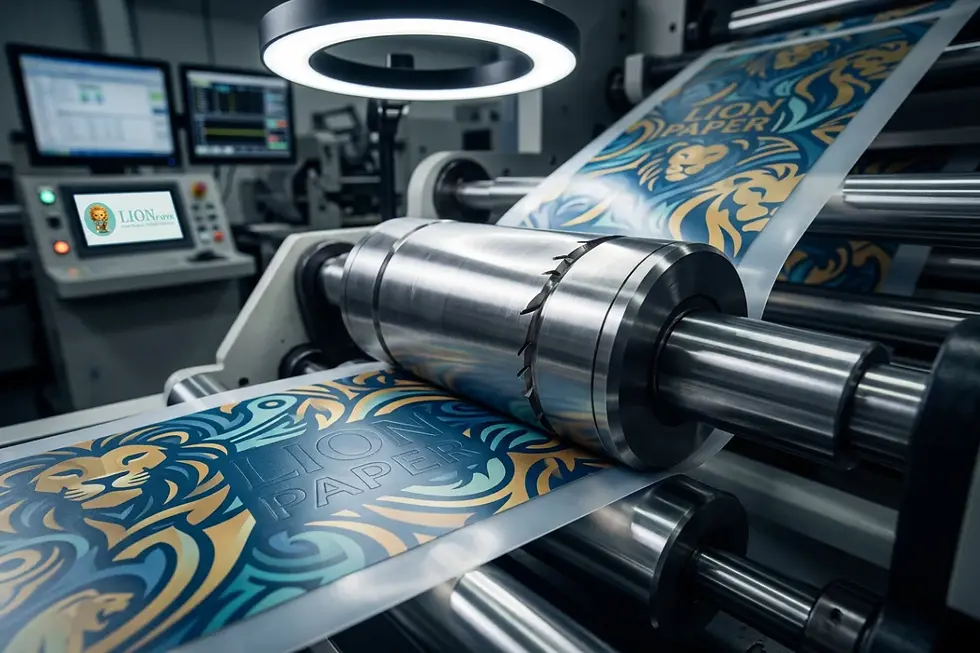
Precision rotary die tooling eliminates blade-induced micro-curls, preventing mechanical sticker edge lift.
What Are the Commercial Trade-offs in Weatherproof Sticker Sourcing and Manufacturing?
Balancing durability targets against landed unit costs and minimum order quantities (MOQs) requires structuring production methods according to the product lifecycle and distribution channel.
Short-Run Prototyping vs. Volume Production: Digital roll-to-roll printing with digital drag-knife or laser cutting allows multi-SKU flexibility with zero tooling costs. However, digital blade cutting drags across the laminate, occasionally creating slight edge puckering on soft PVC. For commercial-scale orders exceeding 10,000 units, moving to full rotary tooling with matched hardened steel dies yields superior edge quality, lower unit costs, and tighter dimensional tolerances.
Unit Cost vs. Material Tiering: Transitioning from a monomeric promotional film to a high-grade polymeric vinyl with solvent adhesive increases raw material costs by approximately 30% to 50%. However, this specification upgrade reduces outdoor warranty claim rates, return rates, and retail quality disputes by up to 95%.
Dual-Site Manufacturing Strategy: Sourcing programs benefit from flexible dual-node supply chains. Prototyping, rapid material matching, small-batch market testing, and accelerated QC validation are efficiently handled in specialized agile R&D facilities, while large-volume production runs are directed to scaled manufacturing hubs with automated high-speed finishing lines to capture scale efficiencies and total-cost optimization.
Sourcing Tier | Target Application | Construction Specification | Cost Index | Primary Risk if Under-Engineered |
|---|---|---|---|---|
:--- | :--- | :--- | :--- | :--- |
Tier 1: Promotional | Short-term handouts, box seals | 3.0 mil Monomeric PVC / Emulsion Acrylic / Paper Liner | 1.0x (Base) | Rapid edge curl, adhesive transfer, UV fading |
Tier 2: Retail Merchandise | Brand merch, laptop/water bottle decals | 3.2 mil Polymeric Vinyl / Solvent Acrylic / Gloss UV Laminate | 1.4x–1.6x | Edge lifting in dishwasher, adhesive yellowing |
Tier 3: Industrial / Outdoor | Powersports, marine, heavy equipment | 2.0 mil Cast Vinyl / High-Tack Solvent / 2.0 mil Cast Overlaminate | 2.2x–3.0x | Catastrophic debonding from vibration & solvents |
What Weatherproof Sticker QC Standards and Lab Testing Protocols Ensure Zero Edge Lift?
To ensure consistent manufacturing quality across production batches, suppliers and brand owners must align on standardized test methods established by international testing bodies (FINAT, ASTM, and PSTC). Adherence to weatherproof sticker QC standards guarantees material performance prior to mass distribution.
Essential Lab Test Methods for Outdoor Decals
180° & 90° Peel Adhesion (FINAT FTM 1 / ASTM D3330): Measures the force required to remove the sticker from standard stainless steel and representative low-surface-energy panels (HDPE) after a 20-minute dwell and a 24-hour dwell. Standard outdoor specs require ≥ 18 N/25mm on stainless steel and ≥ 10 N/25mm on HDPE.
Static & Dynamic Shear Resistance (FINAT FTM 8 / ASTM D3654): Evaluates adhesive cohesive strength and resistance to creep under sustained mechanical load at elevated temperatures (70°C). Zero displacement after 168 hours of static 1 kg shear loading indicates proper adhesive cross-linking.
Initial Loop Tack (FINAT FTM 9): Measures instant wet-out capability without lamination pressure. Minimum threshold for outdoor grade: ≥ 12 N/25mm.
Accelerated Weathering (ASTM G154 / QUV Testing): Exposes finished die-cut samples to alternating cycles of fluorescent UVA/UVB radiation and moisture condensation at 60°C for 500 to 1,000 continuous hours. The pass criteria require zero visible edge lifting, no delamination between laminate and face film, and delta E color shift < 3.0.
Thermal Shock & Dimensional Stability (FINAT FTM 14): Finished die-cut samples applied to aluminum plates are baked at 70°C for 48 hours, followed by -20°C for 24 hours. Dimensional shrinkage along any edge must not exceed 0.2 mm, with zero perimeter curling.
Test Name | Standard Method | Minimum Pass Threshold (Outdoor Spec) | Defect Prevented |
|---|---|---|---|
:--- | :--- | :--- | :--- |
Peel Adhesion (24h Dwell) | FTM 1 / ASTM D3330 | ≥ 16–22 N/25mm (Stainless Steel) | Adhesive failure, peeling under mechanical touch |
Loop Tack | FTM 9 | ≥ 12–15 N/25mm | Poor initial bonding during field application |
Shear Resistance | FTM 8 / ASTM D3654 | > 168 hours (1kg load @ 70°C) | Adhesive bleed, lateral slide, plasticizer creep |
QUV Weathering | ASTM G154 Cycle 1 | 500 Hours (Zero delamination/curling) | Waterproof sticker peeling, laminate clouding |
Dimensional Shrinkage | FTM 14 | < 0.2% max dimensional retraction | Peripheral adhesive halos, corner edge lifting |

Standardized environmental chamber tests verify dimensional stability and hydrolytic resistance before shipment.
How Should Brands Structure a Production RFQ to Guarantee Outdoor Decal Longevity?
Preventing edge lift requires clear engineering requirements at the Request for Quotation (RFQ) stage. Ambiguous terms such as "waterproof" or "heavy-duty" leave critical material and tool variables open to interpretation, often resulting in suppliers choosing lower-grade emulsion adhesives or monomeric films to meet price targets.
An engineering-grade sticker RFQ must detail the following core technical specifications:
Substrate Composition & Texture: Specify target surface chemistry (e.g., molded high-density polyethylene, powder-coated aluminum, borosilicate glass) and surface finish (smooth gloss, matte, orange-peel texture).
Operating Temperature & UV Envelope: State minimum application temperature (e.g., +5°C), long-term operational range (-30°C to +80°C), and required outdoor durability duration (e.g., 3-year outdoor vertical exposure in high-UV climate).
Film & Laminate Construction: Define facestock polymer type (polymeric calendered vinyl vs. cast vinyl vs. PET), nominal film thickness, overlaminate thickness and resin system, and UV-inhibitor topcoats.
Adhesive Chemistry & Coat Weight: Specify high-tack permanent cross-linked solvent acrylic with targeted dry coat weight (e.g., 28–32 gsm).
Die-Cutting Tooling Specifications: Require precision-tooled rotary dies or matched hard-tooling with specified corner radii (R ≥ 1.5 mm), strict burr-free edge tolerances, and silicone release values calibrated for easy consumer release without pre-stretch.
Inspection Standards: Define Acceptable Quality Limit (AQL) standards based on ISO 2859-1 (Level II, Major 1.0, Minor 2.5), backed by batch-specific peel adhesion and dimensional stability test certificates.
Lion Paper Products (Jiaxing) Co., Ltd. integrates specialized design, engineering, and rapid sampling at its 3,000-square-meter Jiaxing facility with high-capacity mass production at its 10,000-square-meter Cambodia manufacturing plant. Operating under ISO 9001, FSC, SMETA, and CPSIA compliance frameworks, Lion Paper manages end-to-end creative product and stationery manufacturing—ensuring every production run meets exact dimensional, adhesive, and outdoor durability standards.
FAQ
Why do outdoor stickers begin peeling at the corners first?
Sharp 90-degree corners create concentrated focal points for peel stress, air resistance, and mechanical abrasion. When vinyl contracts slightly due to UV and thermal cycles, tensile forces concentrate disproportionately at sharp points. Rounding sticker corners to a minimum radius of 1.5 mm to 3.0 mm distributes mechanical stresses evenly around the perimeter, preventing edge lift.
What is the difference between water-based acrylic and solvent acrylic adhesives for outdoor use?
Water-based (emulsion) acrylic adhesives are sensitive to ambient moisture and can re-emulsify when exposed to rain, snow, or high humidity, causing adhesive failure along the perimeter. Solvent-based acrylic adhesives form cross-linked chemical bonds that are impervious to water, resistant to wide temperature swings (-40°C to 120°C), and resistant to chemical exposure, making them necessary for reliable outdoor performance.
How does die-cutting blade sharpness affect long-term sticker adhesion?
A dull die-cutting blade exerts excessive compressive force on the vinyl before tearing through it, creating a microscopic upward lip or burr around the sticker perimeter. This physical deformation (edge curl) prevents the adhesive edge from making full initial contact with the substrate surface, allowing moisture, air, and dust to penetrate underneath and initiate peeling.
Can dishwashers cause waterproof sticker peeling on promotional merchandise?
Yes. Dishwashers subject stickers to sustained high-temperature water jets (60°C–70°C), harsh alkaline detergents, and heat-drying cycles. If the decal utilizes emulsion adhesive, monomeric vinyl, or an unsealed edge, the alkaline water degrades the adhesive matrix and triggers rapid edge curl. Dishwasher-safe merchandise requires polymeric or PET film, high-cohesion solvent acrylic adhesive, and balanced overlaminates.


Comments