


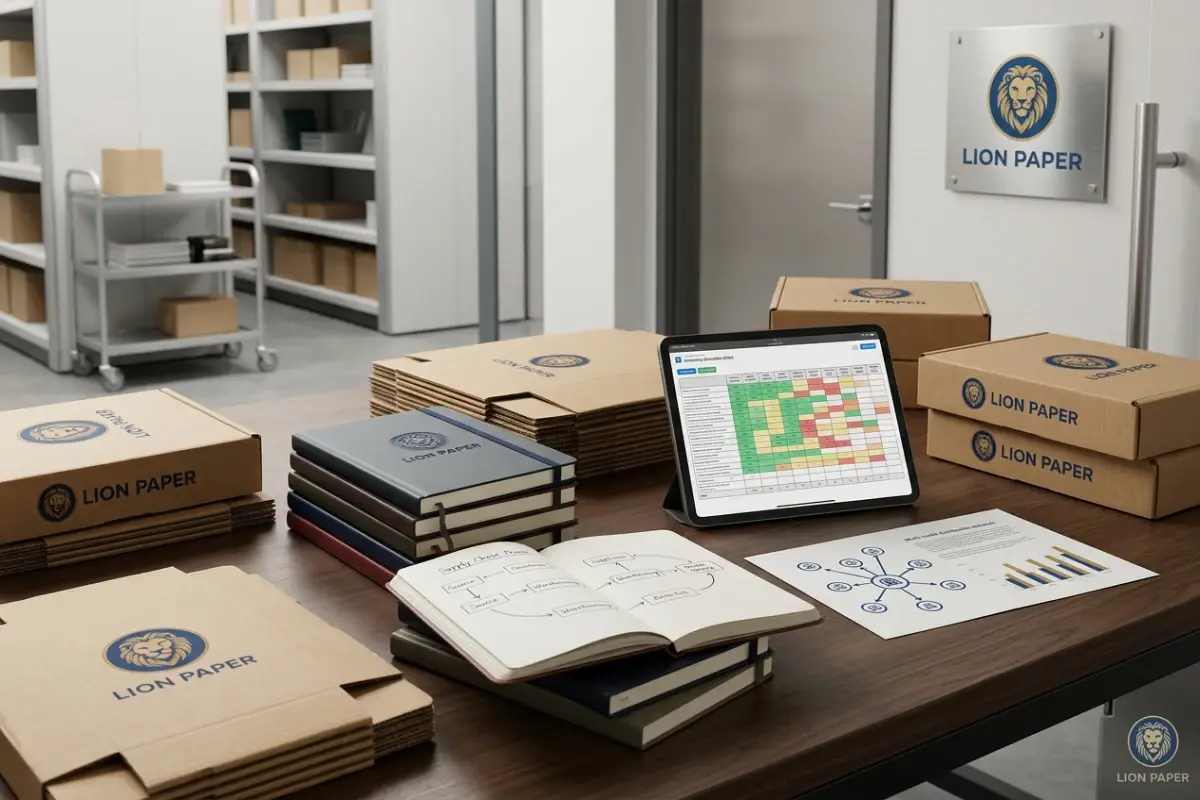
Omnichannel Notebook Inventory Allocation: Supply Planning, Packaging Specs, and Replenishment Framework

Omnichannel notebook inventory allocation balances digital conversion velocity with physical retail sell-through by synchronizing channel packaging specifications, SKU assortment breadth, and production lead times across diverse fulfillment nodes. Successful execution relies on dynamic buffer stock modeling, standardized inner-pack modularity, and dual-site manufacturing synergy—leveraging rapid domestic pilot sampling alongside scaled overseas mass production to eliminate stockouts, prevent channel cannibalization, and minimize global inventory holding costs.
What Are the Core Trade-Offs in Omnichannel Notebook Inventory Allocation?
Managing inventory across brick-and-mortar retail, direct-to-consumer (DTC) storefronts, and third-party e-commerce platforms requires balancing competing operational priorities. Direct-to-consumer channels require high SKU variety, individual unit pick-and-pack efficiency, and rapid turnaround times to satisfy fluctuating daily consumer demand. Conversely, big-box and specialty retail chains demand predictable volume, consolidated pallet shipments, rigid delivery windows, and strict compliance with master carton configurations.
When brands deploy a single unified inventory pool without distinct channel allocation rules, they risk stockouts in high-margin e-commerce channels during viral marketing spikes or, conversely, hefty retailer chargebacks caused by inventory shortages during committed promotional cycles. Effective stationery assortment planning requires inventory managers to evaluate three primary operational trade-offs:
Assortment Breadth vs. Production Scale: E-commerce thrives on wide aesthetic selections (multiple cover materials, niche foil stampings, custom interior grid variations), whereas brick-and-mortar retail requires deep volume across a consolidated core of proven, high-turnover SKUs to maximize shelf productivity.
Holding Costs vs. Channel Service Levels: Centralizing stock in a single regional fulfillment center lowers total safety stock requirements but introduces higher outbound freight costs and longer transit times for physical store distribution centers.
Packaging Flexibility vs. Channel Compliance: Packaging engineered for retail point-of-sale display (such as open-front boxes or tactile belly bands) often fails drop-test standards for courier shipping, while heavy-duty e-commerce packaging increases shelf footprint and diminishes physical merchandising appeal.
By establishing dedicated inventory partitions supported by shared raw material reserves, brand planners can maintain 98%+ order fill rates across all sales channels while containing working capital commitments.
How Does a Channel Allocation Matrix Balance E-Commerce Velocity and Retail Rate of Sale?
A robust notebook supply planning matrix synchronizes production batching with distinct channel velocities. Retail channels operate on a steady "rate of sale" (units sold per store per week), governed by purchase orders placed weeks or months in advance. E-commerce platforms operate on dynamic "sales velocity," where promotional campaigns, digital ad spend, and algorithmic shifts can increase daily volume by 300% to 500% with minimal warning.
To manage these differing dynamics, supply planners utilize a channel segmentation matrix that dictates inventory split percentages, safety stock buffers, and reorder triggers based on SKU classification and channel characteristics:
Channel Type | Typical Demand Velocity | Order Profile & Unit Flow | Primary Packaging Format | Buffer Stock Policy | Reorder Trigger Mechanism |
|---|---|---|---|---|---|
:--- | :--- | :--- | :--- | :--- | :--- |
Direct-to-Consumer (DTC) | High volatility, erratic daily peaks | Single-unit pick & pack, high gift-box share | Individual polybag or self-mailer with custom tissue | 30 to 45 days of forward forecast | Dynamic reorder point based on 7-day rolling sales velocity |
Marketplace (e.g., Amazon FBA) | Steady velocity with sharp deal-day spikes | Multi-pack bundles, standard carton prep | Barcoded scannable shrink-wrap, SIOC compliant | 45 to 60 days of forward forecast | Automated restock alerts integrated with FBA inventory limits |
Brick-and-Mortar Retail | Predictable baseline with seasonal surges | Master carton pallet loads, inner-packs of 4–6 | Retail-ready PDQ trays, belly bands with UPC | 15 to 30 days at regional distribution centers | Fixed EDI purchase order schedule tied to planogram resets |
Corporate & Custom Gifting | Lumpy, project-based bulk volume | Bulk master cartons, specialized palletization | Protective bulk interleaving or premium gift boxing | Zero buffer; made-to-order (MTO) production | Contract execution and upfront deposit milestone |
Using this matrix, inventory planners assign baseline production volume to committed wholesale contracts while holding a 15% to 20% unallocated safety buffer in semi-finished goods (such as printed, un-bound text blocks or un-embossed covers) to react swiftly to sudden digital demand surges.

Differentiating notebook packaging formats ensures compliance across physical retail shelves and e-commerce fulfillment networks.
What Are the Critical Channel Packaging Specifications and Barcode Requirements for Notebook Programs?
Packaging failures are among the most frequent causes of fulfillment delays, channel inventory misallocation, and distributor penalties. Meeting distinct channel packaging specifications requires standardizing the structural foundation of the notebook while customizing outer labeling and secondary protective layers.
Barcode Hierarchy and Data Integrity
Every SKU must maintain a rigid, traceable barcode hierarchy across individual units, inner packs, and master cartons:
Item-Level Identifiers (UPC/EAN/FNSKU): A standard 12-digit UPC or 13-digit EAN must be placed on the back cover or removable belly band for retail scanning. For inventory allocated to marketplace fulfillment centers, item-level barcodes must often be replaced or over-stickered with channel-specific identification codes (such as Amazon FNSKUs) to prevent mixed-inventory co-mingling.
Inner-Pack Labeling (ITF-14 / GS1-128): When notebooks are packed in multi-packs (e.g., 4 or 6 units per shrink-wrapped bundle), the bundle requires a distinct outer barcode preventing retail cashiers from scanning the bundle as a single item.
Master Carton Code (GS1-128 / Shipping Container Code): Master cartons must feature high-contrast, scannable shipping container labels displaying gross weight, net quantity, carton dimensions, production batch number, and destination center routing codes.
Structural Protection and Merchandising Formats
Retail store environments prioritize tactile engagement. Consumers want to touch cover textures, inspect paper finishes, and test ribbon markers. Consequently, retail stationery often utilizes belly bands, hangtags, or open-face slipcases. In contrast, e-commerce fulfillment networks demand full-enclosure protection to withstand automated sorting conveyors, rough transit handling, and dust accumulation.
To harmonize these requirements without managing separate production runs, leading brands adopt "hybrid packaging." The base notebook is assembled with retail-ready belly bands and scannable UPCs, then sealed in an automated, high-clarity recyclable shrink-film. This protects the notebook across e-commerce fulfillment paths while remaining shelf-ready if routed to a physical store floor.
How Can Brands Optimize Retail Notebook Replenishment and Lead Times Using Dual-Site Manufacturing?
Balancing low unit manufacturing costs against responsive lead times is a core challenge in modern stationery supply chain management. Relying solely on a single domestic manufacturing source inflates unit production costs, while relying exclusively on a single offshore production hub introduces 60- to 90-day lead-time vulnerabilities that paralyze retail notebook replenishment.
An agile dual-site manufacturing model overcomes these vulnerabilities by strategically coordinating operations across high-capacity production hubs and rapid-response prototyping centers. For example, Lion Paper Products combines a 3,000-square-meter facility in Jiaxing, China—dedicated to product development, structural engineering, rapid sampling, and specialized pilot batches—with a 10,000-square-meter mass-production hub in Cambodia capable of producing over 5 million notebooks annually.

Dual-site manufacturing networks combine rapid pilot sampling with scaled mass production to accelerate retail replenishment.
This dual-site synergy transforms omnichannel replenishment planning through a tiered fulfillment model:
Initial Core Assortment Mass Production: Baseline retail volume for annual back-to-school and holiday planner resets is produced at the Cambodia facility 4 to 6 months ahead of schedule, maximizing total-cost efficiency, scale sourcing, and duty-optimized ocean freight delivery.
Agile Mid-Season Replenishment: When mid-season retail sell-through exceeds initial projections, or when an e-commerce SKU turns viral, the China development and pilot lines produce rapid-turn replenishment runs within 15 to 21 days, dispatching critical inventory via expedited air or fast-boat sea freight.
Postponement Strategy for Custom Finishing: Standardized notebook cores (e.g., FSC-certified 100gsm wood-free lined paper blocks) are mass-produced in advance and held in inventory. Custom foil stamping, personalized debossing, edge-gilding, or specialized packaging is applied in secondary finishing cells as real-time channel orders materialize.
This balanced manufacturing architecture reduces landed product costs while protecting brands against stockouts and lost revenue during critical sales windows.
How Does the Pre-Production Approval and Quality Proofing Workflow Prevent Multi-Channel Allocation Delays?
Quality deviations discovered after mass production can disrupt multi-channel delivery schedules, resulting in missed retail planogram dates and lost digital search rankings. A rigorous pre-production approval and quality assurance workflow ensures that every notebook batch meets rigorous mechanical, aesthetic, and regulatory standards before goods leave the factory floor.
Concept & CAD Design │ ▼ Structural Unprinted Dummy (White Sample) ──> Validate Paper Thickness, Weight & Binding │ ▼ Wet Proofs & Color Matching ───────────────> Calibrate Spot UV, CMYK & Foil Standards │ ▼ Pre-Production Sample (PPS) ────────────────> Full Specification Sign-Off │ ▼ Pilot Production Run (Small Batch) ─────────> Line Balancing & Automated SOP Validation │ ▼ Mass Production with In-Line QC ────────────> AQL 2.5/4.0 Sampling, Defect Mapping │ ▼ Packaging & Palletization Audit ────────────> Barcode Scan Verification & Drop Testing
Structural White Dummy Validation: Before committing raw materials, engineers produce an unprinted physical prototype to verify text-block thickness, spine rounding, hinge strength on hardcovers, ribbon placement, and back-pocket gusset tolerances.
Color Matching and Material Proofing: Cover materials—whether linen bookcloth, PU leather, or recycled specialty paper—undergo strict spectrophotometer color calibration alongside wet ink proofs to ensure brand consistency across lighting conditions.
Mechanical Stress and Durability Testing: Hardcover and wire-bound journals are subjected to lay-flat cycle tests, page-pull strength measurements (minimum 1.5 to 2.0 kgf/cm depending on binding style), and cover-rub abrasion assessments to verify long-term consumer durability.
In-Line and End-Line AQL Audits: During mass manufacturing, standardized SOPs and AQL 2.5/4.0 inspection protocols govern defect categorization, checking for spine skew, foil stamping flaking, glue squeeze-out, page misregistration, and barcode print quality.
Palletization and Transit Simulation: Finished master cartons undergo standard ISTA drop tests and stacking load simulations to confirm packaging integrity during ocean transport, cross-dock handling, and final-mile courier delivery.
Adhering to strict compliance and quality audits—including ISO 9001, FSC, SMETA, WCA, GSV, FAMA, and CPSIA frameworks—guarantees that multi-channel notebook shipments arrive retail-ready without costly sorting or relabeling interventions.

Rigorous pre-production proofing and AQL quality checks prevent fulfillment delays and inventory chargebacks across retail channels.
What Sourcing Checklist and Essential RFQ Framework Should Stationery Planners Use?
To ensure contract manufacturers provide accurate pricing, feasible lead times, and robust omnichannel support, procurement teams must provide comprehensive RFQ packages. Omitting structural or channel-packaging details often leads to mid-production price revisions and fulfillment bottlenecks.
When preparing a custom notebook sourcing package, supply chain managers should organize specifications using the following framework:
1. Structural & Core Specifications:
Format: Hardcover, softcover, flexi-cover, spiral wire-bound, or twin-ring bound.
Trim Dimensions: Standard A5 (148 x 210 mm), B5 (176 x 250 mm), US Letter (8.5 x 11 in), or custom dimensions.
Page Count & Text Block: Total page count (e.g., 192 pages / 96 sheets), interior print layout (5mm dot grid, 7mm ruled, blank, or dated daily/weekly planner templates).
Paper Stock & Provenance: FSC-certified wood-free paper, recycled paper, or bamboo pulp paper; specified weight (e.g., 80gsm, 100gsm, 120gsm, 160gsm bamboo paper for fountain pen ink bleed-resistance).
2. Decorative Finishing & Accessory Details:
Cover Material: Coated art paper over greyboard, natural bookcloth, recycled Kraft board, vegan PU leather, or RPET fabric.
Surface Embellishments: Metallic foil stamping (gold, silver, rose gold), blind debossing, spot UV varnishing, edge printing, or gilded page edges.
Functional Add-ons: Elastic closure bands (specified width and tension), woven ribbon page markers (single or dual), expanding inner back pockets with fabric gussets, and pen loop attachments.
3. Channel-Specific Packaging & Allocation Requirements:
Individual Pack Format: 100% recyclable POF shrink-wrapping, branded belly bands (specify paper weight and laminate), individual tuck-top gift boxes, or self-sealing biodegradable polybags.
Barcode Specifications: High-resolution vector UPC/EAN artwork, Amazon FNSKU requirements, or retailer-specific price sticker placements.
Carton Packing & Palletization: Maximum carton gross weight limits (e.g., max 15 kg/33 lbs for standard retail and warehouse handling), required inner-pack bundling (e.g., 6 units per shrink bundle, 24 units per master carton), corner-board protection, and heat-treated ISPM-15 wooden pallet requirements.
4. Volume Forecasts and Staged Delivery Schedules:
Total Annual Volume vs. Initial Run Size: Total anticipated annual production divided by initial launch volume and projected quarterly replenishment runs.
Target Delivery Windows: Required ex-factory dates for retail distribution centers versus ocean freight staging for e-commerce buffer warehouses.
Providing this granular level of technical detail upfront allows manufacturing partners to engineer precise cutting dies, optimize raw material master rolls, and configure automated packaging lines for seamless omnichannel deployment.
Frequently Asked Questions About Omnichannel Notebook Supply Planning
How should safety stock ratios be divided between e-commerce and retail warehouses?
Most stationery brands allocate 60% to 70% of total inventory to firm retail purchase orders and regional distribution hubs, while maintaining 30% to 40% in flexible, multi-channel e-commerce fulfillment centers. Holding a small percentage of finished inventory in uncommitted, universal packaging allows planners to reallocate units to retail cross-dock facilities or digital fulfillment nodes based on real-time sell-through data.
What is the most cost-effective way to handle individual unit shrink-wrapping for multi-channel sales?
Automated polyolefin (POF) shrink-wrapping during mass production is the most cost-effective method, adding only pennies per unit. This protects notebooks during rough e-commerce transit while remaining thin, clean, and crystal-clear enough for retail shelf presentation. The film is easily removable by the end consumer or retail staff if unwrapped display copies are required.
How does FSC certification impact notebook supply chain lead times?
FSC-certified paper sourcing requires a verified Chain of Custody (CoC) from certified paper mills to the printing facility. Working with an FSC-certified manufacturer with established raw material reserves ensures standard lead times (typically 30 to 45 days for mass production) are maintained without the 2- to 3-week delays associated with sourcing untracked specialty paper.
What is the standard minimum order quantity (MOQ) for split-channel custom notebook manufacturing?
For fully customized OEM/ODM notebook production involving custom cover tooling, bespoke paper weights, and specialized finishes, production runs typically start at 1,000 to 3,000 units per design. These minimums can be split across channel-specific packaging variations (such as half in retail PDQ displays and half in e-commerce protective wrap) when coordinated during pre-production engineering.
To align your upcoming product lines with a scalable, responsive manufacturing network, share your buyer accounts, proposed SKU list, packaging guidelines, and forecast volumes to contact our supply chain team for a comprehensive OEM/ODM sourcing consultation.
FAQ
How should safety stock ratios be divided between e-commerce and retail warehouses?
Most stationery brands allocate 60% to 70% of total inventory to firm retail purchase orders and regional distribution hubs, while maintaining 30% to 40% in flexible, multi-channel e-commerce fulfillment centers. Holding a small percentage of finished inventory in uncommitted, universal packaging allows planners to reallocate units to retail cross-dock facilities or digital fulfillment nodes based on real-time sell-through data.
What is the most cost-effective way to handle individual unit shrink-wrapping for multi-channel sales?
Automated polyolefin (POF) shrink-wrapping during mass production is the most cost-effective method, adding only pennies per unit. This protects notebooks during rough e-commerce transit while remaining thin, clean, and crystal-clear enough for retail shelf presentation. The film is easily removable by the end consumer or retail staff if unwrapped display copies are required.
How does FSC certification impact notebook supply chain lead times?
FSC-certified paper sourcing requires a verified Chain of Custody (CoC) from certified paper mills to the printing facility. Working with an FSC-certified manufacturer with established raw material reserves ensures standard lead times (typically 30 to 45 days for mass production) are maintained without the 2- to 3-week delays associated with sourcing untracked specialty paper.
What is the standard minimum order quantity (MOQ) for split-channel custom notebook manufacturing?
For fully customized OEM/ODM notebook production involving custom cover tooling, bespoke paper weights, and specialized finishes, production runs typically start at 1,000 to 3,000 units per design. These minimums can be split across channel-specific packaging variations (such as half in retail PDQ displays and half in e-commerce protective wrap) when coordinated during pre-production engineering.


Comments