


Notebook SKU Rationalization: Assortment Optimization and Line Consolidation Guide

Notebook SKU rationalization is the systematic evaluation and pruning of stationery product lines based on contribution margin, demand cannibalization, packaging complexity, and replenishment velocity. By identifying underperforming variations and consolidating shared paper stocks, bindings, and trim sizes, brands and retailers maximize retail shelf productivity, lower warehouse carrying costs, and improve manufacturing economies of scale across their notebook assortments.
What Are the Core Trade-Offs in Retail Notebook Assortment Pruning?
Managing a paper stationery line requires balancing consumer variety with operational simplicity. Retailers often expand their catalogs by introducing multiple cover finishes, page counts, ruling styles (lined, dot grid, blank, graph), and trim sizes (A5, B5, A4, standard pocket). Over time, uncontrolled catalog expansion creates SKU bloat, which leads to diminished stock turns, fragmented production batches, and higher carrying costs.
When conducting notebook inventory pruning, category managers navigate four primary commercial trade-offs:
Assortment Breadth vs. Purchase Indecision: An excessive number of nearly identical journals confuses retail shoppers. Streamlining from fifteen colorways to five signature aesthetic palettes typically concentrates consumer purchases on high-converting items rather than causing lost revenue.
Customization vs. Minimum Order Quantities (MOQs): Offering hyper-specialized interior layouts or bespoke cover textures across dozens of distinct SKUs fractures raw material purchasing. Consolidating around standardized core paper weights (such as 80 gsm woodfree or 100 gsm FSC-certified paper) aggregates volume, allowing procurement teams to access tier-one tiered supplier pricing.
Visual Shelf Impact vs. Planogram Efficiency: Maintaining redundant SKUs consumes valuable retail shelf facings without generating incremental sales volume. Pruning slow-moving variants enables merchandisers to allocate prime planogram space to verified top-sellers or complementary accessories.
Holding Costs vs. Out-of-Stock Risk: Carrying hundreds of slow-moving stationary variations ties up working capital in slow-depleting warehouse inventory. Rationalization concentrates working capital on high-velocity core lines, stabilizing safety stock levels and mitigating supply chain stockouts.

Pruning redundant stationery SKUs clarifies shelf hierarchy and increases retail sell-through velocity.
Which Quantitative Criteria Drive Effective Stationery Assortment Optimization?
Successful stationery assortment optimization relies on multi-dimensional performance tracking rather than gross sales figures alone. A high-revenue notebook with custom packaging, complex foil stamping, and low replenishment velocity may yield less net profit than a standardized staple notebook sold in high volumes.
Category managers should evaluate every SKU across four core quantitative and operational metrics:
Net Contribution Margin After Landed Costs: Gross margin calculations frequently overlook specialized inner packaging, compliance testing, and high dimensional freight costs. SKU rationalization evaluates the true net margin after factoring in ocean freight, duty, pallet utilization efficiency, and warehouse handling fees.
Sales Velocity and Inventory Turnover Rate: Calculate average unit sales per retail store per week (UPW) or monthly e-commerce velocity. SKUs that fall below the bottom twentieth percentile of category velocity without serving an intentional loss-leader or halo branding function are prime candidates for decommissioning.
Direct Demand Cannibalization and Aesthetic Redundancy: Evaluate whether two adjacent SKUs satisfy the exact same consumer use case. For example, maintaining both a charcoal grey linen hardcover and a slate grey fabric hardcover in standard A5 size creates unnecessary cannibalization.
Supply Chain and Packaging Complexity: Analyze component commonality. Notebooks that require unique cover materials, proprietary ribbon colors, non-standard endpapers, or custom rigid boxes require independent raw material inventory. Higher component sharing across SKUs dramatically simplifies replenishment cycles.
How Does a Structured SKU Evaluation Matrix Clarify Rationalization Decisions?
To standardize category review meetings, retail notebook category management teams use an objective scoring matrix. This matrix categorizes SKUs into four clear action quadrants: Retain & Scale, Consolidate Components, Re-engineer Cost Structure, or Discontinue.
Evaluation Metric | Retain & Scale | Consolidate Components | Re-engineer Cost Structure | Discontinue (Phase Out) |
|---|---|---|---|---|
:--- | :--- | :--- | :--- | :--- |
Sales Velocity (Units/Week) | High (Top 25%) | Moderate (25th–60th percentile) | Moderate to High | Low (Bottom 20%) |
Net Margin Contribution | > 42% Landed Margin | 30% – 40% Landed Margin | < 25% (High direct cost) | < 20% Net Margin |
Component Commonality | High (Shared inner block/board) | Low (Bespoke trims/fabrics) | Low to Medium | Bespoke or Obsolete Components |
Packaging Density | Optimized master cartons | Standard master cartons | Sub-optimal dimensional weight | Excess packaging / High cube |
Supply Chain Lead Time | Standard 30–45 Days | 45–60 Days | > 60 Days (Custom sourcing) | Unpredictable / Low batch |
Recommended Action | Expand inventory depth | Standardize paper and binding | Re-source through agile OEM | Mark down and liquidate |
By plotting each notebook variant against these parameters, merchandising teams remove subjective bias from line reviews. SKUs in the "Consolidate Components" quadrant undergo immediate bill-of-materials (BOM) unification, while "Discontinue" items are scheduled for planned markdown cycles to harvest remaining working capital.
How Can Brands Execute OEM Notebook SKU Consolidation Without Losing Market Share?
Executing OEM notebook SKU consolidation requires aligning design aesthetics with factory-floor modularity. Merchandisers can prune half of their physical finished-good SKUs while maintaining the visual breadth that retail consumers expect by adopting a platform-based design strategy.
Platform-based notebook manufacturing standardizes hidden structural foundations while varying accessible surface treatments:
Standardize Text Block Architecture: Maintain uniform interior page blocks across multiple collections. An identical 192-page, 100 gsm FSC acid-free dotted inner block can serve executive, artistic, and wellness notebook covers simultaneously. Standardizing book blocks allows manufacturers to print and fold signatures in high-volume, automated production runs.
Standardize Greyboard and Form Factors: Lock inner chipboard thicknesses (such as 2.0 mm or 2.5 mm European greyboard) and book dimensions to fixed standards (A5, B5, A6). This eliminates machine recalibration and custom die-tooling expenses during mass production.
Differentiate via Post-Press Finishing: Apply varied cover aesthetics—such as PU faux leather, printed art paper, linen cloth, hot foil stamping, debossing, or edge gilding—over identical structural cores. Consumers see a diversified collection, while the production line benefits from structural standardization.
Harmonize Secondary Packaging: Transition disparate blister packs, individual shrink wraps, and custom slipcases into unified, shelf-ready carton packaging (SRP) and standardized barcoded belly bands.
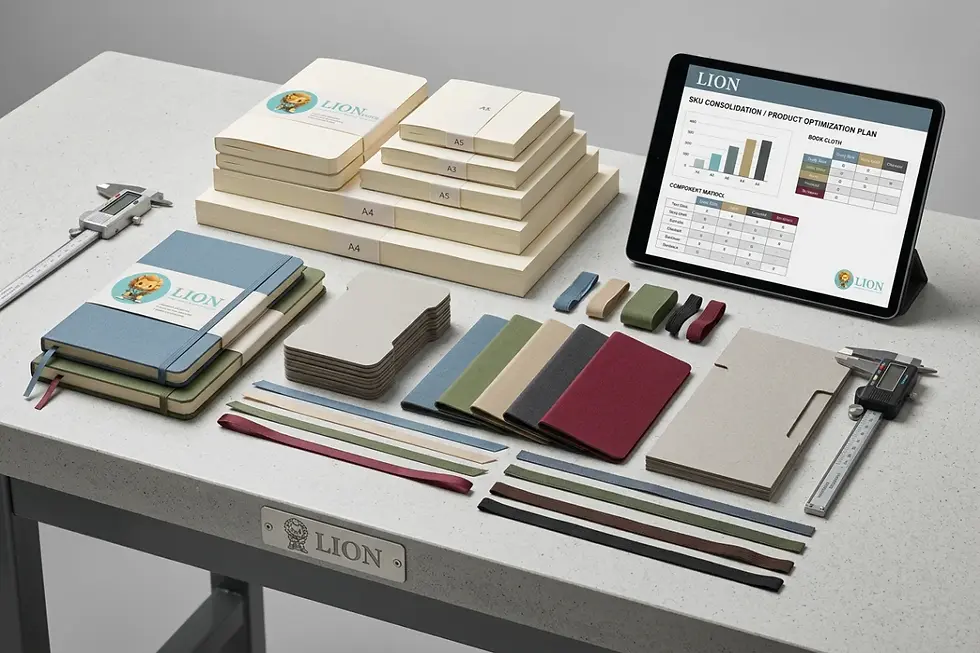
Standardizing interior page blocks and structural greyboard enables efficient OEM notebook line consolidation.
What Sourcing Workflow Transitions Custom Journals from Creative Concept to Consolidated Production?
A structured transition workflow bridges the gap between creative design departments and contract manufacturing facilities during a product line overhaul. The following structured step-by-step protocol outlines an efficient transition:
Catalog Audit & Sales Data Integration: Consolidate point-of-sale (POS) sell-through data, return rates, and customer reviews across all global sales channels to highlight low-performing SKUs.
BOM Decomposition: Break down every existing notebook into its fundamental bill-of-materials: inner paper stock, endpapers, spine reinforcement tape, cover substrate, binding mechanism, ribbon markers, elastic bands, and retail packaging.
Platform Harmonization: Identify shared structural denominators. Group thirty divergent notebook variations into three core structural families sharing standardized spine widths, page counts, and trim sizes.
OEM / ODM Technical Briefing: Deliver consolidated technical specifications to your supply chain partner, specifying standard paper grades, global compliance requirements (e.g., FSC, CPSIA), and master carton pack counts.
Digital Proofing and Rapid Prototyping: Produce physical rapid mockups to verify that standardized components maintain structural integrity, lay-flat capability, and aesthetic luxury.
Phased Inventory Depletion: Align factory purchase orders with the planned phase-out dates of legacy SKUs to prevent obsolete inventory write-downs.
What Quality Proofing and Pre-Production Steps Protect Margin During Assortment Restructuring?
When consolidating multiple notebook lines into standardized manufacturing platforms, thorough quality assurance prevents costly batch failures. Consolidating components means an undetected defect in a single paper batch or binding glue formulation could impact multiple product collections.
Quality engineering during SKU consolidation must focus on four critical production checkpoints:
Paper Bleed-Through and Ink Feathering Verification: When choosing a unified interior paper stock across diverse product lines, verify performance across fountain pens, gel ink, alcohol markers, and rollerballs. Standardizing on high-opacity woodfree paper prevents customer returns across all retail end-use cases.
Spine Adhesion and Lay-Flat Durability: Ensure that hybrid thread-sewn casebound structures utilize temperature-resistant PUR adhesives. Standardized spine blocks must withstand rigorous flex tests (at least 300 openings to 180 degrees) without page detachment or spine cracking.
Foil Stamping and Cover Material Compatibility: Test surface tension and foil adhesion on all cover materials. Unifying foil stamping dies across multiple cover substrates (e.g., uncoated book cloth vs. thermo-PU) requires precise temperature and dwell-time calibrations during the stamping process.
Palletization and Transit Drop Testing: Standardized outer packaging must undergo ISTA 1A or 2A drop testing and compression testing. Standard master carton dimensions maximize ocean container loadability (CBM utilization) and pallet racking efficiency in distribution centers.

Rigorous pre-production proofing ensures batch consistency across consolidated stationery product lines.
What Essential RFQ Specifications Should Merchandisers Prepare for Line Consolidation?
To receive actionable, cost-effective proposals during an OEM notebook SKU consolidation project, procurement teams must provide structured Request for Quote (RFQ) documentation. Supplying precise technical parameters prevents cost overruns, eliminates quoting revisions, and ensures production compatibility.
Your consolidated RFQ package should clearly define the following technical elements:
Consolidated Platform Dimensions: Explicit trim sizes (width x height x spine depth in millimeters) and target page counts.
Material Specifications: Precise inner paper basis weights (gsm), paper shade (cream, natural white, bright white), opacity ratings, and environmental certifications (e.g., FSC Mixed Source or 100% Post-Consumer Waste Recycled).
Binding Construction Details: Exact binding methods (casebound Smyth-sewn, double wire-O, spiral-bound, flexi-softcover, or saddle-stitched).
Cover Substrate & Embellishments: Base board thickness (caliper points or mm), covering material type, and exact decorative finishing dimensions (debossing depth, foil square centimeters, spot UV).
Packaging Architecture & Compliance: Specific master carton limits (gross weight under 15 kg/33 lbs for standard retail handling), retail labeling standards, hangtag attachments, and factory compliance audit requirements (SMETA, WCA, ISO 9001, FAMA).
Volume Projections and Tiered Pricing Breaks: Aggregated annual volume split across core platforms alongside seasonal variant breakdown to evaluate production scalability.
How Does Dual-Site Manufacturing Support Agile Notebook Category Management?
Executing ongoing stationery assortment optimization requires flexible manufacturing capabilities. Category trends change rapidly; hot colorways, trending cover textures, and seasonal formats require fast initial prototyping followed by reliable, cost-effective mass production.
Integrated supply chain networks utilizing dual-site manufacturing provide the ideal operational balance for retail category managers. Design engineering, initial material sourcing, and rapid sample prototyping occur within specialized development centers, allowing brands to evaluate physical samples within days. Once product specifications and consolidated platforms are locked, high-volume production transfers to scaled production hubs equipped with automated binding lines and standardized operating procedures (SOPs).
This integrated design-to-manufacturing framework reduces landed production costs, satisfies international social compliance audits, and mitigates single-region supply chain bottlenecks. Standardized quality control protocols, AQL sampling, and container-optimized packaging ensure consistent retail-ready goods batch after batch.
If you are planning an upcoming stationery line review, optimizing shelf productivity, or seeking an integrated OEM/ODM supply chain partner for your notebooks, journals, and planners, our engineering team can help. Inquire about our custom paper product solutions by sharing your proposed SKU list, channel requirements, packaging specifications, and volume forecasts for a comprehensive sourcing and consolidation evaluation.
FAQ
What is the typical reduction percentage during a notebook SKU rationalization project?
Most brands and retail stationery categories achieve optimal results by pruning 20% to 35% of their total SKU count. This level of reduction removes visual redundancy and slow-depleting stock without impacting overall category sales volume.
How does stationery assortment optimization impact minimum order quantities (MOQs)?
By consolidating shared paper blocks, standard sizes, and identical structural greyboards across multiple collections, total purchase volume is aggregated. This allows buyers to achieve lower factory MOQs per individual cover variant while unlocking higher tier-volume pricing on core materials.
Can custom journal collections maintain a luxury brand feel after SKU consolidation?
Yes. Luxury positioning is preserved by focusing differentiation on tactile exterior elements—such as premium book cloth, genuine foil stamping, custom gilded edges, and bespoke endpapers—while standardizing hidden structural elements like page dimensions, board caliper, and interior paper weights.


Comments