


The Ultimate Notebook Pouch Design Guide: Elevating Brands with Custom Stationery Solutions

The Value of Custom Pouches in Stationery and Gift Packaging
In the contemporary retail and corporate gifting landscapes, a notebook is far more than a functional workspace for writing; it serves as a lifestyle statement. As stationery brands, online retailers, and corporate buyers seek distinct avenues to differentiate their product lines, packaging has shifted from a basic protective element into an essential product feature. This strategic evolution is where a custom-engineered pouch becomes invaluable. Introducing a tailored protective pouch elevates a standard notebook into a premium gift set, expanding its perceived market value and enhancing its long-term utility for the consumer.
A well-designed pouch serves dual purposes: reliable protection and seamless organization. While high-quality paper goods require shielding from bent corners, water exposure, and everyday wear, users also crave a unified solution to carry pens, business cards, sticky notes, and tech accessories alongside their journals. This notebook pouch design guide explores how brands can balance aesthetic intent, functional complexity, and mass-production efficiency to deliver compelling, retail-ready products.
By designing a custom container, brand owners can establish a distinct product ecosystem. Whether launching an executive collection, a student stationery set, or a travel journal, the pouch dictates how the user interacts with the brand daily. Understanding the technical aspects of pouch manufacturing is essential for product managers, procurement leads, and creative directors who want to transform initial design sketches into physical, commercial-grade products.
Material Comparison: Fabric, PU Leather, and Notebook Pouch Materials Wholesale Selection
Selecting the primary material is the fundamental step of any successful stationery accessory project. Material choices dictate the product's tactile experience, structural integrity, and retail price point. When evaluating options through notebook pouch materials wholesale channels, designers must balance design aesthetics with mechanical performance.
Heavy-duty canvas and cotton fabrics (8 oz to 16 oz) remain classic, highly durable choices for casual, academic, and creative lifestyles. Canvas offers a sturdy, tactile texture that responds beautifully to screen printing, embroidery, and woven label stitching. Cotton and linen blends provide a softer hand feel, popular for female-forward journaling brands and eco-conscious collections. However, untreated cotton-based fabrics are susceptible to water absorption and staining, requiring post-weaving chemical treatments if moisture resistance is required.
For premium, executive, and luxury positioning, polyurethane (PU) leather is the material of choice. Modern PU leather replicates the grain, depth, and softness of genuine leather while offering consistent thickness, color uniformity, and superior scratch resistance. It is highly receptive to blind debossing, hot foil stamping, and edge painting. Within our notebook pouch design guide, PU leather is recognized for its structural stiffness, allowing designers to create sleek, semi-rigid shapes that hold their form.
Translucent and clear pouches made from PVC or EVA have surged in popularity among youth and minimalist brands. These materials allow the design of the notebook inside to remain visible on retail shelves, acting as integrated visual packaging. EVA is generally preferred over PVC for premium lines because it is chlorine-free, more flexible at low temperatures, and highly recyclable. Clear materials can show scratches over time, requiring careful selection of sheet thickness (0.3mm to 0.8mm) to ensure durability.
For sports, travel, and high-utility applications, synthetic woven materials like nylon (210D to 600D cordura) or polyester ripstop offer unmatched strength-to-weight ratios. Woven polyester mesh is another excellent choice for secondary pockets or sporty exterior designs, facilitating ventilation for stored writing instruments.
Material | Best For | Pros | Cons |
|---|---|---|---|
:--- | :--- | :--- | :--- |
Canvas / Cotton | Casual, Creative, Eco-friendly | High tactile warmth, excellent printability, highly durable | Susceptible to stains, requires water-resistant coating |
PU Leather | Executive, Corporate, Luxury | Premium look and feel, excellent for debossing, water-resistant | Higher material cost, requires edge-stitching or paint sealing |
EVA / PVC | Minimalist, Youth, Visual Sets | Transparent design displays notebook, waterproof, easy to clean | Can scratch easily, susceptible to creasing during shipping |
Nylon / Polyester | Travel, Heavy-duty, Utility | Exceptionally durable, water-resistant, lightweight | Less organic feel, limited to casual or sporty designs |

Sizing and Capacity Engineering: Implementing the Notebook Pouch Design Guide
A critical mistake in product development is neglecting physical tolerance requirements. If a pouch is designed exactly to the dimensions of an A5 notebook (148mm x 210mm), the notebook will not fit. A professional notebook pouch design guide must emphasize the distinction between a flat pouch's external dimensions and its true internal usable volume, which changes dynamically based on the thickness of the contents.
To engineer a precise fit, designers must consider three key measurements of the targeted notebook: Width (W), Height (H), and Thickness (T). The spine depth varies significantly between a thin 64-page softcover notebook (approx. 5mm) and a thick 240-page hardcover journal with 100gsm paper (approx. 20-22mm). Additionally, the binding style plays a massive role. Wire-o and spiral-bound notebooks require significantly more clearance than perfect-bound or case-bound books because the wire coils protrude outward, creating friction and catch points along the inner fabric of the pouch.
$$ ext{Pouch Internal Width} = ext{Notebook Width} + ext{Notebook Thickness} + ext{Fit Clearance (15mm to 20mm)}$$ $$ ext{Pouch Internal Height} = ext{Notebook Height} + ext{Notebook Thickness} + ext{Zipper Clearance (20mm to 25mm)}$$
If the pouch features a three-dimensional gusset (a side or bottom panel that expands), the flat width calculation can be tightened. However, for envelope-style flat pouches, failing to account for the "displacement curve" of a thick hardcover notebook will result in a pouch that pinches at the corners and exerts destructive tension on the zipper teeth. For standard A5 journals, the industry benchmark for a flat zippered pouch outer dimension is roughly 185mm x 245mm, allowing seamless entry and extraction without excessive shifting inside.
Zipper and Hardware Selection: Ensuring Durability and Brand Consistency
The zipper is the most frequently operated component of a pouch, making it the most common failure point. A high-quality notebook pouch design guide prioritizes durable, smooth-gliding hardware to protect the end-consumer experience and avoid costly retail returns.
Nylon coil zippers (typically size #3 or #5) are the standard for most fabric and utility pouches. They are highly flexible, self-lubricating, and resistant to bending or catching. Metal zippers (such as brass, gunmetal, or polished nickel) offer a classic, premium look ideal for PU leather and heavy canvas items. However, metal teeth are heavier, have higher friction, and can occasionally scratch the edges of a notebook's cover if the opening clearance is designed too tightly. For modern, sleek designs, reversed nylon coil zippers with water-resistant matte polyurethane (PU) tape are highly recommended, presenting a seamless, minimalist exterior line.
The zipper pull is a prime branding canvas. Instead of using standard, generic zinc-alloy pull tabs, brands can develop customized pulls that reinforce their visual identity. Options include molded silicone/rubber pulls, embossed metal pulls, and leather/PU cord pulls. Beyond zippers, secondary hardware like magnetic snap closures, spring-loaded buttons, metal rivets, and carabiner loops should be selected with a uniform finish. If the zipper teeth are antique bronze, all snaps and metal branding plates must match this finish exactly to maintain professional brand consistency across the entire collection.

Branding and Printing Techniques for Personalized Gift Journal Pouches
To transform raw materials into personalized gift journal pouches, designers must select decoration techniques that complement the substrate. Each material has distinct chemical and structural properties that react differently to heat, pressure, and ink chemistry.
Debossing and hot foil stamping are highly effective on PU leather, genuine leather, and heavy felt materials. Blind debossing utilizes a magnesium or brass die heated to approximately 110°C to 150°C, pressed directly into the material to create a permanent, sunken design. This technique yields an elegant, subtle, and tactile result that does not wear off over time. Adding a colored or metallic foil layer during the stamping process (such as gold, silver, or rose gold foil) catches the light and adds a high-end luxury appeal, though fine lines must be designed with sufficient spacing to prevent the foil from filling in.
Screen printing is the most cost-effective and vibrant option for cotton canvas, nylon, and polyester fabrics. It allows for highly opaque, solid PMS color matching. For designs featuring large blocks of color, water-based inks offer a softer feel that integrates into the fabric weave, while plastisol inks provide a thicker, more durable shield layer. Screen printing is ideal for bold typographic layouts, simple vector patterns, and high-contrast branding elements.
When a pouch design involves complex, multicolored artwork, photographic details, or intricate gradients, heat transfer or dye-sublimation printing is necessary. This process transfers dyes from a carrier paper directly into synthetic fibers using high heat and pressure. While visually striking and rich in detail, dye sublimation is restricted to high-polyester or treated synthetic fabrics and does not translate well to dark surfaces or natural cotton without white under-base layers.
For brands looking for a vintage, outdoor, or highly tactile aesthetic, sewing a custom woven label, embroidered patch, or molded PVC patch onto the front of the pouch is an excellent alternative. This adds physical depth to the exterior and allows branding to be applied cleanly even on materials that are otherwise difficult to print on directly, such as highly textured wool felt or open-mesh structures.
Functional Details: Creating a Premium Custom Stationery Organizer Pouch
To elevate a simple sleeve into a highly valued custom stationery organizer pouch, designers must consider the daily workflow of the modern journaler, student, or business professional. The interior layout should solve organization pain points, turning the pouch into a self-contained mobile workstation.
Inside the pouch, separating the notebook from writing instruments is essential to prevent pens from scratching the notebook cover or transferring ink. Designing a secondary pocket—using a soft polyester lining fabric or flexible elastic mesh—creates a secure zone for loose items. An internal zippered mesh compartment is perfect for securing small objects like memory cards, paper clips, and eraser refills, keeping them visible yet contained.
No notebook pouch is complete without a dedicated way to carry a pen. Depending on the design aesthetic, pen storage can be external or internal. An elastic band stitched inside the spine or along the inner lining accommodates various pen diameters, from slim mechanical pencils to thick fountain pens. For premium PU leather designs, a self-fabric pen loop made from matching PU leather can be stitched into the side seam, creating a cohesive, high-end appearance.
An outer slip pocket on the back of the pouch allows users to slide in boarding passes, receipts, or temporary notes without unzipping the main compartment. This increases the pouch's utility during travel or fast-paced meetings. Ensuring this exterior slot has a slight angle or a low-profile magnetic clasp keeps documents secure while maintaining a sleek, bulk-free silhouette.
Balancing Cost and Quality: Design-to-Manufacturing Optimization
Designing a beautiful pouch is only half the battle; ensuring it can be manufactured reliably and cost-effectively at scale is where true commercial viability lies. Unnecessary design complexities can exponentially increase material waste, labor assembly times, and quality control defect rates.
Fabric and PU leather are purchased in wide rolls. When designing the pattern pieces for a pouch, engineers must calculate how these pieces nest together on the cutting table. Irregularly shaped panels, oversized gussets, and decorative curves often lead to high scrap-rate percentages, driving up the raw material cost per unit. Standardizing flat, rectangular, or softly rounded patterns allows laser or die cutters to pack pieces closely together, minimizing waste and lowering the baseline material cost.
Every seam, zipper alignment, and lining insert requires manual labor on a sewing machine. Complex inner pockets with multi-layered stitching require highly skilled operators and more production time, which increases manufacturing costs. By simplifying the internal structure—such as utilizing integrated folded panels instead of multiple separate stitched pockets—brands can dramatically reduce assembly steps without sacrificing overall functionality.
Another critical consideration is how the product packs for international transport. Rigid, hard-shell cases are highly protective but do not compress, meaning they consume large amounts of volume in shipping containers, leading to high shipping costs per unit. Designing a semi-rigid or soft-structured pouch that can lay flat during transport drastically increases container density. Soft pouches can be packed compactly into master cartons, optimizing global logistics costs and helping brands maintain competitive retail price margins.
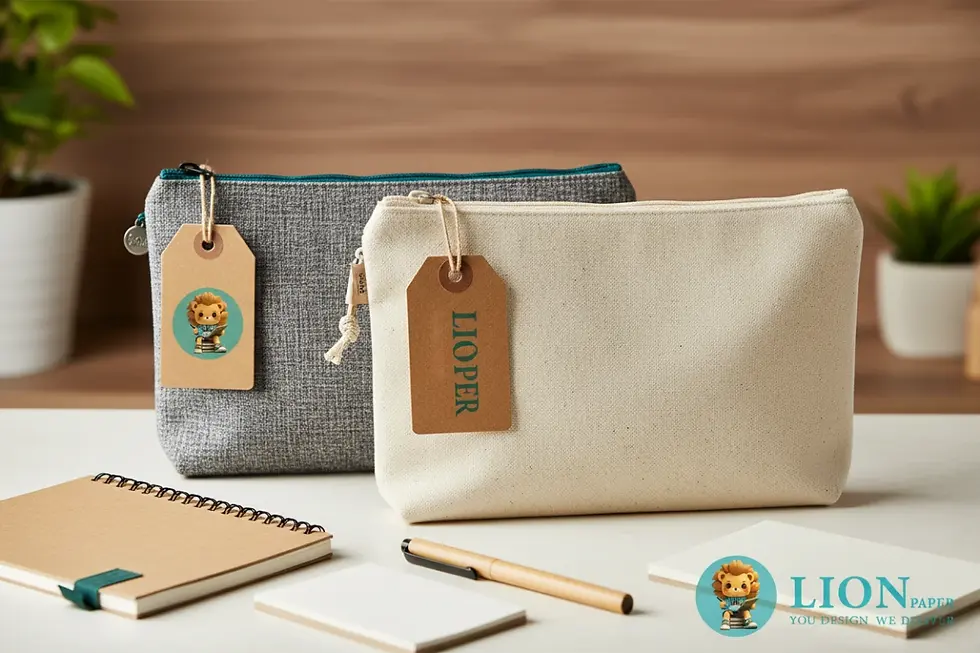
Sustainable Materials for Retail Ready Stationery Packaging Sets
Globally, consumers and corporate buyers are demanding products that align with their environmental values. Introducing sustainable practices into your pouch lines not only satisfies these regulatory and market demands but also builds deep brand loyalty. Creating retail ready stationery packaging sets with a strong focus on sustainability has become a powerful competitive differentiator.
RPET is made by collecting, cleaning, and spinning post-consumer plastic bottles into high-quality polyester fibers. This fabric offers the exact same durability, water resistance, and tensile strength as virgin polyester while reducing plastic waste in oceans and landfills. Using RPET for the pouch lining or outer shell is an excellent way for brands to present an eco-friendly narrative to consumers, complete with clear recycled-content percentages on hanging tags.
For natural fabric lovers, switching to Global Organic Textile Standard (GOTS) certified organic cotton ensures that the raw materials were grown without harmful synthetic pesticides or fertilizers, utilizing water-saving agricultural methods. Combining organic cotton canvas with low-impact, soy-based inks for printing creates a highly biodegradable, earth-friendly accessory.
To capture the luxury of leather sustainably, regenerated leather offers a superb alternative. It is manufactured by blending shredded genuine leather scraps left over from tanneries with natural binding agents. The resulting sheet material looks, smells, and feels like real leather but utilizes recycled pre-consumer industrial waste, avoiding the environmental footprint associated with raw hide processing.
To complete a sustainable product presentation, the external packaging must match the eco-conscious design of the pouch inside. Avoid single-use plastic polybags in favor of compostable cornstarch bags or FSC-certified paper sleeves. Printing retail details directly onto recycled paper belly bands with soy-based ink ensures that the entire product bundle is recyclable, meeting the strict environmental requirements of modern global retailers.
Lion Paper Solutions: Seamless China-Cambodia Dual-Site Manufacturing
When executing a custom notebook and pouch program, partnering with an experienced manufacturer that understands both soft-goods fabrication and high-quality paper engineering is critical. Lion Paper Products (Jiaxing) Co., Ltd., founded in 2015 in Jiaxing, Zhejiang, stands as a premier customized paper goods and creative products supply-chain partner. We offer end-to-end solutions that bridge the gap from your first sketch to the final shipment.
Lion Paper does not simply manufacture; we co-create. Our operations combine a 3,000-square-meter design, prototyping, and customer support center in Jiaxing, China, with a robust 10,000-square-meter mass-production facility in Cambodia. This dual-site synergy allows our in-house design, engineering, and sourcing teams to work closely with you during the early stages of your notebook pouch design guide execution. We produce fast, highly precise samples in China to shorten your development cycle, allowing you to test market feedback before initiating mass production.
Once design concepts are finalized and approved, our Cambodia manufacturing facility takes over to support stable, cost-effective, and high-volume delivery. With automated production lines, standardized SOPs, and an annual notebook output exceeding 5 million units, we provide flexible production capabilities. This dual-site model is designed to support pilot runs, multi-style product launches, and massive volume replenishment plans alike, giving our global B2B clients optimal flexibility in capacity, cost, and lead times.
At Lion Paper, we deliver more than just high-quality products—we deliver stable, compliant, and sustainable business outcomes. Our comprehensive quality control program utilizes standardized AQL sampling, process inspections, and strict defect standards to ensure that every single item matches the original approved prototype. Furthermore, our supply chain is backed by international certifications and audits, including ISO 9001, FSC, SMETA, WCA, GSV, FAMA, and CPSIA. Whether you are targeting major North American department stores, global e-commerce platforms, or specialized creative brands, our facilities are fully equipped to meet your exact market compliance and sustainable sourcing goals.
Let us collaborate to design and manufacture your next bespoke stationery accessories, helping you balance exquisite design, superior quality, and competitive manufacturing costs. To take the first step toward launching your next product line, Request pouch sample options.
FAQ
What is the standard tolerance to add when designing a pouch for an A5 notebook?
To ensure a comfortable fit for a standard A5 hardcover notebook (148mm x 210mm x 18mm), you should add at least 25mm to the width and 30mm to the height for a flat pouch. This results in external flat pouch dimensions of roughly 185mm x 245mm, allowing easy notebook insertion and removal without damaging the cover or binding.
How does Lion Paper Products balance cost and quality for international B2B clients?
We utilize our dual-site synergy. Our Jiaxing, China facility handles high-value product design, engineering, material sourcing, and rapid sampling. Once the design is optimized for manufacturing, our 10,000-square-meter facility in Cambodia handles mass production, leveraging stable delivery schedules and cost efficiencies to provide high-quality products at competitive landed costs.
Can you print custom patterns and logos on transparent EVA or PVC pouches?
Yes, we can print logos and complex designs on transparent or translucent EVA and PVC materials. Silk screen printing is highly recommended for solid, vibrant brand colors, while UV printing can be utilized for complex multi-colored patterns, ensuring excellent adhesion and durability.
Are your notebook pouches and stationery materials certified sustainable?
Absolutely. Lion Paper Products supports sustainable product development. We hold FSC certification for traceable paper products and can source GOTS-certified organic cotton, RPET (recycled polyester), and regenerated leather. Our manufacturing processes adhere to international compliance standards, supported by SMETA, WCA, and ISO 9001 audits.


Comments