


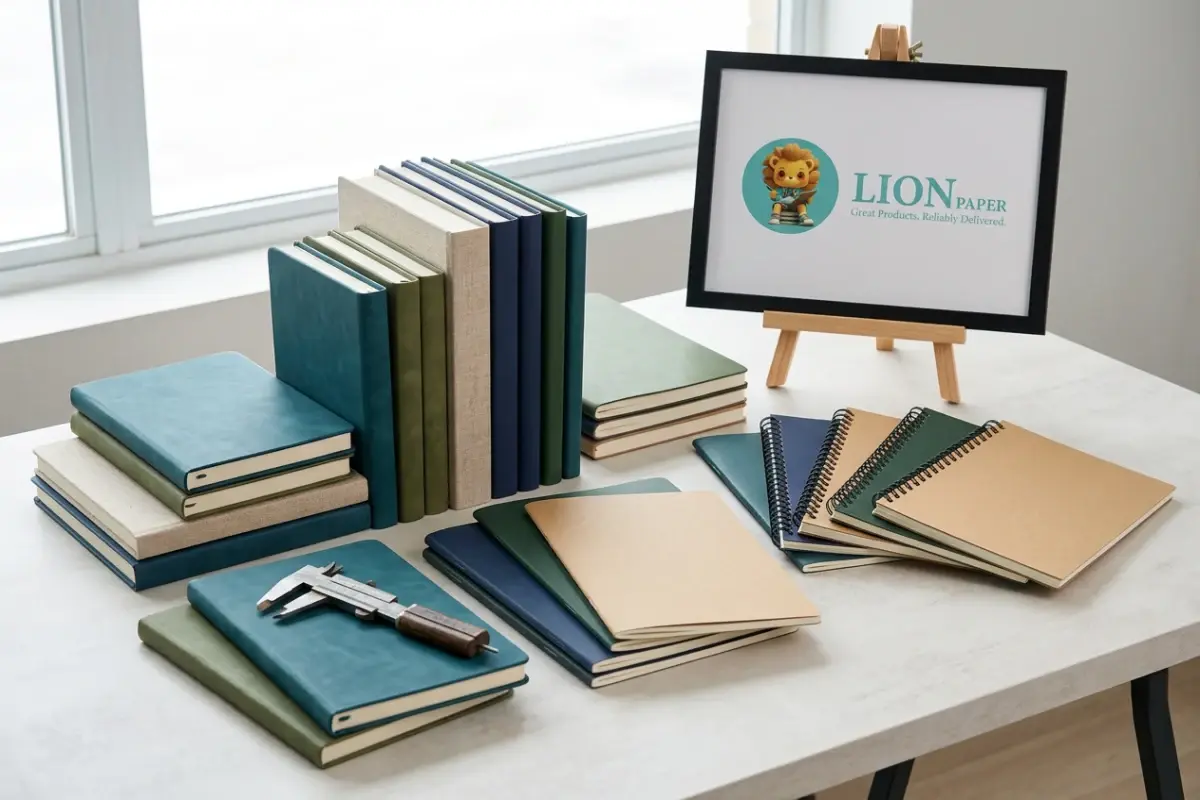
Notebook Portfolio Architecture: Sourcing, Tiering, and Range Planning Guide

Notebook portfolio architecture is the strategic framework for structuring formats, price tiers, shared bills of materials (BOM), and finishing options across a stationery range to maximize retail margin, lower manufacturing MOQs, and streamline supply chain scalability. By standardizing underlying technical specifications across core, mid-tier, and premium lines, brands reduce production complexity while delivering targeted retail price points across diverse sales channels.
What Is Notebook Portfolio Architecture in Stationery Sourcing?
Notebook portfolio architecture is a systematic product-structuring methodology used by stationery brands, retail buyers, and category managers to plan, engineer, and manufacture cohesive notebook collections. Rather than treating each notebook SKU as an isolated custom project, this architectural approach builds a modular product hierarchy that balances consumer aesthetic diversity with back-end manufacturing efficiency.
In global paper product manufacturing, unstructured product expansion often causes severe operational friction, commonly known as SKU bloat. When every new journal design requires unique inner paper grammage, bespoke trim sizes, proprietary cover board calipers, and specialized packaging, the brand fragments its purchasing power. This fragmentation leads to higher Minimum Order Quantities (MOQs), elevated per-unit landed costs, unpredictable factory yields, and prolonged production lead times across the supply chain.
Implementing a robust notebook portfolio architecture solves these operational vulnerabilities through deliberate structural alignment across six core dimensions:
Standardized Core Dimensions: Aligning ranges to universal industry formats such as A5 (148 x 210 mm), B5 (176 x 250 mm), US Letter (8.5 x 11 in), or standard pocket (3.5 x 5.5 in) optimizes paper sheet imposition on printing presses and eliminates off-cut waste.
Material Harmonization: Consolidating core interior paper selections (such as 80 gsm wood-free, 100 gsm FSC-certified offset, or 120 gsm premium bleed-resistant uncoated paper) across multiple product lines pools raw material procurement volumes into full master mill orders.
Binding and Spine Standardization: Aligning page counts and spine widths allows shared manufacturing tooling, automated casing-in, and high-speed wire-o punching setups across different collections.
Finish and Embellishment Stratification: Applying decorative upgrades—such as hot foil stamping, blind debossing, gilded edges, elastic closure bands, and custom ribbon bookmarks—selectively to define retail price points on identical underlying book blocks.
Master Packaging Uniformity: Establishing consistent outer carton dimensions, inner shrink-wrap configurations, and pallet stacking plans across multiple product lines to optimize container space utilization.
Lifecycle Component Modularity: Engineering core paper blocks and boards so that unsold seasonal inventory can be repurposed or rejacketed for upcoming commercial cycles without discarding internal text leaves.
By leveraging structured portfolio architecture, global stationery programs streamline product lifecycles, accelerate sample turnaround, and build scalable production pipelines with manufacturing partners.

A clear stationery product tiering strategy maps distinct material features to Good, Better, and Best retail price points.
How Does a Stationery Product Tiering Strategy Organize Price Points and Formats?
A structured stationery product tiering strategy segments a brand's catalog into distinct commercial tiers—typically categorized as Good, Better, and Best (or Entry, Core, and Premium). This stratification establishes clear retail price ladders while aligning physical product specifications with consumer expectations and channel economics.
The following comparison table demonstrates how manufacturing specifications map across a standard three-tier notebook portfolio:
Portfolio Level | Target Retail Price | Standard Formats & Page Counts | Cover Materials & Binding Type | Interior Paper Specifications | Distinguishing Value-Add Details |
|---|---|---|---|---|---|
:--- | :--- | :--- | :--- | :--- | :--- |
Good / Entry Tier | $4.99 - $9.99 | A5 or B6 Slim; 80-112 pages (40-56 sheets) | Softcover 250-350 gsm C1S art card or kraft; saddle-stitch or flexi-bound | 70-80 gsm FSC wood-free offset; 1-color line grid print | Clean matte lamination, staple or sewn spine, standard belly band packaging |
Better / Core Tier | $12.99 - $19.99 | Standard A5 or 6 x 8 in; 160-192 pages (80-96 sheets) | Hardcover 1.8-2.0 mm greyboard with 128 gsm coated paper wrap, or soft-touch PU; case-bound sewn or twin-wire | 100 gsm acid-free cream offset; 1-color dot grid or ruled print | 1x woven ribbon marker, tonal elastic band closure, foil accent on cover, back gusseted pocket |
Best / Premium Tier | $24.99 - $34.99+ | Custom A5+, B5, or 7 x 10 in; 192-240 pages | Hardcover 2.5-3.0 mm binder board with thermo PU, recycled bonded leather, or woven fabric; Smyth-sewn book block | 120-140 gsm fountain-pen friendly, bleed-resistant FSC paper | Foil-gilded or sprayed edges, dual ribbon markers, premium debossing, numbered pages, rigid gift box |
Each commercial tier fulfills a specific functional and economic role within the brand's broader retail ecosystem:
Entry Tier (Volume & Promotional Capture): Engineered for mass retail shelves, promotional bundles, or impulse check-out purchases. Focuses on low unit manufacturing costs, high-speed automated binding, and lightweight shipping footprints to capture entry-level consumer volume.
Core Tier (Brand Anchor & Commercial Foundation): Represents the signature commercial engine of the brand. It balances substantial hand-feel, structural longevity, and versatile utility, driving repeatable repeat purchases across bookstores, DTC storefronts, and corporate gift catalogs.
Premium Tier (Margin Expansion & Brand Prestige): Serves specialty lifestyle boutiques, executive gifting, and enthusiast communities. It captures high retail gross margins while establishing the brand's benchmark for aesthetic sophistication and premium tactile quality.
How Does Shared BOM Notebook Manufacturing Drive SKU Rationalization?
Shared BOM notebook manufacturing is the practice of utilizing identical raw material components and technical structures across multiple distinct consumer-facing SKUs. This methodology is the operational cornerstone of notebook SKU rationalization, enabling brands to offer wide graphic and aesthetic variety without suffering the cost penalties of fragmented production runs.

Shared BOM notebook manufacturing standardizes core paper blocks and hardware components across multiple cover SKUs.
When a stationery company expands its catalog by introducing twelve distinct cover artworks or seasonal colorways, ordering twelve completely customized production batches results in steep manufacturing premiums and high minimums. However, when those twelve SKUs are engineered using a shared bill of materials, the manufacturing floor processes a single unified master run for the internal book blocks, cover greyboards, elastic bands, and ribbon trims.
Implementing shared BOM structures delivers concrete operational efficiencies across the supply chain:
Raw Material Aggregation: By standardizing interior paper to a single 100 gsm cream offset sheet across 15 SKUs, the factory procures paper in multi-ton master mill rolls instead of disparate, expensive sheet batches, lowering paper procurement costs by 8% to 15%.
Reduction of Machine Changeover Downtime: Printing presses, folding machines, gathering lines, and Smyth-sewing units run continuously without re-calibration. Cover printing and stamping remain the only variable operations, cutting machine setup scrap rates by up to 40%.
Packaging and Carton Standardization: Fixed notebook trim sizes and spine thicknesses allow universal master shipping cartons, interior inner packs, and pallet layouts, maximizing ocean container space utilization and warehouse racking efficiency.
Inventory Flexibility: Unprinted book blocks or standardized board covers can be pre-assembled or staged, enabling faster finishing of specific high-demand cover artworks during peak replenishment cycles.
Streamlined Regulatory and Compliance Testing: Standardizing core paper stocks, binding glues, and cover materials minimizes the number of individual laboratory testing assays required for CPSIA, Prop 65, and REACH compliance across large product lines.
A thorough notebook SKU rationalization review identifies redundant trim variations (such as merging 142 x 208 mm and 148 x 210 mm formats into one standard A5 block), trims underperforming variations, and standardizes interior ruling colors (such as Pantone Cool Gray 4C at 10% tint) across all ruled, grid, and dotted SKUs.
What Are the Landed Cost, MOQ, and Margin Trade-Offs Across Formats?
Designing a balanced stationery collection requires analyzing the mechanical and financial trade-offs inherent in different bookbinding formats, binding styles, and decorative finishes. Each production decision directly impacts the factory MOQ, unit manufacturing cost (FOB), international freight density, and achievable retail gross margin.
Binding Formats: Operational Comparison
Smyth-Sewn Case-Bound Hardcover: Offers lay-flat 180-degree performance, premium perceived value, and structural durability. However, it requires multi-step manufacturing (folding, section gathering, thread sewing, spine gluing, case making, casing-in), which demands higher production MOQs (typically 1,000 to 3,000 units per master run) and higher base unit costs.
Twin-Wire / Double Spiral Binding: Delivers 360-degree fold-back flexibility and easy page-turning, popular for planners and functional work notebooks. While semi-automated wire-o binding offers lower setup costs for short runs, it increases packaging bulk, requiring larger master cartons and increasing per-unit ocean freight costs by 15% to 25% compared to compact book-bound formats.
Flexi-Cover / Softcover Perfect Bound: Provides a modern, lightweight, travel-friendly journal format. It utilizes automated rotary perfect-binding lines, enabling low unit costs and compact pallet density, though it generally yields a lower retail ceiling than structured hardcovers.
Specialty Finishes and Structural Extras
Adding functional and aesthetic accessories shifts the unit cost matrix:
Elastic Closure Bands: Adds approximately $0.10 to $0.25 per unit depending on band width, customized jacquard weaving, and metal eyelet or glued back-cover assembly.
Expandable Back Gusseted Pockets: Requires die-cutting, folding, and manual or semi-automated gluing of kraft or coated card stock to the inside back cover, adding $0.12 to $0.30 per unit.
Edge Gilding or Sprayed Printing: Premium edge metallic foiling or CMYK edge printing elevates visual appeal significantly, adding $0.25 to $0.60 per unit while requiring specialized tooling and strict cleanroom drying processes.
Calculating total landed cost requires factoring in manufacturing FOB, tariff duties, ocean/air logistics, customs handling, and warehouse receiving costs to ensure the target retail markup (typically 4x to 5.5x of landed cost for wholesale, or 6x to 8x for DTC) is preserved.
How Does Dual-Site Manufacturing Balance Agile Sampling and Volume Scalability?
Modern stationery brands face dual pressures: the need for fast, high-touch design iteration during seasonal development, and the requirement for cost-efficient, high-volume production for global distribution. A coordinated dual-site manufacturing network effectively solves this challenge.

Dual-site supply networks balance agile design sampling with scalable mass production capacity.
Lion Paper Products (Jiaxing) Co., Ltd., founded in 2015 in Jiaxing, Zhejiang, operates an integrated dual-base supply chain model designed specifically for customized paper goods and stationery programs:
China Design and Prototyping Hub (Jiaxing): Spanning 3,000 square meters, the Jiaxing facility focuses on design engineering, structural development, paper and fabric sourcing, digital prepress, rapid sampling, and agile small-batch pilot orders. In-house design and technical teams collaborate directly with brand buyers to turn initial sketches into production-ready physical prototypes within 3 to 7 business days.
Cambodia High-Capacity Mass Production Base: Spanning 10,000 square meters, the Cambodia manufacturing facility is configured for large-scale mass manufacturing, long-run retail programs, and cost-effective export fulfillment. Equipped with automated production lines, unified Standard Operating Procedures (SOPs), and standardized quality protocols, this facility supports Lion Paper's annual notebook capacity exceeding 5 million units.
This China–Cambodia dual-site synergy provides distinct operational advantages for international brands:
Risk Mitigation and Tariff Optimization: Sourcing from dual production nodes helps global retailers diversify geopolitical and supply chain risks while optimizing import tariff structures for North American and European destinations.
Agile-to-Scale Transition: New notebook collections, pilot collections, and multi-style creator collaborations can be engineered, tested, and validated in agile pilot runs, then transitioned seamlessly to mass production lines for full seasonal replenishment.
International Compliance and Standards: Both manufacturing hubs adhere to rigorous global quality and social compliance systems, maintaining certifications and audit compliance including ISO 9001, FSC (Forest Stewardship Council) chain-of-custody traceability, SMETA, WCA, GSV, FAMA, and CPSIA product safety protocols.
What Belongs in a Notebook Range Planning Guide and Sourcing Checklist?
Before issuing a Request for Quotation (RFQ) to a paper goods manufacturing partner, brand product managers should compile a complete technical specification packet. Utilizing a standardized notebook range planning guide prevents costly specification ambiguity, eliminates sample revision delays, and ensures accurate initial landed cost projections.
Comprehensive Notebook Sourcing Checklist
Product Dimensions & Page Formats:
Trim Size: Exact width x height in millimeters (e.g., 148 x 210 mm).
Total Page Count: Number of printed pages (PP), specifying sheets (e.g., 192 pages = 96 leaves).
Book Orientation: Portrait, landscape, or square.
Cover Construction & Materials:
Hardcover: Greyboard thickness (1.8 mm, 2.0 mm, 2.5 mm, 3.0 mm) and outer wrap material (128/157 gsm coated art paper, PU leather, bookcloth, linen, or FSC-certified specialty paper).
Softcover: Material weight (250 gsm, 300 gsm, 350 gsm C1S card or duplex kraft board).
Cover Treatments: Matt/gloss lamination, anti-scratch film, spot UV, blind deboss, multi-color foil stamping, screen printing.
Endpapers: Paper type and weight (e.g., 140 gsm wood-free uncoated paper), plain white or custom 4C printed.
Interior Book Block Engineering:
Paper Stock: 70 gsm, 80 gsm, 100 gsm, or 120 gsm wood-free offset, cream acid-free, or post-consumer recycled paper.
Ruling Grid: Lined (e.g., 7 mm spacing), 5 mm dot grid, 5 mm square grid, blank, or customized daily/weekly layout.
Print Colors: 1-color subtle grey (1C/1C) or full color (4C/4C).
Edge Treatments: Plain trimmed, gilded foil, sprayed solid color, or custom edge-printed artwork.
Binding Mechanism:
Type: Smyth-sewn with round or square spine, section sewn flexi-bound, twin-wire spiral bound (exposed, semi-concealed, or fully concealed), saddle-stitched, or PUR perfect bound.
Integrated Accessories:
Ribbon Bookmarks: Number of ribbons (1, 2, or 3), width (e.g., 5 mm or 7 mm satin/grosgrain), single or multi-color.
Elastic Band: Flat or round elastic band, width (e.g., 8 mm, 10 mm, 12 mm), tonal dyed or custom jacquard patterned.
Expandable Pocket: Gusseted back-cover pocket made of 250 gsm card with reinforced fabric or paper folds.
Pen Loop: Elastic fabric or PU material, glued to inside back cover.
Packaging & Retail Presentation:
Individual Pack: Shrink wrap, OPP self-adhesive bag, belly band / paper sleeve (specifying paper weight and print finish), rigid 2-piece gift box, or barcode hangtag.
Master Carton & Palletizing: Export-grade 5-ply corrugated carton, drop-test compliance, maximum gross weight limit (e.g., < 12 kg), corner edge protectors, and stretch-wrapped wooden pallets.
Quality Assurance & Inspection Standard:
AQL (Acceptable Quality Limit) Sampling Standards: Typically Level II Normal Sampling, Major Defects 2.5, Minor Defects 4.0.
Key Quality Checkpoints: Spine squareness, glue integrity, zero adhesive bleed-through, registration precision of foil and deboss, paper opacity, and lay-flat performance.
Developing clear technical range matrices enables paper goods supply chain partners to quickly calculate material utilization, configure production tooling, and deliver reliable commercial production runs.
To optimize your upcoming stationery collection, Share your current notebook SKU matrix, target price tiers, formats and annual volume with Lion Paper for a range-standardization and sourcing brief.
FAQ
How does shared BOM manufacturing reduce minimum order quantities (MOQs)?
Shared BOM manufacturing allows paper converters to order master paper rolls and hardware trims in bulk across an entire product program. The factory can aggregate 10 SKUs of 500 units each into a single 5,000-unit raw material run, enabling lower per-SKU production minimums while preserving bulk material pricing.
What is the most cost-effective binding method for retail notebook programs?
For mass-volume entry tiers, saddle-stitching or automated softcover perfect binding offers the lowest unit cost and fastest output. For core retail lines requiring lay-flat performance and high perceived value, standard case-bound sewn hardcover binding provides the optimal balance of retail price realization and structural durability.
How do FSC certifications and eco-friendly papers affect notebook production costs?
FSC-certified wood-free and post-consumer recycled (PCR) papers typically carry a modest premium of 3% to 8% over standard uncertified virgin papers. However, utilizing standardized FSC paper grades across a shared portfolio BOM minimizes this variance through volume purchasing while satisfying environmental compliance standards for major global retailers.


Comments