


Notebook Paper Specification Sheet: Complete Technical Guide, Tolerances, and Sourcing Standards

A notebook paper specification sheet is a standardized technical document defining paper grade, basis weight (GSM), caliper, brightness, opacity, sizing, grain direction, and compliance requirements to ensure consistent printability, binding integrity, and cost control across production runs. It serves as the engineering baseline between brand developers, procurement teams, and paper mills to eliminate ink bleed-through, spine warping, and lot-to-lot color variation.
What Key Parameters Belong in a Notebook Paper Specification Sheet?
A professional notebook paper specification sheet translates aesthetic preferences and functional writing demands into measurable physical, optical, and chemical parameters. Without explicit numerical thresholds, mills and converters default to broad commercial paper tolerances that can result in inconsistent bulk, rough surface textures, or unexpected ink ghosting across different manufacturing batches.
When compiling a custom journal paper tech pack, product engineers and procurement managers must define parameters across four primary categories: mechanical properties, optical attributes, surface chemistry, and environmental certifications.
Technical Parameter | Standard Unit / Measurement | Target Range (Stationery Grade) | Critical Functional Impact |
|---|---|---|---|
:--- | :--- | :--- | :--- |
Basis Weight | Grams per Square Meter (GSM / g/m²) | 70 – 160 GSM (±3% to ±5%) | Determines page hand-feel, total book weight, spine thickness, and shipping mass. |
Caliper / Thickness | Microns (µm) or Points (pt) | 85 – 190 µm (±4% tolerance) | Directly dictates spine width in case-bound and perfect-bound books. |
Apparent Bulk | Volume per mass (cm³/g or Caliper/GSM) | 1.10 – 1.45 cm³/g | Balances page stiffness against feathering resistance and binding density. |
Opacity | Percentage (%) via TAPPI T425 | 88% – 98% minimum | Prevents show-through and shadow ghosting for double-sided journaling. |
ISO Brightness / Shade | Percentage (%) & CIE Lab* coordinates | 80% – 92% (High White vs. Warm Cream) | Controls visual contrast, eye strain, and color fidelity of printed ruling lines. |
Surface Smoothness | Bekk seconds or Bendtsen (ml/min) | 25 – 60 Bekk s (or 150–250 ml/min) | Dictates tactile glide for ballpoint, gel, fountain pen nibs, and pencil tooth. |
Sizing Degree (Cobb 60) | Water absorption (g/m²) via ISO 535 | 20 – 30 g/m² (Internal + Surface) | Controls ink absorption speed, feathering, line bleed, and drying time. |
Moisture Content | Percentage (%) via ISO 287 | 5.0% – 7.0% (±0.5%) | Prevents paper cockling, edge waviness, and spine curling post-binding. |
Fiber Grain Direction | Machine Direction (MD) / Cross Direction (CD) | Parallel to spine (Grain Long / Grain Short) | Ensures flat page opening, prevents spine distortion and signature buckling. |
pH & Archival Level | pH scale (Cold Extraction ISO 6588) | 7.5 – 9.0 (Acid-Free / Alkaline buffered) | Guarantees non-yellowing and paper longevity over decades of storage. |
Regulatory & Forestry | Traceability Standard | FSC 100%, FSC Mix, PEFC, Recycled (PCR) | Ensures legal origin compliance and environmental supply-chain governance. |
Standardizing these metrics prevents supply-chain ambiguity when scaling production across multiple regional facilities or moving from prototype development to automated high-speed converting lines.

Different paper grades offer distinct balances of opacity, smoothness, fountain pen ink resistance, and tactile bulk.
How Do Core Inner Page Paper Grades Compare in Technical Trade-offs and Writing Performance?
Choosing the correct inner leaf stock requires balancing raw material chemistry, mechanical density, tactile hand-feel, and compatibility with various writing instruments. Notebook paper is generally categorized into five primary paper grades, each exhibiting distinct physical properties and production considerations.
1. Uncoated Woodfree Offset Paper (High White)
Produced from bleached chemical wood pulp without mechanical fiber, uncoated woodfree (UWF) offset is the global benchmark for standard notebooks, office stationery, and educational workbooks. It provides high tensile strength, crisp grid line reproduction, and consistent folding performance. Because of its alkaline sizing, it offers excellent opacity at 80 to 100 GSM. However, basic commercial grades without specialized surface starch sizing may exhibit micro-feathering when subjected to wet fountain pen inks or heavy alcohol-based markers.
2. Premium Cream and Ivory Woodfree Paper
Favored by designer journals, premium lifestyle brands, and executive planners, cream woodfree paper incorporates gentle warm pigmentation, typically targeting CIE L* 92.5, a* 0.8, and b* 5.2. The reduced reflectance lowers optical glare, making it suitable for long writing sessions. High-end variants receive advanced surface sizing via calendered surface starch treatments to create a barrier that retains fountain pen pigment on the surface without letting liquid solvents penetrate to the reverse side.
3. Tree-Free and Agricultural Residue Papers
Alternative agricultural fibers such as bamboo, sugarcane bagasse, and cotton rag cater to eco-forward consumer segments. Bamboo and sugarcane bagasse fibers feature shorter, densely packed fibers that offer natural smoothness and high tensile strength with lower chemical bleaching requirements. Cotton rag paper delivers an artisan, archival texture with superior tear resistance. Sourcing these papers requires strict fiber refinement standards, as unrefined agricultural pulps can suffer from irregular bulk variation and inconsistent ink absorption rates.
4. Post-Consumer Recycled (PCR) Offset Paper
Composed of 30% to 100% de-inked recycled post-consumer waste, PCR stock satisfies corporate ESG mandates and sustainability goals. Modern recycled offset exhibits acceptable whiteness and opacity, but mechanical fiber contamination can introduce micro-specks and lower internal fiber bonding strength. Engineers must specify tighter Cobb sizing and burst-index thresholds in the stationery paper sourcing specification to prevent fiber picking during high-speed offset printing.
5. Coated Art and Matt Finished Paper
Coated papers (C2S/C1S) are rarely utilized for standard lined journals due to extended ink-drying times and ballpoint slip. However, lightweight matt-coated papers ranging from 90 to 128 GSM are specified for hybrid memory journals, full-color illustrated diaries, and guided daily planners requiring rich photographic rendering alongside pencil and dry-ink notes.
How Do Paper Caliper, Bulk, and Grain Direction Dictate Binding Compatibility and Manufacturability?
Paper is not merely a flat printing substrate; it is a structural mechanical component of the finished notebook. When specifying paper for automated binding lines, caliper (thickness per sheet), apparent bulk, and grain orientation dictate production yield, book lay-flat capability, and structural longevity.
Spine Bulk Calculation and Formulas
Spine dimension calculation relies on three main variables: total page count, caliper per sheet, and additional board or endpaper thickness. The mathematical relationship is expressed as:
Total Text Block Thickness (mm) = (Page Count / 2) × (Caliper per Sheet in µm / 1000)
Example for a 192-page journal with 100 GSM paper having a caliper of 125 µm: Total Block Thickness = (192 / 2) × (125 / 1000) = 96 × 0.125 = 12.0 mm.
Caliper and Spine Bulk Tolerances
Spine dimension errors represent one of the most frequent failure points in hardcover notebook manufacturing. If notebook paper weight and bulk tolerance fluctuates by more than ±4% to ±8% from lot to lot, a 240-page journal will experience a spine thickness variance of over 1.2 mm. This shift causes loose cover wraps, spine crushing in automatic casing-in machines, or adhesive hollows in PUR and EVA adhesive binding lines.
In a notebook paper BOM specification, bulk must be constrained to a strict tolerance band, such as 1.20 cm³/g ±3%. This guarantees that total text block thickness remains stable across season-to-season reprints, preserving the exact fit of pre-manufactured greyboard covers, slipcases, and elastic closure bands.
Grain Direction Versus Spine Binding Axis
A strict principle in book engineering is that paper grain direction must always run parallel to the spine, meaning Grain Long for portrait formats and Grain Short for landscape formats.
Grain Parallel to Spine (Correct Standard): The paper folds smoothly along the fiber direction. The leaves turn effortlessly, drape naturally, and lie flat on a desk. The text block expands and contracts evenly with atmospheric humidity changes without buckling.
Grain Perpendicular to Spine (Critical Defect): Folding across the grain ruptures surface fibers, causing jagged signature folds, wavy outer edges, and excessive resistance when opening the notebook. Under humid transit conditions, perpendicular grain causes severe cross-directional expansion, tearing pages away from Smyth-sewn stitches or wire-o loops.
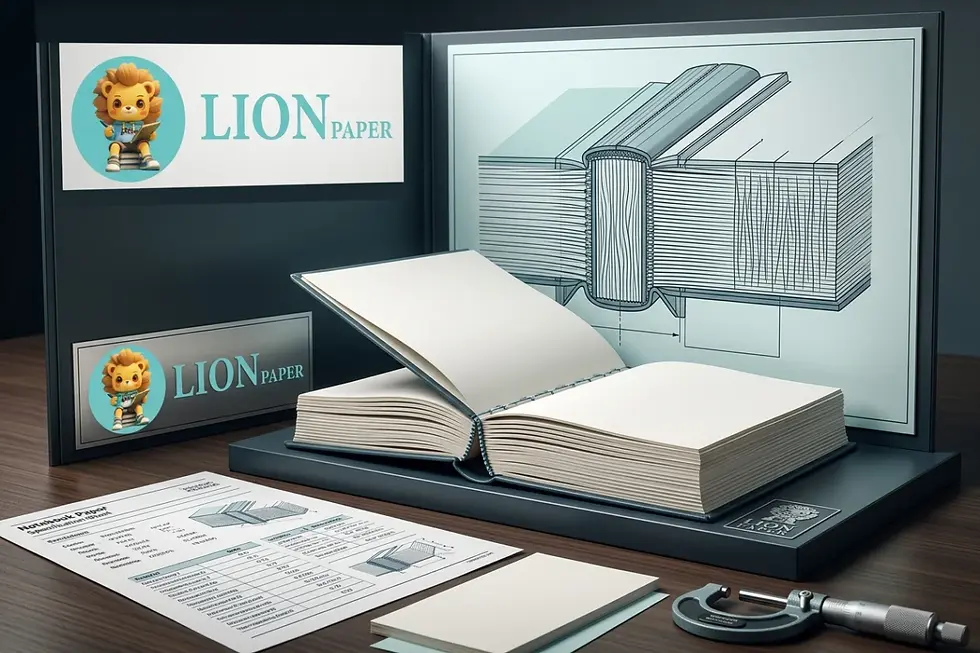
Aligning grain direction parallel to the spine prevents page cockling and ensures flat-lay opening performance.
Binding Type Compatibility Breakdown
Different binding methods demand distinct mechanical properties from inner page paper:
Smyth-Sewn Case Bound (Thread Sewn): Requires high folding endurance (MIT fold cycles > 40) and high burst strength. Paper must withstand 16-page signature folding without spine splitting at the outer corners.
PUR and EVA Perfect Bound: Requires optimized surface energy and zero silicone contamination on the spine edge. High-bulk rough papers allow deeper glue penetration, whereas heavily calendered, ultra-smooth papers demand specialized spine notching to secure page pull strength above 6.0 N/cm.
Wire-O and Spiral Binding: Demands high tear resistance and dimensional stability around square or round punched holes. Minimum distance from hole edge to paper margin must be at least 3.5 mm to prevent corner tear-out during page rotation.
Saddle Stitch: Limited to lower page counts, typically a maximum of 64 pages at 80 GSM. As page count rises, paper caliper causes paper creep, where inner pages protrude past outer leaves, requiring automatic spine creep compensation in trim margins.
What Are the Commercial Trade-offs Among Basis Weight, Yield, Shipping Freight, and MOQ?
Formulating an optimal stationery paper sourcing specification requires understanding how basis weight (GSM) impacts procurement costs, ocean logistics, and retail shelf presence. Over-specifying GSM increases material and freight expenditures, while under-specifying compromises brand perception and opacity.
Container Volume and Payload Weight Dynamics
International shipping containers have strict weight thresholds. A standard 40ft High Cube (40HC) container offers approximately 68 to 72 cubic meters of usable volume and a maximum legal cargo payload of approximately 26,500 kilograms.
High-GSM Notebooks (120 to 160 GSM): The shipping container hits its maximum legal payload weight long before the physical volume is filled, creating dead freight volume and driving up the per-unit ocean shipping cost.
Standard-GSM Notebooks (70 to 80 GSM): The container achieves an optimal balance between weight capacity and volumetric space, maximizing units per shipment.
Paper GSM Versus Landed Cost Economics
Paper mills sell raw material strictly by weight in metric tons, whereas retail brands sell notebooks by individual units. Increasing paper from 80 GSM to 120 GSM represents a 50% increase in raw paper mass per notebook.
For an OEM production run of 100,000 units of a 192-page A5 journal:
80 GSM Paper Requirement: Approximately 23.8 metric tons of paper substrate.
120 GSM Paper Requirement: Approximately 35.7 metric tons of paper substrate.
Net Raw Material Delta: 11.9 additional metric tons of raw paper purchased.
Freight Allocation Impact: Requires additional shipping container allocations due to container weight limits.
Sheet Sourcing Versus High-Speed Reel Slitting
Procurement scale dictates whether paper is purchased as pre-cut sheets or master jumbo reels:
Sheetfed Converting (Low to Medium Volume): Sourcing standard mill sheet sizes, such as 635×965 mm or 700×1000 mm, offers lower minimum order quantities, with MOQs starting at 1 to 3 metric tons, along with shorter lead times. However, sheet conversion involves higher scrap rates of 5% to 8% edge trim and higher unit production costs.
Rotary Reel-Fed Converting (High-Volume Mass Production): Sourcing custom-width jumbo reels directly from paper mills reduces raw material costs by 8% to 15% and slashes conversion scrap to under 2%. However, mill master reel sourcing requires higher MOQs, typically 5 to 10 metric tons per bespoke paper grade and width, with mill production lead times of 30 to 45 days.
Dual-site manufacturing networks leverage this dynamic effectively. Prototyping, fast sampling, and flexible pilot runs are executed at specialized design and sampling centers, while large-scale continuous runs transfer to dedicated high-volume production facilities equipped with automated web-fed converting lines.
Evaluation Factor | 70–80 GSM Woodfree | 100–120 GSM Woodfree | 140–160 GSM Heavy Woodfree / Art | Bamboo / Tree-Free Alternative |
|---|---|---|---|---|
:--- | :--- | :--- | :--- | :--- |
Primary Application | Mass retail workbooks, spiral pads, standard planners | Premium journals, branded corporate notebooks, executive diaries | Mixed-media journals, heavy bullet journaling, sketchbook hybrids | Sustainable private-label collections, ESG-focused stationery |
Bleed-Through Resistance | Moderate (Ballpoint / Gel only) | High (Gel, Rollerball, light Fountain Pen) | Exceptional (Wet Fountain Pen, Markers, Light Inks) | Good to High (Dense short-fiber matrix prevents strike-through) |
Spine Thickness (192 pp) | ~9.5 – 10.5 mm | ~12.0 – 13.5 mm | ~16.0 – 18.5 mm | ~11.5 – 13.0 mm |
Pallet Freight Density | Maximum units per pallet | Balanced retail bulk and shipping weight | High freight penalty per unit | Balanced; dependent on specific fiber bulk |
Mill Sourcing MOQ | Low (Standard stocked commodity grade) | Moderate (Standard premium stock) | Moderate to High (Bespoke run requirements) | High (Specialized pulp runs) |
What Pre-Production Testing Protocols and Quality Tolerances Control Lot-to-Lot Consistency?
A comprehensive technical specification is incomplete without objective quality-assurance testing protocols. Standardizing test methods eliminates subjective debates regarding paper quality and establishes clear Acceptable Quality Limit (AQL) pass and fail criteria.

Standardized Cobb 60 tests and spectrophotometer measurements eliminate lot-to-lot paper bleed and opacity defects.
1. Ink Strike-Through, Feathering, and Ghosting Protocol
To guarantee fountain-pen-friendly or mixed-media performance, pre-production paper swatches must undergo standardized ink application testing:
Standard Pen Matrix: Testing with four ink chemistries: standard oil-based ballpoint (0.7 mm), water-based pigment gel ink (0.5 mm), high-flow dye-based fountain pen ink using broad nibs, and alcohol-based graphic markers.
Feathering Assessment: Microscopic examination at 20x magnification to confirm zero line spreading or capillary starbursts along the stroke edge.
Strike-Through (Bleed) Versus Ghosting (Show-Through): Strike-through, where liquid penetrates through fibers to the reverse page, must be zero points per page. Ghosting, which is optical visibility caused by paper translucency, is measured using a spectrophotometer to verify that the reverse-side optical density delta remains under Delta E < 1.5.
2. Cobb Sizing and Moisture Equilibrium Testing
Cobb 60 Water Absorption Test (ISO 535): Measures the water absorbency of paper over 60 seconds. Stationery writing grades must achieve a Cobb 60 value between 20 and 30 g/m². Values above 35 g/m² indicate under-sizing, leading to ink feathering, while values below 15 g/m² indicate over-sizing, which prolongs ink drying time and causes smudging.
Moisture Content Control (ISO 287): Factory relative humidity (RH) must match paper equilibrium moisture, maintained at 50% to 55% RH and 5.5% to 6.5% paper moisture content. Uncontrolled moisture during printing or binding causes edge wave defects, sheet curl, and glue delamination.
3. Lot-to-Lot Quality Control Tolerances
Production contracts should specify the following allowable manufacturing tolerances across bulk raw material lots:
Basis Weight (GSM): ±3.0% maximum deviation from approved standard.
Caliper and Bulk: ±4.0% maximum variance across master reels.
ISO Brightness: ±1.5% maximum CIE brightness tolerance.
Color Shade Delta: Delta E*ab ≤ 0.8 against the master approved color standard under standard D65 lighting.
Smoothness (Bekk): ±10 seconds tolerance band.
How Should Brands Structure an RFQ Technical Checklist for Multi-Site OEM/ODM Manufacturing?
When preparing a Request for Quotation (RFQ) for multi-site OEM/ODM manufacturing, brands should deliver a structured notebook paper BOM specification. Providing comprehensive technical requirements upfront shortens quoting cycles, eliminates hidden costs, and ensures factory tooling matches product specifications.
Comprehensive Notebook Paper Technical Checklist
1. Core Dimensions and Page Configuration:
Finished Trim Size: Width × Height in millimeters (such as A5: 148 × 210 mm ± 0.5 mm).
Total Page Count: Number of inner leaves (pages and sheets) plus endpaper configuration.
Master Leaf Grain Direction: Explicitly specified as Grain Long, running parallel to the binding spine.
2. Inner Leaf Substrate Specifications:
Paper Category: Uncoated Woodfree Offset, Cream Shade, Recycled PCR, Bamboo, or Specialty Paper.
Basis Weight and Apparent Bulk: Target GSM (such as 100 GSM ± 3%) and target bulk (1.20 cm³/g).
Optical Parameters: Target ISO Brightness (such as 86% Cream) and Minimum Opacity (such as 94%).
Surface Sizing: Specified Cobb 60 absorption range (22–28 g/m²) and Bekk Smoothness (35–50 s).
Archival Chemistry: Acid-free, alkaline buffered with pH 7.5 to 8.5.
3. Print, Lining, and Artwork Standards:
Grid, Lined, or Dot Matrix Specifications: Line weight in points, line spacing in millimeters, and precise ink tint (such as Pantone Cool Gray 4C at 60% tint).
Print Technology: High-speed offset or flexo rotary ruling with zero mechanical pinhole marks.
Bleed and Margin Tolerances: Grid-to-trim edge distance maintained within ±0.5 mm alignment.
4. Structural Binding and Mechanical Engineering:
Binding Construction: Smyth-sewn with round or square spine, PUR perfect bound, or wire-o binding.
Signature Layout: 16-page signatures with heavy-duty polyester-cotton binding thread.
Endpaper Substrate: High-strength 140 to 180 GSM unprinted or printed woodfree cardstock to support cover hinges.
5. Packaging, Palletization, and Climate Protection:
Inner Bundling: Shrink-wrapping with PE or POF film to prevent atmospheric moisture absorption.
Outer Master Carton: Heavy-duty 5-ply corrugated carton with internal poly-bag moisture liner.
Palletization Standard: Wooden heat-treated pallets complying with ISPM 15, equipped with corner edge protectors and 6-layer stretch wrapping.
6. Mandatory Compliance and Chain-of-Custody Audits:
Forestry Certifications: FSC-STD-40-004 (FSC 100%, FSC Mix, or FSC Recycled) with full CoC invoice transfer.
Chemical and Safety Compliance: REACH, RoHS, and CPSIA compliance for heavy metals and phthalates in printing inks and adhesives.
Social and Factory Standards: Validated ISO 9001, SMETA, WCA, GSV, or FAMA facility audit credentials.
Dual-Site Supply Chain Integration
For international consumer brands, managing supply chains across dual-node manufacturing networks provides operational agility and cost optimization. Prototyping, material sourcing verification, rapid pre-production testing, and creative engineering are centralized at advanced R&D and sampling facilities, such as specialized 3,000-square-meter design centers in Jiaxing.
Once raw paper specs, ink formulas, and structural signatures are locked in the technical pack, mass production transitions smoothly to large-scale, automated converting centers, such as dedicated 10,000-square-meter facilities in Cambodia. This structure delivers duty optimization, resilient supply redundancy, and steady production capacity exceeding 5 million notebooks annually for North American, European, and global retail distribution.
To configure your product lines with tight bulk tolerances, optimized ocean freight packaging, and fully auditable raw material certifications, connect directly with technical paper engineers. Share target product, paper specs, annual volume, required certifications and delivery plan with Lion Paper to build a controlled paper-sourcing specification.
FAQ
What is the standard tolerance for paper GSM and caliper in notebook manufacturing?
The industry standard tolerance for high-grade stationery paper is ±3% to ±5% for basis weight (GSM) and ±4% for caliper (thickness). Maintaining caliper within this boundary is essential for automated case binding, as excessive variance alters spine width and distorts hardcover fit.
Why does grain direction matter when specifying notebook paper?
Grain direction must run parallel to the notebook spine (Grain Long for portrait books). Folding parallel to the grain allows pages to turn smoothly, lay flat on surfaces, and absorb environmental moisture without buckling or warping the book block.
What paper specifications prevent fountain pen ink bleed-through and feathering?
To eliminate feathering and bleed-through, paper requires a controlled Cobb 60 sizing value between 20 and 30 g/m², minimum 90 GSM basis weight, dense surface calendering (Bekk smoothness > 30 seconds), and high opacity (> 92%). This surface barrier keeps wet dye pigments on the surface without penetrating fiber capillaries.
How does basis weight (GSM) impact ocean shipping costs for high-volume notebook orders?
Because international shipping containers (such as 40ft High Cube containers) have strict weight limits (~26,500 kg cargo payload), increasing paper from 80 GSM to 120 GSM adds 50% more raw material weight. This causes containers to hit maximum payload capacity with fewer units, significantly increasing per-unit ocean freight costs.


Comments