


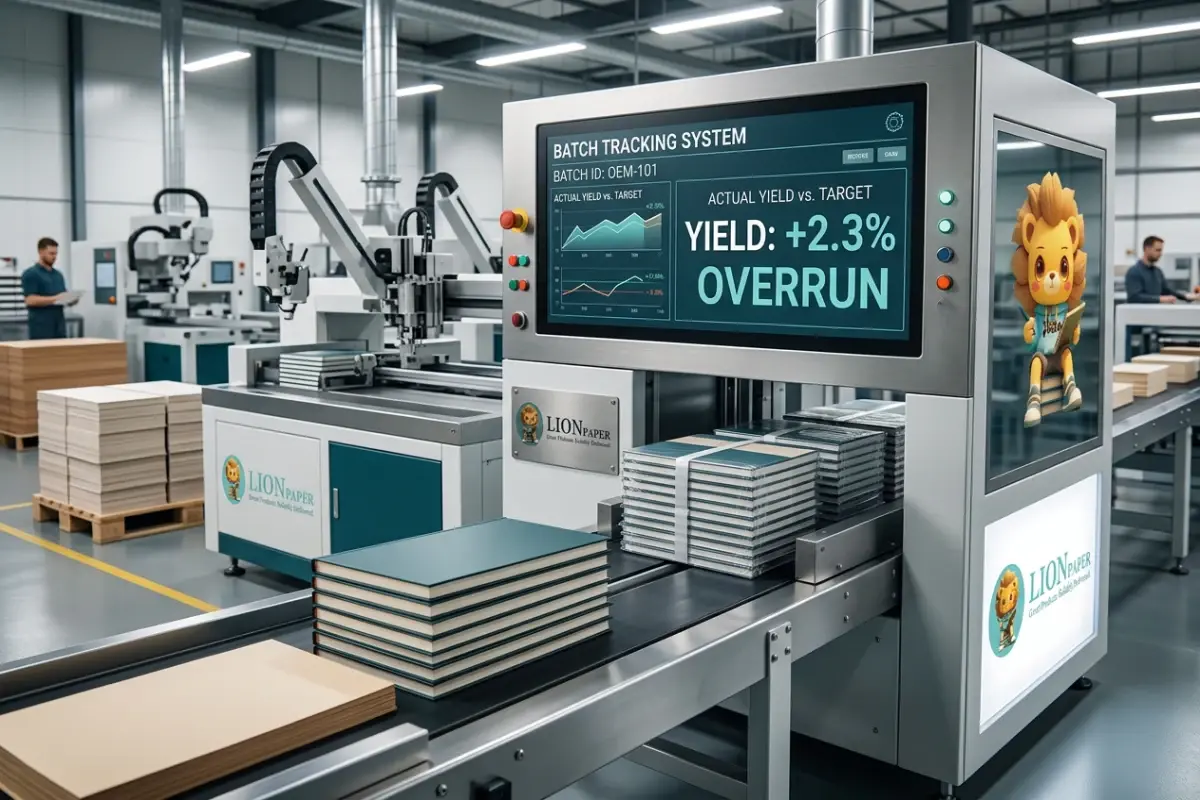
Notebook Order Overrun and Underrun Tolerance: OEM Purchase Order Terms and Quantity Variance Standards

In custom OEM notebook manufacturing, standard quantity tolerance typically ranges between ±3% and ±5% for high-volume automated production runs, and between ±5% and ±10% for complex or low-volume custom orders. This contractual allowance accounts for unavoidable raw material spoilage during printing, binding, and finishing. Explicit purchase order terms must define invoicing adjustments, surplus acceptance caps, and short-shipment remedies to avoid billing disputes and inventory shortages.
What Is an Overrun and Underrun Tolerance in Custom Notebook Manufacturing?
A quantity tolerance—commonly known as an overrun/underrun or overage/underage clause—is a mutually agreed contractual threshold in paper stationery manufacturing that permits a commercial printer or OEM factory to deliver slightly more (overrun) or slightly fewer (underrun) finished notebooks than the baseline quantity specified on a purchase order. Because custom stationery production involves multiple destructive setup stages, raw material yield cannot be calculated to an exact single-unit integer prior to machine calibration.
Every production phase introduces a minor degree of planned paper and board waste, known as technical spoilage. In stationery manufacturing quantity variance calculations, production engineers factor in scrap across several key manufacturing stages:
Offset and Digital Printing Setup: Aligning four-color process (CMYK) or spot Pantone plates requires feeding calibration sheets through the press until ink density, dot gain, and optical registration stabilize.
Signature Folding and Gathering: High-speed folding machines and gathering tracks occasionally jam or misfeed, damaging individual 16-page or 32-page book blocks.
Binding and Trimming: Three-knife trimmers, thread-sewing machines, and perfect-binding lines require mechanical test runs to ensure precise spine squareness, glue penetration, and clean edge cuts.
Cover Fabrication and Embellishment: Hardcover case-making, foil stamping, blind debossing, screen printing, and edge gilding involve heat, pressure, and alignment testing, resulting in sacrificial units during setup.
Because factories must input surplus raw sheets at the start of a production run to guarantee that the final yield meets minimum packaging standards, the resulting batch of commercial-grade notebooks rarely matches the exact round number stated on the purchase order.
What Are the Industry Standard Quantity Tolerance Benchmarks by Order Volume and Complexity?
The acceptable custom notebook quantity tolerance scales inversely with order volume and directly with structural complexity. High-volume runs utilize continuous, highly automated binding lines where setup waste represents a tiny fraction of total material volume. Conversely, short-run, artisan, or multi-process stationery items exhibit higher percentage loss during repetitive machine re-tooling.
The following table outlines standard industrial benchmarks for notebook order overrun underrun tolerance across typical commercial manufacturing tiers:
Order Volume Tier (Units) | Standard Tolerance Band | Primary Complexity Drivers | Typical Billing Treatment |
|---|---|---|---|
:--- | :--- | :--- | :--- |
Under 1,000 units | ±8% to ±10% | Manual setups, complex debossing, edge gilding, mixed substrates | Bill exact delivered quantity at pro-rata unit cost |
1,000 to 5,000 units | ±5% to ±7% | Custom printed endpapers, ribbon placement, elastic closure assembly | Bill exact delivered quantity within capped variance |
5,000 to 20,000 units | ±3% to ±5% | Automated casing-in, standard Smyth sewing, matte lamination | Bill actual delivery; underruns credited against final invoice |
Over 20,000 units | ±2% to ±3% | Dedicated automated inline production, standardized paper rolls | Bill actual delivery or contractually fixed baseline quantity |
When calculating acceptable variance, structural processes such as gilded page edges, multi-foil cover hits, magnetic closure boxes, integrated ribbon bookmarks, and die-cut tabbed dividers inherently elevate the required setup buffer. Buyers procuring journals with multiple specialty finishes should anticipate tolerances closer to the upper boundary of each volume tier.

Careful prepress and signature inspection prevents scrap loss and keeps custom notebook manufacturing within contracted quantity bands.
Which Purchase Order Clauses Control Overruns, Underruns, and Invoicing?
To prevent commercial conflicts upon final delivery, enterprise brands, retail buyers, and e-commerce merchants must incorporate explicit OEM purchase order terms that govern quantity variance, pricing adjustments, and fulfillment obligations. A comprehensive printing overage underrage clause addresses three distinct operational dimensions: financial liability, excess inventory handling, and baseline fulfillment thresholds.
1. Invoicing Structure: Actual Delivered Versus Fixed Quantity
Purchase orders must clearly indicate whether billing is based on "exact order quantity" or "actual delivered quantity within agreed tolerance." In standard commercial trade, suppliers invoice the exact delivered quantity calculated at the agreed unit contract price. If a client orders 10,000 notebooks at $2.50 per unit with a ±3% tolerance and the factory yields 10,250 defect-free units, the total invoice amount equals $25,625.00.
2. Surplus Acceptance Caps
An overrun cap protects the buyer’s working capital and warehouse space from being overwhelmed by unexpected excess units. Contractual terms typically state that any overrun exceeding the agreed percentage threshold (e.g., beyond +5%) is either rejected without financial obligation or transferred to the buyer at scrap-cost value, preventing factories from intentionally over-producing to bill additional revenue.
3. Underrun Short-Shipment Remedies
For retail launches, corporate gifting events, or pre-sold consumer goods campaigns, an underrun can create severe operational disruption. Purchase contracts should specify whether an underrun within tolerance constitutes full contractual satisfaction or requires remedial action. Standard options include:
Invoice Credit: Deducting the value of unproduced units from the final bill of lading invoice.
Shortfall Remake Trigger: Mandating that if the underrun exceeds a strict percentage (e.g., >5%), the manufacturer must run a balance batch or supply equivalent value in replacement goods.
Mandatory Minimum Guarantee ("No Underrun Allowed"): For absolute fixed-count programs, the buyer pays a slight premium (usually 2% to 4%) allowing the factory to load substantial extra raw material, ensuring at least 100% of the baseline order is completed, with surplus units recycled or destroyed.
How Should Procurement Teams Structure Quantity Terms Across Different Business Models?
Different distribution channels exhibit contrasting sensitivities to quantity variance. A retail chain with predetermined planogram allocations operates under different constraints than an online direct-to-consumer (DTC) stationery brand.
| PROCUREMENT TOLERANCE STRATEGY MATRIX |
+----------------------------------+---------------------------+ | Distribution Channel / Scenario | Optimal Contractual Term | Recommended Financial Rule|
+----------------------------------+---------------------------+ | 1. Supermarket & Retail Chains | Strict +3% / -0% Cap | No short-shipment; overage| | (Fixed planograms, promo dates) | (Overrun accepted up to +3%) | absorbed or rejected |
+----------------------------------+---------------------------+ | 2. E-Commerce & DTC Brands | Standard ±5% Variance | Invoiced at pro-rata | | (Continuous replenishment) | (Flexible stock absorption) | unit price |
+----------------------------------+---------------------------+ | 3. Corporate & Conference Gifting | Strict +5% / -0% Cap | Absolute minimum delivery;| | (Fixed attendee headcount) | (Zero underrun tolerance) | buffer absorbed by client |
+----------------------------------+---------------------------+ | 4. Multi-SKU Creator / POD Sets | ±7% per Individual SKU | Aggregate batch invoicing | | (Small batch, multi-design) | (Balanced over total order) | with pooled line items |
+----------------------------------+---------------------------+
Supermarkets and Brick-and-Mortar Retailers
Big-box retailers calculate inventory against rigid shelf space, catalog commitments, and standardized shipping pallet footprints. An underrun leaves empty retail space, while an excessive overrun creates warehouse backlogs. Retail buyers generally negotiate strict clauses where underruns trigger vendor chargebacks, requiring manufacturers to set raw material buffers high enough to deliver at least 100% of the purchase order volume.
DTC and Amazon FBA Sellers
E-commerce merchants managing rolling inventory forecasts often benefit from flexible ±5% tolerances. Overruns provide lower landed-cost inventory for buffer stock, while minor underruns merely adjust the automated reorder point. Standard pro-rata billing simplifies accounting without disrupting supply chains.
Corporate Gifting and Event-Driven Programs
For conferences, anniversary celebrations, and employee onboarding packages, delivering fewer units than the verified attendee count creates reputational damage. In these scenarios, procurement teams must request a "Zero Underrun Guarantee" (e.g., +5% / -0%). The factory inputs sufficient excess paper to guarantee 100% fulfillment, and the buyer agrees to pay for up to 5% excess units as reserve stock.

Clear OEM purchase order terms define overrun and underrun tolerances, invoicing structures, and surplus acceptance limits.
What Exact Contract Wording Protects Buyers and Suppliers from Quantity Disputes?
Ambiguous terminology such as "approximate order quantity" or "standard industry variance" frequently leads to commercial disagreements upon cargo arrival. Professional international stationery manufacturing contracts utilize precise, legally enforceable language.
Below is an example of an industry-standard contractual clause covering quantity tolerance, inspection, and payment reconciliation:
Quantity Variance and Acceptance Clause: "The Seller shall manufacture and deliver the goods within an agreed quantity variance of ±X% of the total units specified in this Purchase Order. Final invoice values shall reflect the exact count of first-quality, commercially acceptable units delivered at the agreed unit purchase price. In the event of an overrun exceeding +X%, the Buyer shall have the option to purchase the excess units at a discounted rate of Y% of the contract unit price, or reject the excess quantity without financial liability. In the event of an underrun within the agreed ±X% band, the Buyer shall be credited for the shortfall on the final commercial invoice, and such delivery shall constitute full performance of the Seller's contractual obligations. Underruns exceeding -X% shall require written Buyer authorization and may trigger a supplementary production run at the Seller's sole expense."
In addition to general terms, multi-SKU purchase orders should specify whether the variance applies on an individual SKU level or across the aggregated batch total. For instance, when producing four cover colorways of 2,500 units each (10,000 units total), running out of a specific cloth cover color might yield a -6% underrun on Navy Blue and a +4% overrun on Forest Green. Defining per-line item tolerances prevents unwanted SKU imbalances.
How Does Lion Paper Optimize Production Yields Across China and Cambodia Facilities?
Minimizing unpredictable yield loss requires tight coordination across prepress engineering, automated manufacturing, and stringent quality control. Lion Paper Products (Jiaxing) Co., Ltd., founded in 2015, operates an integrated supply-chain model featuring dual-site manufacturing capabilities across its 3,000-square-meter facility in Jiaxing, China, and its 10,000-square-meter mass-production site in Cambodia.
With an annual notebook output exceeding 5 million units, Lion Paper utilizes structured yield management protocols to consistently maintain actual quantity variances well within target thresholds:
Design-to-Manufacturing Integration: Pre-production structural planning at the Jiaxing engineering hub validates paper grain direction, spine thickness, and foil die clearances before mass setup, eliminating trial-and-error waste during production scale-up.
Automated Inline Production: High-precision automated folding, Smyth-sewing, casing-in, and adhesive binding lines in the Cambodia plant reduce human handling errors and mechanical jams, stabilizing scrap rates across multi-thousand-unit production runs.
Raw Material Buffer Precision: Enterprise Resource Planning (ERP) systems calculate precise paper, greyboard, and cover cloth sheet requirements based on historical machine efficiency curves rather than rough percentage estimates.
Standardized Quality Checkpoints: Uniform SOP job cards, AQL (Acceptable Quality Limit) defect catalogs, and intermediate process inspections ensure that defective units are identified and removed before undergoing costly secondary operations like gilded edging or specialty packaging.
Dual-Site Supply Flexibility: For clients with tight fulfillment windows, rapid sampling and pilot runs conducted in Jiaxing establish exact process parameters that are replicated seamlessly in Cambodia for stable, cost-effective volume delivery.

Final packing list reconciliation verifies exact carton counts and delivered quantities against the commercial invoice.
How Should Buyers Reconcile Payments When Delivered Quantities Differ from Purchase Orders?
Accounting for final shipment variance requires a standardized reconciliation workflow between the factory's final packing list, the commercial invoice, and the receiving warehouse's inventory scan.
Pre-Shipment Packing List Verification: Prior to vessel booking or customs filing, the factory issues a detailed packing list confirming exact carton counts, units per carton, and gross delivered quantity.
Commercial Invoice Alignment: The supplier adjusts the commercial invoice balance before customs clearance. If a down payment (e.g., 30% deposit) was calculated against the initial estimated purchase order total, the final balance payment (e.g., 70%) is recalibrated up or down to match the verified delivered total.
Customs and Duty Adjustments: Harmonized Tariff Schedule (HTS) declarations and import duties are assessed on the actual commercial invoice value, ensuring full compliance with customs authorities in North America, Europe, Australia, and other global destinations.
Warehouse Inbound Discrepancy Auditing: Upon container destuffing, the receiving logistics team conducts a piece-count cross-check against the Bill of Lading and packing list. Any transit damage or carton discrepancies outside the agreed tolerance band are documented through formal discrepancy reports for cargo insurance or vendor reconciliation.
To establish transparent quantity terms and streamline your next manufacturing run, contact our OEM sourcing specialists to share your notebook specifications, volume projections, sample requirements, and proposed commercial terms.
FAQ
Why can't custom notebook factories deliver the exact number of units ordered?
Custom notebook manufacturing requires setting up multi-stage industrial machinery—including printing presses, signature folders, Smyth-sewing units, case-makers, and foil stampers. Each setup stage consumes sacrificial calibration sheets. Because machine spoilage varies slightly from run to run, factories feed surplus raw material into the production line to guarantee the final yield meets minimum standards, resulting in minor overruns or underruns.
What happens if a custom notebook order has an underrun below my minimum required quantity?
If your purchase contract specifies a standard underrun tolerance (such as ±5%) and the delivered quantity falls within that threshold, the supplier is legally deemed to have fulfilled the contract, and you receive an invoice deduction for the unproduced units. However, if your program requires a strict minimum count, you must negotiate a '+X% / -0%' zero-underrun clause beforehand.
Am I obligated to pay for overrun notebooks that exceed the agreed purchase order tolerance?
Under standard OEM purchase order terms, you are only obligated to pay for excess units within the contracted overrun allowance (e.g., up to +3% or +5%). Any surplus volume exceeding the contracted cap is considered unauthorized overproduction; buyers may choose to reject the excess without payment, accept them free of charge, or negotiate a deeply discounted scrap-rate unit price.
Does quantity tolerance apply to individual cover styles or the total batch quantity?
Unless explicitly stated in the purchase order, standard commercial trade applies quantity tolerance to each individual line item or SKU. In multi-SKU orders with different artwork, cover colors, or inner page layouts, buyers should specify whether tolerance limits apply per individual design or across the aggregate order total to prevent stock imbalances.


Comments