


Optimizing Multi-Size Notebook Launch Ratios: Sizing Mix, Sheet Yields, and Sourcing Strategies

Optimal multi-size notebook launch ratios typically follow a 50:35:15 distribution across Medium (A5/Half-Letter), Compact (A6/Pocket/B6), and Large (A4/B5/Desk) formats to balance retail demand, parent sheet yields, and production MOQs. This baseline stabilizes core inventory turnover while capturing portable impulse purchases and premium executive desktop use cases without fragmenting procurement volume.
What Are the Recommended Launch Ratios Across Standard Notebook Formats?
Determining accurate multi-size notebook launch ratios requires category managers and brand founders to evaluate customer ergonomics, price elasticity, and shelf placement dynamics. A single notebook size rarely addresses all user personas across academic, professional, and lifestyle journaling segments. Launching a coordinated format matrix allows brands to capture multiple price tiers and functional applications while maximizing brand presence on retail shelves and digital marketplaces.
In standard notebook portfolio assortment planning, the standard three-tier hierarchy allocates production volume across three functional classifications:
The Core Driver (Medium / A5 / 5.5 x 8.5 in): 50% to 55% of Total Launch Volume. A5 represents the universal standard for everyday carry, corporate note-taking, and guided journaling. It offers the ideal balance between surface writing area and portable bulk. Because A5 captures the highest baseline retail turnover, it anchors the production order, absorbing the primary fixed setup costs for cover stamping, spine tooling, and ruling plates.
The Mobile Complement (Compact / A6 / Pocket / B6 / 3.5 x 5.5 in): 30% to 35% of Total Launch Volume. Compact formats cater to impulse purchasing, on-the-go lists, travel logs, and entry-level price points. While yielding lower top-line revenue per unit than A5, compact formats lower the barrier to trial and frequently drive basket sizes as add-on purchases or bundle components.
The Anchor / Desk Format (Large / A4 / B5 / 8.5 x 11 in): 10% to 15% of Total Launch Volume. Desk-oriented and letter-sized formats appeal to corporate project planners, designers, students, and home-office workstations. They command premium retail price points but turn over at lower velocity. Keeping this tier capped near 15% avoids tied-up working capital and overstock risks while still providing a complete aesthetic lineup.
Format Tier | Standard Dimensions | Volume Allocation | Primary User Persona | Commercial Role |
|---|---|---|---|---|
:--- | :--- | :--- | :--- | :--- |
Core (A5 / Half-Letter) | 148 x 210 mm / 5.8 x 8.3 in | 50% – 55% | General professionals, daily journalers, students | Primary revenue and volume driver |
Pocket (A6 / Field / B6) | 105 x 148 mm / 4.1 x 5.8 in | 30% – 35% | Commuters, bullet list-makers, add-on shoppers | Impulse entry tier, bundle component |
Desk (A4 / Executive / B5) | 210 x 297 mm / 8.3 x 11.7 in | 10% – 15% | Designers, technical planners, corporate managers | Premium margin anchor, visual flagship |
Adjustments to these baseline notebook retail merchandising ratios depend on binding type and product specialization. For example, technical wire-bound grid notebooks skewed toward architecture or academic markets often see Large (A4/Letter) shares climb to 25%, whereas softcover lifestyle journals frequently push Compact (A6/Pocket) shares to 40% when sold in multi-pack sets.
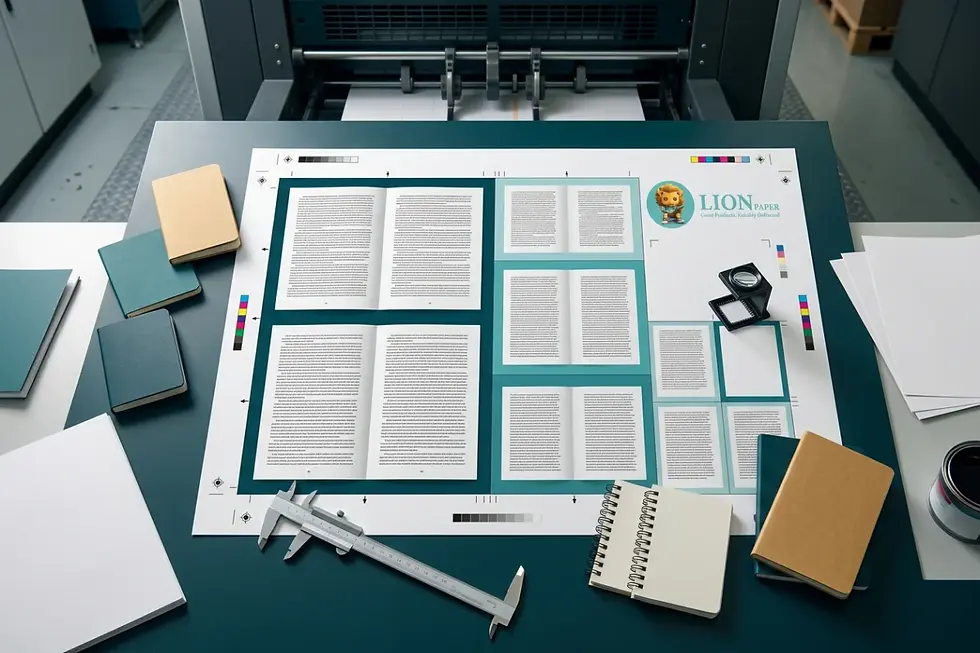
Harmonizing text block dimensions with standard parent sheet sizes maximizes yield and cuts raw material scrap.
How Does Material Harmonization Impact Sheet Yields and Procurement Costs?
A major pitfall in stationery size mix procurement occurs when product development teams select arbitrary trim dimensions that do not align with standard mill parent sheet formats. Notebook manufacturing efficiency is fundamentally governed by how cleanly folded text signatures (typically 8, 16, or 32 pages per section) nest onto parent paper sheets, such as 635 x 965 mm, 787 x 1092 mm, or 889 x 1194 mm.
When standard metric sizes (A4, A5, A6) are manufactured together, their strict geometric halving allows paper mills and offset printing presses to achieve near-zero paper trim waste. An A4 sheet divides evenly into two A5 sheets, which divide evenly into four A6 sheets. This mathematical relationship enables gang-run printing for shared elements like interior ruling grids, dot patterns, or branded flyleaves across different size tiers.
To maximize total-cost efficiency, procurement managers should implement material harmonization across four core variables:
Uniform Text Stock Basis Weight: Standardize all sizes onto a single inner text stock (e.g., 80 gsm, 100 gsm, or 120 gsm FSC-certified woodfree paper). Bulk-purchasing one continuous tonnage of paper reels or parent sheets yields substantial material discounts over sourcing separate basis weights for each size.
Shared Ruling Plates and Inks: Align ruling line spacing (e.g., standard 7 mm college ruled, 5 mm dot grid, or 5 mm square grid) using identical low-impact soy-based inks across sizes. This allows simultaneous press runs without ink-wash turnarounds between formats.
Cover Material Optimization: Select cover substrates—such as PU leather, book cloth, heavyweight kraft, or coated greyboard—that can be slit from shared master rolls with minimal off-cut scrap.
Hardware and Ribbon Harmonization: Utilize identical ribbon bookmark widths (e.g., 5 mm satin), elastic band widths, and spine reinforcement gauzes to streamline peripheral assembly lines.
When off-spec custom dimensions (e.g., 7 x 9.5 in or 6 x 8 in) are chosen without sheet yield analysis, paper scrap waste can exceed 18% to 25%, drastically inflating unit costs. Aligning formats with standard press imposition layouts preserves raw material yield and stabilizes unit production costs.
How Do Brands Balance Manufacturing Economies of Scale and MOQ Trade-Offs?
Managing multi-format notebook MOQ optimization requires balancing commercial inventory objectives against mechanical production realities. Offset printing presses, high-speed automated folding machines, signature sewing lines, and casing-in equipment carry substantial changeover and plate setup times. Consequently, requesting separate small runs across multiple sizes often triggers punitive minimum order quantities (MOQs) or inflated setup surcharges.
To achieve economies of scale without carrying excessive finished inventory, supply chain planners employ several multi-size production aggregation strategies:
Gang-Printing Common Inner Cores: If A5 and A6 notebooks utilize identical ruling lines and paper stocks, the inner block signatures can be printed simultaneously on large-format multi-up presses (e.g., 8-up or 16-up layouts). The printed sheets are subsequently slit and routed to separate binding lines, satisfying overall paper tonnage MOQs while maintaining distinct product size quantities.
Consolidated Cover Substrate Sourcing: Purchasing cover substrates in volume for the entire collection satisfies dye-lot minimums for premium textiles or custom-dyed vegan leathers. Production lines then stamp and cut varying cover blank sizes from the same lot.
Dual-Site Supply-Chain Agility: Utilizing a hybrid manufacturing framework enables low-risk scaling. For example, Lion Paper leverages its Jiaxing facility (3,000 sqm) for rapid structural prototyping, design integration, and initial small-batch test runs, while transitioning volume-heavy orders to its 10,000 sqm Cambodia manufacturing facility for scaled production, tariff mitigation, and landed cost optimization.
Staggered Finishing Operations: Printing large batches of generic dot-grid or ruled text blocks in advance and storing them as collated book blocks allows brands to trigger case-binding and personalized foil-stamping in smaller, responsive batches as real-time sales data unfolds.
Sourcing Parameter | Single-Size Launch | Fragmented Multi-Size Launch | Harmonized Multi-Size Strategy |
|---|---|---|---|
:--- | :--- | :--- | :--- |
Paper Waste Percentage | 3% – 5% | 15% – 25% | 4% – 6% |
Setup & Tooling Surcharges | Low (Single line) | High (Separate tooling across lines) | Amortized across shared gang-runs |
Cover Material Utilization | High | Low (High scrap per off-cut roll) | High (Optimized cut programs) |
Working Capital Risk | Low-to-Medium | High (Excess safety stock per size) | Balanced across demand velocity |
MOQ Flexibility | High per size | Low (Strict per-size minimums) | Flexible via pooled material volume |
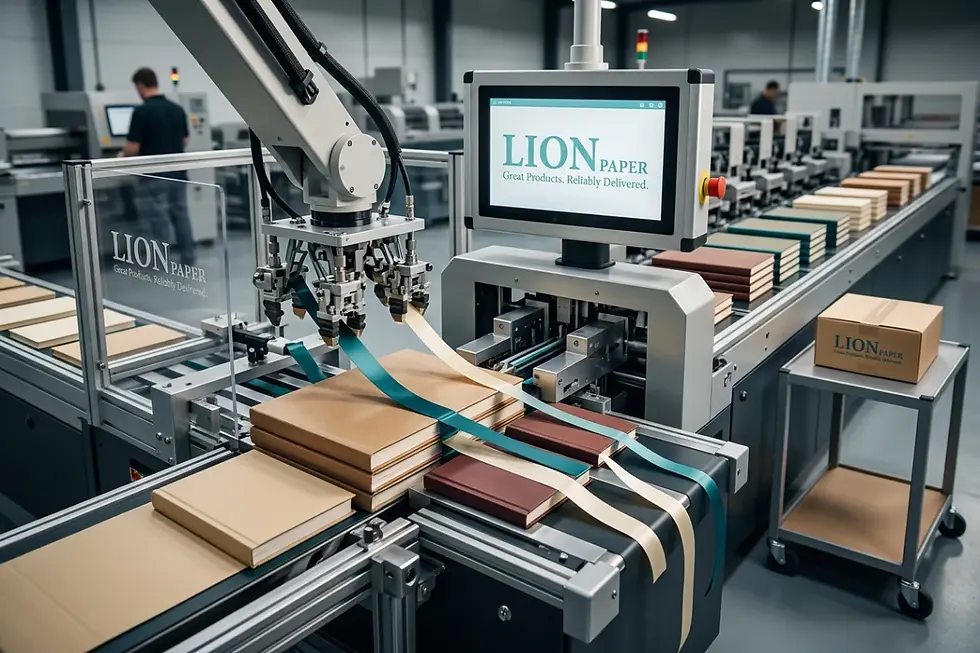
Automated binding and standardized SOPs maintain tight dimensional tolerances across diverse format runs.
What Are the Best Multi-Size Assortment Strategies for Retail vs. DTC Channels?
Omnichannel stationery brands must adapt their notebook retail merchandising ratios according to the physical or digital display constraints of each sales channel. Consumer shopping behavior in brick-and-mortar retail stores differs substantially from conversion paths on direct-to-consumer (DTC) websites or Amazon marketplaces.
Brick-and-Mortar Retail Merchandising Strategy
Physical retail depends heavily on tactile shelf presence, vertical planogram stacking, and visual hierarchy. Merchandisers rely on the "good, better, best" pricing model combined with nested size sets:
Planogram Ratios (45% A5, 40% A6, 15% A4): Compact formats (A6/Pocket) receive prominent impulse placement near checkout counters or top display trays. Core A5 formats dominate eye-level shelving, while large A4 formats are positioned as desktop anchors on bottom shelving runs or feature endcaps.
Nested Retail Display Sets: Engineering matching collections across three sizes encourages multi-unit purchasing. Displaying cohesive colorways or themed cover designs across A4, A5, and A6 drives full-line collector sales rather than single-notebook transactions.
Belly Bands and Packaging Standards: Retail packaging must communicate format, sheet count, paper weight, and ruling type at a glance. Standardized belly bands or scannable shrink-wrap packaging protect covers from handling damage while ensuring barcode scanning efficiency.
DTC and Amazon Marketplace Assortment Strategy
In e-commerce environments, shipping logistics, dimensional weight (DIM weight), and bundling opportunities dictate product assortment ratios:
E-Commerce Ratios (60% A5, 25% A6, 15% A4): Online shoppers skew heavily toward the standard A5 size because it represents a predictable, low-risk purchase. Size conversion data indicates online shoppers actively seek A5 for personal productivity and guided journaling systems.
Multi-Format Bundling: High shipping and fulfillment costs make standalone sales of low-ticket pocket notebooks less profitable in DTC channels. Brands successfully navigate this by bundling A6 notebooks in 3-packs or creating "Executive Sets" pairing an A4 desk notebook with an A5 daily planner and an A6 pocket notepad.
Drop-Test and E-Commerce Packaging: DTC distribution requires robust protective packaging. Corner-protecting individual wraps or branded rigid mailer boxes prevent crushed spines and dog-eared corners during parcel transit.
How Should Brands Manage Prototyping, Pilot Runs, and Quality Assurance Across Formats?
Maintaining structural integrity and brand consistency across diverse notebook sizes requires a systematic quality assurance framework. A binding technique that functions smoothly on a compact A6 notebook may experience spine sag or lay-flat resistance when scaled directly to an A4 format.
To ensure flawless mass execution, brands should systematically validate three technical checkpoints during the prototyping and pre-production phases:
Spine Engineering and Lay-Flat Mechanics: Large formats (A4/B5) require reinforced spine gauze and specialized flexible adhesive (such as PUR or smyth-sewn section binding) to open 180 degrees completely flat without cracking. Smaller A6 notebooks have tighter spine radii, requiring calibrated paper grain alignment parallel to the spine to prevent cover warping.
AQL Defect Standard Calibration: Establish standardized Acceptable Quality Limit (AQL) 2.5 / 4.0 inspection criteria across all formats. Key defect parameters include foil stamping alignment tolerances (+/- 0.5 mm), ribbon bookmark heat-sealed edge sealing, corner rounding radius precision, and spine squareness.
Cross-Format Color Consistency: Cover materials must exhibit exact spectrophotometric color matches (Delta-E < 1.5) across all production lots, ensuring that when an A4, A5, and A6 notebook are displayed side-by-side on a retail fixture, their hue, grain texture, and foil sheen are visually indistinguishable.
Through structured standard operating procedures (SOPs), comprehensive defect catalogs, and rigorous process checks, production partners can safeguard batch-to-batch consistency across complex multi-format launches.

Structured retail merchandising ratios position core A5 notebooks at eye level, supported by compact impulse formats and premium desk anchors.
How Does Lion Paper Support End-to-End Multi-Format Notebook Manufacturing?
Executing a synchronized multi-format notebook launch requires an integrated supply-chain partner capable of bridging concept engineering with mass production efficiency. Lion Paper Products serves global stationery brands, retail chains, and e-commerce leaders as an end-to-end supply-chain solutions provider, turning creative sketches into scalable, compliant product collections.
Lion Paper provides strategic multi-format manufacturing capabilities, including:
Dual-Site Synergy: Product conception, structural engineering, rapid sampling, and client support are spearheaded at the 3,000-square-meter Jiaxing facility in China, while high-volume mass production and export fulfillment are executed at the 10,000-square-meter facility in Cambodia.
Scalable Output: With an annual output exceeding 5 million notebooks, automated production lines support diverse binding styles, including smyth-sewn casebound, wire-o, spiral, flexible flexi-cover, and softcover perfect binding.
Compliance and ESG Governance: Manufacturing facilities operate under robust global audit frameworks, holding ISO 9001, FSC, SMETA, WCA, GSV, FAMA, and CPSIA compliance, ensuring seamless access to mainstream North American and European retail shelves.
Sustainable Material Sourcing: Full traceability for FSC-certified woodfree papers, post-consumer recycled covers, low-impact non-toxic printing inks, and plastic-free recyclable packaging.
Total-Cost Optimization: Comprehensive design-to-manufacturing support optimizes parent sheet impositions, harmonizes component sourcing, and mitigates landed import tariffs via dual-node manufacturing.
FAQ
What is the standard launch ratio for a new multi-size notebook collection?
A standard launch baseline is 50% Medium (A5), 35% Compact (A6/Pocket), and 15% Large (A4/Desk). This distribution aligns with retail turnover velocities and minimizes inventory overstock risks in larger desktop formats.
How does paper sheet size affect multi-format notebook production costs?
Standard parent paper sheets (such as 787 x 1092 mm or 889 x 1194 mm) divide evenly into ISO standard sizes (A4, A5, A6) with 3% to 5% scrap waste. Non-standard custom dimensions cause irregular nesting, increasing paper waste up to 25% and raising unit costs.
How can brands overcome high MOQs when launching multiple notebook sizes?
Brands overcome MOQs by harmonizing interior paper stocks, ruling grids, ribbon colors, and cover materials across all sizes. This enables suppliers to gang-print interior pages and purchase raw materials in bulk, sharing setup costs across the entire portfolio.
Should DTC e-commerce notebook launch ratios differ from retail store ratios?
Yes. DTC channels generally skew higher toward A5 formats (60%+) due to lower return rates and predictable fulfillment dimensions. In retail stores, compact A6 formats can represent up to 40% of visual volume to capture register impulse buys.


Comments